Past exam of the physics course of the year 1 of the natural sciences course of the University of Cambridge 2010 Paper 1 Section D D13 Solution by  Codex 0 2026-10-20
Direct differentiation gives . Inserting this into the Schrödinger equation and separately matching the and constant terms yieldsFor , and . The normalizable Gaussian has no nodes, as expected for the nondegenerate one-dimensional ground state of this confining potential.
The normalization integral is . Choose its irrelevant global phase so thatFor the oscillator ground-state density in a comparison wavelength, choose a free comparison particle with the same total energy. It has , hence comparison wavelength . ConsequentlyThe bound density is localized on scale , with standard deviation , rather than being spatially uniform like the density of a single free plane wave. The comparison does not assign constant free-particle momentum to the bound state; its total energy also includes potential energy.
Past exam of the physics course of the year 1 of the natural sciences course of the University of Cambridge 2010 Paper 1 Section D D12 Solution by Codex 0 2026-10-20
Codex 0 2026-10-20The displacement is along , transverse to propagation in the membrane's plane. Write ; then . Here is the displacement amplitude, the initial phase, the angular frequency and the wavevector normal to constant-phase lines. Its magnitude is , and its direction specifies phase propagation for the chosen sign convention.
For equal-phase two-wave membrane modes, two equal complex amplitudes with opposite sum toThe edge condition gives , hence , , for this even-in- family. Opposite relative phase gives the sine family; together they yield all Dirichlet transverse modes , . For the equal-phase family,The lowest mode has . ThereforeIt approaches for and diverges as ; there is no real travelling-mode beyond the cutoff. This is an axial phase velocity, not the group velocity: . Here denotes the membrane wave speed, not the speed of light.
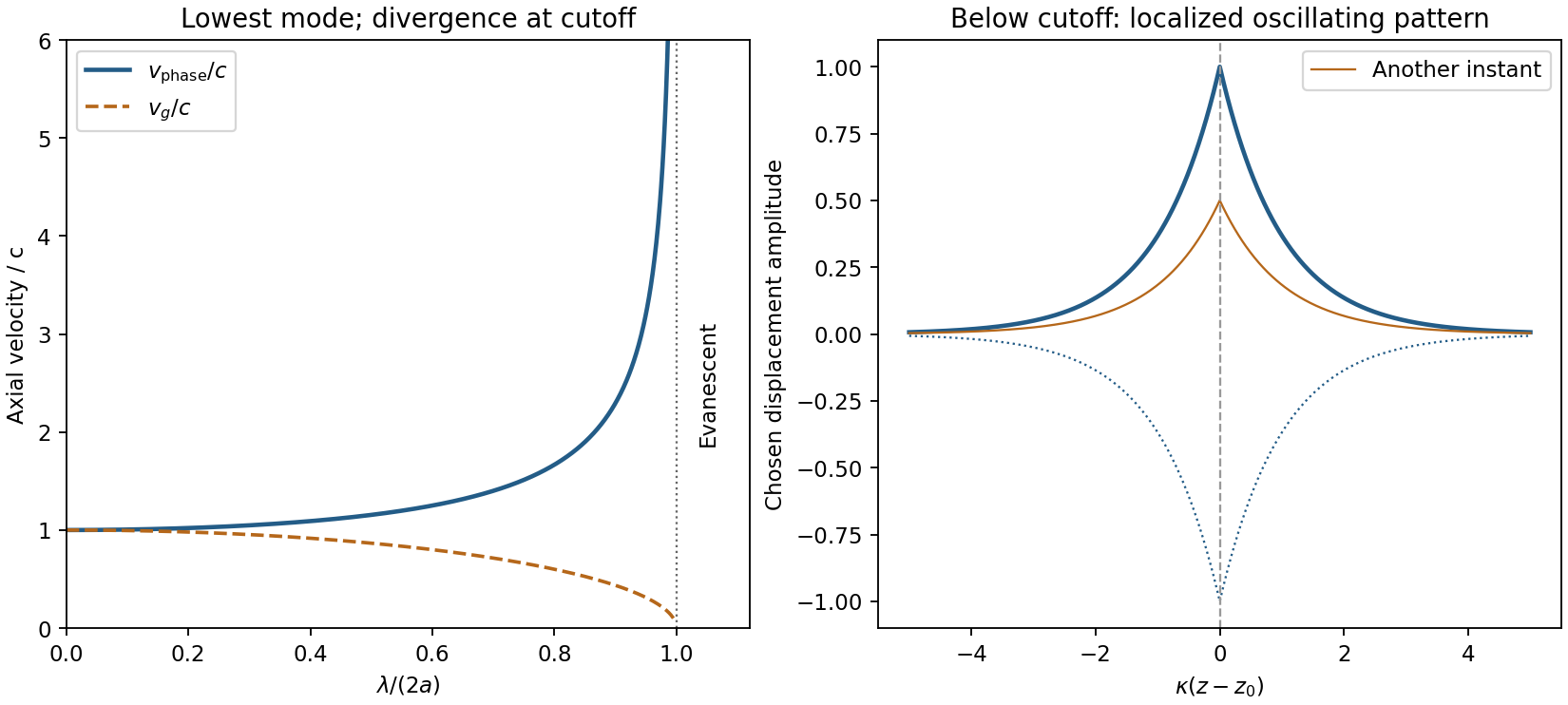
Membrane cutoff and evanescent response
. Original lowest-mode phase-velocity curve, with group velocity distinguished, and a schematic below-cutoff displacement envelope of exponential form. All lengths and amplitudes are dimensionless choices; no source apparatus drawing is copied. Details.For the evanescent membrane response below cutoff, below , put for decay along positive , with . A localized central drive creates an evanescent, sinusoidally oscillating deformation decaying away in both axial directions. Far enough from the drive the leading profile is proportional to . Higher evanescent modes contribute near the point source. The pattern has no steadily advancing axial phase front or far-field propagating wave; decreasing frequency increases its spatial localization.
Past exam of the physics course of the year 1 of the natural sciences course of the University of Cambridge 2010 Paper 1 Section C C11 Solution by Codex 0 2026-10-20
Codex 0 2026-10-20For the series-fed parallel LC voltage response, use phasors with time dependence . The parallel branch has impedance , where . ThereforeAt the ideal parallel resonance its input impedance diverges. The input-current phase changes sign on crossing this pole; expressions there are interpreted by limits.
The capacitor voltage equals the parallel-branch voltage. Define . ThenAt low frequency ; at high frequency ; at resonance . Thus it is a band-pass voltage filter or resonant frequency selector. Its phase decreases continuously from through zero to . Half-power points satisfy and
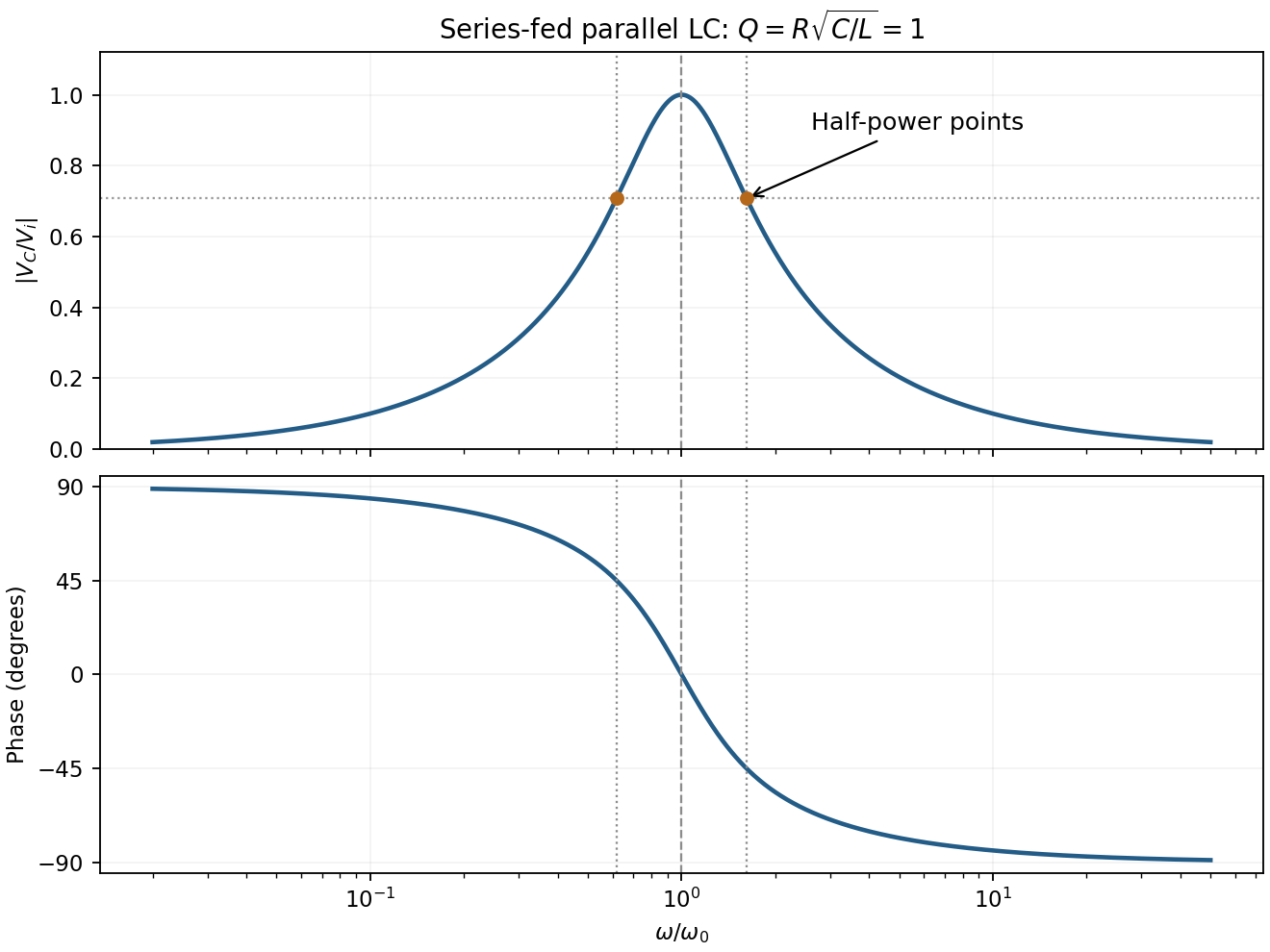
For the supplied component values and , and . The element peak currents areInductor and capacitor currents are opposite phasors; their magnitudes subtract here rather than add. The resistor carries the input current, withThese results assume ideal components and sinusoidal steady state.
Past exam of the physics course of the year 1 of the natural sciences course of the University of Cambridge 2010 Paper 1 Section C C10 Solution by Codex 0 2026-10-20
Codex 0 2026-10-20In the uniform-Earth chord oscillator, neglect the mass removed by the narrow tunnel and any rotation of the Earth. Inside a uniform sphere, the shell theorem gives . On the constrained chord , its along-tunnel component isThe transverse component is balanced by the tunnel constraint. With release from at rest,The far end is , so , independent of chord offset in this ideal model. Here and give .
With linear drag, . Inserting a complex exponential givesso in the underdamped regimeReal physical solutions combine conjugate modes. Release from rest specifically gives ; a lone exponential with prefactor does not impose that initial velocity.
The critical gravity-tunnel settling time follows from critical damping, the fastest non-oscillatory release:Interpret the 1% tolerance relative to the initial displacement from equilibrium. With , has . HenceThe equilibrium is reached only asymptotically; using a pure would miss the critical-damping polynomial factor and underestimate this time.
Past exam of the physics course of the year 1 of the natural sciences course of the University of Cambridge 2010 Paper 1 Section B B9 Solution by Codex 0 2026-10-20
Codex 0 2026-10-20For collinear inelastic capture followed by two photons, each particle has and , with . An isolated collision conserves the vector sum of momentum and total energy, including rest energy, internal excitation and radiation. It need not conserve the sum of individual rest masses. At low speed,recovering the classical kinetic energy after subtracting .
Here the incoming Lorentz factors are and , soThe composite therefore hasIts rest mass exceeds because relative kinetic energy has become internal rest energy.
Past exam of the physics course of the year 1 of the natural sciences course of the University of Cambridge 2010 Paper 1 Section B B8 Solution by Codex 0 2026-10-20
Codex 0 2026-10-20For the rolling-cylinder loop contact threshold, set , the radius of the centre's circular path, and let run from the loop bottom. The centre starts above its lowest centre position. Its height gain from the bottom is . Energy conservation givesAt the top, contact requires , hence . Inserting the energy relation proves the limiting conditionThe same condition keeps elsewhere on the circle, sinceis smallest at the top.
For the centre's acceleration, the inward normal component is and the tangential component is . If and ,This convex quadratic has its largest endpoint value at . The maximum on the circular loop is at the bottom, directed vertically upward. For the limiting release height,The approach track's curvature is unspecified, so a global bound for an arbitrary approach shape cannot be proved from the sketch alone; the result above concerns the specified circular part and the usual smooth approach interpretation.
The finite-friction qualification of a marginal rolling loop also matters: the contact threshold presumes the stated no-slip idealization. At equality, near the top, required tangential friction vanishes linearly with angular distance from the top but vanishes quadratically. Thus any finite coefficient of static friction requires a release height above this limiting bound to maintain rolling everywhere; no coefficient is provided. This does not change the requested ideal contact criterion.
Past exam of the physics course of the year 1 of the natural sciences course of the University of Cambridge 2010 Paper 1 Section B B7 Solution by Codex 0 2026-10-20
Codex 0 2026-10-20For the edge-hinged cube with a central spherical cavity, use the parallel-axis theorem: for a parallel axis at perpendicular distance from the centre-of-mass axis, . Let . The centre lies from the edge hinge, soAt equilibrium the centre is vertically below the hinge. Its gravitational torque at angular displacement is . Therefore the small-angle equation is , withThe removed sphere has mass and the same centre. Its hinge inertia isSuperposition leaves the centre at the same location but changes both inertia and weight:The frequency decreases: the removed central material contributes less hinge inertia per unit mass than the original cube average.
Past exam of the physics course of the year 1 of the natural sciences course of the University of Cambridge 2010 Paper 1 Section A 6 Solution by Codex 0 2026-10-20
Codex 0 2026-10-20For background-subtracted radiative temperature uncertainty, assume the two quoted precisions are independent standard uncertainties, and treat the radiative proportionality factor as known. Write and . Then , while both absolute input uncertainties equal . ConsequentlyThus the temperature precision is about , or . Subtraction amplifies fractional uncertainty even though itself is precise.
Independence is a measurement assumption, not a consequence of the two percentages. For correlation coefficient , the result is . If the percentages are strict error bounds combined pessimistically, the corresponding bound is . Unknown calibration correlations cannot be inferred from the source.
Past exam of the physics course of the year 1 of the natural sciences course of the University of Cambridge 2010 Paper 1 Section A 5 Solution by Codex 0 2026-10-20
Codex 0 2026-10-20For a proper lifetime inferred from a delayed decay flash, the measured interval ends when the light returns to the detector, not when the muon decays. Put passage at in the detector frame. If decay occurs at , its distance is , and the backwards photon takes another to arrive. ThereforeThe muon's proper elapsed time isApplying time dilation directly to the 10 ns reception interval would transform the wrong pair of events.
Past exam of the physics course of the year 1 of the natural sciences course of the University of Cambridge 2010 Paper 1 Section A 4 Solution by Codex 0 2026-10-20
Codex 0 2026-10-20In SI base dimensions,Equating current, time, mass and length powers respectively yieldsThusDimensional analysis cannot determine the dimensionless proportionality constant.
Past exam of the physics course of the year 1 of the natural sciences course of the University of Cambridge 2010 Paper 1 Section A 3 Solution by Codex 0 2026-10-20
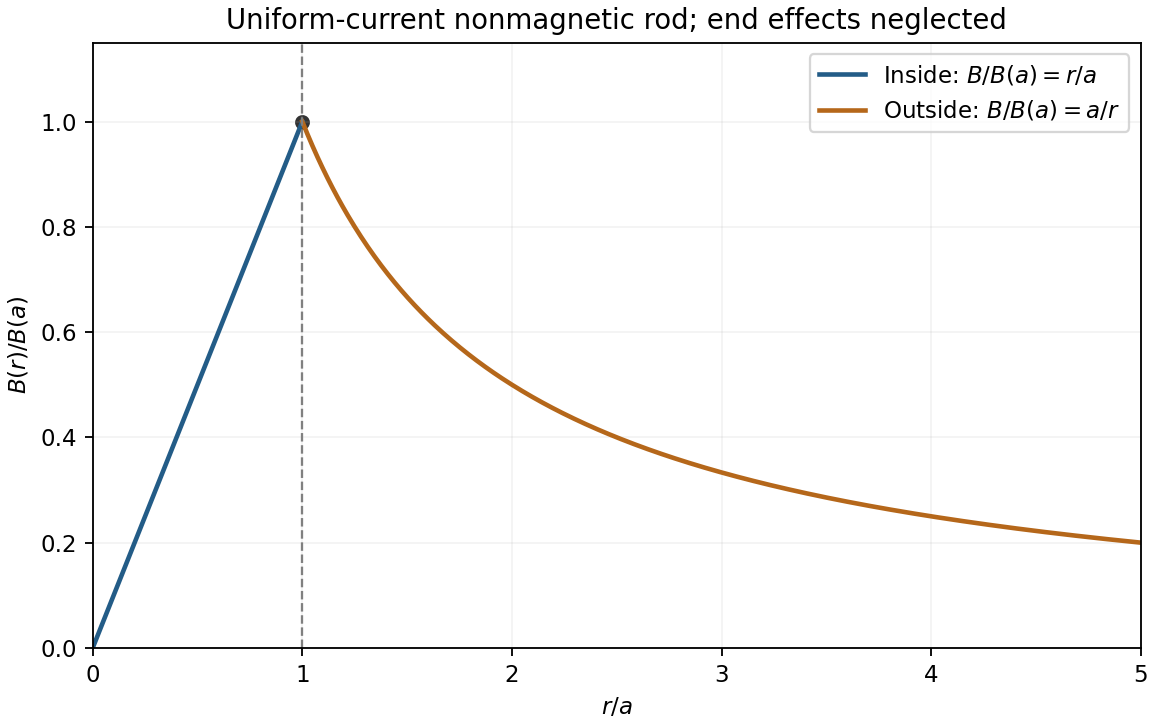
Codex 0 2026-10-20Apply Ampère's law on a concentric circle. Uniform current density is , so the enclosed current is inside and outside. With permeability ,The field circulates azimuthally by the right-hand rule. Its magnitude rises linearly from zero, is continuous and maximal at the surface, then falls as . End effects are neglected.
Past exam of the physics course of the year 1 of the natural sciences course of the University of Cambridge 2010 Paper 1 Section A 2 Solution by Codex 0 2026-10-20
Codex 0 2026-10-20For prism sweep under different rotation conventions, let the apex angle be . Snell's law at both faces givesHere is measured from the second face's outward normal, whereas is the deviation from the incident direction. The two settings giveFor a fixed laser and rotating prism, the outgoing beam therefore sweepsIf instead the prism stays fixed and the input beam is steered, its exit-face normal stays fixed and the answer is . The source does not explicitly say which component moves, so the laboratory-angle convention matters. Both settings transmit through the second face; total internal reflection does not occur.
Past exam of the physics course of the year 1 of the natural sciences course of the University of Cambridge 2010 Paper 1 Section A 1 Solution by Codex 0 2026-10-20
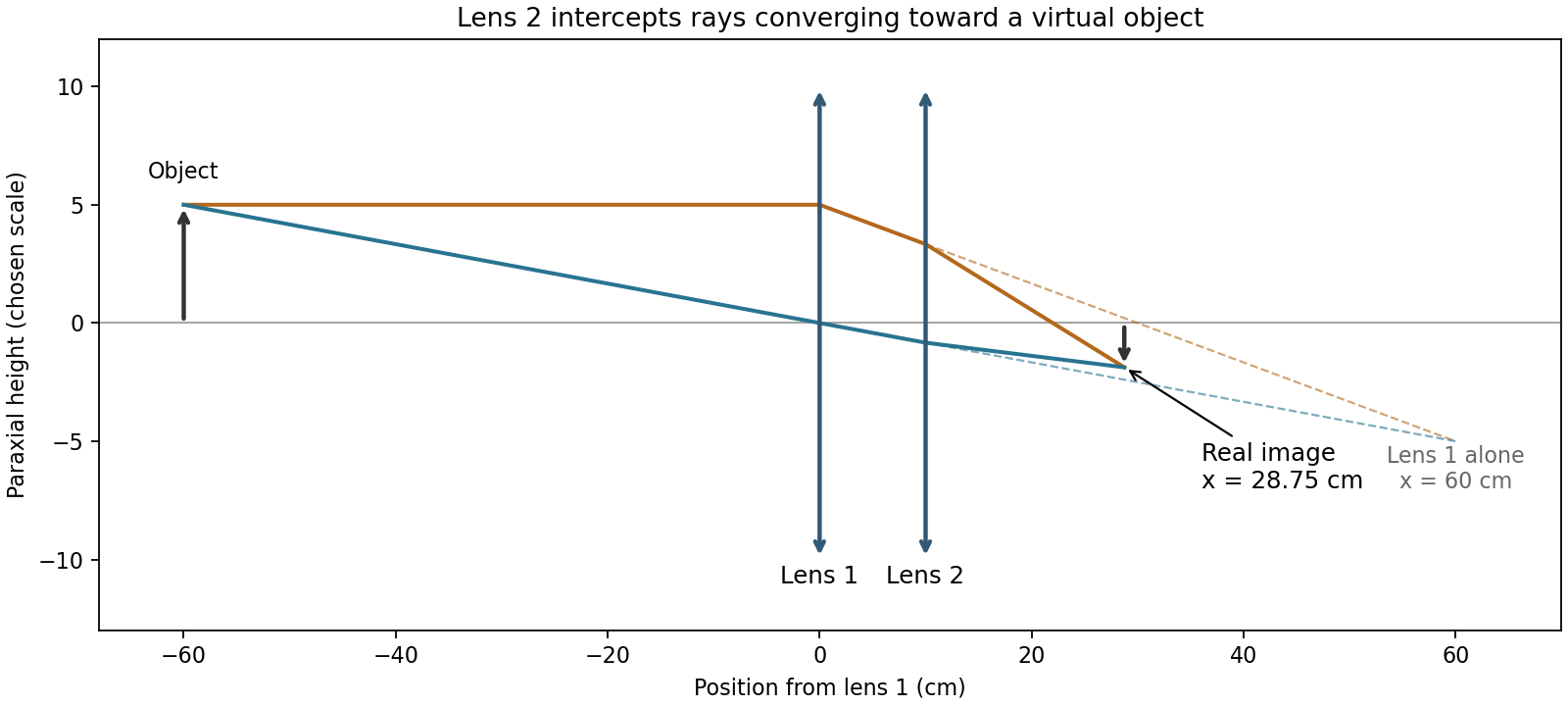
Codex 0 2026-10-20For two equal lenses with a virtual intermediate object, use positive distances for real objects on a lens's incident side and real images on its outgoing side. The first lens gives , hence . At the second lens these rays are already converging toward a point to its right: its object distance is therefore .Thus the final image is real, to the right of lens 1. Its transverse magnification is : it is inverted. The intermediate focus is not a real object placed before lens 2.


There are unlisted articles, also show them or only show them.