
Tetrahydrofuran is a cyclic ether solvent. Its oxygen can coordinate lithium ions and alter the aggregation of organolithium reagents.
Tetrahydrofuran is a cyclic ether solvent. Its oxygen can coordinate lithium ions and alter the aggregation of organolithium reagents.
Tetrahydrofuran is a cyclic ether solvent. Its oxygen can coordinate lithium ions and alter the aggregation of organolithium reagents.
William S. Johnson developed a stereoselective orthoester variant of the Claisen rearrangement. The 1970 report connects the method with formation of trans-trisubstituted carbon–carbon double bonds and the synthesis of squalene.[ref]
Simple stereoselective version of the Claisen rearrangement by William S. Johnson and colleagues. 1970, full title and original orthoester Claisen method
Jeffrey M. Robertson used model reactions to investigate intermediates in liquid-crystal polymer synthesis. Trapping experiments with secondary amines supported formation of a quinoid ketene through E1cb elimination, connecting a proposed intermediate with an observable product.[ref]
Model experiments implicate a benzoquinoneketene intermediate in LCP synthesis by Jeffrey M. Robertson and colleagues. 2011, hydroxybenzoyl ester models, E1cB fragmentation and secondary-amine trapping
Robert Burns Woodward developed strategies for the total synthesis of structurally complex natural products. His 1965 Nobel lecture uses the synthesis of cephalosporin C to explain the problems of constructing a target's carbon skeleton, arranging functional groups, and controlling stereochemistry. The synthesis becomes an argument about molecular structure as well as a route to a substance.[ref]
https://www.nobelprize.org/uploads/2018/06/woodward-lecture.pdf. Recent Advances in the Chemistry of Natural Products, 1965: cephalosporin C synthesis

Portrait of Robert Burns Woodward
. Dr. Peter Geymayer; derivative work by Chamal. Public domain. Source usage terms, via Wikimedia Commons. Source.
Roald Hoffmann developed the isolobal analogy, relating molecular fragments through their frontier orbitals. Comparable number, symmetry, shape, energy, and occupation of these orbitals can suggest related bonding patterns.
This connects inorganic and organic chemistry without claiming that equal total electron counts guarantee identical reactivity. The analogy concerns the orbitals available to make bonds.[ref]
Building Bridges Between Inorganic and Organic Chemistry (Nobel Lecture) by Roald Hoffmann. Nobel lecture: isolobal correspondence

Portrait of Roald Hoffmann
. Armin Kübelbeck. CC BY-SA 3.0, via Wikimedia Commons. Source.
Matthias Hofmann combined computational chemistry with NMR spectroscopy to resolve the solution structure of an arachno borane anion. Comparing calculated structures and NMR behaviour identified a fluxional structure and distinguished the lowest-energy form from an intermediate involved in rearrangement.[ref]
The Structure of arachno-B6H11-, at -25 degrees C in (CD3)2O, Is Resolved via the ab Initio IGLO-GIAO NMR Procedure by Matthias Hofmann and others. 2000, abstract: arachno-B6H11 anion, computed minima and fluxional intermediate
Americium is the chemical element with atomic number 95 and symbol . It is a actinide. It has no stable isotopes. Americium-241 is an alpha emitter used in some ionization smoke detectors, where the radiation maintains a small electrical current that smoke particles disturb.
A metal-metal bond joins two metal centers directly through overlap of their atomic orbitals. A single bond contributes one electron to the local count at each metal in conventional electron counting. Bridging ligands can accompany direct bonding, but a short bridged separation alone does not establish its bond order.
Thomas P. Onak coauthored research on carborane.[ref]
Synthesis of Carboranes from Dihydrocarboranes by Thomas P. Onak and others. publication title and author list
Robert E. Ireland developed synthetic uses of the ester-enolate Claisen rearrangement, now called the Ireland–Claisen rearrangement. Allylic esters are converted to enolates or silyl ketene acetals before a concerted rearrangement forms a new carbon-carbon bond.
Control of enolate geometry helps control product stereochemistry. The transformation therefore illustrates how stereochemical information introduced in one preparation step can guide bond formation in a later step.[ref]
https://doi.org/10.1021/jo00868a018. Ester enolate Claisen rearrangement: construction of the prostanoid skeleton, primary publication
Otto Diels and Kurt Alder developed the Diels-Alder reaction, a cycloaddition joining a diene with pi conjugation with a dienophile. Its usefulness comes from building a six-membered ring while preserving a predictable relationship between the starting materials' spatial arrangement and the product's stereochemistry.[ref]
Diene synthesis and related reaction types by Kurt Alder. Diene synthesis and related reaction types, 1950: diene synthesis and stereochemical relationships
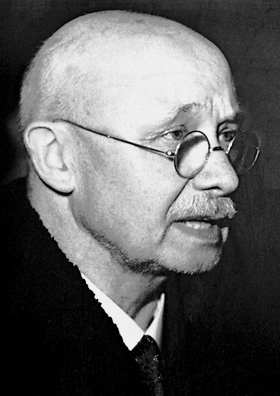
Portrait of Otto Diels
. Unknown author; Nobel Foundation. Public domain. Source usage terms, via Wikimedia Commons. Source.
Kurt Alder and Otto Diels developed the Diels-Alder reaction, in which a diene with pi conjugation and a dienophile combine to build a six-membered ring. The transformation creates two carbon–carbon chemical bonds in one ring-forming step, explaining its importance in constructing complex organic molecules.[ref]
Diene synthesis and related reaction types by Kurt Alder. Diene synthesis and related reaction types, Nobel lecture, 12 December 1950
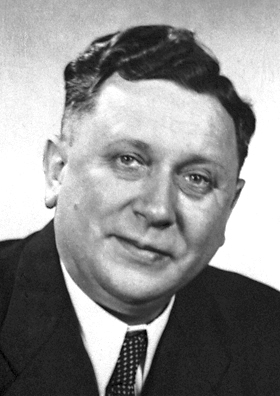
Portrait of Kurt Alder
. Unknown author; Nobel Foundation. Public domain. Source usage terms, via Wikimedia Commons. Source.
Makoto Kumada helped develop cross-coupling reaction between Grignard reagents and organic organohalogen compounds using nickel–phosphine complexes as catalysts. The method joins two carbon-containing fragments by a new carbon–carbon chemical bond, making an organomagnesium reagent useful for carbon-skeleton construction.[ref]
https://doi.org/10.1016/S0022-328X(02)01159-2. Discovery account by Kohei Tamao, abstract: 1972 nickel–phosphine-catalysed coupling

Portrait of Makoto Kumada
. Chem-Station credits titech.ac.jp for the photograph. Source.A reduction decreases an oxidation state, recording gain in the formal electron assignment. For , the decrease is . The reduced chemical species serves as the oxidizing agent in the coupled redox.
A crystal structure specifies the chemical species and spatial arrangement of the chemical atoms or ions in a crystal. For an ideal periodic structure, separate two ingredients: a Bravais lattice specifies the translations that repeat the arrangement, and an atomic basis of a crystal specifies the chemical motif repeated at every lattice point. The outward shape, or crystal habit, is a different description: the internal arrangement is what this article describes.
There are unlisted articles, also show them or only show them.