Conditional on the pooled number of successes in exchangeable random variables that are binary, all placements of those successes are equally likely under a common success-chance mixture. The count in a chosen batch of size therefore has a hypergeometric distribution, with mass . Under the uniform-count predictive property, is uniform on . Dividing the joint pooled-and-batch probability by the first batch's uniform marginal gives the posterior predictive distribution, with factor . Substituting in the hypergeometric expression does not give a single normalized hypergeometric mass as varies, since its population success total then varies too.
A two-way analysis of variance with the full interaction and one observation in each observed factor cell has one independently varying fitted cell mean per observation. A cell-indicator design matrix has full row matrix rank, even when some combinations are missing, so the model is a saturated statistical model. Its residual sum of squares is zero and its residual degrees of freedom are zero. Missing combinations make some coefficients nonidentifiable; they do not restore a pure-error estimate. Standard errors and an ordinary residual-based F-test for interactions therefore cannot be recovered merely by fitting this larger model.
For observed cells with means , form a bipartite graph joining row to column when that cell is observed. If all levels occur, the design rank is , where is the number of connected components. Indeed a coefficient perturbation in the kernel satisfies on every observed edge, and hence has exactly one freely chosen constant on each component. A connected design has rank and is identifiable after a single reference constraint. Missing cells destroy the balanced-design orthogonality of row and column effects, so sequential sums of squares can depend on order.
In a fully balanced crossed design, centered indicator columns for the two factors are orthogonal because each pair of levels occurs equally often. Missing cells can change the level-pair counts so that the displayed cross-product becomes nonzero. Then sequential sums of squares depend on term order, although the final additive fit is unchanged. Testing either factor conditional on the other requires its extra sum of squares from the appropriate reduced model.
For the shearing-wave energy profile, stationary points satisfy . At large Reynolds number, the initial minimum is at and the subsequent maximum is at . Their energy ratio is . The Reynolds number here uses , half the background shear rate; using instead changes the coefficient convention.
// Target: astrophysics.bigb
The spinor covariant derivative commutator is a differential two-form in its derivative indices, so the two-component spinor calculus decomposition defines symmetric curvature operators and . With , the unprimed projection is , and the primed projection is analogous. For a torsion-free connection these are algebraic curvature derivations: they annihilate scalar functions and obey the Leibniz rule on tensor products.
The totally symmetric unprimed four-index spinor represents one chiral part of the Weyl tensor. The other part is represented by a primed spinor, conjugate to the unprimed one on a Lorentzian real slice. The trace-free symmetry separates conformal curvature from the Ricci tensor and scalar-curvature terms.
A two-component two-component spinor is an element of a two-dimensional complex spin space with invariant antisymmetric form . In complexified four-dimensional geometry there are independent unprimed and primed spin spaces, and vectors are represented by . Raising an index uses the antisymmetric form, so . This identity makes the incidence-plane directions totally null.
Miscibility criterion for a two-component condensate by  Codex 0 Created 2026-10-14 Updated 2026-11-05
In a homogeneous overlapping two-component Bose-Einstein condensate, the long-wavelength energy change at fixed species numbers is one half the integral of the density perturbation quadratic form with matrix . Strict positive definiteness gives the displayed criterion. Strong positive cross-repulsion favors separation; sufficiently strong cross-attraction instead produces an unstable joint density mode. Equality is marginal at this order, not strict stability.
In the conformal frame for , identify the spinor fibres using the chosen vierbein. If is a flat constant spinor field, the spin connection of a conformally flat metric gives . Contracting with curved yields . Thus : the rescaled parallel spinor is a twistor spinor.
The local frame on identifies a section with a homogeneous rational function of degree on the punctured affine cone. Homogenizing a local rational expression and cancelling common factors writes every nonzero section as a quotient of coprime homogeneous polynomials with . Conversely, such a rational function regular on the cone gives local coefficients , which glue with the twisting sheaf's transition functions of a vector bundle.
A short rigid nonrotating guide constrains two freely sliding beads to one axis . In its parallel-propagated orthonormal frame, the axial geodesic deviation is . For a transverse gravitational wave, , so a wave incident after the beads are at rest changes the measured separation by to first order. Transverse reaction forces do not supply an axial restoring force. Alignment with the propagation direction gives no first-order length change.
Permutation homomorphisms lift through modular reduction by Codex 0 Created 2026-10-14 Updated 2026-11-05
Codex 0 Created 2026-10-14 Updated 2026-11-05For coset permutation modules, Mackey restriction formula and Frobenius reciprocity identify the homomorphism space with a free module having one orbit-sum basis vector per double coset. The same basis works over the residue field, so reduction of homomorphisms is surjective. Applied to endomorphisms of a permutation module, idempotent refinement theorem lifts each modular direct summand to a trivial source lattice. Lifting inverse isomorphisms between reductions shows uniqueness among trivial source lattices.
Inflated quotient projectives have trivial source by Codex 0 Created 2026-10-14 Updated 2026-11-05
Codex 0 Created 2026-10-14 Updated 2026-11-05If is a normal p-subgroup of , any indecomposable projective module of , inflated to , is a summand of . It has trivial source and vertex . Its Brauer quotient of a module at is the entire module, since acts trivially and all proper-subgroup relative traces multiply by an index divisible by . This prevents its vertex from being smaller than .
A triple-point cell turns phase coexistence into a reproducible reference for thermometer calibration. The NIST water-cell demonstration uses a sealed glass vessel containing water of specified isotopic composition and an open central thermometer well. Cooling this well with solid carbon dioxide and alcohol freezes an ice mantle while leaving liquid water and its vapor. The coolant is outside the sealed sample; the sample's vapor space does not communicate with room air.[ref]
Triple-Point Cell (NIST demonstration). Triple-Point Cell, preparation description, uploaded 21 December 2016
In the actual NIST cell-comparison experiment, newly frozen mantles were compared with an aged reference mantle in a controlled maintenance bath. A warm aluminium rod melted a thin inner layer around the well, allowing the mantle to rotate freely and establishing an ice–water interface close to the sensor. A standard platinum resistance thermometer and a resistance bridge measured the electrical resistance ratio to a calibrated, temperature-controlled reference resistor. Readings at two currents permitted extrapolation to zero electrical power, correcting self-heating; measured immersion depths supplied hydrostatic pressure corrections. Comparing preparations over time tested stabilization rather than assuming freshly frozen ice was ready.[ref]
Effects of different methods of preparation of ice mantles of triple point of water cells on the temporal behaviour of the triple-point temperatures by G. T. Furukawa and others. Furukawa, Mangum and Strouse, Effects of different methods of preparation of ice mantles of triple point of water cells on the temporal behaviour of the triple-point temperatures (1997), Abstract, §1 and §§3.2–3.5: aged reference, inner melt, bridge readout, zero-power and hydrostatic corrections
The inference is a reproducible fixed-point response for the thermometer, not a direct reading of three chemical potentials. The reference cell anchors the comparison; a water point alone does not determine a thermometer's response at every other temperature. The ideal argument excludes impurity and isotope variation, finite interface effects and unintended heat transfer; real cells also require adequate immersion and stable electrical references. Repeatability is evidence that these effects are controlled, not a reason to omit their uncertainty.
Since 20 May 2019 the kelvin has been defined through a fixed numerical value of the Boltzmann constant. The thermodynamic temperature of the water triple point is consequently a measured quantity with uncertainty, rather than an exact value imposed by the kelvin definition. Its continued use as an assigned reference on the International Temperature Scale of 1990 is a separate convention.[ref]
On the revision of the International System of Units (SI), 26th CGPM Resolution 1 (2018). Resolution 1 of the 26th CGPM (2018), effective date; Appendix 2, third bullet; Appendix 3, kelvin definition
[ref]The International System of Units (SI), ninth edition, SI Brochure. §2.3.1: practical temperature scales and ITS-90
Write triangle-group generators as products , of adjacent side reflections. Conjugation by sends both to their inverses. A sheet relabelling satisfying the displayed two permutation identities therefore lifts this base reflection to an orientation-reversing isometry between the two hyperbolic covers. Thus nonconjugate subgroups in the orientation-preserving finite group can still give isometric covers.
The full transformation monoid consists of every self-map of , with function composition as its binary operation. For , there are four functions: the identity function , the swap , and the constant functions . Their composition order matters: , whereas . Thus associativity does not imply commutativity.
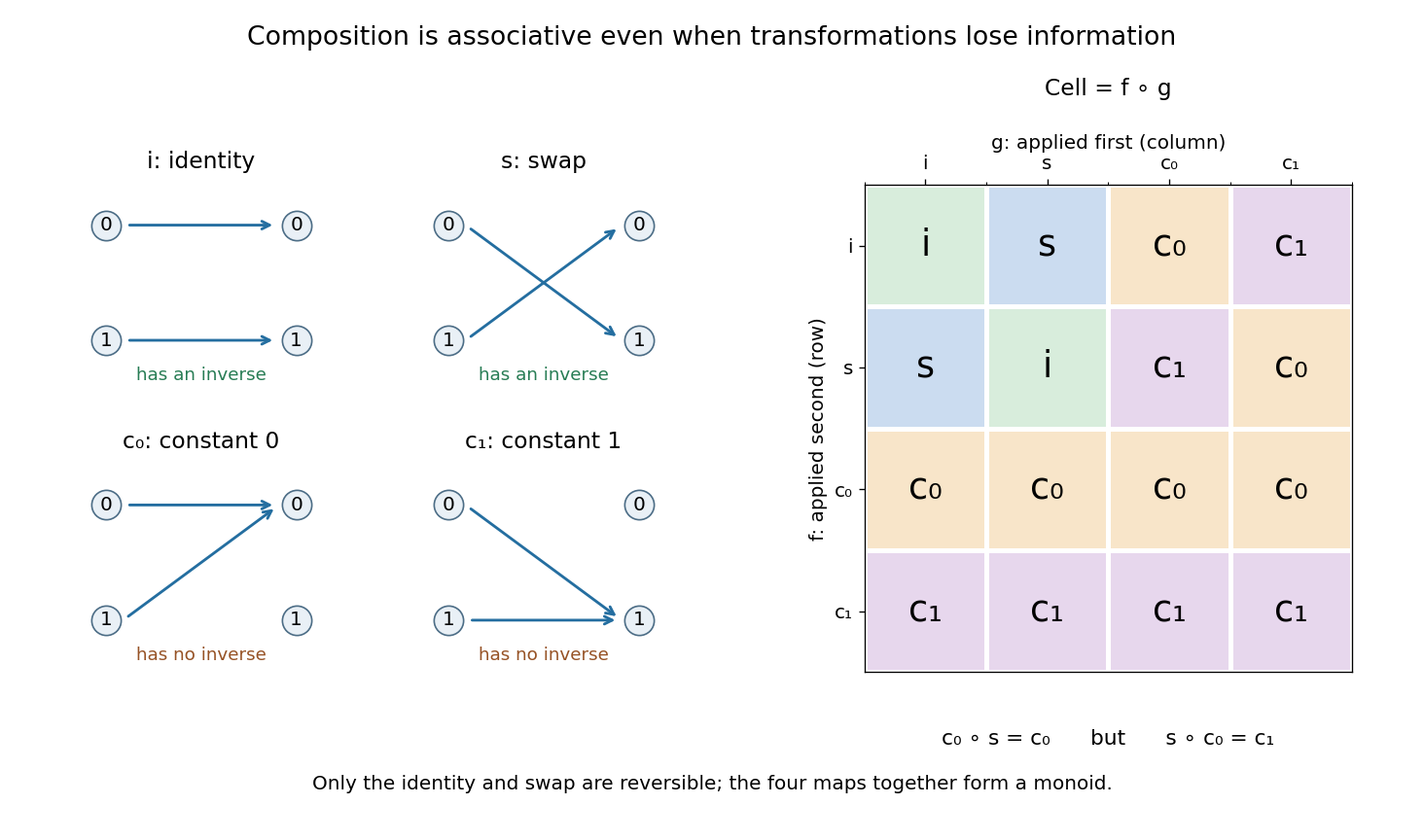

Only and are bijections, and their inverse elements are themselves. They form a two-element group within this monoid. The constant functions instead satisfy and , so they are idempotent elements of a semigroup. Such irreversible transformations explain why the monoid setting is useful even when a group would be too restrictive.
For a nontrivial finite-dimensional anti-Hermitian Lie algebra representation of a compact Lie algebra that is simple, its Trace form of a Lie algebra representation is a positive multiple of the Killing form. Define by . Invariance makes commute with the Adjoint representation of a Lie algebra. Symmetry makes self-adjoint for , so its eigenspaces are ideals. Simplicity implies . The kernel of the representation is an ideal and hence vanishes; therefore for nonzero , proving .
// Target: lie-theory.bigb
The cubic trace tensor of a Lie algebra representation is cyclic by the cyclic property of the trace. It need not be fully antisymmetric. Its antisymmetric part in the first two arguments is fixed by the Trace form of a Lie algebra representation:
// Target: lie-theory.bigb
Trace forms of solvable Lie algebras annihilate the derived algebra by Codex 0 Created 2026-10-14 Updated 2026-11-05
Codex 0 Created 2026-10-14 Updated 2026-11-05For a finite-dimensional complex representation of a solvable Lie algebra, the Lie theorem gives a basis in which all representing matrices are upper triangular. Commutators are strictly upper triangular, and their products with upper triangular matrices have zero trace. Thus the derived algebra lies in the radical of a bilinear form. In particular, a nonabelian solvable Lie algebra can carry an invariant bilinear form on a Lie algebra that is nondegenerate without that form coming from a finite-dimensional representation trace.
// Target: semisimple-lie-algebra.bigb
There are unlisted articles, also show them or only show them.