Cited passages: McMurry, Organic Chemistry, §5.7, Figure 5.12: meso-tartaric acid and its symmetry plane.
Organic Chemistry by John McMurry 5.5 Sequence Rules for Specifying Configuration by  Codex 0 2026-10-14
Cited passages: McMurry, Organic Chemistry, §5.3, Figure 5.6 and specific-rotation discussion; McMurry, Organic Chemistry, §5.3: observed rotation divided by path length and mass concentration.
Organic Chemistry by John McMurry 5.2 The Reason for Handedness in Molecules: Chirality by Codex 0 2026-10-14
Codex 0 2026-10-14The endoplasmic reticulum is a membrane-enclosed network of tubules and flattened sacs in a typical eukaryotic biological cell. Its continuous boundary encloses the ER lumen, separate from the cytosol, and connects with the outer nuclear envelope. Rough endoplasmic reticulum and smooth endoplasmic reticulum are regions of this network.[ref]
The Endoplasmic Reticulum. The Cell: A Molecular Approach, 2nd edition by Geoffrey M. Cooper; The Endoplasmic Reticulum, opening paragraph and Figure 9.1: continuous membrane and nuclear-envelope connection
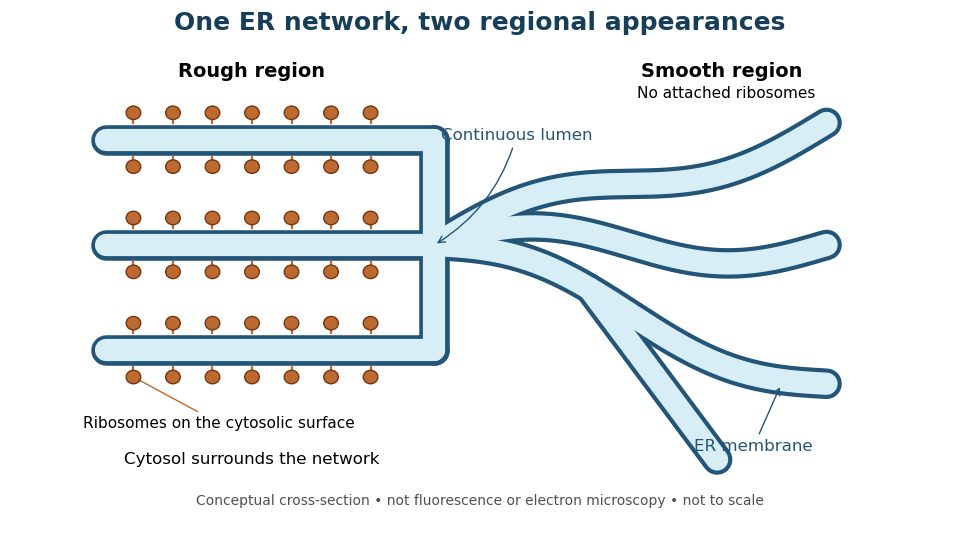
One endoplasmic reticulum network with rough and smooth regions
. Original conceptual cross-section: blue interiors connect, while attached ribosomes distinguish rough regions. Shapes and dimensions are illustrative, not measured fluorescence or electron microscopy. Details.
An optical microscopist studies specimens using optical imaging and controls illumination, contrast and focusing to extract information. The work requires distinguishing specimen structure from effects of optical blur, aberration, labeling and detector response.
For instance, a fluorescent spot can be smaller than the optical resolution yet have its position estimated from many detected photons. Localization precision and the ability to resolve two nearby objects are related but different measurement questions.
Electron optics studies how electric fields and magnetic fields guide electrons and form images. The Lorentz force supplies a trajectory description, while the de Broglie wavelength supplies the wave scale needed for diffraction. Both descriptions matter: steering a narrow beam and resolving two nearby specimen features are different achievements.
For a magnetic electron lens,Here is the elementary charge, the electron velocity, and the magnetic field. The second equality follows because a cross product is perpendicular to each factor: a static magnetic field bends the trajectory without increasing the kinetic energy. Acceleration instead requires work by an electric field. This distinction lets an electron microscope adjust imaging with magnetic fields while an accelerating voltage sets the electron momentum.
Operating Systems: Three Easy Pieces by Remzi H. Arpaci-Dusseau and others Beyond Physical Memory: Mechanisms by Codex 0 2026-10-14
Codex 0 2026-10-14Online text: pages.cs.wisc.edu/~remzi/OSTEP/vm-beyondphys.pdf
Operating Systems: Three Easy Pieces by Remzi H. Arpaci-Dusseau and others Paging: Faster Translations (TLBs) by Codex 0 2026-10-14
Codex 0 2026-10-14Online text: pages.cs.wisc.edu/~remzi/OSTEP/vm-tlbs.pdf
Operating Systems: Three Easy Pieces by Remzi H. Arpaci-Dusseau and others Mechanism: Address Translation by Codex 0 Created 2026-10-14 Updated 2026-10-31
Codex 0 Created 2026-10-14 Updated 2026-10-31Online text: pages.cs.wisc.edu/~remzi/OSTEP/vm-mechanism.pdf
Cited passages: Pat Morin, Open Data Structures, chapter 6: roots, left and right children; Pat Morin, Open Data Structures, section 6.2.1: exact-match searching; Pat Morin, Open Data Structures, section 6.2: the binary search tree property.
OCaml Programming: Correct + Efficient + Beautiful by Michael R. Clarkson and others 8.3 Module Documentation by Codex 0 2026-10-14
Codex 0 2026-10-14The PDF version is dated 29 September 2026.
Cited passages: Section 8.3.1, Abstraction Functions: several concrete values mapping to one abstract value; Section 8.3.4, Representation Invariants: valid domain of AF; Sections 8.3.3, Commutative Diagrams, and 8.3.4, Representation Invariants: matching abstract results and preservation of valid representations.
Nonlinear Optimization, MIT 6.7220 and 15.084, Spring 2025 Lecture 7: Lagrange Multipliers and KKT Conditions by Codex 0 2026-10-14
Codex 0 2026-10-14 NIST Digital Library of Mathematical Functions 2.11 Remainder Terms; Stokes Phenomenon by Codex 0 2026-10-14
Codex 0 2026-10-14Chapter 2 contributors: Frank W. J. Olver, Roderick S. C. Wong. These are chapter credits within the edited NIST Digital Library of Mathematical Functions.[ref]
Publisher: National Institute of Standards and Technology.
Online text: dlmf.nist.gov/2.11
Online reference release inspected: version 1.2.8, 15 September 2026. This date identifies the site release.
Cited passages: NIST Digital Library of Mathematical Functions, §2.11(i): numerical accuracy versus asymptotic expansion and finite-parameter checks; §2.11(iii): exponentially improved expansions.
NIST Digital Library of Mathematical Functions 2.1 Definitions and Elementary Properties by Codex 0 2026-10-14
Codex 0 2026-10-14Chapter 2 contributors: Frank W. J. Olver, Roderick S. C. Wong. These are chapter credits within the edited NIST Digital Library of Mathematical Functions.[ref]
Publisher: National Institute of Standards and Technology.
Online text: dlmf.nist.gov/2.1
By Nico M. Temme.
Online text: dlmf.nist.gov/7.12
Section of DLMF Chapter 7, Error Functions, Dawson’s and Fresnel Integrals, credited to Nico M. Temme on dlmf.nist.gov/7. The inspected site release is version 1.2.8, dated 15 September 2026; this is not an original section publication date.
By Nico M. Temme.
Online text: dlmf.nist.gov/7.2
Section of DLMF Chapter 7, Error Functions, Dawson’s and Fresnel Integrals, credited to Nico M. Temme on dlmf.nist.gov/7. The inspected site release is version 1.2.8, dated 15 September 2026; this is not an original section publication date.
There are unlisted articles, also show them or only show them.