Type II superstring theory is a ten-dimensional closed oriented superstring theory with spacetime supersymmetry and no tachyon. Its massive closed-string levels have squared masses separated by .
An unoriented theory containing open and closed superstrings. Consistent gauge and gravitational anomaly cancellation yields the familiar gauge algebra. Open-string Chan-Paton factors supply the gauge degrees of freedom, while closed strings contain gravity. It is related by strong/weak duality to the corresponding heterotic theory.
If a density of states has high-energy growth proportional to a power of energy times , its canonical Boltzmann sum fails for . The Hagedorn temperature is the corresponding threshold. The open bosonic string mass spectrum and large-level degeneracy of an open bosonic string give in units with Boltzmann's constant, the speed of light and Planck's constant set to one. Polynomial prefactors affect behavior at the threshold itself; the growth alone does not distinguish a limiting temperature from a phase transition.
A fundamental string is the perturbative string of a string-theory description. Its string tension is the displayed expression in the string metric. It couples to the Neveu–Schwarz two-form.
An NS5-brane has five spatial dimensions and is magnetically charged under the Neveu–Schwarz two-form. Its string-frame brane tension scales as .
A string duality identifies apparently different string theory descriptions as descriptions of the same physical system, with a map between their states, parameters and observables. It can exchange quantities interpreted very differently in the two descriptions, such as momentum and winding around a compact dimension.
T-duality relates a circle of radius to one of radius by interchanging momentum and winding quantum numbers. A small geometrical circle in one description can therefore correspond to a large one in another; comparing only the classical geometry would miss the matching spectrum. S-duality instead relates coupling regimes and can turn a difficult strong-coupling question into a weak-coupling one. A proposed duality needs a concrete dictionary and consistency checks; a coincidental equality of one calculation is insufficient to establish equivalence of full theories.
The limiting reagent is the reactant exhausted first if the specified chemical reaction proceeds to the maximum conversion permitted by stoichiometry. With initial values of amount of substance for the reactants and positive consumption coefficients , the largest forward extent of reaction is . Compare these quotients, rather than simply choosing the smallest initial quantity. This calculation predicts the maximum reaction product quantity and identifies which reactant supply must increase to raise it. See Flowers et al., Chemistry 2e, limiting reactants.
Start with of molecular hydrogen, of molecular oxygen and no water. Assume complete conversion by the displayed chemical reaction, without competing reactions. ThenThe molecular oxygen is the limiting reagent. Consumption of of molecular hydrogen and of molecular oxygen forms of water, leaving of molecular hydrogen. Initially there are molecular hydrogen molecules and molecular oxygen molecules; after conversion there are water molecules and leftover molecular hydrogen molecules.
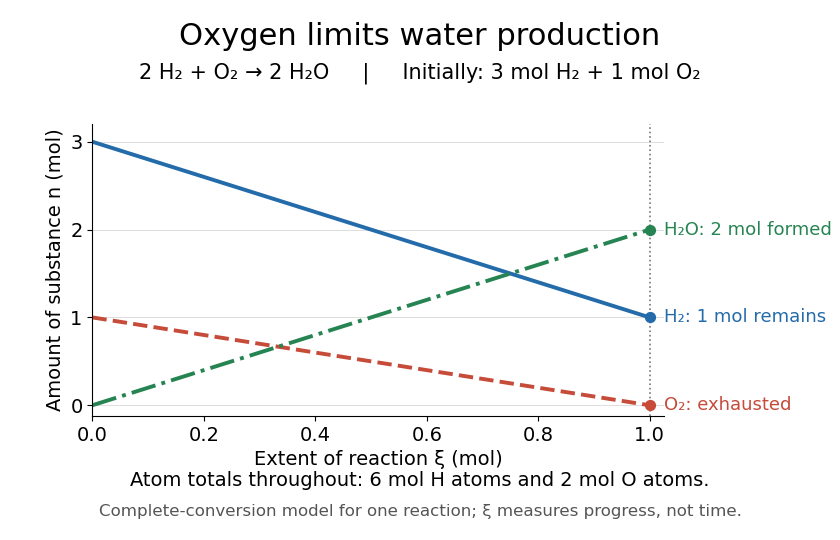
Oxygen runs out while one mole of molecular hydrogen remains
. The horizontal axis is extent of reaction, rather than time. The endpoint assumes complete conversion by one chemical reaction; the curves express stoichiometry. Details.
As a check, the initial inventory has of hydrogen chemical atoms and of oxygen chemical atoms. The final water contains of hydrogen chemical atoms, and leftover molecular hydrogen supplies the remaining . The atom totals balance even though the total amount of substance of molecules falls from four to three moles.
For a closed system with one specified chemical reaction, the extent of reaction records progress from through . Here is the amount of substance of species , and the signed stoichiometric vector has negative entries for reactants and positive entries for reaction products. For the water chemical equation in the order , it is . The normalization of depends on the chosen coefficients. See IUPAC Gold Book, extent of reaction.
With particle numbers instead of molar amounts, a molecular extent obeys , and the chemical potentials are measured per particle. At fixed temperature and volume, the Helmholtz free energy then satisfies . An interior chemical equilibrium requires ; the molar convention gives the same relation with chemical potentials per mole.
The molecular count is a dimensionless integer; the amount of substance has unit mole, symbol . They satisfyThe Avogadro constant is exact by the modern definition of the mole: see SI base unit: mole by Bureau International des Poids et Mesures. Thus two water molecules correspond to moles, whereas two moles of water contain molecules. A mole is a unit for counting specified entities, which may also be chemical atoms, ions or electrons.
Stochastic Geometry: Lectures given at the C.I.M.E. Summer School held in Martina Franca, Italy, September 13-18, 2004 Spatial Point Processes and their Applications by  Codex 0 2026-10-13
By Adrian Baddeley.
Cited passages: David Tong, Statistical Physics, §4.2, equation 4.156 and “Quasi-Static Processes”: state energy versus heat and work; Tong uses work positive inward.
Cited passages: David Tong, Statistical Physics, section 4.1: equilibrium and thermal contact; David Tong, Statistical Physics, sections 4.2–4.3: ideal-gas internal energy and reversible adiabatic work; David Tong, Statistical Physics, §4.3.1: adiabatic expansion between the isothermal legs; David Tong, Statistical Physics, §4.4.2: Maxwell relations and the general heat-capacity difference; David Tong, Statistical Physics, §§4.2–4.3: work, heat, and adiabatic legs of a cycle; Tong, Statistical Physics, first law and heat capacities; Tong, Statistical Physics, §§4.2–4.3: quasi-static and reversible processes.
Online text: www.damtp.cam.ac.uk/user/tong/statphys/four.pdf
Statistical Physics by David Tong 3 Quantum Gases by Codex 0 Created 2026-10-13 Updated 2026-10-18
Codex 0 Created 2026-10-13 Updated 2026-10-18Cited passages: David Tong, Statistical Physics, §3.4: discrete rotational spectrum, vibrational freezing and classical high-temperature limits.
Cited passages: David Tong, Statistical Physics, §3.4: quantum vibrational spectrum, thermal occupations and zero-point energy; Tong, Statistical Physics, section 3: quantum gases and the classical limit.
Author-hosted chapter variant: www.damtp.cam.ac.uk/user/tong/statphys/statmechhtml/S3.html
There are unlisted articles, also show them or only show them.