
For a rectangular channel with stationary width and constant reduced gravity , volume conservation and momentum conservation give and . With the characteristic curves have speeds . The combinations obey the displayed compatibility equations; they are Riemann invariants only when the width source term vanishes.
In angiosperms, pollination transfers pollen from an anther to a stigma. Fertilization is a later fusion of gametes; seed development follows. Pollination may use animals, wind or water, so an insect visit is neither required for every flower nor sufficient evidence of fertilization.[ref]
32.2 Pollination and Fertilization. Biology 2e, §32.2 opening definition, Pollination by Wind and Pollination by Water
Fertilization is fusion of gametes. Fusion of two haploid gametes restores the diploid state in the inheritance model used for Mendelian segregation.
A gamete is a reproductive biological cell that can fuse with another gamete during fertilization. In the ordinary diploid inheritance model, a haploid gamete carries one copy at each genetic locus.
The Bateman equation gives the populations in a sequential radioactive decay chain. For a parent with population and an initially absent daughter, distinct decay constants give ; the first population satisfies .
Cyclic adenosine monophosphate is a cyclic nucleotide made from ATP. It can serve as an intracellular second messenger, changing the activity of target proteins after a signal has been received. Different biological cells can respond differently because they contain different targets. [ref]
https://openstax.org/books/biology-2e/pages/9-2-propagation-of-the-signal. Clark, Douglas and Choi, Biology 2e, §9.2: cyclic AMP as a second messenger
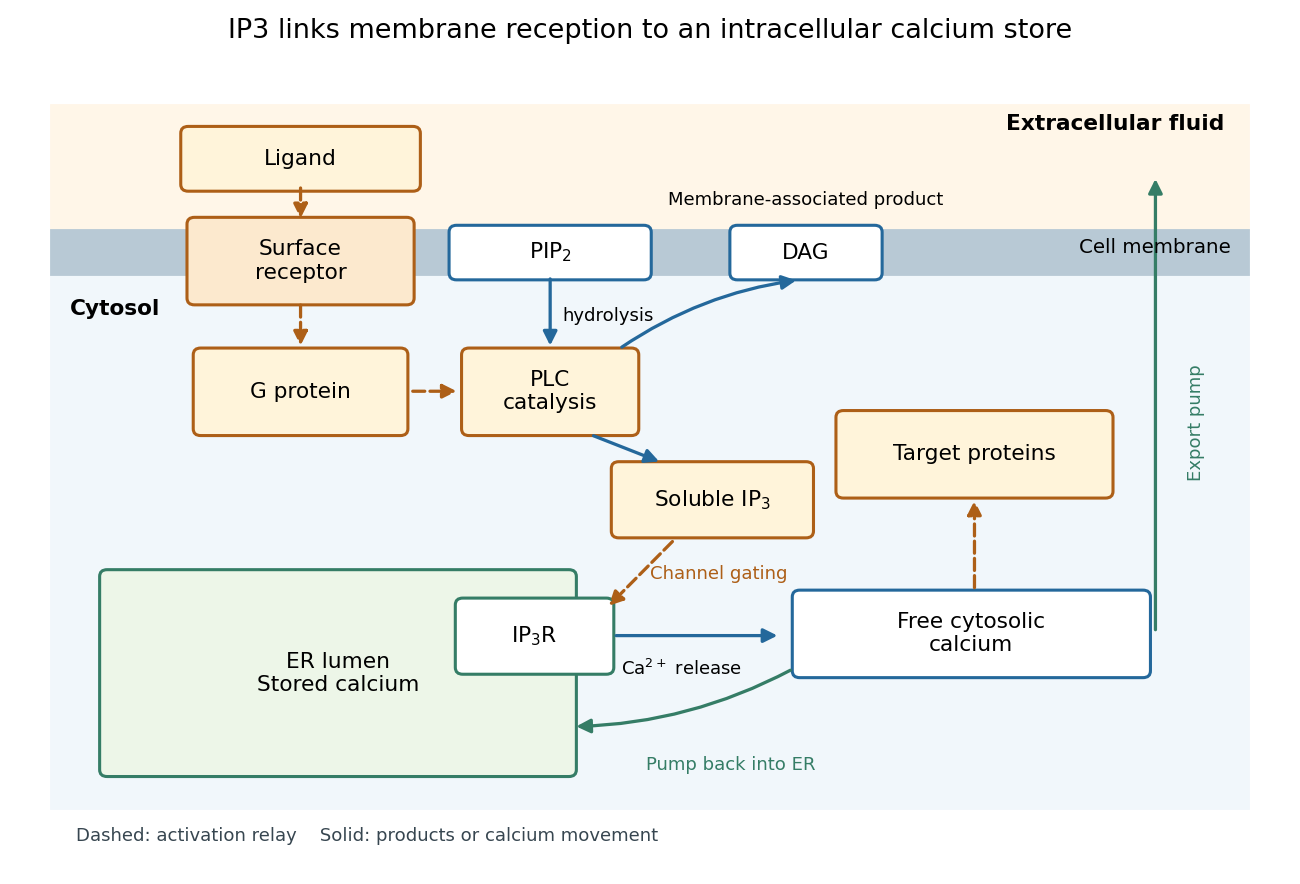
In signal transduction, inositol trisphosphate usually means inositol 1,4,5-trisphosphate: a soluble intracellular second messenger. An extracellular ligand, its cell-surface receptor, IP3 and the released calcium ions are distinct components. IP3 binds an IP3 receptor on the endoplasmic reticulum, promoting stored release into the cytosol.[ref]
Pathways of Intracellular Signal Transduction. Phospholipids and Ca2+, Figure 13.27: soluble IP3 and intracellular calcium release
The useful separation is spatial: an extracellular message can control an internal store without entering it. The existing intracellular-injection experiment under metabotropic receptor tests bypassing reception; the Pancreatic IP3 store fractionation experiment below tests which internal compartment supplies the released calcium. Neither question is answered merely by observing a downstream membrane electric current.

Cited passages: solve_ivp, method parameter: explicit versus implicit methods and stiffness; solve_ivp, rtol and atol parameters: local error estimates, additive scaling and component-specific atol.
A cathetometer measures differences of vertical height using a sighting telescope mounted on a vertical measuring column. The telescope is aligned horizontally, sighted on a first feature, translated vertically and sighted on a second feature. Their scale readings determine the height difference without placing a ruler directly against either feature.
A manometer supplies a useful application: the two liquid surfaces can be sighted separately to determine the column-height difference used to infer pressure. The optical reference, column alignment, meniscus reading and scale measurement calibration all affect the result. Greater apparent magnification alone cannot correct a tilted reference or an incorrectly identified liquid surface.[ref]
Mercury Barometers and Manometers by W. G. Brombacher and others. discussion of cathetometers and optical reading of mercury-column heights
For a nonrelativistic spin-one-half electron of charge , with , the Pauli Hamiltonian isThe wavefunction has two spin components and . If , then ; the Pauli matrix multiplication law gives , explaining the spin-coupling sign. Thus extends the Schrödinger equation to include the electron's magnetic moment.
There are unlisted articles, also show them or only show them.