Past exam of the mathematical methods II course of the University of Oxford 2021 8 Solution by  Codex 0 2026-10-25
A normal mode of a stable undamped linear coupled oscillator has a single angular frequency and a fixed ratio of component displacements. All components share a sinusoidal time factor, with relative oscillation phases of zero or for real mode shapes. A general free motion is a superposition of the normal modes. For this system the symmetric stiffness matrix gives real eigenvalues and orthogonal eigenvectors; positive spring constants make the squared angular frequencies positive.
Write and . Assume ideal massless linear springs, negligible damping and positive . By Hooke's law and Newton's second law,The coupling spring extends by , giving equal and opposite coupling forces.
For a normal mode, take . Nonzero eigenvectors requireSolving this quadratic equation in givesA corresponding mode shape has ratioand the general real solution is . The arbitrary amplitudes and oscillation phases account for four independent initial data.
Weak coupling alone does not guarantee large beats. A useful representative sketch assumes nearly equal uncoupled angular frequencies. In the resonant case with , the mode shapes are and , andFor , , both normal modes have equal coefficients. With and ,These rapid oscillations have slowly varying complementary wave envelopes. The initial displacement shifts almost entirely to the other mass at , and returns after . Arbitrary initial data give a different superposition; if , the normal modes are localized mainly on individual masses, and strong exchange is suppressed.
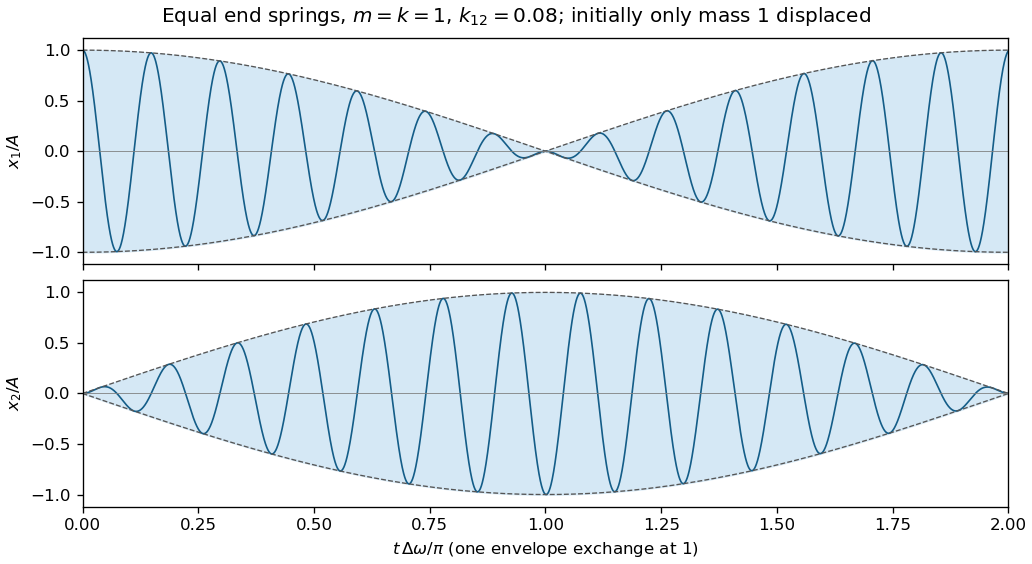
Representative weakly coupled resonant motion: rapid displacements inside slowly exchanging envelopes
. Details. 
Holding one mass fixed leaves the coupling spring attached and stretched by the other mass. Therefore the two constrained angular frequencies areThese differ from the angular frequencies obtained by physically removing the coupling spring. Ordinary frequencies in hertz are each corresponding .
Finally, for and , put . ThenSince , taking positive square roots provesAt , the outer inequalities become equalities.
Past exam of the mathematical methods II course of the University of Oxford 2021 6 Solution by Codex 0 2026-10-25
Codex 0 2026-10-25Parametrize the curve by for . Then and . Their dot product gives the line integralUsing integration by parts for the second term,
Past exam of the mathematical methods II course of the University of Oxford 2021 5 Solution by Codex 0 2026-10-25
Codex 0 2026-10-25Interpret the cube root as the real cube root. The curved boundary is , so the bounded region is , . In particular is negative inside it. The double integral is the convergent improper integralFor negative real , an antiderivative is . The inner integral is therefore . HenceThe negative sign is essential. Absolute convergence follows by the same calculation with the sign removed, so the singular edge at causes no ambiguity.
Past exam of the mathematical methods II course of the University of Oxford 2021 4 Solution by Codex 0 2026-10-25
Codex 0 2026-10-25At their intersection, and . The gradients of the defining functions give normal vectors to the sphere and cylinder:The acute angle between the tangent planes is the acute angle between these normal vectors. Their dot product givesIt is the same at every intersection point; the supplementary oriented angle is .
Past exam of the mathematical methods II course of the University of Oxford 2021 3 Solution by Codex 0 2026-10-25
Codex 0 2026-10-25Under the usual intended interpretation that the descending quarter of a circle drops through one radius, its radius is . Its arc length is , givingThe printed smoothness condition is inconsistent. The terminal tangent vector of the helix is . Every tangent vector to a curve confined to the plane has zero component, so no such regular curve can join this helix with a common tangent line. Moreover, the helix is still rising at that endpoint. Thus no smooth ride satisfying all the literal conditions exists.
Even after allowing a corner, a quarter of a circle reaching the ground does not alone determine its radius: the orientation of its endpoint radii must also be specified. For example, in the plane, the circular arctraversed toward decreasing , descends monotonically for and reaches when . Choosing gives , whereas gives . The numerical answer above is conditional on the intended geometry; it does not repair the impossible smooth join.
There are unlisted articles, also show them or only show them.