
A quantum observable is represented by a self-adjoint operator; its possible measured values are spectral values of that operator.
Multiplying a quantum state by one global complex phase does not change any measurement probability; relative phases between components can affect interference.
The global phase is common to the whole state; relative phases control interference between state components.
A quantum number is a discrete label, usually an observable's eigenvalue, used to distinguish quantum states.
A qubit state specifies measurement probabilities, rather than a pre-existing answer to every possible measurement. For a pure state, normalized vectors differing by a global phase represent the same physical state:Equivalently, the pure state is a ray: the one-dimensional complex linear subspace spanned by any nonzero representative. Dividing a nonzero vector by its norm fixes its length, but leaves the global phase free. The density operator is unchanged because . In contrast, multiplying only one nonzero component by changes a relative quantum phase and can change measurement probabilities. [ref].
After choosing a global phase, every pure state of a qubit can be writtenAt or , the parameter does not distinguish physical states: only one component survives. Elsewhere it is the relative quantum phase. The corresponding unit Bloch vector is on the existing Bloch sphere. Its angles describe a space of states; for a photon polarization qubit they are not the photon's position or direction of travel. [ref].
The Born rule in the computational basis gives and . These probabilities discard . In the Hadamard basis , adding or subtracting the probability amplitudes instead givesThis last equality follows by substituting the angular representative. In the basis , the same calculation givesThus both the real and imaginary parts of quantum coherence can be observed, using different measurement settings. For example, and both give , but the first gives and the second . A global phase could never cause this difference.
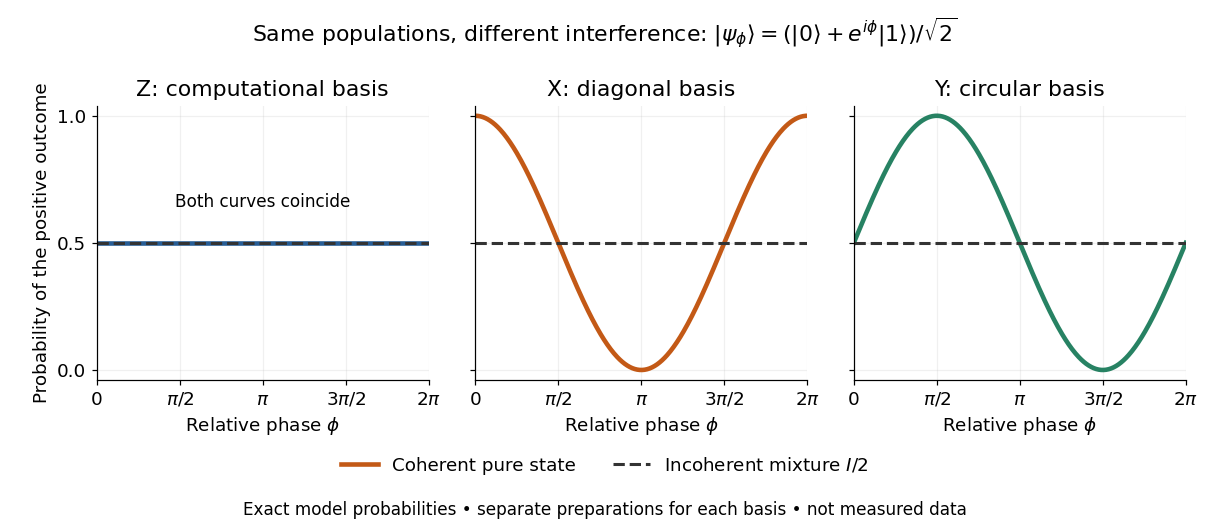
Identical computational-basis probabilities can hide different relative phases and coherence
. Exact model probabilities for , compared with the incoherent mixture . Each curve requires repeated preparations measured in the indicated basis; these are not experimental data. Details.
For a general qubit state, write its density matrix in the computational basis asThese are exactly the Hermitian, unit-trace, positive semidefinite constraints. Positivity means every eigenvalue is nonnegative, not that every matrix entry is nonnegative. The general definition is given in density matrix. [ref]
https://quantum.cloud.ibm.com/learning/en/courses/general-formulation-of-quantum-information/density-matrices/density-matrix-basics. Watrous, IBM Quantum Learning, Density matrix basics, Definition and Connection to quantum state vectors
.For this two-by-two matrix, the explicit constraint follows from its determinant, : with trace one, a nonnegative determinant and real eigenvalues rule out a negative eigenvalue. Its eigenvalues areThe pure states have and eigenvalues ; the mixed states have strict inequality and two positive eigenvalues. For a normalized representative, and . A statistical preparation , with and , averages probabilities, rather than adding probability amplitudes. Such a preparation is mixed if the positive-weight vectors do not all represent the same ray. A reduced density matrix of an entangled pair can also be mixed even when the pair has a pure state. [ref]
https://quantum.cloud.ibm.com/learning/en/courses/general-formulation-of-quantum-information/density-matrices/density-matrix-basics. Watrous, IBM Quantum Learning, Density matrix basics, Interpretation of density matrices
.For a concrete check, the pure state and the mixed state obtained by preparing with probability and with probability haveBoth have trace one and the same computational-basis measurement probabilities. Their eigenvalues are respectively and ; the respective values of their purity of a density operator are and . Their Hadamard basis plus probabilities are respectively and . By contrast, setting would give determinant and eigenvalue : normalized diagonal entries alone do not make a valid qubit state.
The same constraints become especially beautiful in the Bloch ball representation. With the Pauli matrices and the identity operator ,The eigenvalues are , so the Bloch sphere is precisely the pure state boundary, and is the maximally mixed centre. For each axis , the Born rule gives . This unifies a geometric picture, matrix positivity, and experimental frequencies in one description. For the equatorial family in the phase diagram, and ; replacing it by erases the transverse components and every fringe. See quantum state tomography for how independent ensembles measured along the three axes estimate these components. [ref].
A scattering amplitude is the coefficient of an outgoing asymptotic wave relative to the specified incoming wave.
The Lippmann-Schwinger equation rewrites the Schrodinger differential equation as an integral equation using a free Green function and a prescribed incoming state.
Each channel coefficient is a component of the scattering matrix in a basis adapted to rotational symmetry.
For a reflection-invariant localized potential, order incoming amplitudes from the left and right and outgoing amplitudes toward the left and right. Thenwhere and are the reflection and transmission amplitudes. Probability-current conservation makes unitary for a real potential.
The transmission probability is the ratio of transmitted to incident probability current. When the asymptotic wavenumbers agree, it is the squared modulus of the transmission amplitude.
A reflected wave is an outgoing component travelling back toward the side from which the incident wave arrived.
The spin coherent-state path integral contains a Berry phase equal, modulo gauge choices, to the spin times the solid angle swept on the Bloch sphere. Single-valued path-integral amplitudes require .
A ferromagnetic spin chain favors aligned neighbouring spins. Its conventional long-wavelength magnons have quadratic dispersion.
An antiferromagnetic spin wave is a long-wavelength fluctuation of staggered magnetic order. In an isotropic ordered antiferromagnet its low-energy dispersion is linear.
Entanglement monogamy limits how strongly one subsystem can be entangled with several independent partners.
Quantum binary hypothesis testing chooses a two-outcome measurement to distinguish two candidate density operators, trading the probabilities of the two kinds of error.
A bipartite quantum state is separable when its density operator is a convex combination of product states; otherwise it has entanglement. Operationally, Alice and Bob can prepare a separable quantum state by sharing a classical random label and each preparing the corresponding local state.
Separable does not mean uncorrelated. The mixture in Bell correlations versus a classical mixture is separable with two terms of weight , yet the parties' records agree perfectly. A single product state would give independent local outcomes. Allowing a mixture of products captures shared classical randomness; excluding this possibility would incorrectly classify ordinary correlations as entanglement.
There are unlisted articles, also show them or only show them.