
Finite families of convex subtrees of a tree have the Helly property: if every pair intersects, then their total intersection is nonempty.
A group acts on the left cosets of a subgroup by left multiplication; its kernel is the core of that subgroup.
Let be a subgroup. The notation here means the set of left cosets , even when is not a normal subgroup. DefineThis gives a group action without needing a quotient group structure on .[ref]
Group Actions by Keith Conrad. Example 2.12, printed pages 7–8: left multiplication on left cosets, without normality
The representative check is essential: if , then for some , and . Thus equal input cosets give equal output cosets. The identity element fixes every coset, and associativity gives . Each induced map is a permutation, with inverse induced by . This is a transitive group action because sends to .
The stabilizer subgroup of is itself. At a general coset, the stabilizer subgroup and the group kernel areConsequently the coset action is a faithful group action exactly when the subgroup core is trivial.[ref]
Indeed, exactly when , or . Intersecting these membership conditions over all cosets gives the group kernel. Conjugation permutes the subgroups in this intersection, making it a normal subgroup of contained in . Conversely, any normal subgroup of contained in lies in every . This explains why the subgroup core is the largest such normal subgroup: it is exactly the portion of invisible at every label, rather than merely at the label .
For a normal subgroup , every equals , so . For , the construction is the regular group action behind Cayley's theorem. Between these extremes, a nontrivial subgroup with trivial subgroup core can give a faithful group action on fewer labels. If the index of a subgroup is finite, , the first isomorphism theorem givesThus a subgroup of small index of a subgroup exposes a small permutation group associated with . The two examples below and in nonfaithful coset action of the symmetric group on three letters show exactly which information can survive.
For a group action of a group on a set , the stabilizer subgroup of consists of the transformations that leave fixed:It is a subgroup: the identity element fixes , products of transformations fixing fix , and the inverse element of a transformation fixing also fixes . A stabilizer subgroup is a subset of , whereas the orbit of a group action is a subset of . See Ackerman's algebra notes, definition 0.4.1.2.
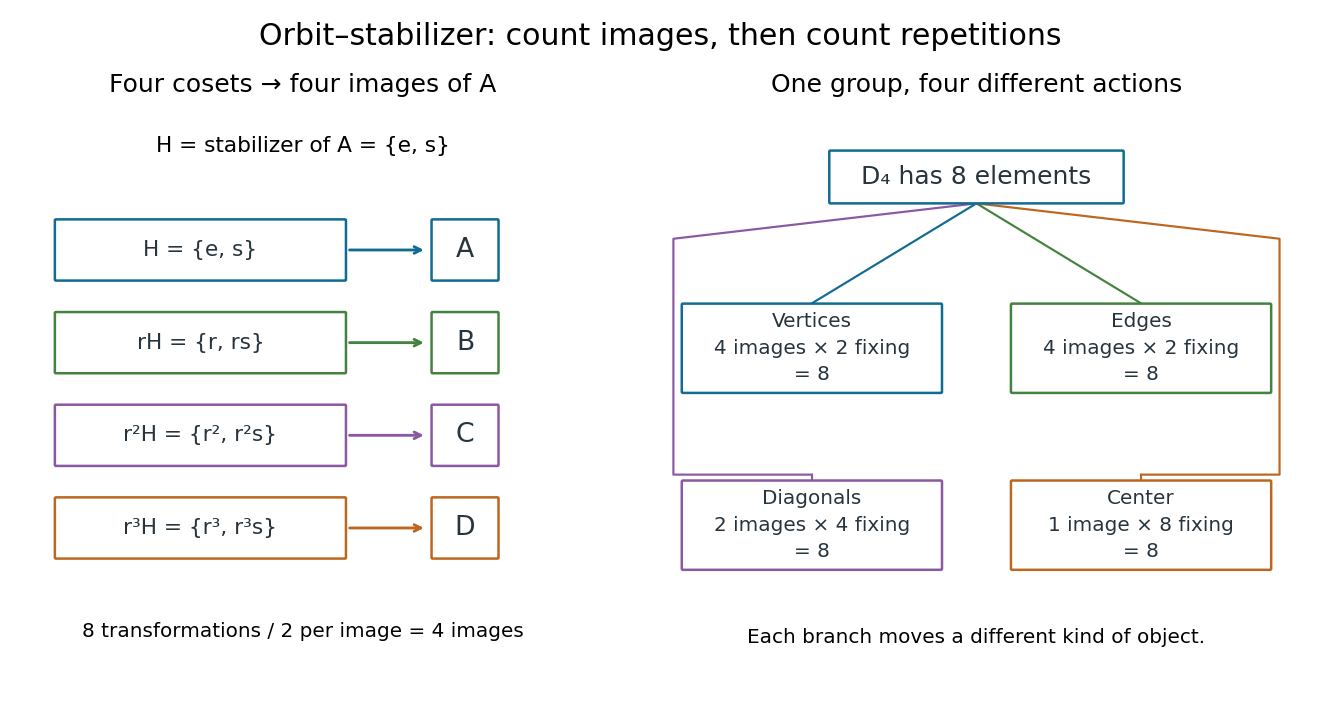
For the square group actions defined under group action, direct calculation givesThe reflection fixes and individually. The reflection preserves the unoriented side of a polygon by exchanging its two vertices of a polygon. The half-turn rotation exchanges the two ends of the unoriented diagonal of a polygon while preserving that diagonal of a polygon. Thus fixing a side of a polygon or diagonal of a polygon as an object does not mean fixing every point on it; the latter condition uses a pointwise stabilizer. The four stabilizer subgroups have group orders , matching group orbit sizes through the orbit-stabilizer theorem.
A stabilizer subgroup records the transformations still available after imposing a constraint. Fixing a vertex of a polygon of the square leaves two choices; fixing its centroid leaves all eight. In a faithful group action, a stabilizer subgroup can still contain a nonidentity transformation, as shows: a faithful group action requires that only the identity element fix every point of simultaneously, not that every individual stabilizer subgroup be trivial. The two-point cyclic group example under group action has both stabilizer subgroups equal to the group kernel of its associated group homomorphism.
For a group action of on a set , form the group homomorphismA faithful group action means that is injective: different group elements induce different permutations of . Equivalently, its group kernel is trivial:Here is the stabilizer subgroup of , and is the identity element.[ref]
Group Actions by Keith Conrad. Theorem 1.7, printed page 3, and Definition 2.17, printed page 9: actions as homomorphisms and faithfulness
The test is global. A faithful group action requires each nonidentity group element to move at least one point; a free group action requires it to move every point. In the faithful coset action of the symmetric group on three letters, fixes one coset and exchanges the other two. Thus a nontrivial stabilizer subgroup does not rule out faithfulness. The distinction follows directly from the order of the quantifiers:On a nonempty set, a free group action is therefore a faithful group action. A transitive group action instead asks whether every point can reach every other; it allows several group elements to perform exactly the same rearrangement. The nonfaithful coset action of the symmetric group on three letters is a counterexample to the claim that every transitive group action is a faithful group action.
For a short proof of the group kernel criterion, exactly when is the identity permutation, or . If , this forces ; if contains a nonidentity element, that element and act identically. Thus a faithful group action turns into an actual subgroup of a symmetric group, retaining its group operation as function composition. Choosing a suitable coset action can give a much smaller set of labels than the regular group action used in Cayley's theorem.
The full isometry group of a cube has order . Its transitive actions on the vertices, edges, and main diagonals have stabilizers isomorphic respectively toThe action on main diagonals has kernel .
For a group action of any group on a set , the cardinality of the orbit of a group action through is the index of a subgroup of its stabilizer subgroup:In particular, if is a finite group,For a fixed finite group, a larger stabilizer subgroup means a smaller group orbit: more transformations repeat the same image of . The set itself need not be finite.
The underlying bijection uses left cosets, without requiring to be a normal subgroup:To check it briefly, replacing by with preserves , so is well-defined. Every member of the group orbit has this form. Finally, implies , hence , proving the bijection. This is the construction in MIT's group-action notes, lemma 23.5. For infinite groups, the bijection and the cardinality statement still hold; division of infinite cardinalities does not supply the finite formula.
For the eight-element dihedral group acting on the square described under group action, moving a marked vertex of a polygon gives . Moving a marked side of a polygon also gives ; moving one unoriented diagonal of a polygon gives ; moving the centroid gives . These are four different group actions, each with one group orbit. In the first group action, the four left cosets of areThey correspond respectively to . Counting all eight transformations would count each position of the marked vertex of a polygon twice.

For a second computed example, let the symmetric group act on the Cartesian product by . There are two orbits of a group action:andThe first stabilizer subgroup can exchange and while fixing ; the second must fix both and , so also fixes . The orbit-stabilizer theorem gives and , and the two group orbit sizes account for all nine ordered pairs. The general reason for exactly these two group orbits is equality-pattern orbits of ordered pairs.
A subgroup is a subset of a group that is itself a group under the same group operation. It must contain the identity element of and be closed under products and inverse elements. Associativity is inherited from , so it needs no new proof. The whole group and the trivial group are always subgroups. A proper subgroup satisfies .
A useful single-condition test isTo see why it works, choose ; then . Taking gives every inverse element . Applying the test to and then gives . Conversely, every subgroup satisfies the test by closure under products and inverse elements. This also makes the additive version memorable: a nonempty subset of an additive group is a subgroup exactly when it is closed under differences. See McKernan's MIT lecture 2, Proposition 2.3, for the equivalent closure criterion.
For the square dihedral group above, is a cyclic subgroup: products add exponents modulo four, and . The smaller collections and are subgroups of group order two. But is not a subgroup, since lies outside it. A plausible-looking list of symmetries therefore need not constitute a complete collection of reversible operations.
Inside , the even numbers form a subgroup: is an even number. Its two cosets consist of the even numbers and the odd numbers, so its index of a subgroup is two. The parity group homomorphism has as its kernel of a group homomorphism. A subgroup can thus identify exactly which information a composition-preserving map forgets.
Subgroups also describe residual symmetry. In the group action of on the four vertices, the stabilizer subgroup of is : the diagonal reflection fixes that vertex, and the other six motions move it. Requiring a feature to stay fixed still leaves a group, because both composition and reversal preserve that requirement. This is why subgroups are useful for studying a group action one feature at a time.
A finite additive group is a finite group whose operation is written as addition. Its identity element is denoted , the inverse element of is denoted , and translation is a bijection.
An abelian group is a group whose group operation is commutative: for every . Thus rearranging a finite sequence of operations preserves the result. Associativity already permits changing parentheses; commutativity additionally permits exchanging the elements.
The additive integers, the additive real numbers, and every cyclic group are abelian groups. Additive notation is often convenient: the identity element is written , the inverse element of is , and . It does not force an element to be an ordinary number: in , an element is a pair of binary coordinates, added componentwise modulo two.
Commutativity is useful because an integer linear combination of chosen group elements depends only on their coefficients, rather than on the order in which the operations were performed. The Fundamental theorem of finitely generated abelian groups turns this simplicity into a classification by cyclic groups. However, commutativity does not imply that a single generator of a group suffices: the Klein four-group is the smallest counterexample, as the cyclic group of order four and Klein four-group demonstrate.
A cyclic group is a group that can be generated by repeating a single group element and its inverse element:For an additive group, the same expression is written : means repeated addition, including subtraction when is negative. A finite cyclic group has a repeating cycle, while an infinite cyclic group is isomorphic to the additive integers. The notation refers to a finite cyclic group of order .
This definition compresses a whole composition rule into one repeatable operation. Once is chosen, , so working with group elements becomes working with integer exponents. In the finite case those exponents are reduced using modular arithmetic. It also proves that every cyclic group is an abelian group, because . A finite cyclic group of order has exactly solutions of for every positive integer divisor of : in exponents, has exactly solutions modulo . The standard finite and infinite models are described in Group Theory (v4.01) by James S. Milne (section 1.16).
Left and right multiplication by a fixed group element are bijections, called left and right translations.
Both translations are bijections because the inverse element gives the inverse multiplication operation.
A group operation is the associative binary operation of a group. It has an identity element, and every element has an inverse element.
An inverse element of in a monoid is an element satisfying , where is the identity element. Its notation is . Some elements of a monoid can lack an inverse element; a group requires one for every element. Associativity makes a two-sided inverse element unique: if both invert , then .
For the full transformation monoid, a self-map has an inverse element exactly when it is a bijection; that element is its inverse function. On , the swap is its own inverse element, while a constant function has none because it merges the two inputs.
An identity element for a binary operation satisfies for every element of the underlying set. It is a two-sided identity: merely satisfying one of the two equations is insufficient. It is unique when it exists, since two candidates satisfy . This uniqueness does not require the associative property.
Zero is the identity element for addition of integers, one for multiplication of integers, and the identity function for function composition of self-maps. The empty word is the identity element for concatenation. An associative operation with an identity element makes a monoid; inverse elements are an additional requirement for a group.
A nontrivial group has more than one element.
There are unlisted articles, also show them or only show them.