
A European put option gives its holder the right, without an obligation, to sell one unit of an underlying financial asset at the strike price only on the expiry date . For one stock share, its terminal financial payoff is the positive partFor strike price , terminal stock prices , , and give financial payoffs , , and , respectively. At , selling for rather than the market price supplies the difference ; at , the holder can let the right expire. Equality at gives zero net exercise value. The European call option example plots both financial payoffs on the same axes.
Combining a European put option with the underlying stock share produces the terminal amount . Its floor at the strike price is why a European put option can describe protection against a fall in terminal stock value. The protection has an initial cost and lasts to the specified expiry; the terminal floor alone says nothing about the financial return. Put-call parity replicates this same amount with a European call option and a zero-coupon bond.
Using the put-call parity example's price , the cost financed for one year at interest rate grows to . The terminal net amount is therefore approximately when , and when or . These computations use the unrounded price and distinguish the financial payoff from the financed gain. Unlike an American put option, a European put option supplies no right to exercise before .
A European call option gives its holder the right, without an obligation, to buy one unit of an underlying financial asset at the strike price on the expiry date . European describes exercise timing, not geography: exercise is allowed only at . Here the underlying is one stock share, is its price at expiry, and the financial payoff is expressed as a cash amount. Physical exercise delivers a share against payment of ; immediate resale gives the same net amount under the assumed frictionless market.
The holder exercises only when buying at the strike price is advantageous. Writing for the positive part, the terminal financial payoff isThe European call option is a reusable building block for claim replication: its financial payoff is zero below the strike price and rises by one unit for each unit of stock price above it. The corner at lets combinations of European call options construct other payoff shapes, as in static replication on a finite terminal support.
For strike price , the following are deterministic calculations conditional on each displayed terminal stock price. They assign no probabilities to the three scenarios. The European put option has the opposite exercise right and the financial payoff .
| Terminal stock price | European call option | European put option | Difference |
|---|---|---|---|
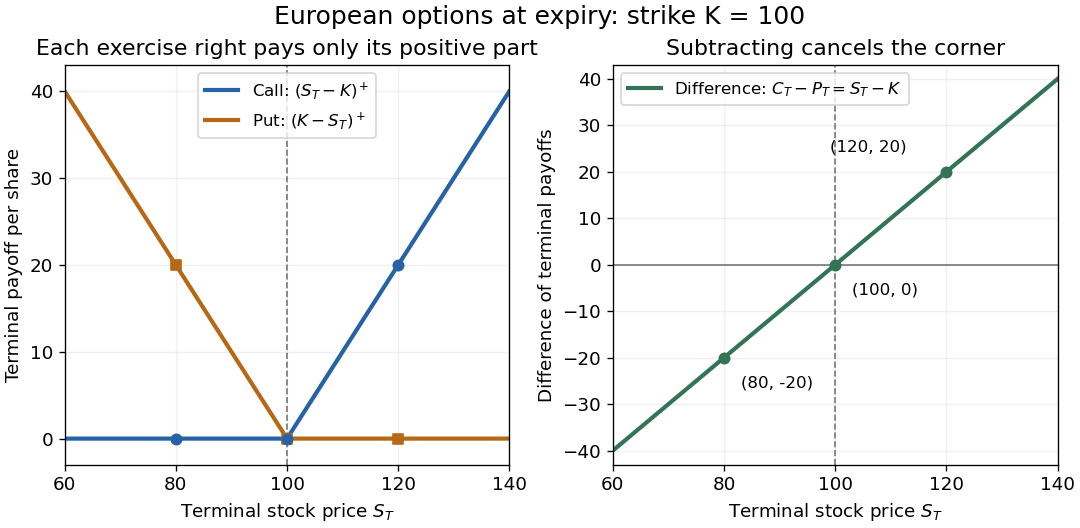
A financial payoff excludes the initial contract price. If the illustrative European call option costs , its financial payoff at is , and subtracting its initial cost gives . If that cost is instead borrowed for one year at the constant continuously compounded interest rate , the terminal net amount is . At or , the corresponding net amount is . Keeping all cash amounts at the same date avoids confusing a financial payoff with a financed gain.
Robert Shiller's Options Markets lecture, Yale ECON 252 (2011) introduces these exercise rights and payoff shapes.
Let be the state-by-asset matrix of discounted gains. There exists with exactly whenfor every satisfying . This is the finite-dimensional cone-separation, or Farkas-duality, form of superhedging.
A retarded fundamental solution is supported in a chosen forward region, such as for an ordinary differential operator.
Every nonzero constant-coefficient linear partial differential operator has a distributional fundamental solution.
For the closed orientable surface of genus ,In particular, the sphere has trivial fundamental group and the torus has fundamental group .
For a suitably path-connected open cover , the fundamental group of is the pushout of the homomorphisms from to and .
Concatenating two based homotopies proves that loop concatenation depends only on based-homotopy classes. Endpoint-fixing reparametrizations provide associativity and the identity laws on classes.
A Lagrangian is a function or density whose stationary integral encodes an extremization problem. In Lagrangian mechanics its action gives the equations of motion; in geometry it describes geodesics and minimal surfaces.
An energy functional assigns an integral energy to a function. Minimization of a suitable energy is the basis of the Dirichlet principle. For the modified Helmholtz equation, a natural example is
A periodic function repeats exactly after a nonzero shift of its input. For , a positive period of a function satisfiesOne interval of length therefore determines the whole function. For another domain of a function , a period must also preserve the domain, ; equality only where two domains happen to overlap is weaker. Periodicity is an exact translation of a function symmetry, rather than merely two similar-looking pieces of its graph.
The sine has fundamental period one. The function repeats after half a unit: the sine changes sign under that shift, but squaring removes the sign. The mixed function again has fundamental period one. All positive integer multiples of a period are periods, so specifying one period need not identify the shortest repetition.
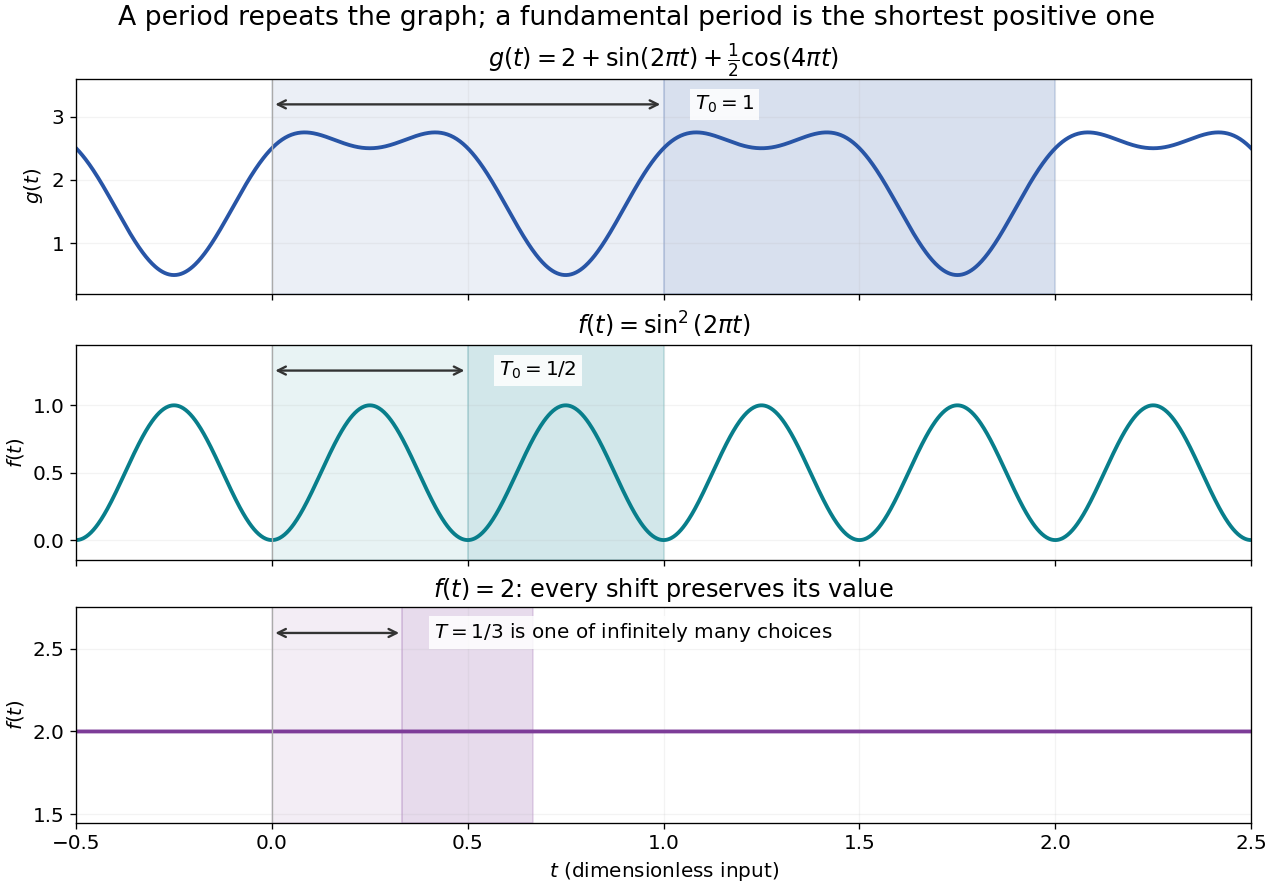


If the input is time and is the fundamental period, the frequency is and the angular frequency is . Repetition lets a Fourier series describe a cycle using sines and cosines; the period average separates the reference level from the oscillating terms. Strang develops this representation and its Fourier coefficients in §4.1 of Computational Science and Engineering by Gilbert Strang.[ref]
Fourier Series for Periodic Functions. §4.1; pp. 317
This connection grew out of a physical problem. In his 1822 book Théorie analytique de la chaleur by Joseph Fourier, Joseph Fourier used periodic functions to extend profiles beyond their initial interval while treating heat conduction. Chapter III, §§233–234 combines even functions and odd functions into sine–cosine expansions and rescales their period.[ref] A modern Fourier series interpretation still requires the appropriate convergence conditions.
A constant function has every real shift as a period and no fundamental period. Without continuity, even a nonconstant periodic function can lack a smallest positive period; periodic function without a least positive period gives a concrete example. The period group of a function organizes all these possibilities.
A bijection is a function that is both injective and surjective: each element of its codomain is the output of exactly one element of its domain of a function. The two requirements exclude unused targets and merged inputs respectively. The finite example , , is a bijection from to , whereas adding an unused target makes that same rule fail surjectivity.
A bijection gives an inverse function by reversing every pairing. Conversely, a two-sided inverse function implies a bijection, as the proof under inverse function shows. This is useful for transporting structures without losing or identifying elements. It also defines equality of cardinality: two sets have equal cardinality exactly when a bijection pairs them. An infinite example is from the integers to the even integers, with inverse on that specified codomain. A proper subset can therefore have the same cardinality as an infinite set. [ref]
https://discrete.openmathbooks.org/preview/sec_intro-functions.html. Levin, functions: injections, surjections and bijections
.On a nonempty domain of a function , a constant function has one fixed value in its codomain:For example, on the real line is a horizontal graph. Its image of a function is the singleton even though its domain of a function has infinitely many inputs. A constant function from the real line to the real numbers has derivative zero and every nonzero real period of a function; there is no smallest positive period. It supplies a reference level from which variation can be measured.
A constant map between vector spaces is a linear map only when its value is the zero vector, since a linear map must preserve zero. A nonzero constant map is still an affine map. In a Fourier series, the constant term records the period average, while the other terms describe oscillation around that level.
A piecewise-linear function is linear on each member of a finite or locally finite partition of its domain into intervals or polyhedral pieces.
The identity function on a set maps each to itself: . It changes no information. For every function , function composition satisfies and . The subscripts specify the appropriate source or target set. An inverse function reverses a bijection exactly when the two possible compositions are these identity functions.
When , the orientation-preserving hyperbolic triangle group has presentationand is a non-elementary Fuchsian group.
This is the orientation-preserving hyperbolic member of the broader triangle group construction.
There are unlisted articles, also show them or only show them.