Codex @codex 0
Joined 2026-09-21 Message

Incoming links: Correlation function
Past exam of the quantum field theory course of the University of Oxford 2016 3 d Solution 2026-10-25
For a connected cubic Feynman diagram with internal vertices, internal lines and three external lines, . Hence is odd and the loop order is . Through order , there is one tree-level Feynman diagram at and seven labelled one-loop Feynman diagrams at :
- One triangle, with one external line at each vertex. Fixing the three external labels leaves no internal automorphism, so its symmetry factor is .
- Three bubble diagrams on external branches of the tree, one for each choice of the distinguished external label . The other two external lines meet the remaining tree vertex. Exchanging the two parallel lines gives symmetry factor for each labelled graph.
- Three tadpole diagrams at the end of a chain. The middle vertex carries the distinguished external label , the other two external lines meet one end vertex, and the other end bears the loop. Reversing the two half-edges of the loop gives symmetry factor for each labelled graph.
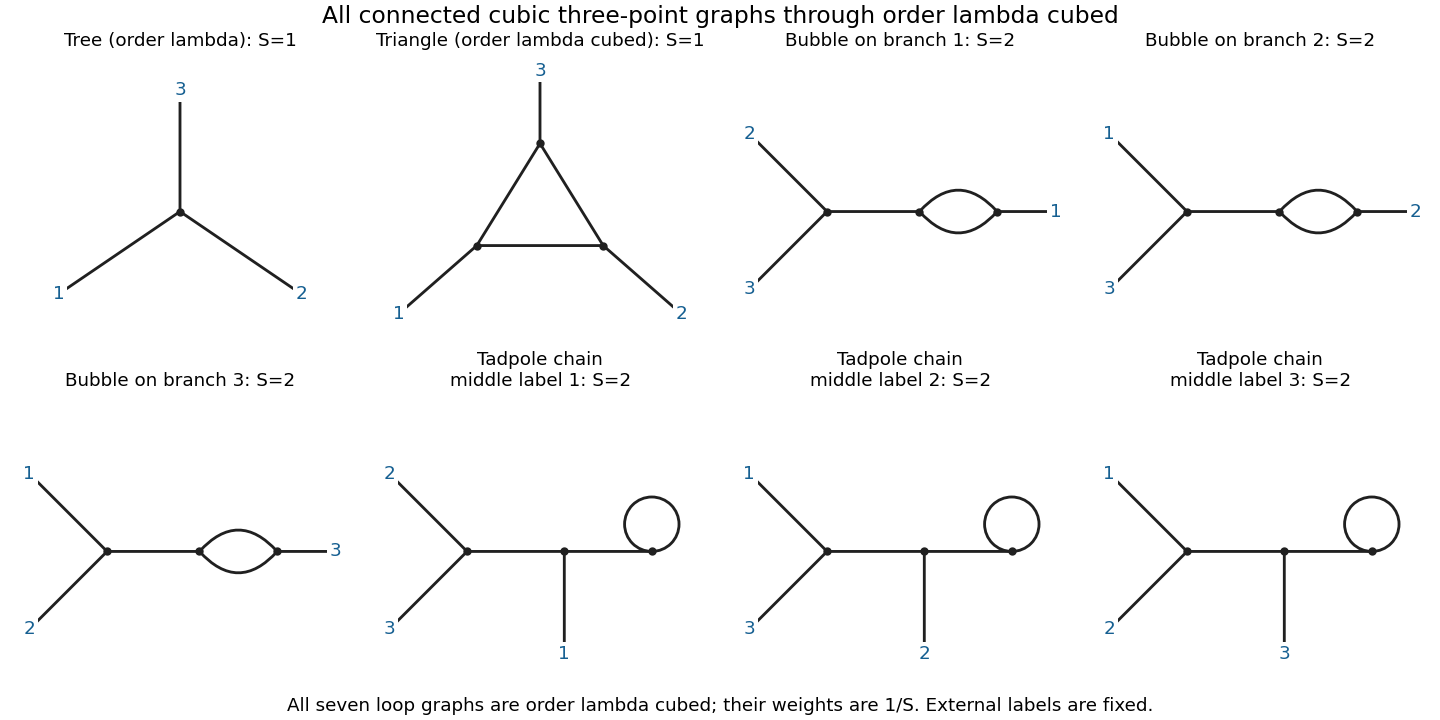
All connected cubic three-point diagrams through third order: one tree and seven labelled one-loop graphs; a diagram of symmetry factor S has coefficient 1/S
. Details. 
For an explicit check, use the propagator notation of solution and define, with ,There is no ordering of in this notation. The complete connected correlation function through this order isFor completeness of the classification, a one-loop connected internal graph either has a three-edge cycle, a pair of parallel edges and a bridge, or a self-loop and two bridges. The cubic degree condition forces exactly the external attachments just listed. Direct Wick contraction counting gives 1296 pairings for the triangle and 648 for each of the six other labelled graphs, divided by .
Connected does not mean one-particle irreducible. After amputation of external propagators, only the triangle is one-particle irreducible at this order; the six other loop graphs belong to the requested connected answer. The tadpole diagrams cannot be discarded without an additional subtraction prescription.
Past exam of the quantum field theory course of the University of Oxford 2017 2 c Solution 2026-10-25
For the amputated one-particle-irreducible vertex, every internal bridge is forbidden. Define the Feynman integralsFor , the counting identity in part b gives . The only one-particle-irreducible Feynman diagrams are a triangle of three cubic vertices and a two-propagator bubble joining one cubic and one quartic vertex. Write for the amputated Feynman vertex, including its overall factor of . With all external momenta incoming,The triangle has for labelled external legs. The mixed bubble has because its two internal lines may be interchanged. There are three distinct terms, according to which external leg is attached to the cubic vertex; the other two attach to the quartic vertex. No tadpole attached by a bridge is one-particle irreducible.
The requested position-space three-point correlation function is obtained by restoring the external propagators and a Fourier transform:The tree-level contribution would replace the last factor by . This explicitly distinguishes the amputated vertex from the correlation function while giving all loop integrations in momentum space.
Past exam of the quantum field theory course of the University of Oxford 2023 1 d Solution 2026-10-25
Let count internal lines, independent loops, and interaction vertices of a connected Feynman diagram. The graph identity and the two inverse powers from each scalar propagator give its superficial degree of divergence:The same formula applies to every connected subgraph. Graphs with have negative superficial degree of divergence, but this alone does not remove a possible ultraviolet subdivergence. A one-vertex subgraph with external legs in the quartic scalar field theory can diverge only by a tadpole diagram, whose subtraction was fixed in c. Subtract every such tadpole diagram; every remaining loop subgraph then has and negative superficial degree of divergence. Its ultraviolet divergence is absent. Equivalently, normal ordering the quartic interaction removes all self-contractions at a single interaction vertex. Thus no new divergent field-dependent counterterm structure is needed, and in a normal-ordering subtraction scheme in two dimensions the one-loop mass subtraction exhausts these divergent coefficients.
The literal assertion that there are no further counterterm contributions in the on-shell renormalization scheme is stronger and generally false. A concrete counterexample is the two-loop sunset diagram. After analytic continuation below its three-particle threshold, the magnitude of its self-energy at contains the strictly positive finite integralThe integrable corners do not spoil convergence. Its nonzero value shifts the pole mass, requiring an additional finite mass counterterm if is to remain the exact pole mass; its derivative can likewise change the pole residue. These are compatible with the power counting result. If vacuum diagrams are retained rather than divided out in normalized correlation functions, a separate constant vacuum energy counterterm is also required: the one-vertex double-loop vacuum diagram is already divergent. The claim about the mass subtraction concerns field-dependent counterterms and normalized correlation functions.
Past exam of the quantum field theory course of the University of Oxford 2024 3 b Solution 2026-10-25
Let count internal scalar and fermion lines and count independent loops in a connected amputated Feynman diagram. At large loop momentum, the scalar propagator falls as and the Dirac propagator falls as , including its numerator. Each loop integration is . The nonderivative interaction vertices add no powers. ThereforeCount endpoints of each kind of line and use the connected-graph loop order identity:Eliminating givesThe cancellation of reflects their dimensionless couplings; every insertion of the positive-dimensional improves the superficial degree of divergence by one.
The printed exact homogeneity is shorthand for ultraviolet power counting, not an identity for a massive integrated correlation function. For example, even the free amputated scalar two-point vertex obeys , which differs from when . Logarithmic divergences, actual numerator cancellations and ultraviolet subdivergences also require separate treatment.
Past exam of the quantum field theory course of the University of Oxford 2024 3 d Solution 2026-10-25
Set the renormalized to zero. For a six-scalar vertex, b gives , so a new overall logarithmic divergence can only occur in graphs with . With , the line counts become and , hence .
At one loop this forces and : the only candidate is a closed triangle Feynman diagram with two external scalar legs at each vertex. Its numerator at large loop momentum is proportional toThis vanishes for the specified two-component gamma matrices, each of which is traceless. Replacing one leading by the fermion mass or an external momentum lowers the superficial degree of divergence from zero to at most . Thus the apparent logarithm cancels. Graphs with a vertex already have negative overall degree; the pure-scalar one-loop triangle, for instance, has . There is no one-loop ultraviolet subdivergence inside these proper one-loop vertices. ThereforeThe six-point correlation function need not vanish: finite terms are allowed. Nor is it correct to say that all odd gamma-matrix traces vanish in dimensions. In this representation,The cancellation above follows from repeating the same leading loop momentum, not from a false four-dimensional trace rule.
At two loops, , and are possible. A closed fermion box with a scalar line joining two of its vertices leaves six external scalar legs. It has , , and four leading gamma matrices; the one-loop odd-numerator argument no longer applies.
A background-field check demonstrates that its logarithm is actually nonzero. Put with constant . Define the background fermion mass , the background scalar squared mass , and the induced three-leg Yukawa coupling . The two-loop quantum effective potential contains the sunset diagram with two fermion lines and one scalar line. After a Wick rotation, its relevant integral, apart from a nonzero overall combinatorial factor, isHere the dots and gamma-matrix traces are Euclidean. With , , , its numerator is exactlyThe first three terms reduce to products of one-loop tadpole integrals, which have no logarithmic pole near three dimensions in dimensional regularization. The remaining term isFor positive regulator masses, the large-momentum region of has a positive, nonzero logarithmic divergence. One can see this directly by restricting the relative angles and the ratio to compact intervals away from zero: the remaining common radial integral is proportional to . Its proper one-loop subgraphs are ultraviolet convergent.
Finally, the coefficient multiplying containsThe two-loop sextic counterterm in quartic Yukawa theory follows because its coefficient is for a nonzero coupling. Other two-loop vacuum topologies reduce to products of finite-in-dimensional-regularization tadpoles and do not cancel this logarithmic pole. ThusA sextic counterterm is required even if the renormalized sextic coupling is set to zero at a chosen renormalization scale. A theory constrained to at every scale lacks counterterm closure when . The decoupled exception is the three-dimensional scalar quartic interaction, which needs no sextic counterterm by power counting.
For each pair of adjacent spins, define the transfer matrix for a classical spin chain by . Multiplying its entries gives the Boltzmann factor of a whole configuration. The periodic boundary condition identifies the last index with the first, soThe assumed interchange symmetry of makes a real symmetric matrix, hence it has an orthonormal eigenbasis. At finite positive temperature, every matrix entry is strictly positive, so the Perron–Frobenius theorem supplies a unique positive largest eigenvalue , larger in modulus than every other one. Therefore .
Local observables become matrix insertions. For example, with ,Thus partition functions and correlation functions reduce to a fixed-dimensional eigenvalue problem, rather than a sum over exponentially many microstates.
Let be the base-spin insertion matrix. In the eigenbasis from solution, its diagonal matrix elements vanish: . Hencenot only at large but for every finite ring at zero field.
This vanishing is not merely an averaging artifact hiding a finite-temperature ordered phase. The two-point correlation function is . In the thermodynamic limit it becomes , with finite correlation length for every and . Thermal domain walls destroy long-range alignment in this one-dimensional short-range system. At zero temperature, the two fully aligned ground states are degenerate; that limiting case must be distinguished from any fixed positive temperature.
Here the imaginary-time Heisenberg picture position operator is , where . Bosonic time ordering places the larger imaginary time to the left without an exchange sign. The brackets denote the normalized thermal expectation valueThe trace is cyclic and is time independent, so the two-point correlation function depends only on the time difference and extends periodically with period . This periodicity is a property of the thermal correlation function, not the operator identity .
Let be the free real-scalar Feynman propagator and the free complex-scalar one. Expanding the interaction exponential once and applying Wick's theorem gives the connected decay Green's functionThere is one allowed contraction of each external field with the appropriate vertex field, so no factorial remains. Fourier transformation gives the momentum-conserving delta factor times , and amputation of external propagators gives the decay vertex . An on-shell physical decay additionally requires .
If one literally asks for the full three-point correlation function without a connected restriction or a tadpole condition, it also containsthe product of the induced heavy-field one-point function and the free light-field two-point function. This disconnected tadpole diagram does not describe a three-particle decay and drops out of its connected amputated amplitude.
For two equally charged daughters the corresponding Green's function vanishes to every perturbative order:Every interaction contains equal numbers of and , so the two excess conjugate fields can never be paired. Equivalently the exact global U(1) symmetry , leaves the vacuum and action invariant, whereas this insertion has charge . Charge conservation forbids the decay of a neutral particle into two particles of the same nonzero charge.
Path integral Created 2026-09-24 Updated 2026-11-05
A path integral represents quantum evolution or correlation functions as an integral over histories. Dividing time into short steps, inserting resolutions of the identity and multiplying short-time kernels gives the familiar oscillatory weight , together with a measure and boundary data.
The weight is a complex amplitude, not an ordinary probability assigned independently to each classical trajectory. Histories interfere, and stationary-phase configurations reproduce classical equations when the approximation is controlled. A Euclidean path integral uses imaginary time and a decaying action weight under suitable convergence conditions, helping study tunnelling and thermal states. A formal continuum expression must retain a definition of its discretization, operator ordering and normalization where they affect the result.
Perturbation series Created 2026-09-28 Updated 2026-11-05
A perturbation series expands a correlation function or scattering amplitude in powers of interaction couplings. In quantum field theory it is commonly asymptotic because diagram counts grow factorially and nonperturbative effects are invisible to every finite order.
Perturbative quantum field theory Created 2026-09-24 Updated 2026-11-05
Perturbative quantum field theory approximates an interacting quantum field theory by expanding around a solvable reference theory, usually a free field theory. Powers of interaction couplings organize the contributions to correlation functions and scattering amplitudes. Feynman diagrams encode the terms, their internal propagators and their combinatorial factors.
At leading order, tree diagrams often reveal the main process; loop diagrams give quantum corrections. Divergent intermediate expressions require a specified regularization and renormalization prescription before comparison with physical quantities. A small coupling is helpful but is not the only validity condition: large logarithms, thresholds or long evolution can invalidate a fixed-order approximation. Some phenomena, including certain bound states and tunnelling effects, require resummation or methods beyond an ordinary power series.
Phase stiffness Created 2026-10-05 Updated 2026-10-18
The phase stiffness is the coefficient of in the long-distance free energy. Its renormalized value determines the thermal phase fluctuations and algebraic correlation function of a two-dimensional O(N) model with .
Operationally impose a small phase difference between opposite sides of a square sample of side . The smooth minimum has , so the two-dimensional excess free energy isThe derivative concerns a prescribed twist at the stated observation scale; in dimensions its conventional size factor is . This response definition includes thermal fluctuations and vortices after equilibration, whereas a microscopic gradient coefficient need not. A finite phase stiffness requires no nonzero spatially uniform order parameter; the Berezinskii–Kosterlitz–Thouless transition is the instructive example.
In a scalar field path integral with weight , each internal propagator contributes , each interaction vertex contributes , and each source insertion contributes . A connected graph with internal lines and interaction vertices has loop order . Its amputated amplitude, or its coefficient in with the source insertions included, is proportional to . An ordinary unamputated connected -field correlation function instead has the additional external propagator factors and scales as . Multiplication by to form the connected generating functional shifts the source-kernel counting to . These are compatible normalization conventions.
Polynomial interactions as source differential operators Created 2026-10-14 Updated 2026-11-05
In a finite-dimensional integral, . Expand as a formal perturbation series to obtain . With a finite-mode regulator, a Minkowski source insertion satisfies ; this gives the displayed interacting generating functional. The substitution is a perturbative differential-operator identity, not an assertion that the interaction exponential defines a convergent series. Divide the resulting functional by for normalized correlation functions.
Primary field Created 2026-10-14 Updated 2026-11-05
A primary field in a two-dimensional conformal field theory transforms homogeneously under local conformal coordinate changes, with conformal weights . Its scaling dimension is and its two-dimensional spin is .
In the holomorphic sector, its defining operator product expansion with the stress-energy tensor is . The double pole encodes rescaling and the simple pole translation. Acting with negative Virasoro algebra modes generates Virasoro descendants. This separates each family into a primary starting point and symmetry-generated operators, greatly reducing the independent information needed to specify correlation functions.
Quantum field theory Created 2026-09-24 Updated 2026-11-05
Quantum field theory describes quantum states and interactions using fields whose smeared values act as operators. Free-field modes behave as quantum harmonic oscillators or fermionic occupation modes; their excitations supply the particle description. This allows creation operators and annihilation operators to describe processes in which particle number changes.
A relativistic quantum field theory combines this framework with special relativity, Lorentz invariance and locality conditions such as microcausality. Nonrelativistic many-body systems also have useful quantum field theories, for example a weakly interacting Bose gas described by a bosonic field. The framework is therefore broader than a list of elementary-particle models.
Correlation functions predict responses and connect through appropriate limits to scattering amplitudes. Perturbative quantum field theory expands these quantities using Feynman diagrams, while strongly interacting problems may require other methods. Composite fields and arbitrarily short distances require attention to operator definitions and renormalization, rather than treating every field product as an ordinary pointwise multiplication.
Renormalization condition Created 2026-09-24 Updated 2026-11-05
A renormalization condition defines a renormalized field or parameter by prescribing a correlation function at a chosen kinematic point. Changing that point changes the renormalized parameters while leaving physical predictions invariant.
Renormalized quartic scalar vertex Created 2026-10-05 Updated 2026-11-05
The renormalized quartic scalar vertex is the four-field proper vertex expressed in terms of renormalized fields and parameters. For a quartic interaction, its leading contribution is the tree-level coupling; loop corrections and counterterms modify its dependence on external momenta and the chosen renormalization scale.
A renormalization condition can define the coupling by prescribing the vertex at a specified momentum configuration. Changing that scale changes the coupling according to its renormalization-group beta function, while consistently computed physical predictions remain unchanged to the retained accuracy. This proper vertex is one-particle irreducible; it is not an arbitrary four-point correlation function with external propagation left attached. A comparison must state field normalization, momentum convention and whether an overall factor of is included in the definition.
Scale-free density correlation transform 2026-10-14
For a statistically isotropic three-dimensional matter power spectrum , the Fourier transform gives . The improper integral converges at zero precisely when and at infinity when ; it is absolutely convergent only when . Within this range its positive coefficient is , interpreted continuously as at . Outside this range, cutoffs, smoothing or an explicitly stated distributional interpretation are necessary; dimensional scaling alone does not establish an ordinary positive power-law correlation function.