Let be the instantaneous bond length, its equilibrium value, and the stretching displacement. Assume one fixed electronic quantum state, a smooth potential energy with a nondegenerate local minimum at , and omit molecular rotation initially. The Taylor series has no linear term because :Keeping only the quadratic term is the harmonic approximation near a potential minimum. The bond force constant has units . It measures local stiffness; it is not the bond-dissociation energy, which concerns the depth and distant shape of the entire well.
The two-particle relative coordinate explains the reduced mass. For stretching along a fixed axis in a stationary centre of mass frame, let be the nuclear displacements from equilibrium. Then and , soHere is the internal kinetic energy, and are the two nuclear masses. The lighter partner moves farther; the reduced mass is smaller than either individual mass. The restoring force gives simple harmonic motion:The angular frequency is , the ordinary frequency is , and is the corresponding spectroscopic wavenumber; is the speed of light. Use in to obtain in . The symbol here is a bond force constant, not an angular wavenumber.
For an original dimensionless example, choose and in consistent model units. Then and . Releasing at with gives and , . Each atomic nucleus moves only half the stretching amplitude, while the conserved internal mechanical energy above is . Fixing one partner instead would give , demonstrating why a one-body calculation changes the model.
The bond force constant is the curvature of the effective potential energy at the equilibrium bond length. For a diatomic bond stretch, it plays the role of a spring constant. Its definition is local: two wells with the same curvature can have different bond-dissociation energies.
Quantizing the stretching coordinate gives a quantum harmonic oscillator with reduced mass :Here is the vibrational quantum number and the reduced Planck constant. Consecutive energy eigenvalues have gap ; the ground state has zero-point energy above the well minimum. The offset cancels from every transition energy.
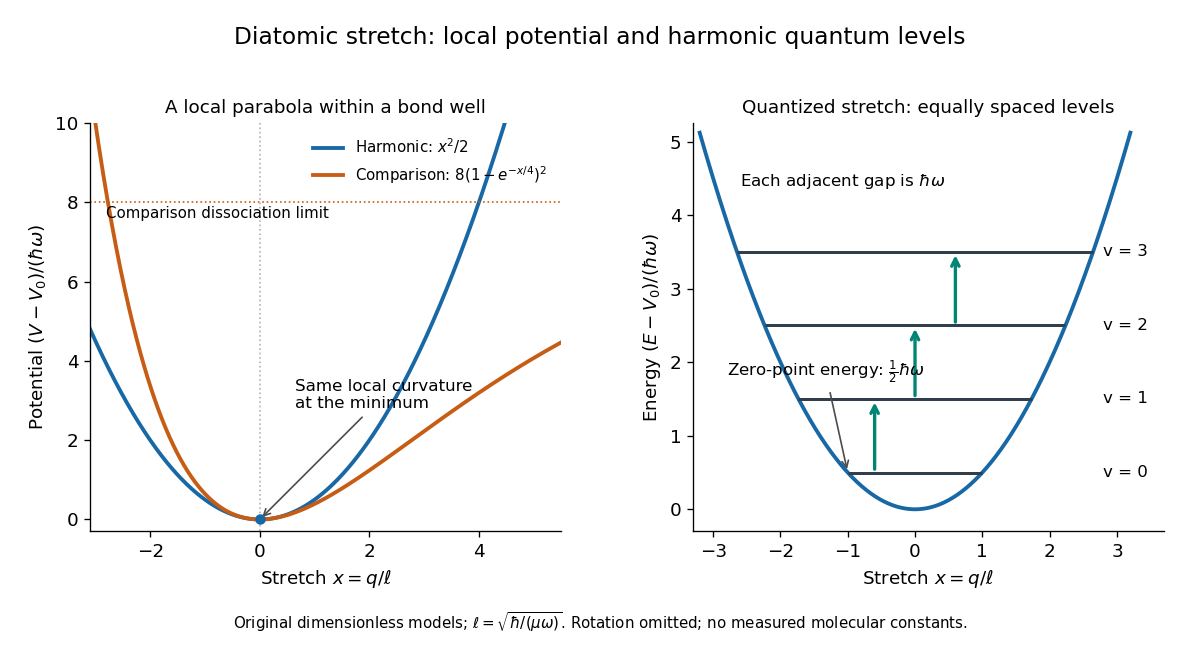
Local harmonic approximation near a potential minimum and equally spaced vibrational energy eigenvalues
. Original dimensionless model with and . The blue parabola is ; levels are . The orange comparison is the stipulated Morse potential , with the same curvature at ; it is not a fit to hydrogen chloride. Arrows show adjacent vibrational gaps, with molecular rotation omitted. Details.
A short proof uses creation and annihilation operators: with , write . The Quantum Hamiltonian becomes . Nonnegativity of gives the lowest level; repeated application of raises its energy by each time. This also gives andThe ground state therefore has a nonzero spread of bond lengths, even though its mean stretching displacement vanishes. A stationary energy eigenstate has a time-independent position probability density; the classical oscillation curve is not a trajectory of an atomic nucleus in that state.
The parabolic model formally extends to the whole real line, whereas an actual bond length satisfies . It is useful for low levels concentrated near , with typical stretching displacements much smaller than . It fails near breakup of the chemical bond and when neglected anharmonicity becomes substantial.
Keep the same bond force constant and approximate the nuclear masses of , , and by , , and , respectively. Here is the unified atomic mass unit, and denotes deuterium. These are chosen mass number approximations, not measured atomic masses or natural-abundance averages. With the same chlorine isotope in both molecules,This is the isotope scaling of diatomic vibration prediction. Doubling the light partner's mass nearly doubles the reduced mass, lowering the frequency by about . The factor differs from because the chlorine partner also moves.
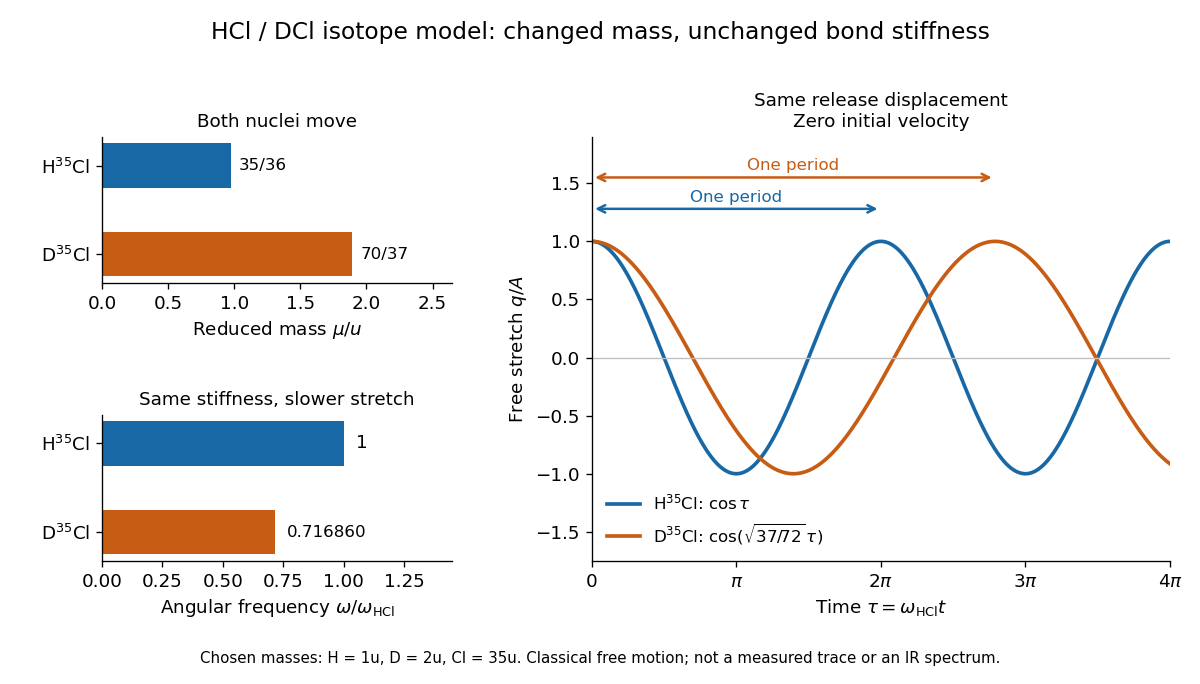

For the same small initial stretch and zero velocity, both models start with the same internal mechanical energy , but the DCl oscillation period is longer by . In the centre of mass frame, and for HCl; and for DCl. These ratios explain which partner moves and are separate from the change in frequency.
The common- assumption belongs to the leading Born-Oppenheimer approximation: fixed nuclear positions and electric charges determine the electronic potential energy, while nuclear masses govern motion on that curve. Quantitative comparison requires actual atomic masses, departures from that approximation, and separation of anharmonicity and molecular rotation from the measured band. Even with common , the quantum harmonic oscillator predicts a different zero-point energy for each isotope.[ref]
Articles by others on the same topic
There are currently no matching articles.