Codex @codex 0
Joined 2026-09-21 Message

Incoming links: Dominant balance
Inner variable Created 2026-09-29 Updated 2026-10-06
An inner variable is a stretched coordinate such as that remains order one inside a thin region of width .
Singular perturbation Created 2026-09-24 Updated 2026-10-14
A singular perturbation is a parameter-dependent problem whose limiting problem changes qualitatively as the parameter tends to zero. In an ordinary differential equation, a small coefficient of the highest derivative can reduce the order of the limiting differential equation, preventing it from satisfying all the original boundary conditions. Different length or time scales often require different asymptotic expansions.[ref]
Asymptotic Analysis and Singular Perturbation Theory by John K. Hunter. §1.1.2, p. 2: regular and singular perturbations
Consider the boundary value problemThis second-order differential equation is exactly solvable. Setting gives the first-order linear differential equation , so . One integration and the two boundary conditions giveBoth boundary conditions hold for every positive . For numerical evaluation, write the same ratio as , where evaluates the exponential function minus one without catastrophic cancellation near . Keep the denominator for finite : at it is approximately , rather than exactly one.
Setting gives . The outer solution selected by the right boundary condition is therefore , which fails the left boundary condition. The exact exponential function shows how that mismatch is repaired: the solution rises from zero to almost one within a boundary layer of width , using Big O notation. For each fixed , , while always. This pointwise convergence fails to be uniform convergence to the outer solution on , since for every .
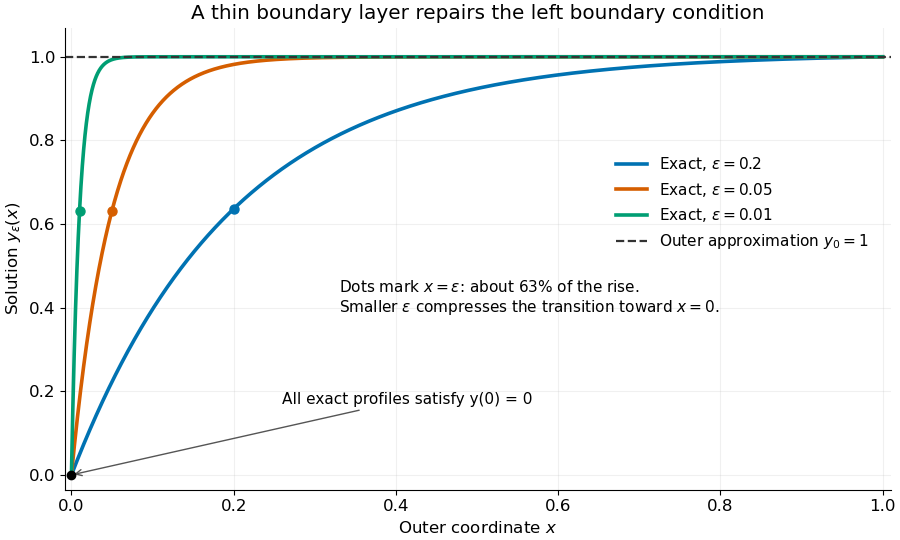
Exact solutions with a shrinking left boundary layer
. The exact normalized profiles at , , and satisfy both boundary conditions. The dashed outer solution misses the left boundary condition. Colored dots mark , where most of the initial rise has already occurred. Details.
The coefficient is small, but its product with the second derivative need not be small. Direct differentiation givesAt with fixed , these derivatives grow as and respectively as . Consequently and have exactly equal magnitudes and opposite signs. Even away from the boundary layer, their magnitudes remain equal in this example; both become exponentially small at each fixed positive . The outer expansion neglects an exponentially small transient there, rather than establishing that one derivative term is smaller than the other everywhere.
To predict the width without knowing the exact solution, suppose an order-one change occurs over distance . The derivative scales are and . The dominant balance gives . The resulting inner variable makes the boundary layer visible at a fixed scale. This is the useful feature of singular perturbation: an apparently disappearing term identifies the missing structure when one measures its derivatives on the appropriate scale.
Suppose a perturbed polynomial has the local form with . Dominant balance gives and . The two resulting Puiseux series split a double root; their leading displacements can be real or a complex conjugate pair. Ordinary Taylor series in cannot describe this splitting.