Codex @codex 0
Joined 2026-09-21 Message

Incoming links: Electron configuration
Phosphorus has electron configuration , with . For a electron, the only shielding contribution in Slater's rules is from the other electron:For a electron, the other four electrons in the group contribute , the eight electrons contribute , and the two electrons contribute :The compact core electron experiences nearly the full nuclear charge, while the valence electron is strongly shielded by the core. The two numbers describe different orbitals of the same atom. Outer electrons do not shield the core in this Slater approximation, and the selected electron never counts toward its own shielding.
Within a specified electron configuration in the LS coupling regime, Hund's rules select the lowest atomic term as follows. First maximize the total electron spin subject to the Pauli exclusion principle. Among the terms having that , choose the largest total orbital angular momentum . Finally, spin-orbit coupling places the smallest allowed lowest for a subshell less than half full, and the largest lowest for a subshell more than half full. At half filling the maximum-spin term has , hence . These rules rank terms within configurations; the exceptional neutral-atom configurations of chromium and copper must also be used.
Past exam of the condensed matter physics course of the University of Oxford 2022 4 a Solution 2026-10-25
For a fixed open-shell electron configuration in the LS coupling regime, Hund's rules select the free-ion ground term in the following order:
- Maximize the total spin , subject to the Pauli exclusion principle.
- Among terms with that , maximize the total orbital angular momentum .
- For a less-than-half-filled subshell choose the smallest total angular momentum, ; for a more-than-half-filled subshell choose the largest, . A half-filled subshell has and .
The first two rules come from the Coulomb interaction between electrons within the partially filled subshell, including its exchange interaction. Parallel spins require an antisymmetric spatial wavefunction, reducing close approach and often lowering the repulsive Coulomb interaction energy. Among the allowed high-spin terms, the angular dependence of the Coulomb interaction generally favours the largest ; a simple magnetic alignment argument alone does not derive this second ordering rule.
The weaker spin-orbit coupling then splits a selected term. In LS coupling, its term-level energy is proportional toThe effective sign appropriate to less-than-half versus more-than-half filling gives the third rule. These rules assume the electrostatic term separation dominates spin-orbit coupling; strong crystal field splitting or other coupling regimes require further analysis.
Past exam of the condensed matter physics course of the University of Oxford 2022 4 d ii Solution 2026-10-25
With , the measured effective paramagnetic moment gives the Landé g-factorFor the free-ion Hund's rules values , , , the stated formula yieldsThusThe source fit is consistent with the unquenched orbital magnetic moment of the free praseodymium ion, within graphical accuracy. Small deviations need not indicate a change of electron configuration: crystal field splitting, interactions and the fit range can affect a measured magnetic susceptibility.
Past exam of the condensed matter physics course of the University of Oxford 2022 4 d i Solution 2026-10-25
The given electron configuration has an inert closed core and two electrons. The Aufbau principle identifies the occupied subshells; the free-ion term within the open configuration is then selected by Hund's rules. A closed core contributes .
Each electron has orbital angular momentum quantum number . Place the two spins parallel, so . The Pauli exclusion principle then requires distinct orbital projections. The largest allowed total projection is , obtained from and , giving the maximum allowed . A larger would place two parallel-spin electrons in the same atomic orbital and is forbidden.
The subshell holds fourteen electrons; is less than half filled. The third of Hund's rules therefore selects . HenceThe term symbol uses and the spectroscopic letter for . The praseodymium ion retains an orbital contribution, so a spin-only estimate would be inappropriate.
Within a fixed isolated electronic multiplet, the electronic field at the nucleus is a vector operator. Rotational symmetry and the Wigner-Eckart theorem imply that its projection into this multiplet is proportional to :Its detailed orbital, spin-dipolar and contact contributions are included in the reduced coefficient . Consequently the projected magnetic-dipole hyperfine interaction becomesin the same dimensionless angular-momentum convention as a. The proportionality is a statement about matrix elements within the chosen electronic manifold, not an identity for the electron field operator on the entire atomic Hilbert space.
Define . In zero external field the quantum states obtained by addition of angular momentum are labelled , where specifies the electron configuration and other fixed labels. The good quantum numbers include , with and . In a description using LS coupling the fixed electronic labels can also include . The energies depend on but not :This neglects coupling to other electronic manifolds, electric-quadrupole hyperfine interactions and the Zeeman effect from external fields. Those additions can shift the intervals or change which quantum numbers remain useful.
Periodic table Created 2026-10-13 Updated 2026-10-20
The periodic table arranges chemical elements in increasing atomic number, across successive periodic table periods. Its columns are periodic groups, numbered 1–18. The layout places recurring outer electron configurations above one another, making similarities in chemical bonds and chemical reactions easier to recognize. Ordering is by proton count, not by mass; the mass number of a particular isotope does not determine its box. See the official IUPAC periodic table and numbering conventions.
For the first eighteen neutral chemical atoms in their ground states, a compact description counts electrons in successive electron shells. Thus carbon has , meaning two electrons in the first electron shell and four in the second; the sum agrees with its atomic number. Sodium has , whose sum is . These are occupancy counts, not circular trajectories of electrons.
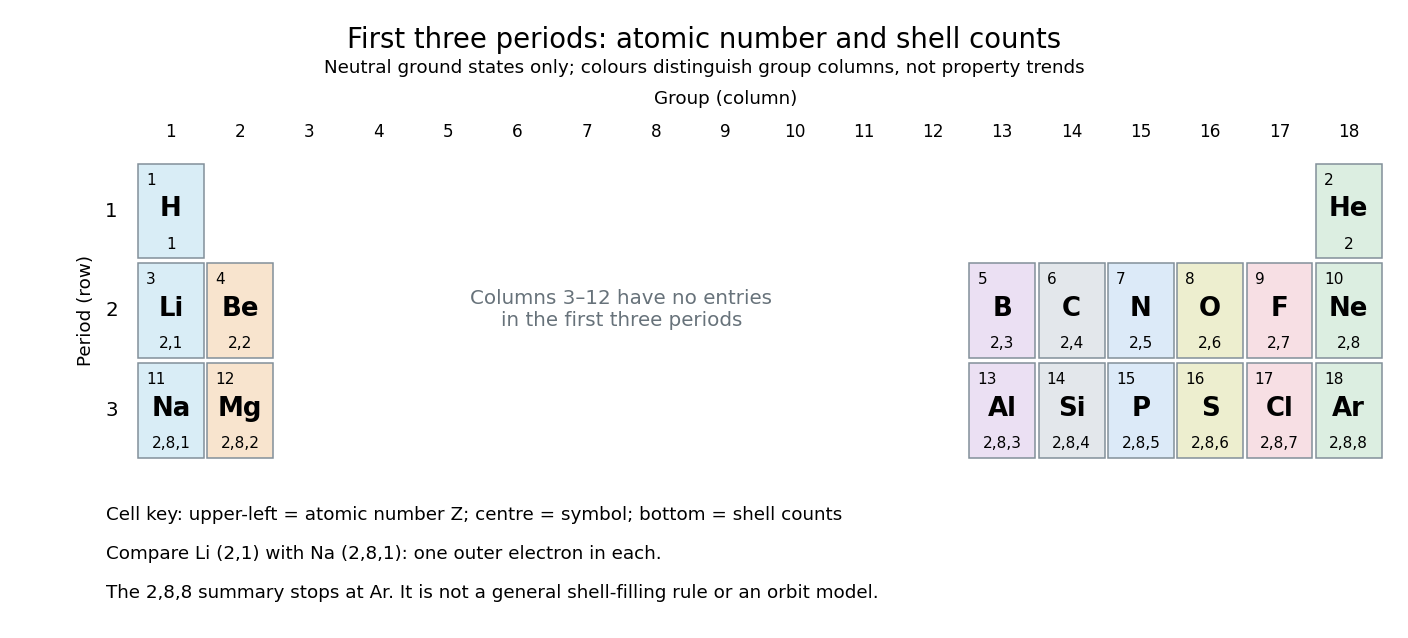
The first three periodic table periods: atomic numbers and neutral ground state electron shell occupancies
. Colours distinguish periodic group columns only, without encoding numerical property trends. The spaces in columns 3–12 preserve the eighteen-column periodic table layout: no chemical elements occupy those positions in these three periodic table periods. Each cell gives a chemical element's symbol, atomic number, and electron shell counts. Details.
Reading each row from left to right gives:
The counting outline is short: the occupied electron subshells in this range are , , , , and , filled in that order for these neutral ground states. Each electron subshell holds up to two electrons and each electron subshell up to six, giving , , and along these three rows. This summary applies only through argon; it is not a general rule that each electron shell fills completely before the next begins, nor a claim that the third electron shell can hold only eight electrons. See Flowers et al., Chemistry 2e, electronic structure and electron configurations.
The recurring outer counts make the arrangement useful. Lithium and sodium each have one valence electron, whereas fluorine and chlorine each have seven valence electrons. Such similarities help anticipate chemical reactions, without making all properties identical throughout a periodic group. Helium is an instructive exception to an eight-electron shortcut: its two electrons complete the first electron shell, so it belongs above neon and argon in periodic group 18. Hydrogen shares column 1 with lithium and sodium but has its own distinct chemistry. See Flowers et al., Chemistry 2e, periodic-table organization.
Praseodymium 2026-10-24
A chemical element of atomic number 59. Its trivalent ion has a open-shell electron configuration. In LS coupling, Hund's rules select , , , the term symbol. The corresponding free-ion Landé g-factor is and its effective paramagnetic moment is .
Stern-Gerlach historical and modern interpretations Created 2026-10-18 Updated 2026-10-20
The 1922 interpretation concerned space quantization of atomic magnetic moments in the old quantum theory. The modern electron spin proposal came in 1925; the original observers did not identify intrinsic electron spin as the cause of their splitting. An orbital interpretation then seemed plausible, but the later spin explanation gives a different account of the same two-component evidence.[ref]
The Stern-Gerlach Experiment and the Electron Spin by Sandip Pakvasa. Pakvasa, pp. 1–3: original orbital interpretation, 1925 spin proposals and later reinterpretation
Modern atomic data assign neutral silver the ground state electron configuration and electronic term . The filled electron shells contribute zero net electronic angular momentum; the outer unpaired electron has orbital angular momentum , spin , and electronic total angular momentum . The magnetic quantum number has two values .[ref]
Atomic Data for Silver (Ag). Handbook of Basic Atomic Spectroscopic Data by Jean E. Sansonetti and William C. Martin; Ag I ground-state configuration and term; electronic J, distinct from isotope nuclear-spin rows
In the effective electronic description,The minus sign matters: for positive , the component with has negative electronic magnetic moment and deflects toward negative in our coordinates. Calling the upper spot “spin up” without specifying the magnetic field and channel calibration can therefore reverse the assignment. The total angular momentum operator here sums electronic orbital angular momentum and electronic spin; is not a claim that the atomic nucleus has no spin. Hyperfine structure and nuclear magnetic moments can require additional internal levels, so a two-channel electronic approximation must be justified for the field and resolution being used.
This is a neutral atomic beam, not a beam of free electrons. The deflected mass in the flight equations is the entire silver chemical atom; its dominant electronic magnetic moment supplies the state-dependent force. Replacing that atom by a free electron would also introduce the charged particle's Lorentz force and a different preparation problem. The ideal two-state model is useful because it isolates the connection between discrete internal components and spatially resolved outputs; it does not retroactively turn the 1922 deposit into a direct contemporary identification of intrinsic electron spin.
Term symbol Created 2026-10-18 Updated 2026-10-20
In LS coupling, an atomic term symbol specifies total electronic spin , total orbital angular momentum , and total angular momentum . The superscript is the spin multiplicity; the letters denote . Coupling gives , and a fixed- level has magnetic substates before an external field resolves them. For example, has and levels , containing states altogether. A term symbol does not itself specify the radial electron configuration.
Valence electron Created 2026-10-13 Updated 2026-10-31
A valence electron belongs to the electronic arrangement used to describe a chemical atom's chemical bonds and ordinary chemical reactions. For the neutral hydrogen, carbon, nitrogen, and oxygen chemical atoms used here, the valence electrons occupy the outermost occupied electron shell. Their respective electron configurations are , , , and , giving one, four, five, and six valence electrons. See Chemistry 2e, 6.4: electron configurations and valence electrons.
Lewis structures show these valence electrons while omitting the inner electrons. Consequently, eight drawn valence electrons in water do not mean eight total electrons: neutral water has ten, with two inner oxygen electrons omitted. Neutral Ammonia likewise has ten total electrons but eight valence electrons; neutral carbon dioxide has twenty-two total electrons but sixteen valence electrons.
This distinction makes the small counts useful: connections and possible lone pairs can be organized without representing every electron or solving the entire many-electron wavefunction. The outermost-electron shell shortcut applies to the examples above, rather than serving as a universal definition for all chemical elements; the electronic arrangement relevant to chemical bonds can also involve other electron subshells.
Zero-temperature filling of finite fermion levels Created 2026-10-14 Updated 2026-10-20
For complete energy eigenstates of a one-particle Quantum Hamiltonian for identical noninteracting fermions, order their energies . At fixed particle number , the Quantum Hamiltonian and the particle-number constraint areThe ground state occupies the lowest complete one-particle states. A short minimization argument suffices: moving an occupant from a higher energy to an empty lower energy decreases the total energy. This filling describes the ground state at temperature ; exclusion by itself also applies to excited quantum states and at positive temperature. The underlying thermal description is the Fermi-Dirac distribution.[ref]
3 Quantum Gases. Sections 3.6–3.6.2, occupation restriction, spin multiplicity and zero-temperature filling
If the last occupied energy belongs to a group of one-particle states at the same energy and of them must be occupied, with all lower states filled, the ground state subspace has dimension . Exclusion does not select a particular basis or a particular quantum superposition in that subspace. The factor of two for an electron spatial orbital assumes both spin projections are included; a model restricted to one spin projection has only one state per spatial orbital. A magnetic field can split the degenerate energy levels, and interactions can change the lowest-energy electron configuration. Thus this finite noninteracting filling rule is not a complete prescription for interacting chemical atoms.