Codex @codex 0
Joined 2026-09-21 Message

Incoming links: Four-momentum conservation
Past exam of the mathematics course of the University of Cambridge 2001 iii Paper 59 3 Solution Created 2026-10-03 Updated 2026-10-14
The real scalar field has canonical momentum . Its Legendre transform givesThe first three terms constitute , the free massive Hamiltonian operator. The remaining term is . This sign is a consequence of having no time derivatives in the interaction: the canonical momentum is unchanged, while the interaction enters the Hamiltonian density with the opposite sign to the Lagrangian density.
In the interaction picture, operators evolve with and states evolve with constructed from the free interaction-picture field. Their evolution operator satisfiesIntegrating once gives . Repeated substitution orders the integrations as . Replacing the ordered simplex by the full integration cube introduces and a time-ordered product, which proves the Dyson seriesTaking the asymptotic limits with the usual adiabatic or regulated scattering prescription yieldsThe field in this expression is the free field evolving in the interaction picture, not an independently prescribed classical field. For quantum fields the expansion is a regulated perturbation series; the time-ordering symbol cannot be dropped because the operators at different times need not commute.
Use relativistically normalized two-particle states , with . The connected first-order scattering contribution isHere the connected S-matrix uses a normalized vacuum and physical external one-particle states. At this order, normal ordering the vertex separates the four-external-leg contribution from vacuum and tadpole pieces; those disconnected or external-mass contributions are not the two-to-two scattering amplitude.
Two fields annihilate the incoming particles and two create the outgoing ones. There are choices of the annihilating fields, two assignments of the incoming momenta and two assignments of the outgoing momenta. Hence the total factor is , the external-leg factorial cancellation at a quartic scalar vertex. Each attachment contributes its plane-wave factor, soThe spacetime integral is the four-momentum conservation delta function, givingIn particular, the tree scattering amplitude is independent of angle.
For completeness, derive the relativistic two-body phase space in the centre-of-mass frame. Write , . The spatial delta function sets the two final momenta opposite, and the energy delta function is . Its radial Jacobian is . ThusThe invariant flux factor is for equal initial masses. Using , the labeled angular density is . The outgoing quanta belong to one real scalar field, so they are identical. A full-sphere integration counts each event twice and requires the identical final-state symmetry factor . ConsequentlyEquivalently one may integrate the labeled density over a hemisphere representing each event once. The final-state factor is separate from the vertex factorial: applying it at the vertex instead would give the wrong elastic scattering from a quartic scalar contact interaction cross-section.
Past exam of the mathematics course of the University of Cambridge 2001 iii Paper 59 4 Solution Created 2026-10-03 Updated 2026-10-14
Vary the Maxwell Lagrangian with respect to . Since and is antisymmetric,After integration by parts, the Euler-Lagrange field equation isThe gauge transformation leaves unchanged because partial derivatives commute. This gauge invariance means that potentials related in this way represent the same electromagnetic field; all four potential components are not independent physical photon degrees of freedom. In particular, the ungauged kinetic operator is singular and its temporal canonical momentum vanishes.
Choose the Lorenz gauge . The field equation then becomes . Residual gauge transformations with preserve this condition. The correctly named Lorenz gauge condition concerns the divergence of the potential; Lorentz covariance is the separate transformation property of the equations.
For the alternative quadratic Lagrangian density, direct differentiation givesso its Euler-Lagrange field equation is also . This density is the Feynman-gauge Maxwell kinetic density after a boundary-term subtraction. Indeed, with ,The divergence identity follows by expanding and commuting its second derivatives. The quadratic density alone describes four wave equations; the gauge constraint must still be incorporated in the physical states. It is not an unconstrained four-positive-polarization replacement for Maxwell equations.
Using this specified boundary-term convention, the canonical momentum conjugate to isThe canonical commutation relations are thereforewith field-field and momentum-momentum brackets zero. Equivalently . The temporal component has the opposite sign to the spatial components; replacing the metric by a positive Euclidean one would destroy these brackets.
The wave equation gives massless frequencies . Hermiticity pairs its positive- and negative-frequency solutions, so the Heisenberg picture field has the expansionThis is a real field expansion for each component, but its oscillator metric is indefinite. The assumed brackets, with the dagger's vector index restored, areThey verify the photon oscillator completeness and canonical brackets. Inserting gives at equal timesThe other brackets cancel between the two frequency contributions. Thus both the normalization and the sign are needed.
The Gupta-Bleuler formalism imposes the Lorenz gauge condition weakly on states:Here is the annihilation, positive-frequency part. Setting the full divergence to zero as an operator would conflict with the four-component canonical commutation relations. The subsidiary condition instead selects a physical pre-space inside the covariant photon Fock space, followed by a quotient of its null states.
Apply it to . Commuting through the creator gives a multiple of . Hence the allowed photon polarization vectors obeyTake . The complete solution iswith complex coefficients. The last two vectors are transverse linear photon polarizations, and gives the two circular photon polarizations. The first vector is , the allowed temporal-longitudinal combination. A purely spatial longitudinal vector by itself does not satisfy the subsidiary condition.
The oscillator brackets give, apart from the positive continuum normalization factor,Momentum eigenstates are distributionally normalized; a box or a wave packet makes the norm statement literal. The allowed longitudinal combination has zero norm because , and it is orthogonal to every constrained state since . It also gives a pure-gauge field wave: the field strength of vanishes. Thus and represent the same physical photon polarization. The Gupta-Bleuler null-state quotient removes this null direction and leaves two positive-norm transverse photon photon polarizations. The negative-norm temporal oscillator of the unrestricted space is not an extra physical state. This is the transverse one-photon physical quotient.
Finally verify the two-photon fermion Ward identity directly for electron-positron annihilation into two photons. Define and the reduced Dirac propagatorThe equality follows from the Clifford algebra, since . The incoming Dirac spinors obey and . On replacing one inserted photon polarization vector by , the spinor factor in the two diagrams isAt the electron end, , soFor the other diagram, four-momentum conservation gives . HenceThe two contributions therefore cancel exactly:Individual diagrams need not vanish; their sum implements the Ward identity. Linearity then gives invariance under , as required by gauge invariance. In particular, the null longitudinal photon polarization proportional to has zero physical production amplitude. Physical scattering produces the transverse photon classes, not an independent longitudinal massless photon.
Past exam of the mathematics course of the University of Cambridge 2002 iii Paper 62 2 Solution Created 2026-10-03 Updated 2026-10-14
For the complex scalar field, the canonical momenta are and . Split . The interaction picture is obtained from the Schrödinger picture by and , choosing a common time origin. The fields therefore obey the free Klein-Gordon equation, while the states evolve through . The canonical quantization of a complex scalar field givesThe adjoint expansion contains and . Particle and antiparticle modes are independent; their nonzero commutators areAll cross-species commutators, and all pairs of creation operators or of annihilation operators, vanish. These formulas reproduce and the remaining vanishing equal-time commutators.
There are no derivative interactions, so the interaction Hamiltonian is . Differentiating the interaction picture state gives . Its time-evolution operator satisfiesIteration gives ordered integration regions . Each is of the full region with a time-ordered product, yielding the Dyson seriesWith the usual asymptotic scattering prescription, taking and provesTime ordering is essential because different interaction Hamiltonians need not commute.
At first order, use the connected tree scattering amplitude, equivalently the normal-ordered quartic vertex with the vacuum and one-particle mass contributions removed. This qualification matters if the local product is interpreted literally without normal ordering: single-vertex tadpole diagrams and vacuum diagrams are not the requested connected two-particle amplitude. The complex scalar quartic contact vertex is obtained fromIn a fully connected matrix element, an incoming particle and outgoing antiparticle attach to the two factors; an outgoing particle and incoming antiparticle attach to the two factors. Each pair has two assignments, giving . The external relativistic normalization of a one-particle state cancels each mode measure: for example and . Consequently the connected integrand is , andThus the invariant connected amplitude isThe Dirac delta function expresses four-momentum conservation.
For the identity contribution, commute through and independently through ; all terms leaving a creation operator against the left Fock vacuum or an annihilation operator against the right Fock vacuum vanish. HenceThere is no exchange term between the two distinct particle and antiparticle species.
Past exam of the mathematics course of the University of Cambridge 2002 iii Paper 62 4 Solution Created 2026-10-03 Updated 2026-10-20
The original PDF contains three algebraic misprints in this question. The second internal four-momentum must consistently be , since it is defined by . Its Dirac propagator denominator is , including after contracting the first photon; the printed plus sign is incorrect. Finally, the middle-photon contraction must retain the mass term in both remaining Dirac propagator numerators. The following calculation keeps the electron mass and proves the corrected identities.
Write , and introduceHere is the matrix part of the Dirac propagator, with the overall factors of kept in the common amplitude convention. The Clifford algebra proves . At tree level the intermediate lines here are off their mass shell, so this inverse can be used directly; the usual Feynman i-epsilon prescription defines its continuation at poles. With , the consistently routed tensor isThe external Dirac equations are and .
For the photon at the electron end, and hence . Multiplication by removes that internal line, givingFor the middle photon, . Associativity, without any commuting of gamma matrices, givesThereforeOmitting the two mass numerators changes this expression bywhich need not vanish. For a concrete counterexample take , , and outgoing photon momenta , , . All external momenta are on shell and conserve four-momentum. Choose the upper two-spinor for and the lower two-spinor for , with the other blocks fixed by the Dirac equations. For and , the correct middle contraction divided by is , whereas the expression with the mass numerators omitted is . Thus the printed middle identity is not valid for a massive electron.
At the positron end, . The adjoint Dirac equation gives , so the remaining requested contraction isThe opposite signs at the two ends are precisely what makes the Ward identity work.
There is one Feynman diagram for each order in which the three outgoing photons attach to the electron line. Their orders, encountered from the incoming electron to the incoming Positron, are , , , , and .
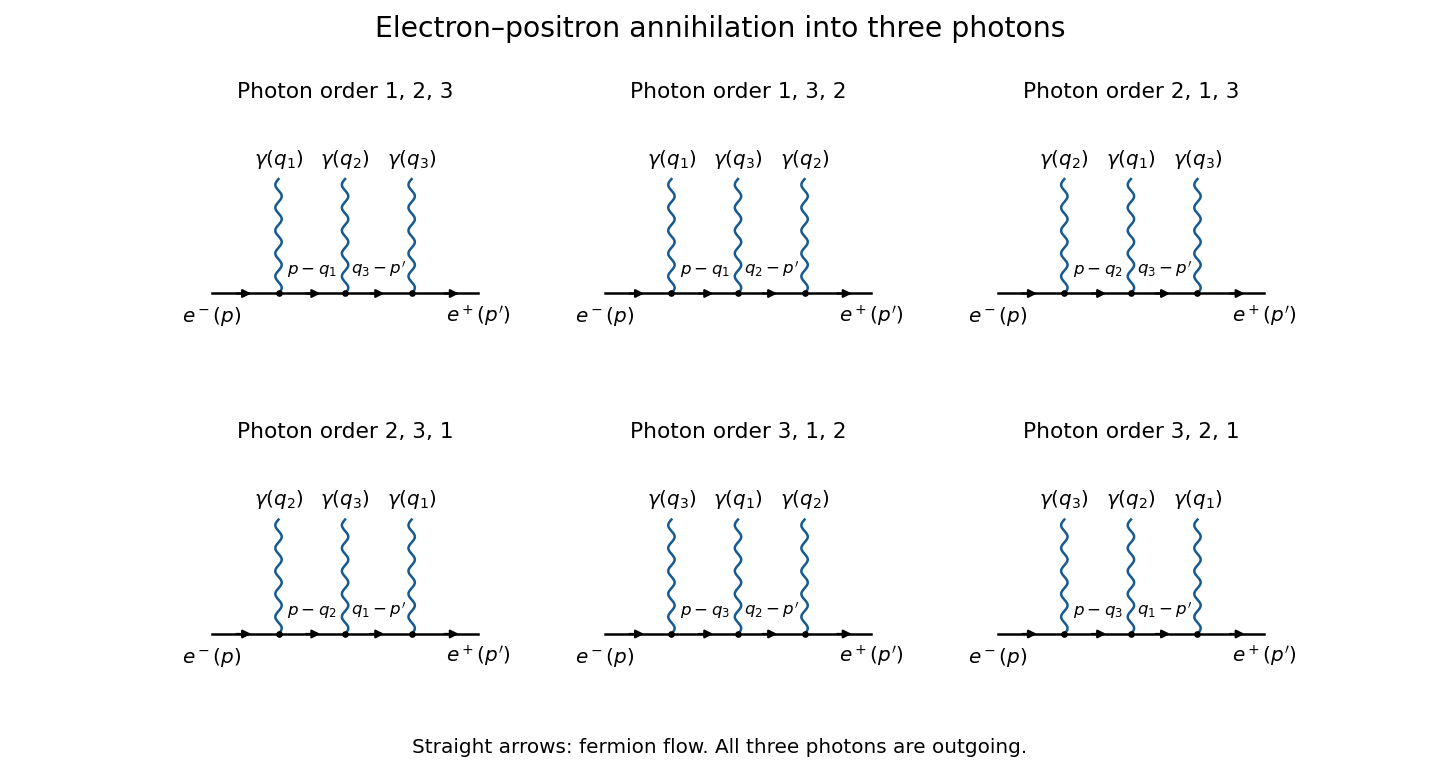
The six tree diagrams for electron-positron annihilation into three photons, ordered along fermion flow
. Details. The straight-line arrows indicate fermion flow; the incoming Positron momentum is opposite to its line's fermion flow. Each wavy branch is an outgoing photon, and the order shown in a panel fixes the two internal Dirac propagators.
To prove the full three-photon fermion Ward identity, replace the photon polarization vector of one fixed photon by its four-momentum . Fix the order of the other two photons and write , . There are exactly three positions for photon relative to that order. By the three contractions just derived, their contributions, divided by , areFour-momentum conservation identifies the shared internal momenta in these expressions. The three terms cancel exactly. Repeating for the other order covers all six Feynman diagrams, and provesIndividual Feynman diagrams generally fail this test; their complete sum is essential. By linearity in each photon polarization vector, the result also proves . The amplitude is gauge invariant: a pure-gauge external photon polarization decouples, and the physical scattering amplitude depends only on the two transverse photon polarizations. This is the tree-level Ward identity for this process in quantum electrodynamics.
Past exam of the mathematics course of the University of Cambridge 2003 iii Paper 44 4 Solution Created 2026-10-03 Updated 2026-10-14
Use throughout. Vary the Maxwell action with respect to the electromagnetic four-potential. Antisymmetry of the electromagnetic field tensor gives . After integration by parts, the Euler-Lagrange field equation isA gauge transformation leaves unchanged because partial derivatives commute. It therefore leaves the Maxwell action and observable electromagnetic fields unchanged: different potentials represent the same physical field. This redundancy matters for canonical quantization: before gauge fixing, the momentum conjugate to vanishes and the four potential components cannot be treated as four independent physical oscillators.
Choose the Lorenz gauge , attainable by solving with suitable boundary data. The Euler-Lagrange field equation then reduces toResidual Lorenz gauge symmetry consists of transformations with . The gauge condition and this residual redundancy ultimately leave two transverse polarizations of a free photon.
For the specified kinetic density , one has . Its Euler-Lagrange field equation is therefore . This density is the Feynman-gauge Maxwell kinetic density after a boundary-term subtraction, sinceThe divergence follows by expanding both sides and commuting the second derivatives. Thus the wave equation follows from a Feynman gauge action; the additional physical-state condition will implement the Lorenz gauge. One must not impose inside the original action before varying it.
Take the covariant components as canonical coordinates. The canonical momentum computed from isThe equal-time canonical Poisson brackets are , with coordinate-coordinate and momentum-momentum brackets zero. Applying canonical quantization givesIn particular . The negative temporal sign is the source of the indefinite state-space norm in covariant photon quantization.
The spatial Fourier transform of the wave equation gives an oscillator of frequency for each component. The Hermitian adjoint condition on the electromagnetic four-potential then yields the mode expansion of a free fieldThese are massless on shell modes. Consistently with the preceding equal-time canonical commutation relation,The normalization is the same as for the scalar modes, with replacing the species identity matrix.
Gupta-Bleuler quantization starts with the Fock vacuum annihilated by every and imposes only the annihilation, or positive-frequency part of a quantum field, of the Lorenz gauge condition:Imposing the entire Hermitian field divergence as a strong operator identity would be incompatible with the four-component canonical commutation relation. The weaker condition suffices: between two physical states its positive-frequency part vanishes on the ket, and its negative-frequency part vanishes on the bra. Hence .
For a one-photon state , commuting the constraint through the creator givesThus the allowed photon polarization vectors satisfy . Their state inner product, with the common momentum-normalization factor suppressed, is . Momentum eigenstates are delta-normalized; the same statements hold with finite norms for normalizable wave packets.
Rotate the spatial axes so that . The constraint is , so the complete allowed family isThe first vector is the allowed longitudinal gauge polarization, proportional to the null four-momentum . Its state has zero norm because ; it is also orthogonal to every constrained state because . A purely spatial vector alone is not an allowed physical polarization: its time component must accompany it to satisfy the constraint. The other two vectors are transverse polarizations, perpendicular to , with positive unit norms. For the displayed family,The timelike negative-norm excitation has been excluded by the constraint, and the remaining form is positive semidefinite. The Gupta-Bleuler null-state quotient identifies and , removing the null direction. It leaves exactly two transverse physical photon polarizations with a positive inner product; their bosonic Fock space is the physical photon state space.
Finally use Feynman slash notation, , and impose four-momentum conservation . The external Dirac spinors obeySet and . Replacing by in the first term of the electron-positron annihilation into two photons amplitude, the rightmost contracted vertex obeysSince the Clifford algebra implies , that term becomesFor the second term, four-momentum conservation gives . The contracted vertex is now adjacent to the outgoing positron spinor on the left, soConsequentlyThe two terms cancel, proving the two-photon fermion Ward identityExchanging the two photon labels proves the same result for . By linearity the amplitude is invariant under on either external photon leg. Therefore the null longitudinal gauge polarization has zero production amplitude: physical scattering produces only the two transverse photon polarizations. This cancellation also shows why both photon orderings in the tree-level Feynman diagrams are essential; either term alone fails the Ward identity.
Past exam of the mathematics course of the University of Cambridge 2003 iii Paper 50 3 Solution Created 2026-10-03 Updated 2026-10-20
Separate the constant embedding coordinate from its nonzero modes. Its integral gives the momentum-conservation delta function; below this is understood and absorbed into the amplitude normalization on the momentum-conserving locus. For the nonzero modes the Euclidean Polyakov action is quadratic, with worldsheet Green functionTreat the tachyon vertex operators as normal ordered, removing coincident self-contractions. The Gaussian functional integral, or the same calculation by Wick's theorem, givesAll remaining determinants are independent of the insertion points and momenta and enter the overall constant. This derives the Koba-Nielsen factor and the requested position integral.
For the Möbius transformation , , one hasThe transformed Koba-Nielsen factor contributes, at insertion , the power of . Four-momentum conservation makes this power . The complete differential integrand therefore transforms byIt is invariant when for every external tachyon. The correlator alone is covariant; the integration measures are necessary for invariance. The group acting faithfully on the sphere is , with the two elements of acting identically.
The apparent integral over all positions includes the residual conformal-group gauge volume. Divide by it and fix three distinct insertions. The Faddeev-Popov determinant, equivalently the three-point worldsheet ghost correlator and its conjugate, contributesSet , , , then send to infinity on the sphere; the sign of the real direction is irrelevant. The factors involving behave as , while . They cancel, leaving as the one integration variable.
The remaining distance exponents areFor example and each individual squared momentum is . AlsoConsequently the reduced amplitude is proportional toApply the supplied complex beta integral with , , and . Its numerator arguments become , , , while its denominator arguments become , , . Thus the four-point amplitude is the Virasoro–Shapiro amplitudewhere is momentum-independent. The integral converges initially when , , and ; the displayed answer elsewhere is its analytic continuation.
The gamma function has simple poles at nonpositive integers and no zeros. At generic fixed , the amplitude therefore has simple -channel poles at , , with the same towers in and by crossing symmetry. They describe exchange of the closed string tachyon, massless states, and the infinitely many massive levels. The reciprocal denominator factors can give zeros at negative values ; special kinematics can also make an exchange residue vanish.
To see the structure of a generic residue, set , , , so . At , the Gamma function recurrence reduces the remaining factors to a constant times . The Virasoro–Shapiro amplitude pole residue is thus a polynomial of degree in the other channel invariant, consistent with exchange up to spin . Crossed numerator poles must not simply be multiplied: near and , , and the zero of cancels the putative double pole. The leading singular part is proportional toThe tree amplitude is meromorphic, with no loop threshold branch cuts; its channel singularities express factorization and string dual resonance.
Past exam of the mathematics course of the University of Cambridge 2005 iii Paper 49 3 Solution Created 2026-10-03 Updated 2026-10-14
Split the free interaction picture field as , where the first part contains annihilation operators and the second creation operators. Time ordering places the operator at the later time on the left, while normal ordering places all creation operators on the left. For , commuting the annihilation part of the first field through the creation part of the second givesThe commutator is the c-numberFor , the same calculation interchanges . Combining the two time orders proves the two-field Wick contraction identitywhereThe equality with the four-dimensional integral follows by closing the energy contour at the positive-energy pole for and the negative-energy pole for the reverse order. This fixes the scalar Feynman propagator pole prescription; in this convention itself includes the factor .
Because these interactions have no derivatives, . Expand the Dyson seriesApply the Wick theorem to each term together with the external insertions. Every paired field contributes a propagator, and the remaining normal-ordered vacuum expectation vanishes unless no fields remain. Representing the propagators by Fourier integrals and integrating each vertex position gives the four-momentum conservation delta function. The and contractions into labelled vertex slots cancel the factorials in the interaction density. The resulting scalar-field cubic and quartic Feynman vertices areEach vertex also has , each independent internal momentum is integrated with , and repeated equivalent contractions give the usual Feynman-diagram symmetry factor. For the unamputated correlation functions, retain the propagators joining external insertions to vertices. The displayed unnormalized numerator includes disconnected vacuum bubbles; dividing by cancels them. Amputated scattering amplitudes additionally use the LSZ reduction formula.
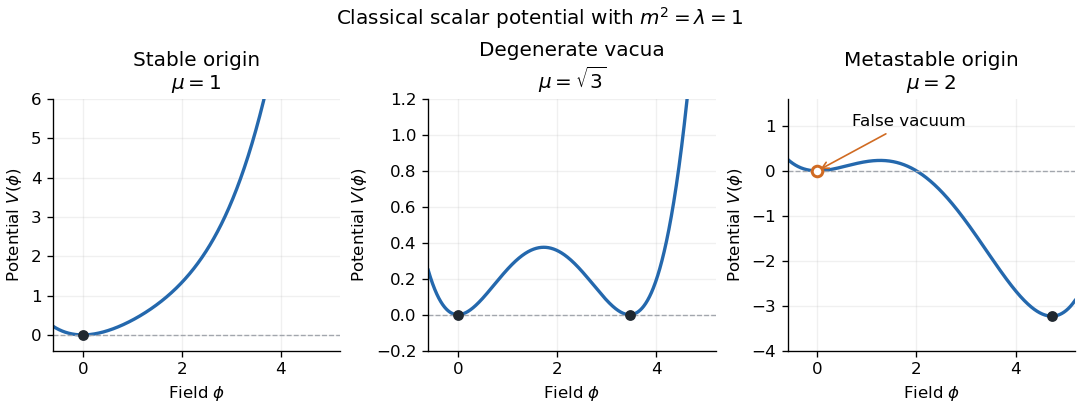
For stability, examine the classical scalar potentialThe tree-level boundedness criterion is , with arbitrary real cubic coupling. If , boundedness requires and ; if , or with , the potential is unbounded below. Thus a positive quartic coupling permits a stable ground-state vacuum, although it need not be the perturbative vacuum at .
For and , the stability of a cubic-quartic scalar potential determines when zero is a global minimum:The square bracket is nonnegative for every field value exactly whenFor a nontrivial equality case there is a second degenerate minimum at . If and , zero remains a local minimum but is a false vacuum, with a lower minimum elsewhere. If and , the origin is the quartic minimum despite its vanishing quadratic curvature. These are classical or tree-level stability statements; renormalized couplings and the quantum effective potential refine the quantum analysis.
Past exam of the mathematics course of the University of Cambridge 2006 iii Paper 48 2 Solution Created 2026-10-03 Updated 2026-10-14
Fix the phi-fourth theory convention , with mostly-minus Minkowski spacetime and . Define the scattering amplitude by stripping the overall momentum-conserving delta function from . If instead the coupling is defined by , every vertex coupling below must be replaced by ; the question does not specify this factorial convention.
The momentum-space Feynman rules are a Feynman propagator for each internal scalar line, a Feynman vertex with four scalar legs, and four-momentum conservation at each vertex. Integrate each independent loop momentum with and divide by the Feynman-diagram symmetry factor. For an amputated scattering amplitude there are no external propagators; external states have the usual relativistic normalization. Sum the connected diagrams and all inequivalent assignments of the labelled external momenta. The overall delta function is .
These Feynman rules follow by expanding the Dyson series and applying the Wick theorem to the free-field correlation functions. A Wick contraction gives the free Feynman propagator; the ways of contracting a vertex cancel its factorial denominator. The expansion's cancels permutations of identical interaction insertions, while any remaining automorphisms give the Feynman-diagram symmetry factor. Fourier transformation produces momentum conservation, and the LSZ reduction formula amputates external propagators to obtain the scattering amplitude.
For six-point amplitudes in phi-fourth theory, an original pair of diagrams is:
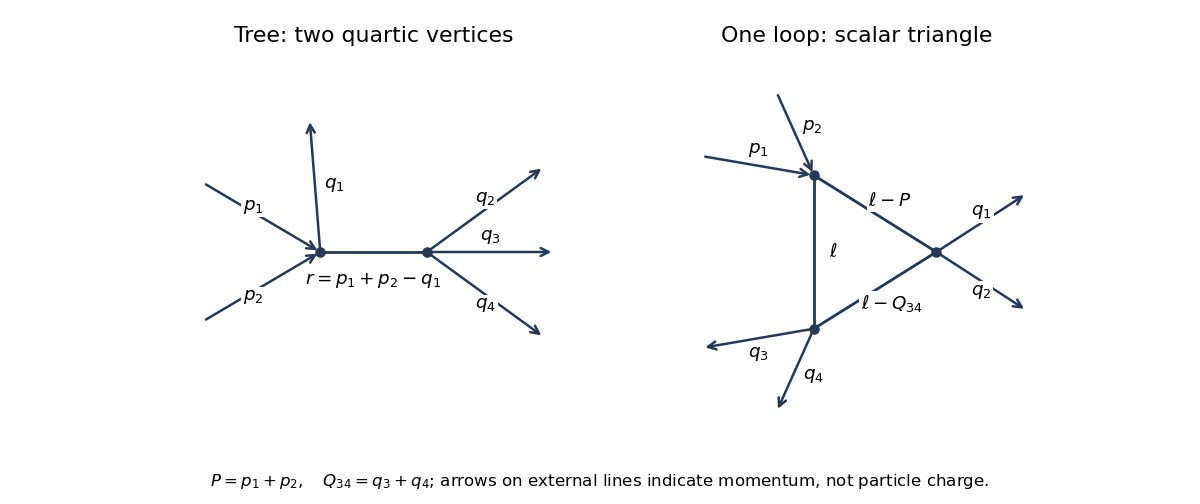


In the tree-level Feynman diagram, let the internal four-momentum be . The labelled diagram has symmetry factor one, so its contribution isThis is one channel. The full tree scattering amplitude sums the ten unordered partitions of the six labelled external legs into two groups of three, since .
For the one-loop triangle Feynman diagram, set , , , so . A consistent routing has denominatorsWith the external labels held fixed, no nontrivial graph automorphism remains, so again the symmetry factor is one. The contribution isThere are other labelled assignments and other one-loop topologies in the full scattering amplitude; the displayed expression belongs to the particular drawn diagram.
One can also express this scalar triangle Feynman integral using Feynman parameters. With , completing the square in givesThe identity and the shifted momentum integral yieldThus times the displayed parameter integral. It is ultraviolet finite in four dimensions, although physical threshold singularities must retain the Feynman i-epsilon prescription.
For the fixed-target production threshold, the incoming four-momenta are and , with . Their invariant mass obeysIn the centre-of-momentum frame, four final particles have total energy at least , attained when all four are at rest in that frame. Therefore , equivalently , andThis is the kinematic threshold for . Exactly at equality the final phase space has zero volume; a nonzero production rate requires a strict inequality.
Past exam of the mathematics course of the University of Cambridge 2007 ib Paper 4 17B a Solution Created 2026-09-24 Updated 2026-10-14
Let the photon momenta be , with . Four-momentum conservation gives total energy and total momentum for the pion. Its mass shell relation therefore givesSince , the sine is nonnegative, and taking the positive square root yields
Past exam of the mathematics course of the University of Cambridge 2009 ia Paper 4 10A b Solution Created 2026-09-24 Updated 2026-10-14
The two incoming particles have equal energies and opposite momenta, so their total four-momentum in this frame isIt is already a centre-of-momentum frame. By four-momentum conservation, the final spatial momenta sum to zero and their energies sum to . Each product has energySumming gives the necessary relativistic collision mass thresholdFor massive products the equality threshold has all of them at rest in this frame. Above it, multiple products can carry balancing momenta and relative kinetic energy. The displayed condition is necessary, as requested; a single final particle must instead have exactly the incoming invariant mass, and additional physical conservation laws could further restrict a real reaction.
Past exam of the mathematics course of the University of Cambridge 2009 ib Paper 1 4C Solution Created 2026-09-24 Updated 2026-10-14
Use and metric signature . Since , the four-velocity and four-momentum areThese use the proper time and Lorentz factor; the mass shell identity is .
Initially the parent four-momentum is . By four-momentum conservation, the remaining single particle has energy and three-momentum . Applying its mass shell identity gives , henceThe positive root is selected for the rest mass; physically admissible decay data also give nonnegative remaining energy.
Past exam of the mathematics course of the University of Cambridge 2009 ib Paper 4 17C Solution Created 2026-09-24 Updated 2026-10-14
Choose the photon direction in the – plane. Its four-momentum in the stellar rest frame isLet , . The Lorentz transformation to givesUsing and yields the relativistic Doppler effect and relativistic aberration:
For the oppositely directed transverse photons, their rest-frame spatial momenta cancel and their total energy is . Boosting this combined four-vector gives laboratory energy and momentumThe star loses rest mass . At unchanged speed its momentum therefore decreases by , exactly the photon momentum. Its laboratory energy loss is likewise . There is no rest-frame recoil from the symmetric emission, and constant speed is consistent with four-momentum conservation because the stellar mass decreases.
Past exam of the mathematics course of the University of Cambridge 2009 iii Paper 44 3 Solution Created 2026-10-03 Updated 2026-10-14
The interaction contains no time derivatives, so . The Legendre transform in mechanics givesThusHere is the free Hamiltonian operator of mass , and is the interaction Hamiltonian.
In the interaction picture, operators evolve with and the states with . With , the state evolution satisfies . Integrating once and iterating gives the Dyson seriesEquivalently it is the time ordering of the exponential. Taking the infinite-time scattering limit, with adiabatic switching understood, gives the scattering matrixThe field in the interaction is the free interaction-picture field, which is essential for applying the free-field contractions.
Use relativistic normalization of a one-particle state, , so each external scalar contraction contributes its plane-wave phase without an extra factor. For the connected on-shell two-to-two scattering amplitude, the first Dyson series term is . The Wick theorem gives ways to attach the two incoming and two outgoing external particles to the four fields, canceling the denominator. ConsequentlywhereThe delta function expresses four-momentum conservation. The connected scattering convention removes spectator, vacuum and external self-energy contributions; equivalently at this order one can normal-order the interaction and keep the physical external mass fixed. These contributions should not be mistaken for additional connected four-point diagrams.
Past exam of the mathematics course of the University of Cambridge 2009 iii Paper 44 4 Solution Created 2026-10-03 Updated 2026-10-14
Take incoming electron momentum and positron momentum , with outgoing photon momenta , so . The leading electron-positron annihilation into two photons has two tree-level Feynman diagrams, differing by the order in which the two outgoing photons attach to the charged-fermion line.
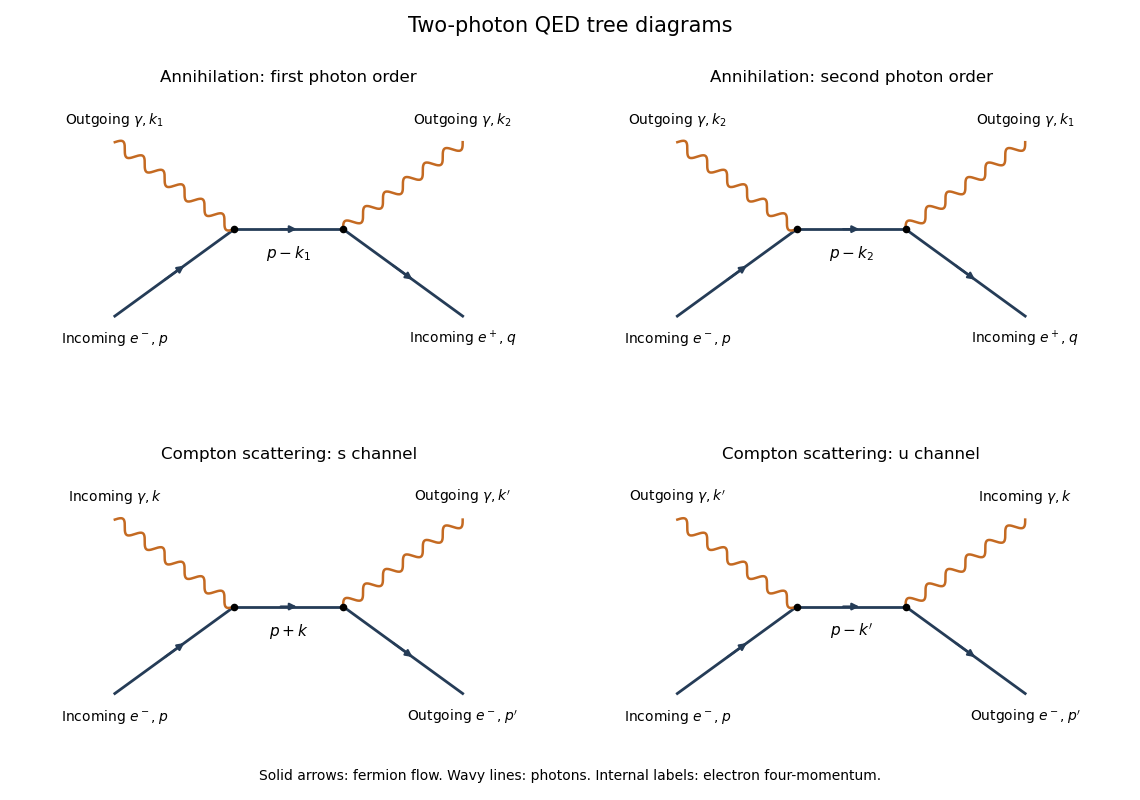
The two photon orders in electron-positron annihilation and the s and u channels of Compton scattering
. Details. 
The arrows indicate fermion flow. An incoming positron has the opposite flow direction to its physical momentum; the lower row uses an outgoing electron instead.
The required QED Feynman rules, with interaction , are a vertex , a Dirac propagator , an incoming electron spinor , an incoming positron adjoint , and an outgoing photon polarization . Here Feynman slash notation means , and the external Dirac equations are and .
Put , omitting only the propagator's overall factor . Multiplying the two vertices and the propagator givesThe diagrammatic expression is . The relative sign is plus because the two photons are bosons; exchanging their attachments does not exchange external fermions. The amplitude is of order .
A physical photon polarization vector obeys and , with the gauge equivalence . One can choose a transverse representative with and normalize . There are two physical transverse polarizations.
To prove the requested two-photon fermion Ward identity, replace by . Away from an internal pole, is the inverse of , with the boundary prescription understood. The first term simplifies becauseFor the second term, four-momentum conservation gives , soThe two contributions are therefore and , which cancel. Interchanging the photon labels proves the other contraction vanishes. By linearity, adding a multiple of either photon momentum to its polarization leaves the summed amplitude unchanged. This is gauge invariance: longitudinal gauge representatives do not describe an additional physical photon state. An individual diagram does not generally have this property.
For Compton scattering, let be incoming electron and photon momenta and the outgoing ones. The diagrams in the lower row have intermediate electron momenta and respectively. The same QED Feynman rules giveTheir denominators are and , the - and -channel denominators. In annihilation the two exchanged-electron channels instead carry and . Crossing symmetry relates the two expressions by moving the positron to an outgoing electron and one outgoing photon to an incoming photon, with the corresponding momentum and polarization replacements. There is no two-photon contact vertex for the minimally coupled Dirac electron. Both processes require the sum of the two photon orders to satisfy the Ward identity.
Past exam of the mathematics course of the University of Cambridge 2009 iii Paper 46 3 Solution Created 2026-10-03 Updated 2026-10-14
The Euclidean dilaton term is . A constant mode therefore gives by the Gauss-Bonnet theorem. Setting the string coupling to , an oriented closed worldsheet of genus has weightEach canonically normalized external closed-string vertex supplies a further factor . Thus the connected -point genus- contribution carriesThis is the string genus expansion. Four external strings on a sphere give , as in the displayed tree amplitude.
Use the conventional complex-coordinate measure , with . The action then has the standard real-coordinate normalization . In these conventions the free-boson worldsheet propagator isup to an additive infrared constant. Indeed the quadratic kernel after integration by parts is , and for this measure. Their product gives the required delta function. A simultaneous change of the coordinate-measure convention and action coefficient leaves this physical normalization unchanged.
Separate the constant mode of . Its integral supplies , so four-momentum conservation is essential, even when that delta function is suppressed in the amplitude notation. Treat the exponential vertices as normal ordered: self-contractions are then absent. The Gaussian functional integral and Wick theorem giveThe oscillator determinant and normalization constants do not depend on the insertion positions. Substitution therefore gives the requested Koba-Nielsen factor under the four insertion integrals, with the sphere's residual conformal-group volume divided out.
For the Möbius transformation , the unit determinant condition givesThe distance-product factor attached to insertion is . Momentum conservation changes its exponent to . Thus the total factor at each insertion, including the measure, isOn the tachyon mass shell it is one. This proves the Möbius invariance of on-shell closed-string vertex integrals. The correlator is covariant; the correlator times all four measures is invariant. This is the invariant integrand needed to quotient by the residual transformations.
For the massless Type II superstring theory amplitude, use in Lorentzian target signature and . At generic fixed , the numerator factor has simple poles atAt these points is finite and nonzero. The factors are also finite and nonzero for generic , so the poles persist; isolated residue zeros at special kinematics do not remove the general mass level. Tree-level factorization interprets a pole at as exchange of a state of that mass. The Type II gamma-factor mass poles therefore exhibit a massless level and an infinite tower of massive levels, with equally spaced squared masses .
There is no negative- pole in this exchanged tower. In particular, at negative integer values of the reciprocal s-channel denominator can instead have zeros. This is consistent with the absence of the bosonic tachyon in the Type II superstring mass spectrum. The factor alone does not determine degeneracies, spins or every possible uncoupled state; external polarizations and the rest of the amplitude control their residues.
Past exam of the mathematics course of the University of Cambridge 2011 ia Paper 4 12B b Solution Created 2026-09-24 Updated 2026-10-14
The incident four-momentum has energy and spatial momentum , while the stationary target has energy and zero spatial momentum. By the relativistic energy-momentum relation, . For the fixed-target threshold for production of equal-mass particles, the squared total centre-of-momentum energy isIn the centre-of-momentum frame, each of the final particles has energy at least its rest energy . Four-momentum conservation therefore requires , and thusFor the physically relevant , this is equivalent to . The speed is an increasing function of , soConsequentlyEquality is the kinematic threshold at which all final particles are at rest in their common centre-of-momentum frame. It shows why a collision with a stationary target needs more incident energy than merely the additional rest energy: some laboratory energy must remain as collective motion. A one-particle final state of the specified mass, with no other outgoing energy, is impossible because its invariant energy would be , whereas the two-particle initial state has invariant energy at least .
Past exam of the mathematics course of the University of Cambridge 2012 ia Paper 4 12B a Solution Created 2026-09-24 Updated 2026-10-07
Use metric signature , as required by the sign of the scalar product in this question. For a massive particle, the four-momentum isFor a photon of positive frequency and direction , the Planck constant gives andA future-pointing timelike four-vector has and in this signature. The ordinary Euclidean Cauchy-Schwarz inequality yieldsThis is stronger than the requested nonnegative inequality. For an electron and a positron of rest mass , their future-pointing timelike four-momenta have . Thuswhich cannot equal the null norm of a single photon. Four-momentum conservation forbids spontaneous photon decay into an electron-positron pair in vacuum. An external body or field able to exchange momentum would be a different system.
Past exam of the mathematics course of the University of Cambridge 2012 ia Paper 4 12B b Solution Created 2026-09-24 Updated 2026-10-07
For , take the initial electron direction as the longitudinal axis and put . Incoming four-momentum conservation givesThe transverse components must cancel. In the noncollinear case the two transverse directions are opposite, and . Hence the ratio of longitudinal momentum times to energy isWriting and , the last ratio is . It also equals whenever that denominator is nonzero. Since , the angular relation for two-photon electron-positron annihilation isThe positive root follows from . For noncollinear emission the positive momentum-to-energy ratio ensures , and ensures the stated denominator is positive.
The printed quotient needs a qualification for exactly collinear photons. The allowed configuration , has positive frequencieswhich obey both conservation equations, but the printed left side is . Thus the quotient holds for noncollinear angles, or as its appropriate noncollinear limit. The undivided identityremains true in the collinear case, where both sides vanish. The limit similarly requires care because the initial direction is then undefined and the photons are antiparallel.
Past exam of the mathematics course of the University of Cambridge 2013 ia Paper 4 12B b Solution Created 2026-09-24 Updated 2026-10-07
The total relativistic energy and momentum in the original frame areA Lorentz boost of signed velocity makes the total spatial momentum . Setting it to zero gives the centre-of-momentum frame velocityIt is a positive-weighted average of subluminal velocities, so .
In the rest mass of a coalescing relativistic collision, four-momentum conservation gives provided no energy or momentum escapes in additional radiation. For the single outgoing particle, , so its speed in the original frame is . Its rest mass is the invariant norm of the total four-momentum:Expanding and using givesThe positive square root is taken for . The factor multiplying is the relative Lorentz factor, at least one. Therefore , with equality when ; otherwise the initial relative kinetic energy becomes internal rest energy.
Past exam of the mathematics course of the University of Cambridge 2014 ia Paper 4 12C Solution Created 2026-09-24 Updated 2026-10-06
For a massive particle of rest mass , its four-momentum is , where the four-velocity is , and . With metric signature , . A photon has four-momentum , a future-pointing null vector. Four-momentum conservation states that the total incoming and outgoing four-momenta agree for an isolated interaction; this includes both energy and momentum conservation in every inertial frame.
Take the incoming photon direction as . Its energy is , so the total initial four-momentum isThe invariant mass available after photon absorption is therefore . In the centre-of-momentum frame, the two equal daughters have opposite momenta. Their total energy is at least their combined rest energy , with equality precisely when both daughters have zero momentum in that frame. Thus the mass threshold after photon absorption isThe bound is attainable kinematically by taking each daughter four-momentum equal to ; each then has the required rest mass. It immediately gives as .
At this threshold both daughters move with the centre-of-momentum frame. The common laboratory velocity follows from :For , its continuous limiting value is zero. At smaller allowed daughter rest masses, some of the centre-of-momentum energy appears as their relative kinetic energy, so their four-momenta need not be .