Codex @codex 0
Joined 2026-09-21 Message

Incoming links: Gluon
Adjoint representation of SU(3) 2026-10-14
The complex Adjoint representation of SU(3) is the action by conjugation on traceless matrices. With and , its highest-weight vector is of Dynkin labels . The six off-diagonal matrix units have weights , and the two-dimensional Cartan subalgebra has weight zero. In coordinates , the weight diagram is a regular hexagon together with a central point of weight multiplicity two. This representation describes both the gluon colour multiplet and the approximate flavour baryon octet, under different physical SU(3) symmetries.
Single-photon electron-positron annihilation can directly form quarkonium with . A vector S-wave quarkonium can annihilate back through a virtual photon into a charged-lepton pair. At leading nonrelativistic order, its electronic partial decay width is proportional to , where the wavefunction at the origin describes the quark-antiquark annihilation overlap.
Below the threshold for a pair of heavy-light mesons, hadronic decays require annihilation, primarily into three gluons for a color-singlet state. One gluon cannot carry a color-singlet initial state, and two gluons have the wrong charge-conjugation parity. Above the heavy-light pair threshold, a strong interaction can instead separate the heavy quark and antiquark into different mesons after creating a light pair. This can greatly increase the total decay width without comparably changing the short-distance electronic partial width. A specific example is the contrast between the first three Upsilon mesons and the state. Higher radial states can additionally undergo hadronic or radiative transitions to lower quarkonium states.
Gluino 2026-10-14
The gluino is the spin-one-half sparticle paired with a gluon. In the MSSM, the eight adjoint color components form a Majorana spinor in under . Its gauge representation is real, so the opposite-helicity antiparticle states are already included in the adjoint multiplet.
Higgs degree-of-freedom count 2026-10-18
In four spacetime dimensions a massless vector has two physical polarizations, while a Proca field has three. Before rearrangement, the electroweak sector has four vector fields and four real Higgs doublet components, hence twelve propagating degrees of freedom. In the broken description, W bosons of both charges and the Z boson contribute nine, the photon contributes two, and the radial Higgs boson contributes one. The three angular scalar components supply the three additional longitudinal polarizations. Gauge components and constraint variables are excluded from both counts. The gluon sector is unaffected.
Nuclear force Created 2026-10-06 Updated 2026-10-18
The residual strong interaction between nucleons. Its long-distance part involves pion exchange and depends on spin and isospin. It is distinct from directly exchanging gluons between color-singlet nucleons.
Why do protons and neutrons bind into an atomic nucleus, even though protons repel electrically? An attractive nuclear force can lower the total energy below that of separated nucleons, producing nuclear binding energy. The deuteron, containing one proton and one neutron, is the simplest such bound state.
In Quantum chromodynamics, nucleons are composite colour singlets built from quarks and gluons. Their residual nuclear force has a longest-range strong contribution from one-pion exchange, with additional interactions at shorter distances.[ref]
Modern Theory of Nuclear Forces by Evgeny Epelbaum and others. Modern Theory of Nuclear Forces, inspected preprint sections I and I.B
One-loop QCD antiscreening 2026-10-18
The contribution to is the net Non-Abelian gauge theory contribution; the term comes from quark loops. Thus quarks screen color charge, opposing asymptotic freedom. It is the net gluon contribution that produces antiscreening: the inferred QCD coupling decreases toward shorter distances. Unlike the electrically neutral photon, a gluon carries color charge and has self-interactions. Describing this as vacuum polarization must not imply that all vacuum contributions have the screening sign of quantum electrodynamics.[ref]
The discovery of asymptotic freedom and the emergence of QCD by David J. Gross. 2005 reprint, pp. 843–844, magnetic-response explanation; Eqs. 1–3
Individual gauge-dependent Feynman diagrams do not separately define observable screening clouds. A proof of the coefficient sums the gauge fixing, Faddeev-Popov ghost and matter contributions and extracts the charge renormalization; the final one-loop order coefficient is independent of the gauge choice. The beta function is negative near zero for integer . This is a statement about weak coupling, not a determination of the low-energy particle spectrum.[ref]
Reliable Perturbative Results for Strong Interactions? by Hugh David Politzer. 1973, pp. 1347–1348, Eqs. 3–7; warning below Eq. 7
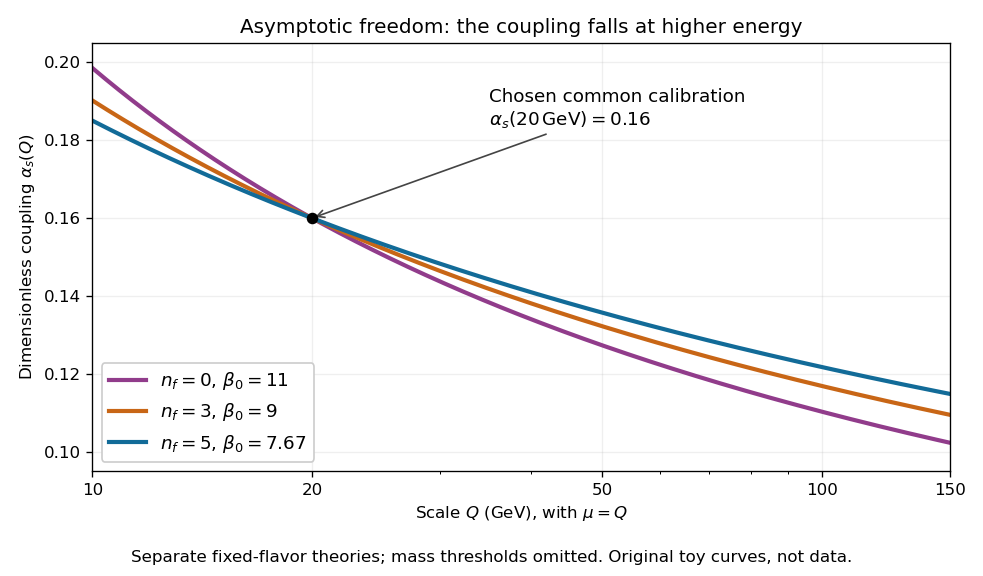
One-loop running couplings with a common chosen calibration
. Original fixed-quark flavor calculations with in each theory. More quark flavors reduce and slow the decrease at higher energy. The three curves have different strong-coupling scales; they are not successive threshold intervals of one physical theory. Details. Past exam of the mathematics course of the University of Cambridge 2005 iii Paper 53 2 Solution Created 2026-10-03 Updated 2026-10-14
The local matrix is a gauge transformation in the representation acting on the matter field. With Hermitian Lie algebra generators it can be written locally in spacetime, and pointwise for , asThe real functions can instead include a factor of by redefining the transformation parameters. The gauge covariant derivative convention in this paper is . Inserting the stated transformed shows explicitly that the term cancels, giving .
In QCD, each quark field is in the colour fundamental representation , with . Thus its colour generators are eight matrices, conventionally for the Gell-Mann matrices; their number is not their matrix dimension. The eight gluons themselves transform in the adjoint representation of SU(3).
With , the pure Yang-Mills theory has Lagrangian . Put and . Since ,The cross term has two derivative contributions. Interchange and then in the second; antisymmetry of makes it equal to the first. The cubic and quartic Yang-Mills self-interactions are thereforeThe positive cubic sign follows from the negative term in the given Yang-Mills field strength; changing the covariant-derivative convention consistently changes intermediate signs.
For the left-handed quark doublet , the hypercharge is and the weak generators are . Its electroweak term isThe Pauli matrices give diagonal entries and off-diagonal entries . Expanding the term givesIn particular the off-diagonal weak charged current coupling is .
Write , . Invert the neutral-field rotation: , . The original PDF gives , soThe photon coefficients inside the derivative are for , and for . Multiplication by the in the kinetic Lagrangian gives the requested electromagnetic coupling of a weak multiplet:Equivalently it is , making the electric charges explicit. The remaining neutral terms are . The TeX's missing prime in the mixing-angle ratio and truncated first Pauli matrix are conversion errors, not physical assumptions.
Past exam of the mathematics course of the University of Cambridge 2007 iii Paper 53 3 Solution Created 2026-10-03 Updated 2026-10-14
Quark mixing arises because the up-type and down-type quark Yukawa matrices need not be diagonal in the same weak interaction basis. In the Standard Model the three left-handed quark doublets transform as under , whereas and transform as and . With a Higgs doublet and its conjugate , the gauge-invariant Yukawa interaction isThe generation indices are matrix-multiplied. Electroweak symmetry breaking, , produces and .
Each complex fermion mass matrix admits a biunitary diagonalization,where the diagonal entries are real nonnegative quark masses. Define and , and similarly for right-handed fields. The kinetic terms retain their canonical form because the transformations are unitary matrices. However, the weak charged current becomesThis unitary matrix is the Cabibbo-Kobayashi-Maskawa matrix. Its entries multiply transitions between up-type and down-type mass eigenstates. The minimal Standard Model has no analogous right-handed charged weak current.
Quark mixing does not introduce tree-level flavor-changing neutral currents. Photon, gluon and weak neutral current couplings are proportional to the identity within each fixed-charge quark sector, and . The single Higgs doublet also has diagonal neutral scalar field couplings after the same transformations that diagonalize the masses. At higher loop orders, flavor changes are possible. For example, an amplitude contains . Unitarity of the CKM matrix sets the sum of coefficients to zero, cancelling any mass-independent part. This is the GIM mechanism; mass splittings leave a suppressed, generally nonzero amplitude.
For generations a unitary matrix has real parameters: mixing angles and phases. Rephasing the up-type and down-type quark fields removes phases; a common baryon number phase leaves every matrix entry unchanged. Hence the physical numbers areTwo generations therefore give a real Cabibbo rotation,with strangeness-changing charged-current transitions suppressed by . Three generations have three mixing angles and one irreducible weak CP phase. This counting assumes nondegenerate masses; degeneracies allow additional basis rotations.
Writing and , a standard exact parametrization isComplex entries alone do not establish CP violation, because quark quantum field rephasings can change their phases. For nondegenerate quark masses the weak mixing sector conserves CP precisely when a basis makes real. A useful invariant test is the Jarlskog invariant,A nonzero requires all three mixing angles and a nontrivial phase. If two same-charge quark masses coincide, the additional basis freedom removes the corresponding physical CP effect. The possible QCD theta angle is a separate CP parameter, not part of this weak-mixing count.
The Wolfenstein parametrization displays the hierarchy of quark mixing economically. Put , , and . Expanding the exact matrix givesThe observed pattern is predominantly diagonal, with - mixing largest and -, - mixing successively suppressed. The expansion implies . The truncated matrix must not be treated as an exactly unitary matrix.
Column orthogonality givesThe three complex numbers form a CKM unitarity triangle, with area . Dividing by puts its vertices at , and , where . The barred parameters include higher-order corrections to the Wolfenstein parameters. Comparing independent measurements of its sides and angles tests both quark mixing and the absence of additional flavor dynamics.
Semileptonic decay rates determine magnitudes of CKM entries through factors once hadronic matrix elements are controlled. Neutral kaon and neutral B-meson mixing constrain products of entries through weak box scattering amplitudes. CP asymmetries probe their invariant relative phases, with kaon mixing providing indirect CP violation and decay amplitudes providing direct CP violation. These processes complement tests of the unitarity constraints on rows and columns. The minimal three-generation Standard Model describes weak quark mixing by a unitary matrix with three angles and one physical CP phase; it does not predict the Yukawa couplings or their hierarchy.
Past exam of the mathematics course of the University of Cambridge 2007 iii Paper 55 5 Solution Created 2026-10-03 Updated 2026-10-14
Use left-chiral superfields throughout, abbreviating the conjugate singlets by , , and . The printed hypercharge convention is the negative of the usual one, so ; consequently is the down-type and the up-type Higgs doublet. Write for the weak-doublet contraction. Assign baryon number , , and lepton number , ; both Higgs fields have .
The baryon number and lepton number conserving homogeneous cubic superpotential isEach term has zero hypercharge, is a color and weak singlet, and has . Higgs expectation values give the usual quark and charged-lepton Yukawa interaction masses and, here, Dirac neutrino masses. The complete remaining cubic part isThe first two terms have , the third has , the fourth has , and the last has . Their Hermitian conjugates reverse these signs. Commutativity of chiral superfields and the antisymmetric weak/color contractions give and ; can be taken completely symmetric. All other coupling tensors are unrestricted complex tensors.
To check completeness, a cubic color singlet containing a quark doublet and an antiquark singlet must contain a colorless weak doublet; the allowed hypercharges give , and . Three color-antitriplet singlets can form a singlet with , but hypercharge permits only . Three quark doublets cannot be a weak singlet. With no colored fields, an even number of weak doublets is necessary. Two doublets and a singlet give precisely , , and ; contractions of two identical Higgs superfields vanish. With no doublets the only neutral triple is . Thus is the most general homogeneous cubic superpotential for the printed fields, including their singlet neutrinos.
If “cubic” is intended to mean a polynomial of degree at most three, also addThe term conserves both charges; the other nonconstant terms have respectively . This distinction will matter for the printed claim about R-parity.
For squark-mediated proton decay, choose and with or . The same down-type singlet squark can appear in both vertices; would give by antisymmetry. The first term includes an electron/up-quark/squark vertex, and the second an up-quark/down-quark/squark vertex. Exchanging a squark of mass and expanding its propagator at momenta much smaller than produces the dimension-six effective operatorThe left- and right-handed pairs are separately contracted spinor bilinears. This operator converts an up/down quark pair into a positron and an antiquark; the spectator up quark can combine with the antiquark into the neutral pion. Equivalently its hadronic matrix element between a proton and a pion is permitted, so it induces . Having both the baryon number and lepton number violating vertices is what enables this channel.
Since has mass dimension , dimensional analysis givesThe dimensionless includes the hadronic matrix element and two-body phase space; the pion mass changes this factor rather than the leading dimensions. Dimensional grounds alone do not give a precise hadronic coefficient. Using the lifetime supplied in the paper, rather than substituting a different bound, gives and henceFor an illustrative squark this is about when is rounded to . The bound constrains the relevant flavour product and depends on the exchanged mass; separate smallness of each coupling does not follow without an additional assumption.
Define matter parity and R-parity byEvery matter superfield has , whereas and the vector superfields have . For ordinary quarks and antiquarks, is odd and , so . For charged leptons, neutrinos and their antiparticles, is odd and , again giving ; the singlet neutrino fermion obeys the same rule. Gluons, the photon, and have and spin one, hence ; Higgs bosons have and also . Thus every Standard Model particle is R-even, including the corresponding antiparticles. Changing spin by one half within a supermultiplet reverses , so squarks, sleptons, gauginos and Higgsinos are R-odd.
Each conserving cubic term contains two R-odd matter superfields and one even Higgs superfield, so it is even under matter parity. Each term in has an odd number of matter superfields: three for , and one for . All are therefore forbidden. At the component level the two fermion spin factors in a Yukawa interaction multiply to , so the same selection rule follows directly from R-parity. This verifies all cubic baryon/lepton-number violating terms are forbidden while the Yukawa fermion mass terms survive.
The blanket assertion needs a qualification beyond homogeneous cubic terms. The Higgs term is even; and are odd and forbidden. But is even and permits a Majorana neutrino mass despite violating lepton number by two. Likewise the higher-dimensional operators and are even. Consequently R-parity alone does not enforce all-order conservation of baryon number and lepton number, or absolute proton stability; the stated precise exclusion holds for the violating cubic interactions above.
Two physical implications follow from multiplicative conservation of R-parity. Superpartners are produced in even numbers from an initial state consisting only of Standard Model particles, leading to pair production at the lowest threshold and parity-conserving cascades. The lightest supersymmetric particle is stable, since one R-odd particle cannot decay exclusively into R-even particles and no lighter R-odd state is available. A neutral weakly interacting lightest supersymmetric particle can therefore be a dark-matter candidate and produce missing-energy signatures; neutrality and a suitable abundance require further model assumptions.
Past exam of the mathematics course of the University of Cambridge 2008 iii Paper 49 2 Solution Created 2026-10-03 Updated 2026-10-14
The commuting Hermitian operators admit a weight-space decomposition. The six root vectors shift their simultaneous eigenvalues byor their negatives. Put , and . The supplied relations giveThese are three sl2 triples, coming from the complexifications of the three SU(2) Lie algebra root-pair subalgebras. They act through homomorphisms into . For a nontrivial representation, simplicity of the SU(3) Lie algebra makes its kernel zero, so these images are actual subalgebras; a trivial representation gives zero actions. The real compact generators can be taken as , and .
Decomposing under any one of these subalgebras gives finite weight strings in its root direction. The two simple-root highest weights must be nonnegative integers. In the SU(3) highest-weight coordinates used here, this condition isHere are the Dynkin labels; are the eigenvalues of . An irreducible representation is determined by these labels and has dimension . An arbitrary finite-dimensional anti-Hermitian representation is a direct sum of such representations: the orthogonal complement of an invariant subspace remains invariant.
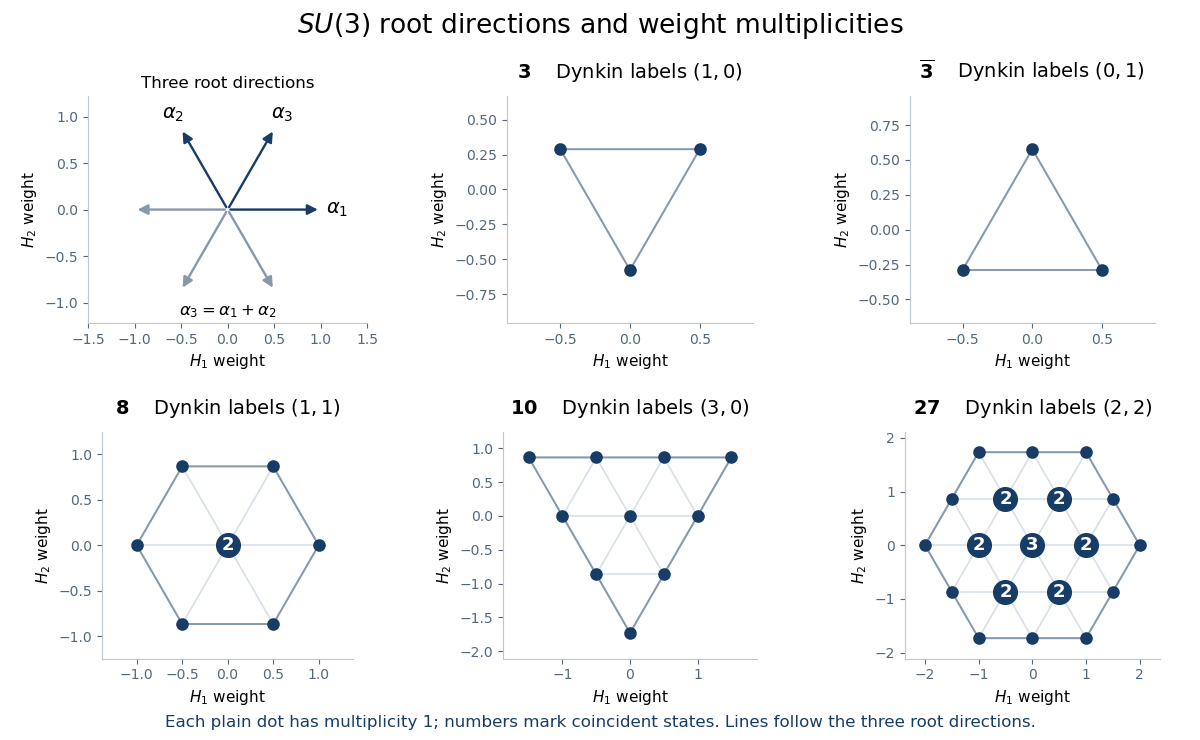
The weight diagram has Weyl group symmetry, namely reflections and rotations by degrees. Its convex boundary is a hexagon with alternating side lengths , degenerating to a triangle when one label vanishes. Generic representations need not have -degree symmetry. Boundary weight multiplicities are one. Moving inward through hexagonal layers increases multiplicity by one, up to ; triangular inner layers retain that maximum. An exact version of this rule is the dominant weight multiplicity formula for sl3: move a weight by the Weyl group to dominant Dynkin coordinates and setIts multiplicity is zero unless are integers, and otherwise is . These rules construct the diagram while counting coincident weights correctly.
For the Casimir calculation, set , , and for each root pair use and . In the defining representation these eight generators satisfy . Their summed squares are precisely the question's . The invariant trace form makes their structure constants of a Lie algebra antisymmetric, sothe antisymmetric coefficient contracts a symmetric anticommutator. Thus is a quadratic Casimir operator and is scalar on an irreducible representation by the Schur lemma.
Let be a highest-weight vector, annihilated by all . On , each vanishes and each reduces to the root commutator. Summing those three commutators gives . Henceand therefore the SU(3) quadratic Casimir eigenvalue isFor a reducible representation the same calculation applies separately to its irreducible blocks.
For light-hadron flavour symmetry, the up quark, down quark and strange quark form , and antiquarks form . Conventional mesons have . Conventional three-quark baryons haveobtained from , and . Their Dynkin labels are , and , respectively. Thus the conventional meson octet, baryon octet, baryon decuplet and singlet multiplets give , with the same values for conjugate antibaryon multiplets. More generally, the zero flavour triality of a light-quark hadron imposes on multiplets constructed entirely from light quarks, antiquarks and gluons. Their Casimir values are given by the same formula for these labels. Higher multiquark representations can therefore have other eigenvalues; the illustrated , of labels , has .
Past exam of the mathematics course of the University of Cambridge 2008 iii Paper 54 3 Solution Created 2026-10-03 Updated 2026-10-14
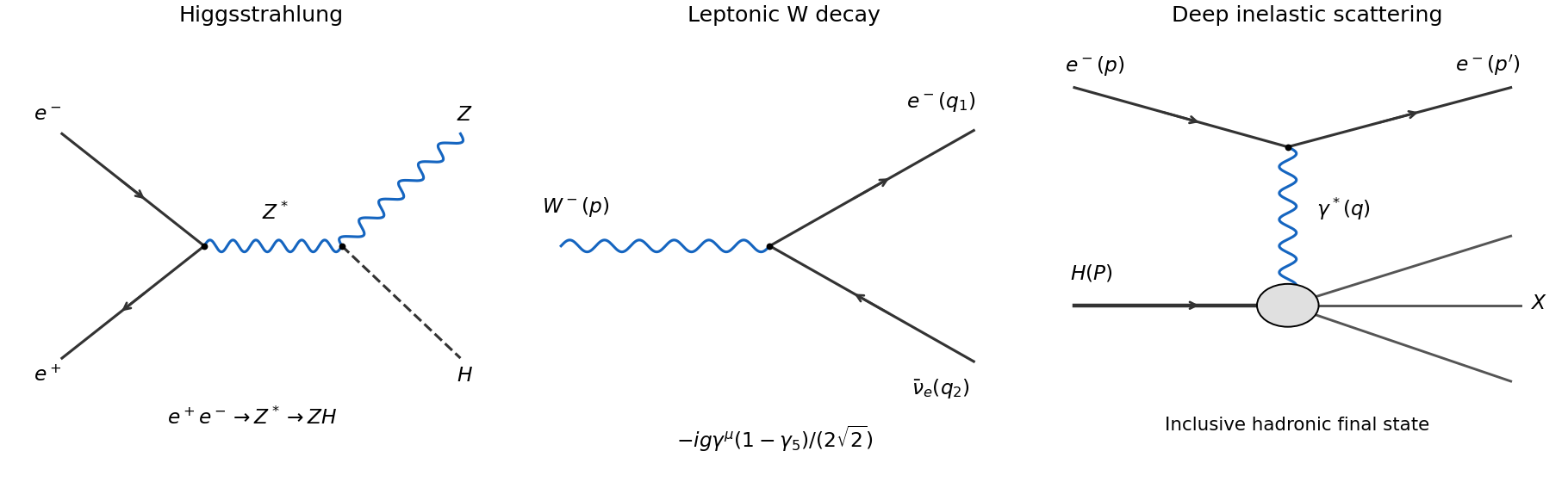
The middle panel shows the Feynman diagram for the leptonic W boson decay. With the charged-current Lagrangian density sign in the question, its vertex Feynman rule isAn overall field-phase convention can change the overall amplitude sign but cannot change the decay width. With the standard Dirac field current ordering, the amplitude isThe unusual order of barred fields in the printed description should be interpreted as this physical weak charged current matrix element.
For massless final fermions, the fermion spin sums are and . The massive-vector spin average divides by three. Thuswith the chiral traceAnticommuting through the two following gamma matrices and using gives its symmetric partIts remaining part is an antisymmetric epsilon tensor from the gamma matrix trace identities; it vanishes against the symmetric polarization tensor . Direct contraction gives andHenceNo additional averaging over hypothetical right-handed neutrino states is appropriate: the chiral projector already enforces the physical helicity coupling.
On shell, , and , so and . The squared matrix element reduces to . In the parent rest frame, integrate the spatial momentum delta first in two-body Lorentz-invariant phase space. The remaining radial integral isConsequently the massless leptonic W decay width isLepton universality gives in the same massless approximation. The muon and tau lepton masses produce small corrections if retained.
With an identity CKM matrix, the allowed quark channels are and . The corresponding third-generation channel is closed by the top threshold. Each open channel has three orthogonal matching-color final states, so the color multiplicity in a decay width gives . There is no initial color average because the W boson is colorless. The tree-level W branching fractions are therefore:
| Final channel | Partial width | Branching fraction, rounded |
|---|---|---|
The rounded percentages sum to 99% because of rounding. The exact fractions sum to one, with total leptonic fraction and hadronic fraction . The total decay width isAs an illustrative numerical estimate, taking and gives , each open quark width and . These are tree-level model estimates with the stated illustrative inputs, not a fit to a measured width. Strong radiative corrections increase the inclusive quark widths.
The produced quark and antiquark radiate gluons, generating a parton shower. As their virtualities fall towards the strong-interaction scale, perturbation theory gives way to hadronization: confinement converts the colored partons into color-neutral hadrons, typically seen as two particle jets, with additional radiation sometimes producing resolved extra jets. Unstable hadrons subsequently decay; the primary quarks are not observed as free particles.
Including the CKM matrix, the charged current couples an accessible up-type flavour to every kinematically accessible down-type flavour . ThereforeThe sums over remain by row unitarity, so the massless tree-level total remains . Quark mixing redistributes the hadronic branching fractions; it does not create a new total color factor. If a family is above threshold, only its accessible channels enter, and the unitarity sum must not be applied to an incomplete set of final flavours.
For completeness, CKM parameter counting starts with real degrees of freedom of an unitary matrix. This follows by counting real entries and independent Hermitian constraints in . The real-orthogonal subclass has mixing angles; the remaining parameters can be viewed as phases. Rephasing each up-type and down-type mass eigenfield changes by . Of the phases, the common phase does nothing, so are removable. ThusFor three generic nondegenerate families this is three angles and one CP-violating phase. Degenerate masses can allow additional changes of basis and reduce the count.
Past exam of the mathematics course of the University of Cambridge 2009 iii Paper 45 4 Solution Created 2026-10-03 Updated 2026-10-14
Start with a nonzero highest-weight vector and set . The sl2 highest-weight lowering formula follows inductively from the commutator relations:Indeed gives the weight formula, and turns the coefficient at step into at step . The nonzero have distinct eigenvalues, so are linearly independent. Finite dimensionality therefore forces a last nonzero vector . Applying to gives , hence . This also proves that no earlier vector can vanish. Thus the cyclic highest-weight representation generated by isIt is irreducible: spectral projections in select a weight vector from any nonzero invariant subspace, and its nonzero raising and lowering coefficients then generate the whole string. This gives the classification of finite-dimensional sl2 representations used for each root direction below.
For the SU(3) Lie algebra, the repeated-index relation is the trace constraint . The displayed generators are a basis of its complexification, not nine independent generators or three individually vanishing diagonal elements. Realize them by matrix units as ; the compact real algebra is obtained from anti-Hermitian combinations. Thenand , , , . Substituting into the given commutators givesThus both root pairs obey the required sl2 Lie algebra relations. More generally, their Cartan matrix isA weight vector with eigenvalues moves by under and by under . The third negative-root operator is and moves it by . In the required weight diagram coordinatesthese moves are , and respectively. Successive lowerings from a highest-weight vector, with linear dependencies removed, construct the following bases.
For Dynkin labels , use the defining action of SU(3) on . Its highest vector is ; lowering gives and . There are no further independent vectors. The weight diagram of the defining SU(3) representation, in the present rescaled coordinates, isand . Any invariant weight subspace raises to and lowers to all three vectors, proving irreducibility.
For , use the adjoint representation of SU(3) on traceless matrices, with acting by . The highest vector is : both and vanish, while . Lowering gives and . Further lowering produces and , then and , and finally . Consequently the basis is the six off-diagonal matrix units together with :The six nonzero weights have weight multiplicity one, and zero has multiplicity two. Thus . Its irreducibility follows also because an adjoint-invariant subspace is an ideal and is a simple Lie algebra.
For , take the symmetric cubic representation of SU(3), , realized by homogeneous degree-three polynomials. Hereso is a highest-weight vector with eigenvalues . For ,which is nonzero and constructs every monomial. These monomials form a basis and have distinct weights . If an invariant subspace is nonzero, joint spectral projections in select one monomial; repeated transfers its powers to , and repeated transfers all its powers to , reaching . Lowering then generates the whole basis, proving irreducibility without merely assuming the dimension formula. The plotted weights arewith multiplicity one at every point. Hence .
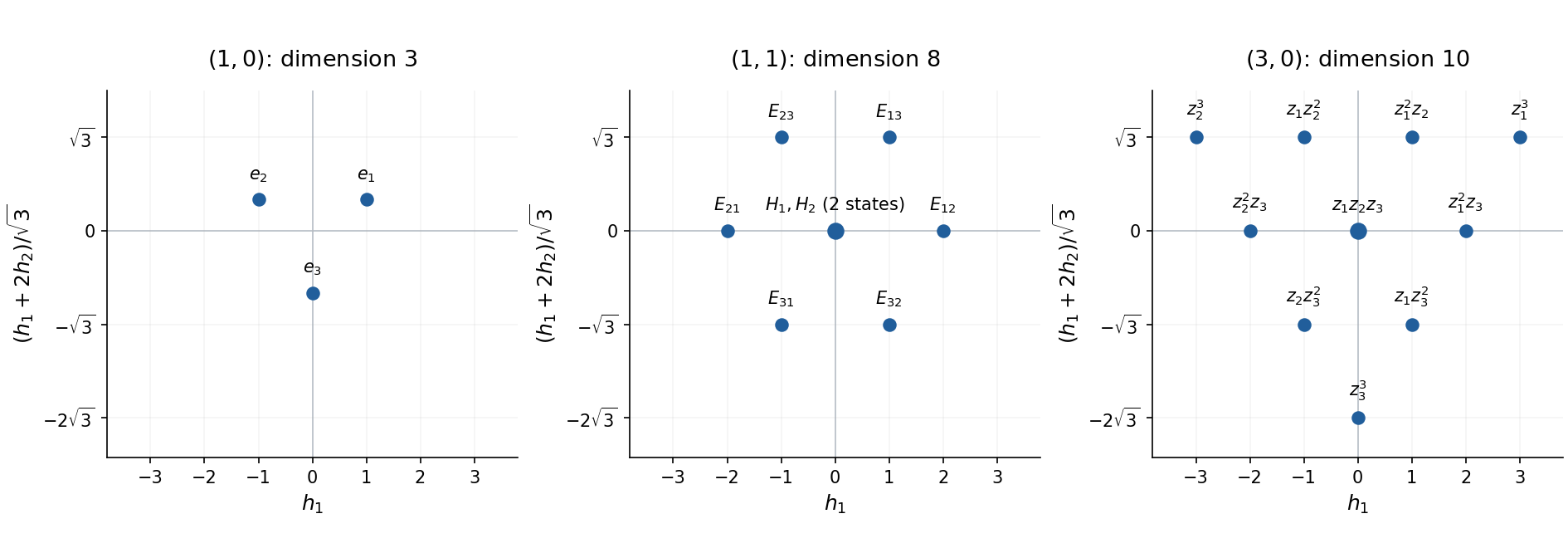
SU(3) weights in the three requested representations, with the two independent zero-weight octet states marked
. Details. For approximate flavor symmetry, identify with the up quark, down quark and strange quark. The defining representation is their flavour triplet. The baryon octet realizes and contains the spin- nucleons and the multiplets; its central double weight distinguishes and . The baryon decuplet realizes the symmetric flavour representation , containing the spin- multiplets. In standard isospin and flavor hypercharge normalization, and , so these plots use and . Three-quark spin and flavour combine subject to the Pauli constraint on three-quark flavour multiplets and the antisymmetric three-quark colour singlet. The adjoint flavour representation also describes a meson octet. A distinct, exact colour SU(3) gauge symmetry places quarks in its defining representation and gluons in its adjoint octet; colour and flavour here are different physical group actions.
Past exam of the mathematics course of the University of Cambridge 2009 iii Paper 47 2 Solution Created 2026-10-03 Updated 2026-10-14
Set . The angular integral of the electron-positron annihilation into a muon pair differential cross-section isThereforeThe printed comparison of with a quantity in has inconsistent units: the high-energy condition means an energy large compared with particle masses, or equivalently an energy-squared large compared with their squared masses.
At leading order, inclusive electron-positron annihilation into hadrons proceeds through , as in the first panel below. The photon couples to each quark with strength ; the corresponding contribution is times the muon-pair rate per colour. Summing over the three orthogonal final colours and active flavours gives the hadronic R ratioFor massless flavours this gives , with charm included , and with bottom as well .
The approximation assumes unpolarized beams and negligible electron mass; active quark masses are small relative to , and heavy flavours below threshold are excluded. Photon exchange dominates, so exchange and photon- interference are neglected; this is appropriate sufficiently below the Z boson scale, not at arbitrary high energy. The coupling must be evaluated consistently in numerator and reference rate. We also neglect higher-order QED radiation. Relating the inclusive partonic calculation to hadrons invokes quark-hadron duality: the energy should be in a perturbative continuum region, away from thresholds and narrow resonances, with power-suppressed nonperturbative effects neglected. An exclusive hadron channel cannot be obtained merely by multiplying the parton rate by the colour count.
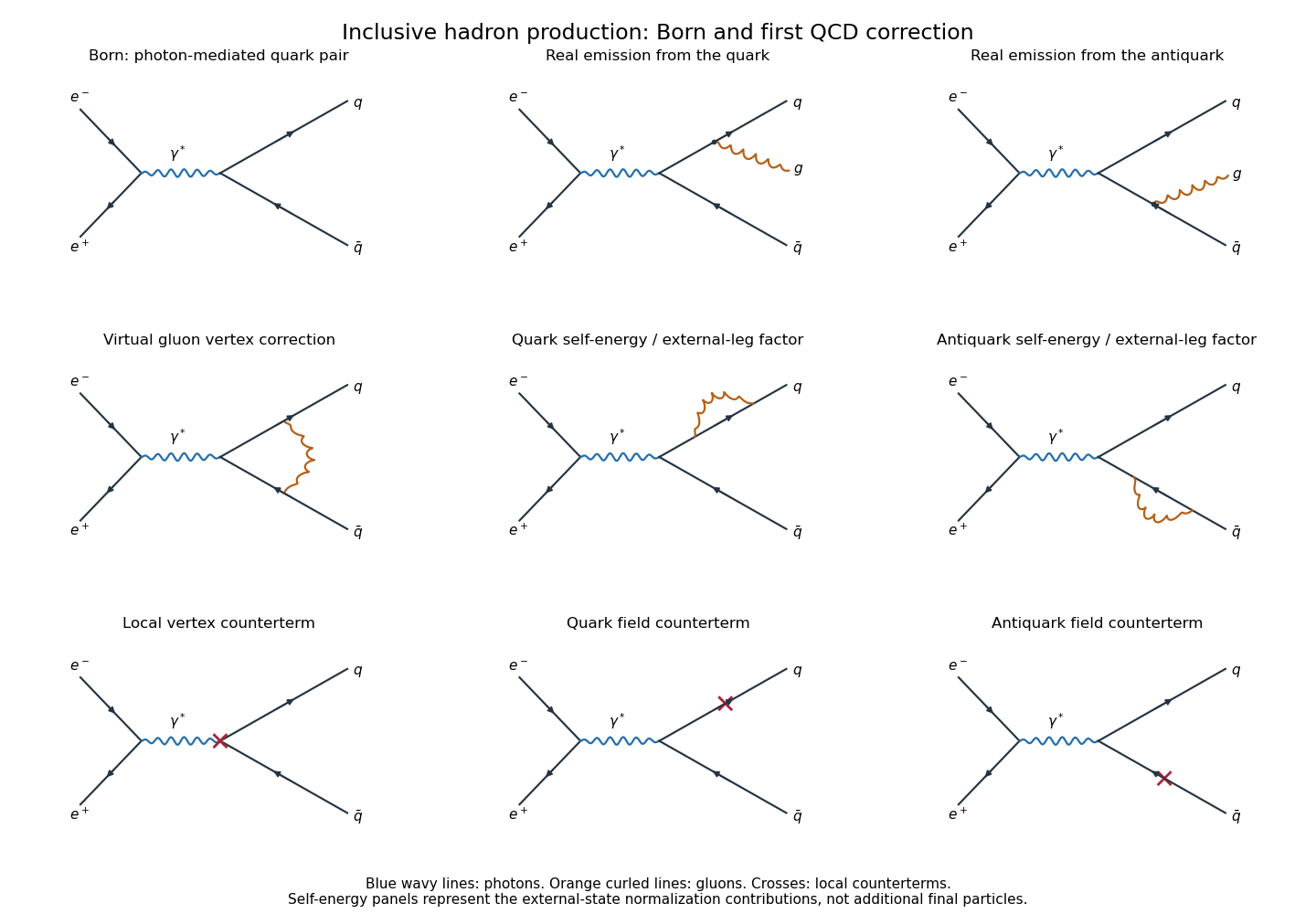
Born hadronic production, real and virtual first-order QCD corrections, and their local counterterms
. Details. At next order in QCD, the real-emission amplitudes are the two distinct diagrams for , with the gluon emitted from the quark or antiquark. They must be added before squaring, including their interference. Each amplitude is order at the hadronic current vertex and gives a relative order- contribution to the rate.
The virtual order- amplitudes consist of the gluon correction to the photon-quark vertex and the quark and antiquark self-energy/external-state normalization contributions. The figure also shows the corresponding local vertex and field counterterms. In an amputated on-shell calculation the external-leg terms are represented by wave-function factors, rather than counted as extra final states. There is no gluon attachment to an electron, since it carries no colour. Gluon self-energy insertions and additional non-Abelian vertices enter at higher orders here. The rate correction is the Born-virtual interference plus the integrated squared real-emission amplitude, not the square of the one-loop amplitude.
Use dimensional regularization, , to keep ultraviolet and infrared singularities in a common scheme. Ultraviolet divergences in the virtual quark and vertex contributions are removed by consistent wave-function renormalization and local counterterms; the conserved electromagnetic-current identity relates the vertex and field renormalizations. One uses a renormalized QCD coupling ; its running changes this first correction only at the next perturbative order. In the massless on-shell scheme some external self-energy integrals are scaleless and vanish, but that statement combines ultraviolet and infrared poles and must not be used to discard the associated normalization terms inconsistently.
The remaining infrared divergences occur when a gluon is soft, and collinear divergences occur when it is parallel to a massless quark. They appear in both virtual diagrams and the real-emission phase-space integral. For the fully inclusive total rate, unresolved final states are summed and real-virtual infrared cancellation in inclusive QCD removes their poles. A resolved jet rate instead needs an infrared-safe observable and a resolution prescription. An isolated real or virtual correction is not a finite physical inclusive cross-section.
Define the dimensionless constant with the conventional loop factor extracted. Then the requested form isFixed numerical and colour factors are contained in ; choosing another extracted prefactor simply redefines that constant. No explicit loop coefficient is required to establish the form.
The Born and virtual processes give two energetic particle jets. Hard, well-separated real radiation gives a three-jet event; unresolved radiation changes jet widths and event-shape distributions, while the combined terms correct the inclusive rate. Resolved three-jet events in electron-positron annihilation provided the direct gluon signature, observed at PETRA in 1979. Their interpretation is energetic quark, antiquark and gluon fragmentation, with approximately planar three-body momentum balance. The primary institutional account is www.desy.de/news/news_search/index_eng.html?openDirectAnchor=1643&printversion=1 .
Past exam of the mathematics course of the University of Cambridge 2009 iii Paper 47 3 Solution Created 2026-10-03 Updated 2026-10-14
Write and use . The renormalization-group beta function impliesIntegrating the one-loop running coupling equation givesHere the sign of is the sign convention in the question: a negative coefficient makes the inverse coupling increase towards high energy.
For gauge coupling unification, let and let be the common inverse coupling at the unification scale. The normalized hypercharge coupling is , soSubtract the second relation from the first to determine , then subtract it from the third. Provided , this provesThe factors belong to the inverse normalized coupling; dropping them changes the prediction.
Use the Standard Model gauge group and convention . One fermion family and one complex Higgs doublet have the following Standard Model representations. The left-handed quark and lepton doublets contain two Weyl spinors each; the right-handed fields are single Weyl species.The row denotes the right-handed up quark. Equivalently an all-left-handed table replaces the three right-handed fields by , , and ; these are alternative descriptions, not extra fermions. The minimal model has no right-handed neutrino. For completeness, the family-independent gauge fields are the spin-one gluons , weak gauge bosons , and hypercharge gauge boson ; they are not counted once per family.
For the Standard Model one-loop gauge coefficients, include three fermion families and one Higgs doublet. With , the colour Dynkin index sum in one family isThe first factor two counts the two members of ; the colour trace is already included in the Dynkin index. There is no coloured scalar. HenceFor , the three colours of and the lepton doublet give per family. The Higgs contributes . ThusFor , sum squared hypercharges over every colour and doublet component. One family contributesThe two complex Higgs components contribute . There is no Abelian gauge self-interaction term, soThis is for the unnormalized coupling used in the question. For , the corresponding coefficient is . This distinction is required for a consistent unification calculation.
Past exam of the mathematics course of the University of Cambridge 2009 iii Paper 55 3 b Solution Created 2026-10-03 Updated 2026-10-14
Count one neutrino species as the usual two thermally populated particle-antiparticle helicity states, with negligible chemical potential. Its entropy weight is . In the ideal high-temperature Standard Model, the bosonic count is from gluons, electroweak gauge bosons and the Higgs field. The fermionic count is from quarks, charged leptons and the three ordinary neutrino species. Hence the relativistic entropy content of the Standard Model is for the remaining bath. Before the new species leaves, the total count is ; its separately cooling states are excluded from the subsequent bath count.
Near ordinary neutrino decoupling, the still-coupled bath hasfrom photons, electron-positron pairs and the three ordinary neutrinos. After those neutrinos decouple, the electromagnetic bath falls from to two when the pairs annihilate. Cosmological entropy conservation in that bath gives .
The new species has cooled as since its earlier decoupling, whereas annihilation of Standard Model species heated the remaining bath. The temperature ratio of an early-decoupled neutrino is thusThese are ideal-gas estimates with the high-temperature count implicit in the question; precise electroweak thresholds change them slightly.
Entropy degrees of freedom weight temperature ratios with their cube, while energy degrees of freedom use their fourth power. The remaining Standard Model entropy today, in photon-temperature units, is . The new contribution is . Therefore the fractional entropy of a relativistically decoupled species isAbout 1.6% of the total entropy is in the new species. Separate comoving entropy conservation also derives this fraction directly at decoupling. A model populating four helicity states instead would require the corresponding doubled species count.
Past exam of the mathematics course of the University of Cambridge 2010 iii Paper 40 1 Solution Created 2026-10-03 Updated 2026-10-14
Use hypercharge normalized by , and express all matter fermions as left-handed Weyl spinors. Thus denote the charge conjugates of the right-handed Standard Model fermions; the superscript is unrelated to the antiparticle marker . Each chiral superfield contains a complex scalar field and a Weyl spinor, while each vector superfield contains a gauge boson and a gaugino. The complete propagating content of the Minimal supersymmetric Standard Model before electroweak symmetry breaking is:
Table 1.
Propagating MSSM fields before electroweak symmetry breaking
. | Sector | Component field | representation | Spin | Families or copies |
|---|---|---|---|---|
| , quark Weyl spinors | ||||
| , squarks | ||||
| , quark Weyl spinor | ||||
| , squark | ||||
| , quark Weyl spinor | ||||
| , squark | ||||
| , lepton Weyl spinors | ||||
| , sleptons | ||||
| , lepton Weyl spinor | ||||
| , slepton | ||||
| , Higgs complex scalar fields | ||||
| , higgsinos | ||||
| , Higgs complex scalar fields | ||||
| , higgsinos | ||||
| Color vector multiplet | , gluons | adjoint, | ||
| Color vector multiplet | , gluinos | adjoint, | ||
| Weak vector multiplet | , weak gauge bosons | adjoint, | ||
| Weak vector multiplet | , winos | adjoint, | ||
| Hypercharge vector multiplet | , hypercharge gauge boson | |||
| Hypercharge vector multiplet | , bino |
The marker means that conjugate antiparticle states must also be counted: a charged Weyl spinor has a particle helicity and a distinct antiparticle helicity, and a complex scalar field has particle and antiparticle excitations. The real adjoint gauge bosons and adjoint Majorana fermions already contain their conjugate states, so no extra marker is attached to them. For example, the charged combinations are both contained in the one real weak triplet. There are no right-handed-neutrino chiral superfields, no gravitino, and no propagating auxiliary fields in this field table. The matter sector has gauge components; the two Higgs chiral doublets add four. Thus the count is , before mass effects are considered.
R-parity is the multiplicative discrete quantum number , with baryon number , lepton number and spin . Ordinary quarks, leptons, Higgs scalars and gauge bosons have ; their sparticles have . For superfields the equivalent rule is matter parity : are odd, and and the gauge superfields are even. With contracting weak indices and implicit color contractions, the renormalizable R-parity-conserving MSSM superpotential isSigns of the three Yukawa couplings can be absorbed into their matrices. Every term has even matter parity and zero hypercharge; holomorphy requires the two independent Higgs chiral doublets, rather than using in a superpotential.
Conserved R-parity forces an even number of odd particles in a process whose incoming particles are all ordinary particles, so colliders produce sparticles in pairs or another even multiplicity. Their decay chains end in the stable lightest supersymmetric particle. A neutral, weakly interacting lightest supersymmetric particle, commonly a neutralino after electroweak symmetry breaking, escapes the detector and gives missing transverse momentum; it is also a possible dark matter constituent. Stability alone does not establish its relic abundance, and a charged or colored stable lightest supersymmetric particle is not the usual viable dark matter candidate. Conserved R-parity forbids the renormalizable interactions responsible for the decay below. It does not by itself forbid higher-dimensional proton-decay operators: the superpotential operators and have even matter parity. Thus the renormalizable R-parity-conserving MSSM protects the proton, while ultraviolet physics can still induce its decay.
The gauge-invariant renormalizable R-parity-violating superpotential isHere and because of the weak and color antisymmetric contractions. The first two trilinear terms and the bilinear term violate lepton number, whereas the term violates baryon number. The are dimensionless and has mass dimension one.
For a concrete squark-mediated proton decay channel, take and nonzero. Antisymmetry allows these indices: the exchanged scalar is a strange squark, not a repeated down flavor in . Two quarks in the proton undergo ; the spectator combines with into the component of . The baryon-violating Feynman vertex and lepton-violating Feynman vertex give .
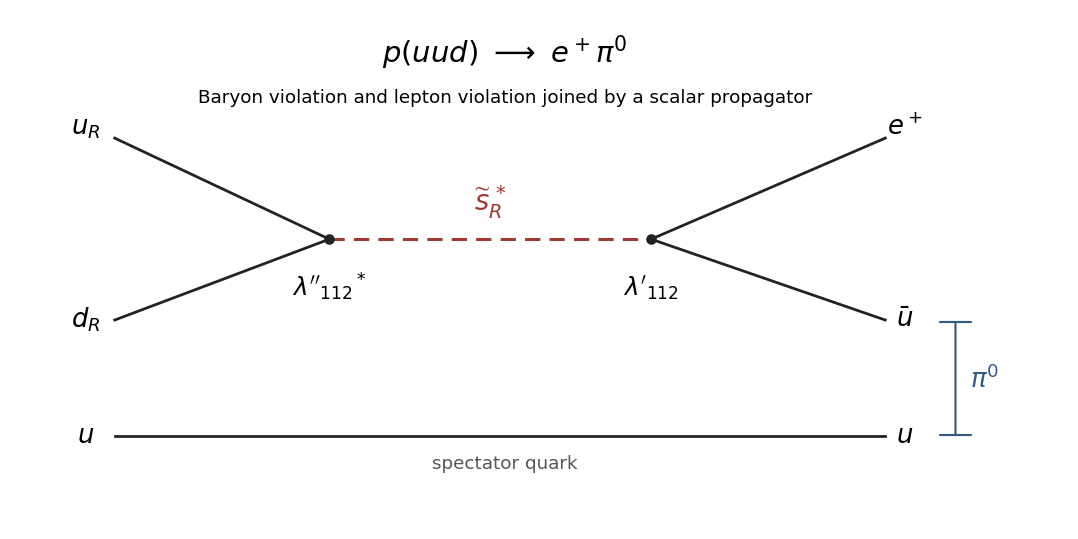


At momenta small compared with the squark mass , its scalar propagator is of order . Eliminating it generates a dimension-six four-fermion proton-decay operator, schematically , with coefficient . Consequently the dimensionless decay amplitude is of order , and phase space supplies one more power of to the width:This is a dimensional estimate; phase-space constants and hadronic matrix elements change its coefficient, not its fourth-power dependence on . For order-one couplings and , the stated lifetime limit is . Therefore , giving .
Such a mass is incompatible with the intended weak-scale MSSM explanation of the hierarchy problem: squarks that cancel the Higgs-sector sensitivity to high scales must not introduce a new enormous splitting from their light quark partners. For example, with order-one couplings would give only . The field content alone does not mathematically prohibit extremely heavy superpartners, but that choice sacrifices the weak-scale naturalness motivation. The usual resolution is conserved R-parity, or sufficiently suppressed simultaneous baryon number and lepton number violation, rather than making the exchanged squark this heavy.
Past exam of the mathematics course of the University of Cambridge 2016 iii Paper 308 3 Solution Created 2026-10-03 Updated 2026-10-06
QCD supplies the underlying strong interaction; Skyrmions provide a mesonic effective description of baryons, and quantized multi-Skyrmions can model nuclei. These are related descriptions at different scales, not three identical theories.
In QCD, quarks carry color charge and interact through gluons, the gauge fields of the color special unitary group . Its Lagrangian density has the formAsymptotic freedom makes short-distance processes accessible through small-coupling expansions, but nuclear scales involve strongly coupled, confined dynamics. Observable hadrons are color singlets. A nucleon, either a proton or a neutron, is a baryon with baryon number one; a nucleus contains such units of baryon number. Directly extracting all nuclear binding energies, spectra and interactions from QCD is difficult, motivating low-energy effective field theories that preserve its symmetries and relevant degrees of freedom.
For the two light quark flavours, the small-mass limit has approximate chiral symmetry . Chiral symmetry breaking leaves its vector subgroup , the approximate isospin symmetry. The three pions are the associated Goldstone bosons in the massless limit and pseudo-Goldstone bosons when the light quark masses are retained. Package these pions into a special unitary group fieldwhere is the pion decay constant in this normalization and are the Pauli matrices. The nonlinear sigma model is the leading two-derivative mesonic theory. The Skyrme model adds a specific four-derivative stabilizing interaction. One conventional normalization isHere is a dimensionless model coupling, not electric charge. The last term accounts for a common pion mass and preserves vector isospin. It vanishes in the chiral massless limit. This effective field theory uses color-singlet mesonic fields and does not resolve constituent quarks or gluons inside a baryon.
The condition at spatial infinity compactifies physical space to . Since is itself a three-sphere, the field defines a map with integer topological charge in . This is identified with the topological baryon number in the Skyrme model:The associated topological current is identically conserved. A single Skyrmion has , and a multi-Skyrmion with is a candidate intrinsic configuration for an ordinary nucleus; negative charge describes antibaryonic sectors. Integer topology prevents a smooth finite-energy unwinding into the classical vacuum, but it does not by itself guarantee a nonzero-size energy minimum.
The energetic reason for the Skyrme term is Derrick scaling. For the rescaled field in three dimensions, let be the quadratic-gradient, quartic-gradient, and potential energies. Their scale dependence isThe two-derivative nonlinear sigma model alone can lower its static energy by shrinking. The positive quartic Skyrme term instead grows under shrinking, permitting a balance and a stable soliton size. Without the mass term, this balance gives . The displayed scaling convention uses , so it is the inverse of the equally common convention.
The connection with QCD is strengthened by large-Nc baryon scaling. Generalize the number of colors to while keeping fixed. Meson masses remain of order one, their interactions weaken, and an effective mesonic action has an overall scale of order . In the Skyrme model this corresponds to and of order , so the soliton mass and rotational moment of inertia are also of order , whereas rotational level splittings are of order . These are the expected baryon scaling properties of large- QCD. A massive, semiclassical soliton built from meson fields is therefore consistent with the underlying theory, even though physical is only a finite value and the simplest Skyrme model is not uniquely determined by this argument.
To represent a nucleon, a classical Skyrmion must be quantized. The unit Skyrmion hedgehog ansatz ties spatial rotations to isospin rotations. Its collective coordinates include its position and orientation; rotational quantization of a unit Skyrmion gives the rotor spectrumin units with . The Finkelstein-Rubinstein constraints impose the correct fermionic sign under a nontrivial configuration-space loop. In particular a spatial rotation acts on a charge- state by in the physical odd-color theory: odd admits half-integer spin, while even has integer spin. For , the lowest allowed doublet represents the proton and neutron; the rotor state represents the Delta baryon resonance. A bosonic pion field can therefore describe fermionic baryons because the quantum wavefunction carries this nontrivial topological sign.
For nuclei, minimize the classical energy in a fixed baryon number sector, then quantize the permitted rotations, isospin rotations, and relevant vibrations or relative motions. The toroidal two-Skyrmion has a lowest nuclear state with , identifying it with the deuteron. The cubic four-Skyrmion has an allowed state appropriate to the alpha particle. The rational map approximation for Skyrmions makes these intrinsic symmetries easier to construct, while collective-rotation constraints for a Skyrmion select allowed nuclear quantum numbers. A spin-zero state has rotationally invariant laboratory expectation values; a classical cubic intrinsic field should not be interpreted as a fixed cube visible in every orientation. Collective-coordinate quantization restores this distinction between intrinsic shape and a physical quantum state.
The nuclear force also has a mesonic interpretation. At large separation the tails of Skyrmions are weak pion fields; with nonzero mass their multipole falloff derives from derivatives of the Yukawa potential. Their interaction depends on relative orientation, and after quantization generates the familiar spin- and isospin-dependent pion-exchange structure of the nuclear force. Attractive channels allow several unit Skyrmions to form a lower-energy multi-Skyrmion. In nuclear language the positive nuclear binding energy is the difference between the separated nucleon masses and the mass of the quantized bound state, not just a count of topological units.
The limitations remain physical. The simplest Skyrme model retains only selected terms in a derivative expansion, and finite solitons probe gradients where omitted terms can matter. Its parameters require matching or calibration; predicted binding can be too strong, and masses, radii and spectra are not all fixed correctly by topology. Rotational quantization alone neglects quantum and vibrational corrections, especially when clustering or breakup channels are important. More general mesonic interactions, additional meson fields, and less restrictive classical ansätze can improve the description, but they introduce further low-energy information. The organizing relation is thereforeIt links underlying quark and gluon dynamics to a geometric, symmetry-based account of baryons and nuclei, while keeping the distinction between an effective approximation and a full derivation from QCD.
Past exam of the mathematics course of the University of Cambridge 2021 iii Paper 305 1 c Solution 2026-09-28
For static sources, the spatial Fourier transform of a massive scalar propagator isThus massive-vector exchange likewise produces a Yukawa potential, , with range instead of the infinite range of the Coulomb potential.
Quantum chromodynamics supplies the requested massless-vector counterexample. Its gluons are massless, but confinement and the QCD mass gap prevent a long-range color force between color-singlet asymptotic states. The short range is generated by strong dynamics rather than by a vector-boson mass.
Past exam of the mathematics course of the University of Cambridge 2022 iii Paper 305 1 i Solution 2026-09-28
The range of a force is controlled by the lightest state that can carry it. Exchange of a particle of mass produces a Yukawa potential proportional to , with range . The electromagnetic interaction is long range because its carrier, the photon, is massless. The weak interaction is short range because the W bosons and Z boson are massive. Although the gluons of the strong interaction are massless in the Lagrangian, Quantum chromodynamics confines color and has a mass gap; only color-singlet hadrons propagate over macroscopic distances. The residual nuclear force is consequently controlled at long distance by massive pion exchange.
Past exam of the mathematics course of the University of Cambridge 2022 iii Paper 305 1 v Solution 2026-09-28
After electroweak symmetry breaking, the Higgs field has vacuum expectation value . A Yukawa interaction then becomes a fermion mass with . The Higgs gauge-covariant kinetic term giveswhile the radial fluctuation is the massive Higgs boson. The photon and all eight gluons correspond to unbroken gauge generators and remain massless. In the minimal renormalizable Standard Model, which has no right-handed neutrinos, the neutrinos also remain massless; adding right-handed neutrinos permits Higgs-generated Dirac masses.