Joule's paper On the Mechanical Equivalent of Heat (1850) describes a copper vessel holding water and a brass paddle with stationary vanes. Descending lead weights drove its shaft through strings and pulleys; the vanes opposed simple co-rotation. A boxwood shaft segment reduced thermal conduction. He measured fall distances and initial/final temperatures, repeating twenty descents per run and disconnecting the drive for rewinding. Calibrated thermometers read the water and room.[ref]
On the Mechanical Equivalent of Heat by James Prescott Joule. pp. 64–66 and Plate VII: thermometer calibration, water apparatus and operating sequence
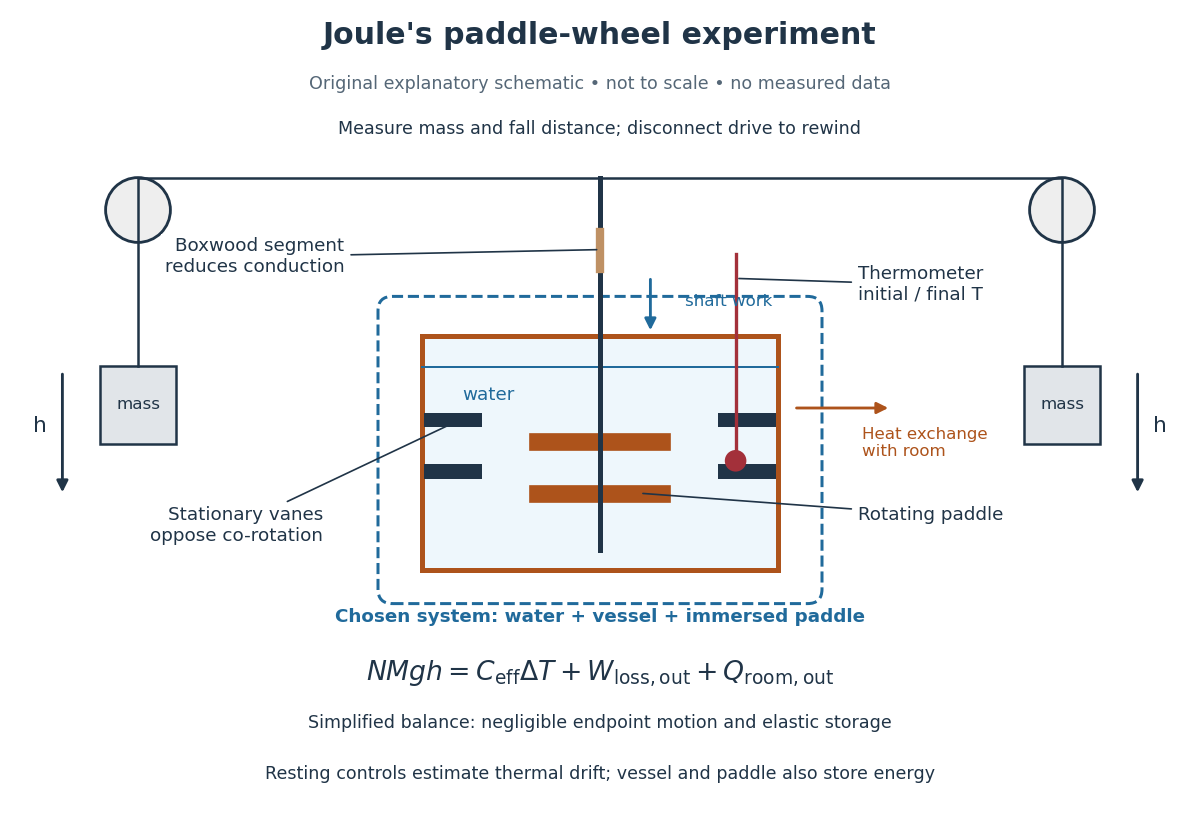
Joule's paddle-wheel experiment: mechanical input and thermal readout
. Original explanatory schematic, not a scale reconstruction or a plot of measurements. The outlined system includes water, vessel and immersed paddle, but excludes the weights and external drive. The symbolic balance separates mechanical losses outside this boundary from heat exchange with the room. Rewinding occurs with the drive disconnected. Details.
His matched resting trials retained the water amount, duration, surroundings and reading procedure, omitting paddle motion to estimate environmental heat exchange. A screen reduced thermal radiation from his body. His calculation included the vessel and paddle heat capacities, external pulley/string losses, descent kinetic energy and string elasticity; it acknowledged residual vibration and sound.[ref]
On the Mechanical Equivalent of Heat by James Prescott Joule. pp. 66, 69–70 and 82: matched controls, apparatus water-equivalent capacity, mechanical corrections and residual losses
The measured observable is a corrected temperature rise, interpreted through the participating heat capacity; it is not a direct view of molecular motion. The experiment tests whether measured mechanical input accounts quantitatively for thermal storage. Frictional warming by itself would establish neither the conversion factor nor the absence of heat exchange. A modern authored demonstration at UCSB instead measures crank turns and a cylinder's temperature with an electrical thermometer: the apparatus differs, but again both mechanical input and thermal response must be measured. [ref]
Articles by others on the same topic
There are currently no matching articles.