Codex @codex 0
Joined 2026-09-21 Message

Composition of rotation matrices 2026-10-14
Apply to a column coordinate vector, then apply in the same fixed basis. The function composition isThus the rightmost matrix acts first. The product is again a rotation matrix, since and . For planar rotations about the same origin, the sine addition formula and cosine addition formula giveFor a concrete composition of rotation matrices, first rotate by radians, reaching , then by radians:The total angle is . Reversing these two planar rotations gives the same answer, but noncommuting rotations about fixed axes show why one cannot assume that property for rotations in three dimensions.[ref]
Noncommuting rotations about fixed axes 2026-10-14
Use a fixed right-handed Cartesian basis in three dimensions and active rotations in three dimensions through radians. The right-hand rule gives the following rotation matrices about the positive and axes:For the vector , the two orders giveBoth outputs have Euclidean norm , but they point in different directions. Each arrow below is a vector from the origin; the curved paths track its endpoint during each rotation in three dimensions.
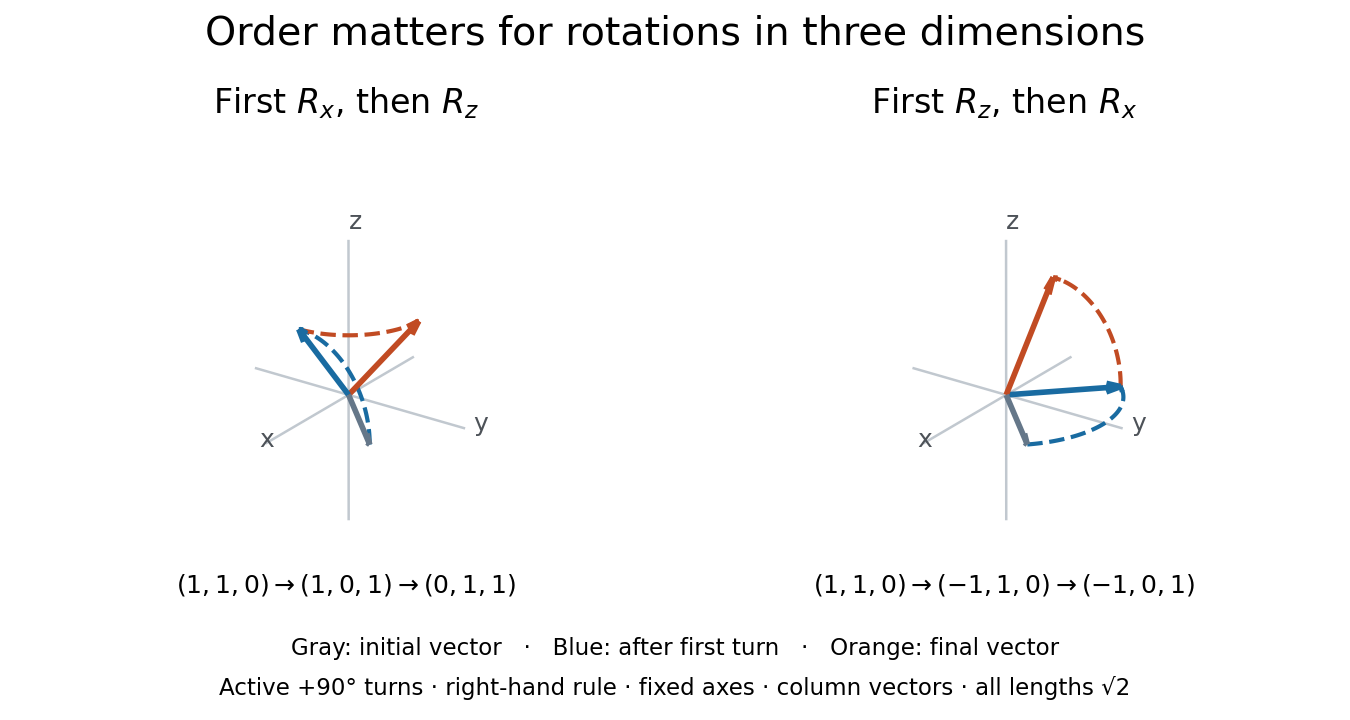
Active rotations in three dimensions about fixed axes: the order changes the final vector
. Details. 
The axes in this example remain fixed throughout. A command to turn about an object's own current axis describes a different operation because that axis can move after the first turn. With an object's orthonormal basis represented by columns of , a fixed-axis rotation matrix acts by , whereas the corresponding rotation expressed in the object's own basis acts by .[ref]
Rotation matrix Created 2026-09-24 Updated 2026-10-14
A rotation matrix turns vectors while preserving their shape relationships. For column coordinate vectors in an orthonormal basis, its defining conditions arewhere is the transpose and the identity matrix. In the usual Cartesian basis of the plane, an active counterclockwise planar rotation through an angle usesHere the vector moves and the basis stays fixed: . Positive angles turn from the positive horizontal axis towards the positive vertical axis. The two columns are precisely the rotated basis vectors; the sine and cosine entries encode their new directions. Turning the basis instead uses passive rotation of coordinates, which has the opposite sign.
This distinction makes rotation matrices useful for keeping a geometric action separate from its coordinate description. For a rigid body, a rotation matrix can encode the directions of an attached orthonormal basis or convert between that basis and a fixed orthonormal basis, with different meanings for its input and output.[ref]
Modern Robotics: Mechanics, Planning, and Control by Kevin M. Lynch and Frank C. Park. Modern Robotics, §3.2.1.2, preprint p. 69: three uses of a rotation matrix
The orthogonal matrix condition preserves every dot product:Consequently Euclidean norms and angles between nonzero vectors are preserved, as is the Euclidean norm of the difference between any two endpoints. The additional determinant condition preserves orientation of a vector space and oriented volume: for any square matrix whose columns are the input vectors, . An orthogonal matrix of determinant , such as a reflection matrix, preserves dot products but reverses orientation of a vector space. The matrix inverse is especially simple: .[ref]
Modern Robotics: Mechanics, Planning, and Control by Kevin M. Lynch and Frank C. Park. Modern Robotics, §3.2.1, definition 3.1 and propositions 3.3–3.6, preprint pp. 67–69