Homeostasis is the maintenance of usable internal conditions despite disturbances. It concerns selected regulated physiological variables, rather than keeping every part of an organism unchanged: core body temperature may remain near its usual range while skin temperature, sweating and blood pressure change. Regulation makes a relatively dependable environment for biological cells out of a changing external world. [ref]
1.5 Homeostasis. §1.5, opening paragraphs and Negative Feedback: normal ranges and compensatory responses
A useful causal description separates a physiological sensor, a physiological integrator and a physiological effector. The return from the physiological effector's action to the sensed regulated physiological variable closes a feedback control loop. In negative feedback, that return opposes the disturbance. The insulin and glucagon articles already trace the blood glucose example; synaptic integration explains how several inputs can jointly influence a neuron. These are implementations and ingredients, not a requirement that every regulatory loop use one anatomical control center. [ref]
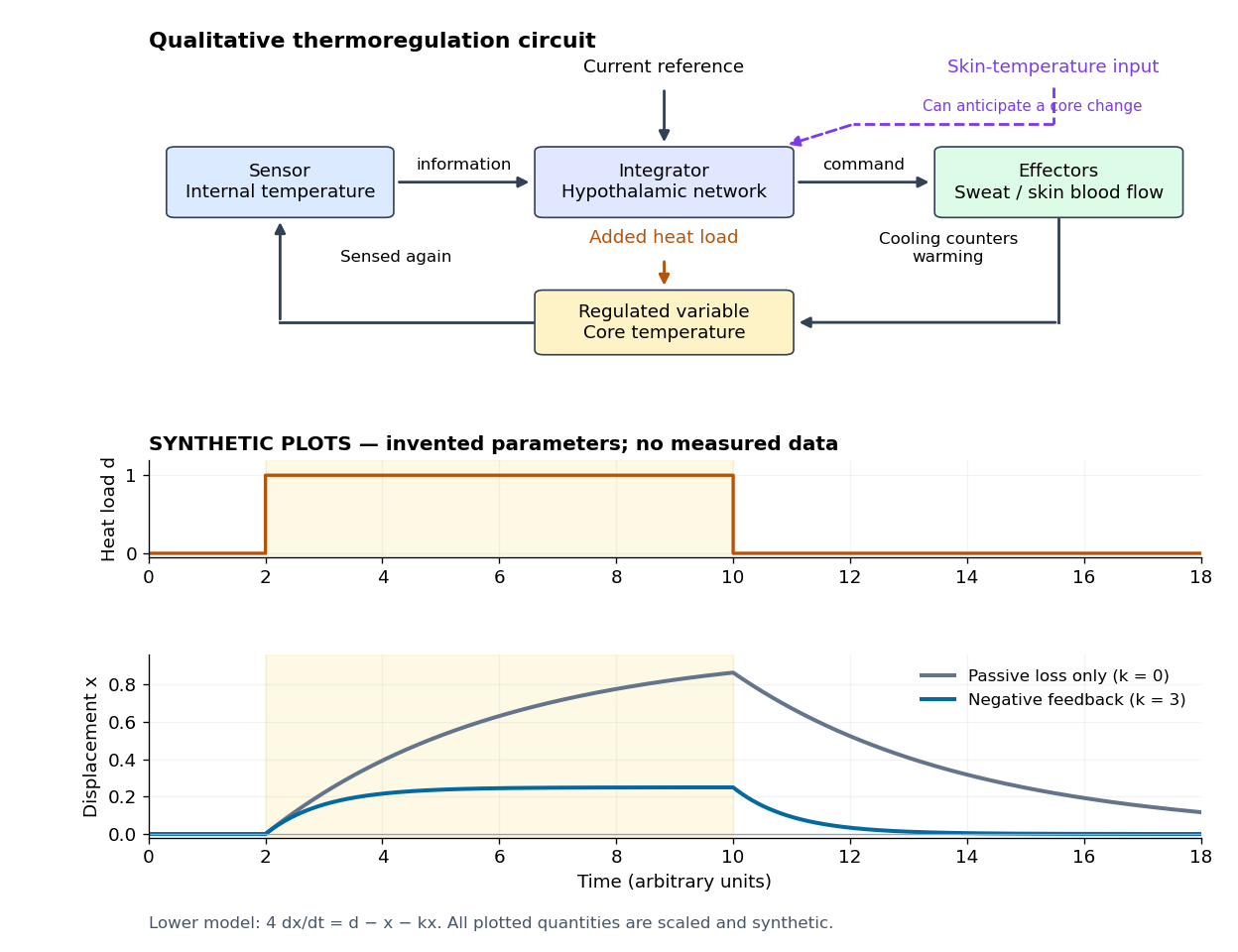

Homeostasis is useful precisely because internal activity can change: a nearly steady temperature can conceal a large increase in heat transfer. Conversely, observing a flat trace alone does not identify a regulatory mechanism. The environment might simply be constant, or the measuring instrument too insensitive; a perturbation and an independent response readout provide stronger evidence. The skin-temperature perturbation experiment below makes that distinction tangible.
The historical motivation was the puzzle of stability in changing living material. In his 1932 The Wisdom of the Body, Walter Bradford Cannon emphasized that an organism exchanges material with its surroundings and continually replaces its own structure, yet maintains relatively steady internal conditions. This authored excerpt presents homeostasis as active compensation for external and internal disturbances, rather than a static body. [ref]
Homeostasis (excerpt from The Wisdom of the Body). Homeostasis excerpt, paragraphs beginning The wonder increases, Resistance to changes and In short; hosting page identifies book and 1932 date
Regulation of cellular water balance, solute content and pressure in response to external osmotic conditions.
An accumulated small solute that helps balance osmotic pressure with relatively limited interference with cellular macromolecules.
Maintenance of a tissue's organization and function despite continuing cell production and loss. Stable population size need not imply that its individual cells or constituent clones persist.
A regulated physiological variable is a specified internal quantity whose departures elicit actions tending to restore an appropriate range. Examples include core body temperature, blood glucose concentration, blood pressure, and the pH and osmolality of extracellular fluid. Specify the compartment and readout: skin temperature and core body temperature are different quantities, and an insulin concentration is a regulatory message rather than the blood glucose it helps control.
Osmolality counts dissolved particles per mass of solvent; it characterizes a chemical solution, rather than the total amount of water in an organism.
A physiological sensor detects a relevant condition and changes a signal. In thermoregulation, temperature-sensitive neurons supply information about internal and skin temperature. Sensing a disturbance and sensing its internal consequence need not be the same operation.
A physiological integrator combines regulatory inputs to select a response; it need not perform the mathematical integral action used in control theory. In thermoregulation, the hypothalamus participates in combining internal and skin signals. The term describes a role, which can be distributed across interacting biological cells, rather than a mandatory single comparator.
A paired hypothalamic structure with hippocampal and brainstem inputs and outputs to the anterior thalamic nuclei. It can contribute actively to memory processing rather than merely relay hippocampal output.
A physiological effector performs the action that changes the regulated physiological variable. In thermoregulation, sweat glands, changes in skin blood flow, and skeletal muscle shivering contribute different actions. The command, the action and the resulting temperature are three distinct readouts. [ref]
Effector saturation is a capacity limit beyond which a larger command cannot produce a larger corrective action. In the homeostatic temperature model, take during the sustained unit disturbance. Before reaching the cap, . The cap is reached at , when . ThereafterThe lasting displacement is now , compared with without the cap. The negative feedback command still asks for more cooling, but the action cannot supply it. This illustrates a capacity limit without predicting a human temperature limit. Increasing feedback gain cannot remove a binding cap; integral action cannot overcome inadequate physical capacity either.
A physiological set point is a reference around which regulation is organized, analogous to a reference signal. An observed average is not automatically a separately encoded target. A range of acceptable values and different response thresholds can be more informative than a single exact number. Negative feedback describes a causal sign; neither perfect constancy nor complete restoration follows from that sign alone.
For core body temperature, circadian rhythms and fever can change the defended level. Thus a response toward the current physiological set point need not restore yesterday's temperature. A drifting target and imperfect tracking of a fixed target are different explanations for a changing readout. [ref]
Fundamental Concepts of Human Thermoregulation and Adaptation to Heat: A Review in the Context of Global Warming by Chin Leong Lim. §2.3.1, Figure 1 and following paragraphs: circadian and pyrogen-related changes of the temperature set point
Here is an explicitly synthetic mathematical model of a warming disturbance and its compensatory cooling. It is a teaching analogy for thermoregulation, not a measured human heat budget. Write , where is a lumped internal temperature, is a fixed reference and is a chosen temperature scale. Let be an additional heating rate and an additional cooling rate, both scaled to the same reference rate. All three are dimensionless variables, while is a time constant in the chosen time units. The ordinary differential equation isThe term idealizes increased passive heat transfer with increased internal temperature, around the baseline. The term opposes warming through proportional control with feedback gain . This local signed model does not treat a negative as negative sweating: it would represent decreased cooling relative to baseline. Changes of the environment and multiple body compartments are omitted.
For a constant disturbance and initial condition , the exponential function solution isSubstitution checks the ordinary differential equation directly. Increasing reduces the lasting offset and, in this instantaneous model, shortens the response time constant to . It does not make zero for a nonzero disturbance and finite : a persistent cooling command requires a persistent displacement under proportional control. At the equilibrium point, the extra heating is balanced by passive loss plus active cooling . Zero change of temperature means balanced rates, rather than zero rates, consistent with conservation of energy.
The first diagram uses , , and a pulse from to , comparing with . The latter approaches during the pulse, compared with without active feedback control. After the pulse ends, each displacement decays as . These are computed curves, not physiological measurements. The curve still has passive loss; it is not a claim that an unregulated body warms without limit.
Real physiological effectors take time to respond. To isolate that issue, set and replace the instantaneous command by another ordinary differential equation:Here the disturbance remains from onward and the effector time constant is also . The equilibrium point is still , but the characteristic polynomial is . Its eigenvalues give decaying oscillations and asymptotic stability. The exact response isIn particular, , so the first maximum occurs at , with . The response exceeds its eventual displacement while remaining above its baseline. The return has the same negative sign as before; the extra state changes the timing. A finite effector time constant is distinct from the fixed time lag in the delayed negative feedback model.
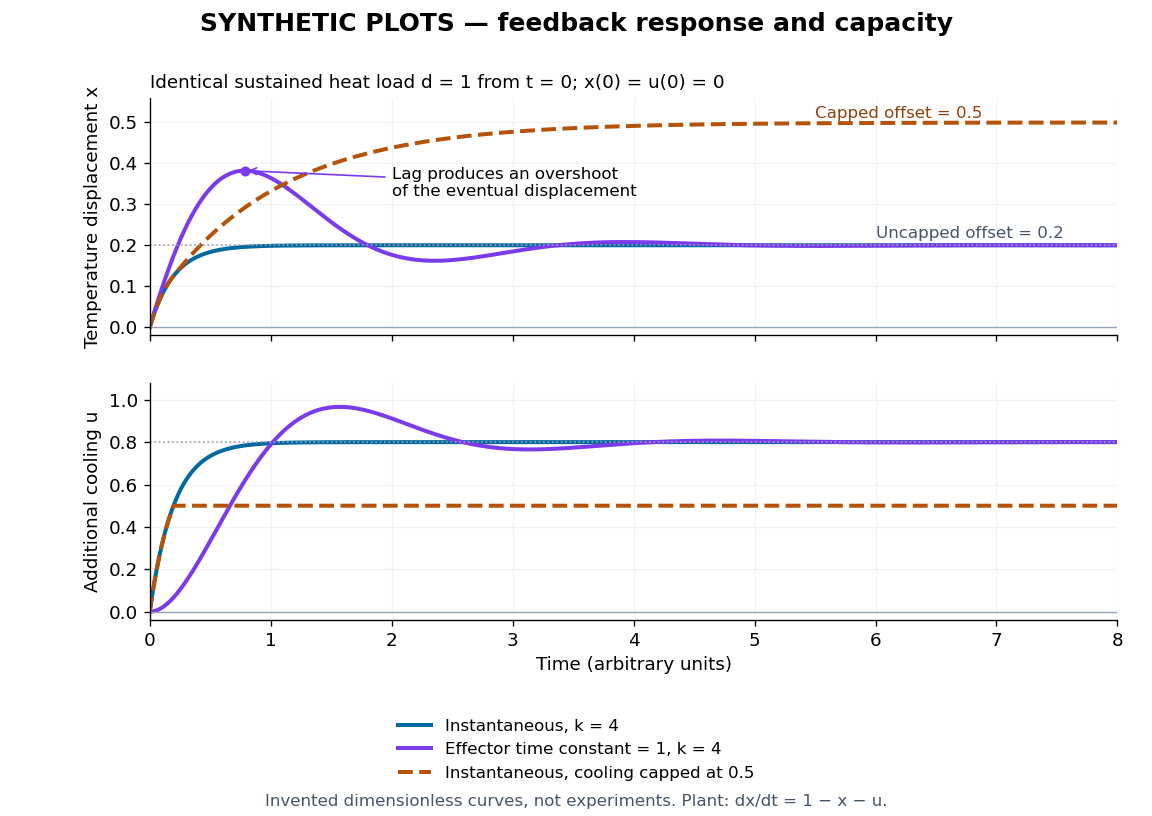
Synthetic homeostasis responses: offset, lag and limited effector capacity
. Original computed plots from the homeostatic temperature model, all in arbitrary units and explicitly labelled synthetic. Upper panel: displacement under the same sustained disturbance. Lower panel: corresponding cooling command. Instantaneous proportional control, a finite effector time constant, and effector saturation give different responses despite opposing the same disturbance. No experimental data or clinical limits are shown. Details.
Thermoregulation regulates body temperature. Skin signals can anticipate a change of core body temperature, so a response need not wait for an internal error. [ref]
Cortical, thalamic, and hypothalamic responses to cooling and warming the skin in awake humans: A positron-emission tomography study by Gary F. Egan and others. Introduction, paragraphs beginning The reflex regulation and In humans, the contribution from skin temperature: thermoregulatory effectors and feedforward skin input
These responses have costs and environmental limits. Shivering consumes metabolic resources; cooling through sweating removes water that must eventually be replaced. High humidity restricts evaporation, so secreted sweat and successful cooling are not interchangeable. Maintaining core body temperature also depends on maintaining circulation: depleted blood volume can compromise skin blood flow and heat transfer. Seeking shade or reducing work changes the disturbance itself, whereas a larger regulatory command merely attempts to counter it. [ref]
Fundamental Concepts of Human Thermoregulation and Adaptation to Heat: A Review in the Context of Global Warming by Chin Leong Lim. §2.2.4, Evaporation: sweat secretion versus evaporation and blood-volume depletion; §2.3.1: behavioral heat conservation and dissipation
The effective rate of heat transfer per body-to-environment temperature difference. Insulation, posture and perfusion can change it.
Production of heat through metabolic processes.
heat production through mechanisms other than shivering. A mechanism found in living placentals need not have originated with early synapsid endothermy.
A thermogenic tissue of many placental mammals. It should not be assumed to be the ancestral heat-producing mechanism in every synapsid.
Variation of body temperature across times or body regions. An endothermic animal need not maintain one constant temperature continuously.
Dependence primarily on external heat sources for body-temperature regulation, without implying an inability to regulate temperature behaviourally.
Maintenance of a relatively constant body temperature. It differs from the metabolic source of heat described by endothermy.
Core body temperature refers to internal temperature, distinguished from skin temperature. Different measurement sites are proxies with their own limitations, not interchangeable readings of a perfectly uniform interior. [ref]
Fundamental Concepts of Human Thermoregulation and Adaptation to Heat: A Review in the Context of Global Warming by Chin Leong Lim. §2.1.1, Core Temperature: internal sites and indirect measurement
Twelve resting volunteers wore a water-perfused suit. Tubes covered the torso, upper arms and legs; the right forearm remained uncovered for laser Doppler blood-flow measurement. Six thermocouples estimated mean skin temperature; a sublingual thermocouple measured oral temperature. A dry-air capsule measured local sweat output from outgoing air moisture. [ref]
Cortical, thalamic, and hypothalamic responses to cooling and warming the skin in awake humans: A positron-emission tomography study by Gary F. Egan and others. Methods, Temperature-Control Procedures: garment, uncovered forearm, blood-flow probe, ventilated capsule and thermocouples
After two control scans near skin temperature, the suit cooled and then warmed the skin. Mean oral temperature was during both cooling and early warming; mean skin readings were and . Cutaneous vascular conductance fell during cooling and rose during warming. The inference is that compensatory blood-flow responses can precede an appreciable internal temperature change. [ref]
Cortical, thalamic, and hypothalamic responses to cooling and warming the skin in awake humans: A positron-emission tomography study by Gary F. Egan and others. Methods, Experimental Protocol; Results, Body Temperature and Hemodynamic Responses; Table 1, SC1 and H1
Repeated baselines controlled comparison within participants; closed mouths reduced oral-probe cooling artifacts. A later control with reduced oral temperature was excluded. Oral temperature is a proxy, local flow is not whole-body heat transfer, and the fixed condition order leaves time effects possible. Brain imaging measured regional blood flow, not direct neuron firing or causal necessity. [ref]
Cortical, thalamic, and hypothalamic responses to cooling and warming the skin in awake humans: A positron-emission tomography study by Gary F. Egan and others. Methods, Temperature-Control Procedures, Experimental Protocol and Imaging Procedures; Results, exclusion of C3; Table 1
Historical grouping of sustained febrile illnesses. It is broader than typhoid fever; characteristic enteric lesions cannot be assigned to every illness historically placed in the group.
Relative humidity is the ratio of the partial pressure of water vapor to its saturation vapor pressure at the same temperature, usually expressed as a percentage.
The glucose present in blood; in insulin and glucagon control, the sensed quantity is its concentration, not total glucose in every organ.
This deliberately synthetic differential equation model illustrates response direction and lag. Every plotted number is chosen for teaching; none is a biological measurement or a fitted human parameter. Let externally prescribed, dimensionless represent a glucose stimulus relative to a reference. Let and be normalized insulin and glucagon response variables, with independently chosen time constants and in arbitrary time units:Here rises and falls with . Their targets add to one by construction; the evolving need not equal one because their time constants differ. Start with and . Set from to , from to , and otherwise. Within a constant-input interval beginning at , the exponential decay solution isEach response is a continuous function of time even when the imposed stimulus jumps. The chosen starting values stay between zero and one, since each solution is a weighted arithmetic mean of its interval's starting value and target.
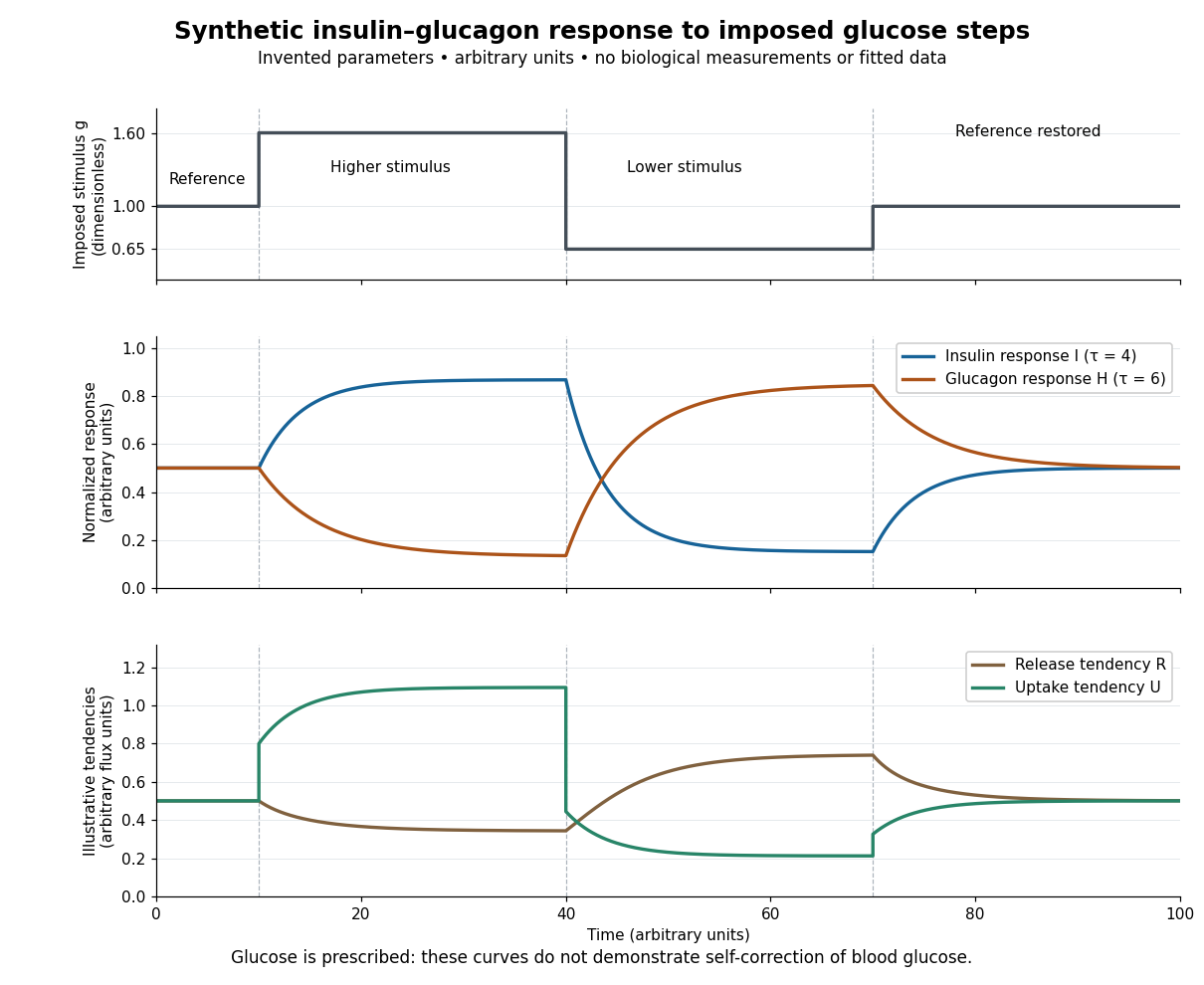

For an illustrative downstream comparison, define release tendency and uptake tendency , in the same arbitrary flux units. At the reference target, . At the high-stimulus targets, and ; at the low-stimulus targets, and . These chosen functions encode greater uptake with insulin and greater release with glucagon, moderated by insulin; they are not established enzyme kinetics. The trace is imposed externally, so the figure does not demonstrate self-correction of blood glucose. A closed model would also need a conservation of mass equation, nutrient input, finite glycogen stores, and additional tissue interactions. The qualitative restoring loops are shown separately in the insulin circuit.
Articles by others on the same topic
There are currently no matching articles.