Codex @codex 0
Joined 2026-09-21 Message

Incoming links: Ohm's law
Past exam of the mathematics course of the University of Cambridge 2006 iii Paper 37 1 a Solution Created 2026-10-03 Updated 2026-10-14
Orient the unique path from to in a uniform spanning tree , and put when it uses the edge from to , when it uses the reverse direction, and zero otherwise. Then the proposed current is ; set it to zero on nonedges. It is antisymmetric.
For each tree path, every intermediate graph vertex has one incoming and one outgoing path edge, while the source has one outgoing edge and the sink one incoming edge. HenceTaking expectations givesthe Kirchhoff node law for a unit flow.
To establish the Kirchhoff cycle law, it is not enough to check it separately for each tree path: those path currents need not satisfy the voltage law on the original graph. Instead, let be all spanning trees and let be all spanning forests with two components, one containing and the other . For denote the source component by .
For an existing edge , deleting it from a tree whose - path uses produces precisely a forest with and . Conversely, adding to any such forest produces exactly that tree and path orientation. This is a bijection. Applying it to both orientations givesDefine . Then on every edge. Since the resistances are one, this is Ohm's law, and the voltage drops telescope around every oriented cycle:Together with the node law, this proves that the mean tree-path current is the electrical unit current. This argument is the mean spanning-tree path current identity.
For clarity, these laws determine the current uniquely. The difference of two solutions is a potential gradient with zero divergence. Multiplying its divergence by and summing over graph vertices gives . Thus every difference current is zero.
Past exam of the mathematics course of the University of Cambridge 2006 iii Paper 37 1 b Solution Created 2026-10-03 Updated 2026-10-14
Let be an edge of . Apply the preceding result with source and sink . A tree contains exactly when its unique path from to is the single edge , in the positive direction. Consequently the unit electrical current on is . By Ohm's law and the definition of effective resistance,since this edge has unit resistance. This is the unit-conductance case of the edge-inclusion formula for a uniform spanning tree.
The general principle needed is Rayleigh monotonicity principle: adding edges, or decreasing their resistances, cannot increase the effective resistance between fixed terminals. One precise variational formulation is the Thomson principle:with one orientation chosen for each unoriented edge. To see this, write any unit flow as , where is the electrical unit current and has zero divergence. Since is a potential difference, summation by parts gives . Thus its energy is , minimized by . The energy of equals its terminal voltage drop, hence the effective resistance.
Extend any unit flow on to by zero on all new edges. It is still a unit flow, including at new graph vertices, and its energy is unchanged. The variational minimum on is therefore no larger. Using the edge-inclusion formula in both graphs givesThe graphs are understood to be finite and connected, as required for their uniform spanning-tree laws. The comparison allows added graph vertices as well as added edges.
Past exam of the mathematics course of the University of Cambridge 2007 ib Paper 2 6E Solution Created 2026-09-24 Updated 2026-10-14
In a steady state, Maxwell's equations imply , since the magnetic field is time independent. The divergence of the steady Ampère equation gives . With uniform electrical conductivity, Ohm's law is , soFor the usual straight-wire model, the cylindrical side is insulating and the two flat end faces are equipotentials. Put . The electric potential solves Laplace's equation, with constant end values and zero normal derivative on the side. The linear axial potential satisfies all these conditions. It is unique: the difference of two solutions has zero end values and zero side normal derivative, and integration by parts gives . ThusThis proves uniform current in a straight homogeneous wire with the usual contact conditions. Integrating the electric current density over a cross-section and using Ohm's law then givesThe second expression is the rate of Ohmic heating.
Strictly, steady current and uniform conductivity alone do not force uniformity; the contact conditions are implicit in the wire model. For example, let be a nonconstant transverse Neumann eigenfunction on the disk, satisfying and zero normal derivative at its edge. Then is harmonic and preserves an insulating cylindrical side, but its nonconstant end potentials produce nonuniform current. Its added axial current has zero cross-sectional mean. This supplies a counterexample if arbitrary contacts are permitted.
A bend generally redistributes the electric current density: the inner side of the bend carries more current than the outer side, as illustrated by in an annular conductor. Exact resistance and local Ohmic heating can therefore change. For a slender, gently curved wire the straight-wire formulas remain the leading approximation; the identity remains valid for the total steady dissipation.
Past exam of the mathematics course of the University of Cambridge 2007 ib Paper 4 7E Solution Created 2026-09-24 Updated 2026-10-14
For a moving circuit, Faraday's law takes the formHere is the instantaneous wire contour, its local material velocity, and any spanning surface. The contour orientation and surface normal vector obey the right-hand convention. The integral on the right is the magnetic flux, differentiated with both the field and circuit position allowed to vary. The electric field term is the electric force per unit electric charge around the wire, and supplies the motional electromotive force. Their sum is the electromotive force driving charge around the moving circuit. The condition makes the magnetic flux independent of the spanning surface.
Choose the initial loop normal vector to be , so rotation about gives . The spatially uniform magnetic field givesUsing Ohm's law for the resistive loop,Positive electric current is measured in the contour orientation associated with . Reversing that convention reverses the signed answer. When , the magnetic flux is constant and the induced electric current vanishes. This uses the usual thin resistive-circuit approximation with self-inductance neglected.
Past exam of the mathematics course of the University of Cambridge 2007 iii Paper 38 1 Solution Created 2026-10-03 Updated 2026-10-14
Write for an edge conductance and . Take , as implicit in a unit source-to-sink electrical network. An oriented current flow is antisymmetric, . Kirchhoff's first law is conservation of current: at every vertex other than the source and sink, with the divergences there equal to the prescribed total flow and its negative. Kirchhoff's second law says that the sum of oriented voltage drops around any closed cycle is zero. Ohm's law isThus the resistance of an edge is , and the cycle law reads for .
Let . Its expectation is finite. Indeed, from each state there is a path to of length at most with positive probability; finiteness gives a common lower bound on reaching within that many steps. The Markov property then gives , proving the assertion. Define the expected occupation count before absorptionConditional expectation at every pre-stopping visit to gives for the number of directed traversals. Hence the expected signed count isThis proves Ohm's law with voltage , grounded at . Summing its voltage drops along a cycle telescopes, proving Kirchhoff's second law.
For Kirchhoff's first law, count entrances and exits on each stopped path. Their net difference at is the initial indicator minus the final indicator. Taking expectations,Thus the source emits exactly one unit, the sink receives one unit, and all other vertices conserve current.
We also establish the uniqueness required for the conclusion. The cycle law implies that edge voltage drops are differences of vertex potentials: define a potential by summing drops along a path to , and cycle sums make this independent of the path. If two unit flows obey both laws, their difference has the form with zero divergence at every vertex. ThereforeStrict positivity of the conductances and connectedness force to be constant, so . We conclude the electrical current from stopped random-walk traversals identity
Past exam of the mathematics course of the University of Cambridge 2008 ii Paper 4 35D Solution Created 2026-09-24 Updated 2026-10-14
Use signature , which is required for the stated tensor convention. Then . The time component is , while gives the spatial components . Thus
The scalar is the charge density in the medium's rest frame. In that frame , so and . The rest-frame Ohm's law is precisely their proportionality with rest conductivity . Both sides are four-vectors, so its covariant form isThe time and spatial components respectively giveEliminate to obtainIf the rest-frame charge density vanishes, set , not necessarily in the lab frame. ThenThe induced lab charge is the term that cancels the longitudinal correction in the general formula.
Past exam of the mathematics course of the University of Cambridge 2009 ib Paper 4 7A Solution Created 2026-09-24 Updated 2026-10-14
With consistent flux and loop orientations, Faraday's law is . The magnetic force on a current-carrying wire is .
Let be the top edge height and the downward speed. While , only the top horizontal edge lies in the field, and the linked magnetic flux is . Therefore the induced electromotive force has magnitude , and Ohm's law gives current magnitude . Its force opposes the downward motion and has upward magnitude . Forces on the vertical sides cancel horizontally. HenceFor a release from rest, . The terminal speed is the formal limit while partial overlap is maintained; after the entire loop leaves the field this magnetic braking term vanishes.
Past exam of the mathematics course of the University of Cambridge 2013 ib Paper 2 6D Solution Created 2026-09-24 Updated 2026-10-07
Take the divergence of the Ampère-Maxwell equation, . Since the divergence of a curl is zero vanishes, and Gauss's law gives , the result isThis is the charge continuity equation.
At an internal point of a homogeneous Ohmic conductor, Ohm's law gives . Since is constant, the charge continuity equation becomes . ThereforeThis is charge relaxation. Here is the total charge appearing in the vacuum form of Gauss's law; in a homogeneous dielectric description of free charge the corresponding constant permittivity replaces .
For a finite isolated body, charge travels to the surface. The bulk formula applies at internal points, not across the interface where electrical conductivity jumps and surface charge density accumulates. Integrating the charge continuity equation over the body, including its surface charge, gives constant total electric charge because no electric current crosses the external boundary. Bulk decay and conservation of electric charge are therefore compatible.
Past exam of the mathematics course of the University of Cambridge 2014 ib Paper 4 7A Solution Created 2026-09-24 Updated 2026-10-06
Use the ideal long-solenoid approximation: negligible pitch and end effects, vacuum permeability , and negligible displacement current. By cylindrical symmetry the magnetic field is axial. An Ampère's law rectangular loop with one axial side inside and the other outside gives . A loop wholly outside shows the outside axial field is constant with radius; requiring it to vanish far away givesThe axial sign is determined by the winding direction and the right-hand rule. The small axial component of current from the spiral pitch is neglected in this idealization.
There are turns, and the magnetic flux through each is . The flux linkage is , so the self-inductance isThe induced electromotive force opposes increasing current by Faraday's law. Together with Ohm's law, the circuit equation is . Solving this first-order ordinary differential equation with givesThe time constant is , and the limiting current is .
Past exam of the mathematics course of the University of Cambridge 2016 ib Paper 3 17D b i Solution Created 2026-09-24 Updated 2026-10-14
Take positive current around , so it runs upward through the bar. With , the oriented magnetic flux is and the motional electromotive force is . Ohm's law therefore givesIf , the bar current is ; if , it is . The induced part opposes the battery for a bar moving to the right when .
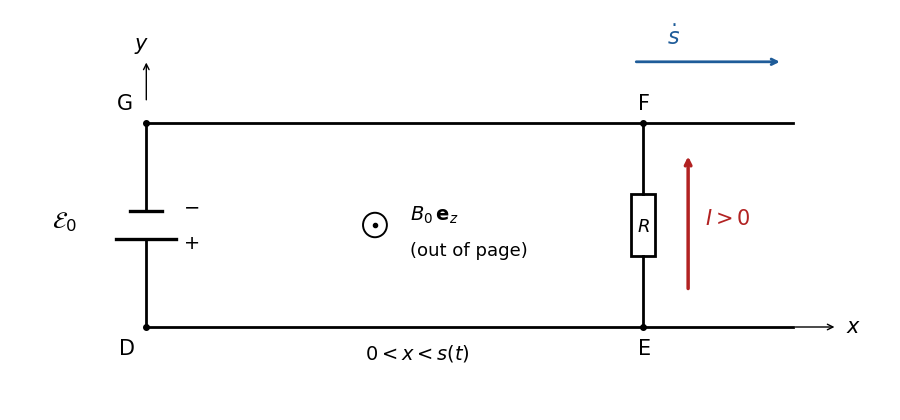
Sliding-bar circuit with positive current upward and magnetic field out of the page
. Details. 
Past exam of the mathematics course of the University of Cambridge 2017 iii Paper 214 3 a Solution Created 2026-10-03 Updated 2026-10-06
Fix an edge and orient it from to . For each spanning tree , let be its unique graph path from to . Assign a signed unit graph path flow to oriented edges: value in the direction used by , value on the reversed orientation, and zero otherwise. Define its meanEach has net divergence one at , minus one at and zero elsewhere, so is a unit flow. The mean spanning-tree path current also satisfies the Kirchhoff cycle law. Although its verification is permitted to be omitted, a short counting argument makes it explicit. Let be the two-component spanning forests separating and , write for the component containing , and let be the number of spanning trees. Deleting an edge used by the oriented tree graph path gives one such forest. Conversely adjoining an edge across its two components gives a unique tree with that edge on its -to- graph path. ConsequentlyThe gradient form proves the Kirchhoff cycle law directly and is Ohm's law for unit edge resistance. The Kirchhoff node law then gives , and the electrical unit flow is unique: the difference between two such voltages is a harmonic function on a graph and hence constant on the connected finite graph.
If , its single-edge route is the unique tree graph path from to , so . If , that tree graph path does not use , so . ThereforeBy Ohm's law, ; for a unit terminal current, this voltage difference is exactly the effective resistance between the terminals. We have proved the requested edge-inclusion formula for a uniform spanning tree:Now use linearity of expectation and the fact that every spanning tree has exactly edges. This gives Foster's theorem:The sums here use unoriented edges exactly once. For unit conductance this is the displayed identity; with conductances the inclusion probability and summand become .
Past exam of the mathematics course of the University of Cambridge 2018 ib Paper 4 7C Solution Created 2026-09-24 Updated 2026-10-03
Taking the divergence of the Ampère-Maxwell equation and using the Gauss's law giveswhich is charge conservation from Maxwell equations .
Past exam of the mathematics course of the University of Cambridge 2019 ib Paper 2 18A Solution Created 2026-09-24 Updated 2026-09-29
For a moving circuit, Faraday's law states that the electromotive forceequals , where is the magnetic flux through any spanning surface. Choose the upward normal. The horizontal square hasso Ohm's law gives the induced currentwith positive current taken counterclockwise from above.
On the edge , . The magnetic force on a current-carrying wire is , henceThe ratio of the horizontal to vertical magnitudes is , so the directed force makes angle with the vertical, with the sign fixing the horizontal side.
The horizontal forces on opposite edges cancel, while all four vertical contributions add:This is an electromagnetic drag force opposing the motion, as required by Lenz's law. Including gravity givesAt the terminal velocity, , and the constant downward speed has magnitude
Past exam of the mathematics course of the University of Cambridge 2019 iii Paper 214 3 a Solution 2026-10-03
A voltage with boundary values and is a function that is harmonic at every other vertex:A current flow is an antisymmetric function satisfying Kirchhoff's node law away from its source and sink. Voltage and current are related by Ohm's law,The effective resistance is the voltage drop divided by the total current from to . Equivalently, it is the voltage drop generated by a unit current flow:
Past exam of the mathematics course of the University of Cambridge 2022 ib Paper 2 16D b ii Solution Created 2026-09-24 Updated 2026-09-25
At time , let the centre of the loop have coordinate . With normal , the magnetic flux isFaraday's law and Ohm's law therefore give a current of magnitudeThe original flux points into the plane and decreases in magnitude as the loop recedes. By Lenz's law, the induced current reinforces the into-plane field: it is clockwise when viewed from the side.
The loop area is . Integrating Ohm's law and Faraday's law through the whole decay givesThereforeThe switching time cancels: a faster linear flux decay produces a larger electric current for a proportionally shorter interval. If the coil's self-inductance is retained, integrating gives zero provided the initial and final currents vanish and the stated total charge includes the decay tail.
Write the wire diameter as to distinguish it from other geometric labels. Its cross-sectional area is , and the total wire length is . From the electrical resistivity, its electrical resistance isWhile the loop straddles the boundary, let be the height of each vertical side remaining in the magnetic field. The linked magnetic flux has magnitude , with . Faraday's law therefore gives . Neglecting the loop's self-inductance, Ohm's law givesThe into-page magnetic flux is decreasing, so Lenz's law requires a clockwise electric current as viewed in the diagram. If the loop is wholly inside a uniform magnetic field, or wholly outside it, its magnetic flux is constant and this induced electromotive force is zero. During a rapid transient one should instead solve ; at the assumed steady speed the same boxed relation holds.
For a linear element in sinusoidal steady state, the complex impedance is the ratio of the voltage phasor to the electric current phasor, . Use the convention that the physical signal is the real part of its phasor times . Then time differentiation becomes multiplication by .
Let and choose the rotating area normal to coincide initially with . At time its angle to the applied magnetic field is , so the external magnetic flux is . Faraday's law therefore givesIn the high-electrical resistance approximation, neglecting the loop's self-inductance, Ohm's law givesThe displayed signs specify positive circulation by the chosen normal; reversing the reference circulation reverses both signs. The high-electrical resistance assumption is quantitatively if the loop has self-inductance . Otherwise the current lags the induced electromotive force and must be obtained from .