Landau quasiparticles describe the long-lived low-energy excitations of an interacting normal Fermi liquid. Starting from a free Fermi gas, imagine switching on interactions without changing the phase or destroying the one-to-one labelling of low-energy states. The resulting excitation carries the quantum numbers of a dressed particle but has a renormalized energy and interactions with other excitations. Its microscopic wavefunction need not resemble a bare electron state. The occupied momenta define a Fermi surface, and the quasiparticle energy measured from the chemical potential vanishes on that surface.
The Landau quasiparticle energy functional expresses the change near equilibrium in terms of occupation changes:Differentiation gives the energy of one quasiparticle in the distorted distribution. This is a phenomenological expansion around the true interacting ground state, not the assertion that its total energy equals that of independent particles. For an isotropic system, spin-symmetric and spin-antisymmetric components of are expanded in Legendre polynomials. Multiplication by the appropriate Fermi-surface density of states defines dimensionless Landau parameters . The original formulation relates a change in the distribution to the energy shift.[ref]
On the Theory of the Fermi Liquid by Lev Davidovich Landau. Page 70, quasiparticle interaction and distribution variation
Pauli blocking makes the low-energy excitations sharp. The phase space for a quasiparticle to scatter while creating another particle–hole pair shrinks as the Fermi surface is approached, giving the regular three-dimensional low-energy Fermi-liquid quasiparticle lifetimeThus at zero temperature its width is small compared with its excitation energy. The single-particle spectral function has a pole with quasiparticle residue , generally less than one, and an incoherent remainder. In a conventional Fermi liquid the occupation distribution has a discontinuity of height at the Fermi surface, rather than a unit free-particle step.
For an isotropic three-dimensional system, define to include both spins. The quasiparticle density of states determines the low-temperature electronic heat capacity, . In the usual Landau-parameter normalization, the spin response is modified by and the compressibility by . In a Galilean-invariant continuum, ; that particular relation must not be imposed unchanged on a crystal band. A denominator approaching zero signals a possible instability of the assumed normal state.
The same interaction functional and a kinetic equation describe collective zero sound when the excitation frequency exceeds the collision rate. Ordinary first sound is the collision-dominated hydrodynamic limit. The theory organizes thermodynamics, response and transport through a small set of measured effective parameters while explaining why interactions coexist with long-lived fermionic excitations. It is not applicable without qualification in phases where the Fermi-liquid quasiparticle pole disappears or a gap opens over the relevant Fermi surface.
A Wannier-Mott exciton is a bound conduction-band electron and valence-band hole whose envelope extends over many lattice cells. That large radius permits an effective mass description and dielectric screening of the electron–hole attraction. With electron and hole masses , define reduced mass and center-of-mass mass . The bulk relative-motion Hamiltonian is hydrogenic with an appropriate relative permittivity :A semiconductor quantum well confines the electron and hole perpendicular to the plane while leaving approximately free in-plane center-of-mass motion. If the well width is small compared with the bulk exciton Bohr radius, their relative motion becomes quasi-two-dimensional. The ideal zero-width, same-dielectric limit isIts ground-state binding is , compared with in three dimensions, and the ground envelope decays on the scale . Stronger binding follows because confinement prevents the pair from separating in the third direction.
For a finite-width quantum-well exciton, average the Coulomb attraction over the normalized electron and hole confinement envelopes:This smooths the strict planar singularity and changes the binding. The ideal factor four is a useful reference, not a universal value for every real well. Finite barriers, dielectric mismatch, several confinement subbands and nonparabolic valence bands can require a coupled treatment.
Optical absorption creates a nearly zero in-plane center-of-mass wavevector exciton. For the lowest confinement subbands, its line lies approximately atThe discrete bound-state peaks occur below the free electron–hole continuum. Dipole-allowed envelope states have nonzero relative wavefunction at zero separation; the absorption strength also contains the confinement overlap . Confinement can increase the overlap and the binding, making excitonic optical structure more prominent. A perpendicular electric field shifts and separates the confinement envelopes, changing the transition energy and usually reducing their optical overlap: this is the quantum-confined Stark effect.
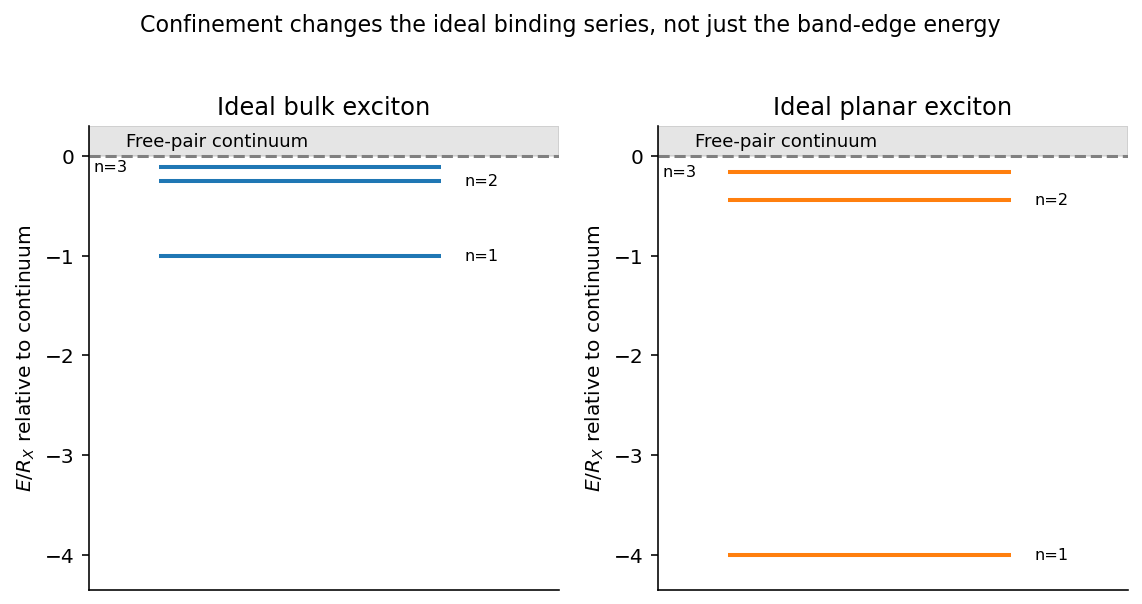

Quantum wells tune both the continuum threshold and the bound-state energy; an optical line shift is not automatically a change in binding alone. The hydrogenic envelope model requires a Wannier-sized state, rather than an exciton localized to one lattice cell.
Experimental tests of BCS theory compare several properties of the same superconducting state. In the conventional weak-coupling setting, phonon-mediated attraction pairs opposite momenta and spins, and the BCS quasiparticle spectrum is . Agreement with a single energy scale and its temperature dependence is more discriminating than observing zero resistance alone.
The superconducting isotope effect tests the lattice's role. Replacing one isotope by another changes ionic masses while leaving the chemical valence nearly unchanged. Phonon frequencies scale approximately as , so a weak-coupling phonon mechanism predicts with when other parameters stay fixed. The shift was measured in mercury before the microscopic pairing theory was developed.[ref]
Isotope Effect in the Superconductivity of Mercury by Emanuel Maxwell. 1950 primary report, transition-temperature comparison of mercury isotopes
Deviations from can result from Coulomb, anharmonic and strong-coupling effects; the isotope observation supports lattice-mediated pairing without uniquely proving every assumption of the simplest model.Thermodynamic measurements test the gapped excitations and condensation energy. An isotropic fully gapped superconductor has exponentially small low-temperature electronic heat capacity, rather than the normal linear law. At the transition the weak-coupling BCS thermodynamic ratios areHere means the electronic contribution after subtracting the lattice background. The gap closes at , and the same framework predicts the temperature dependence of penetration depth and thermodynamic critical field. These quantities were quantitative comparisons in the original theory.[ref]
Theory of Superconductivity by John Bardeen and others. Abstract and thermodynamic discussion: energy gap, specific heat and penetration depth
Electron tunnelling measures the excitation spectrum more directly. A normal-metal–insulator–superconductor junction has, at sufficiently low temperature and nearly constant tunnelling matrix element, proportional to the superconducting density of states at :The suppression below the gap and enhancement at its edges test the BCS electronic density of states. Giaever's thin oxide-barrier junction measurements established such energy-gap structure.[ref]
Energy Gap in Superconductors Measured by Electron Tunneling by Ivar Giaever. Physical Review Letters 5, 147–148; tunnel-current and differential-conductance measurements
For a junction between two superconductors the threshold involves the sum of their gaps, so it must not be read as a normal-metal single-gap spectrum without accounting for the two electrodes.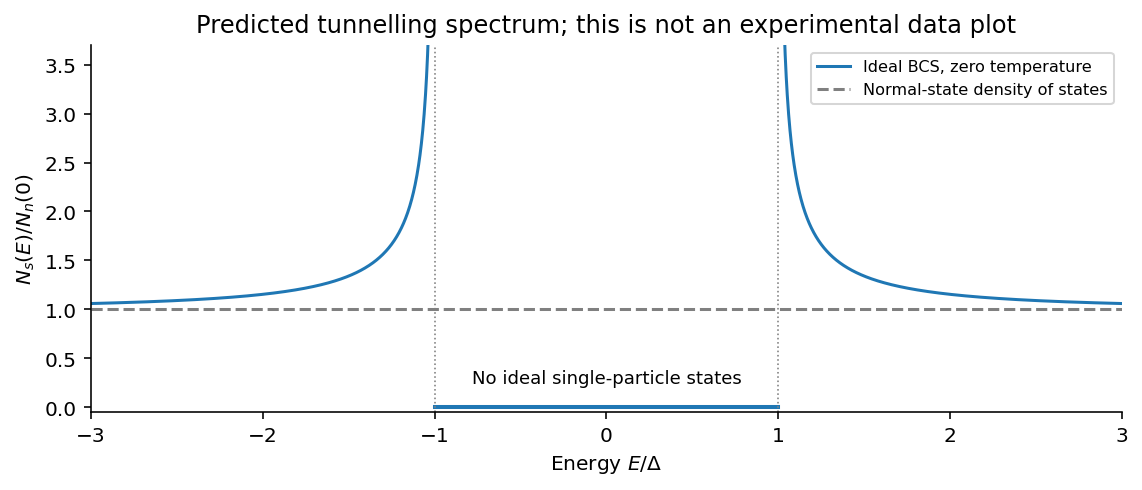
Ideal BCS density of states illustrating gap-edge spectroscopy; model prediction, not experimental measurements
. Details. 
Nuclear spin-lattice relaxation supplies a phase-coherence-sensitive test. In the conventional s-wave case, the Hebel-Slichter coherence peak just below is followed by a falling rate at lower temperature. Density of states alone is not enough: the BCS coherence factors enter the transition matrix elements. The contrast between nuclear relaxation and ultrasonic attenuation was explained using the paired state, unlike a simple two-fluid population model.[ref]
Nuclear Spin Relaxation in Normal and Superconducting Aluminum by L. C. Hebel and Charles Pence Slichter. Abstract: field-cycling method and comparison of nuclear relaxation with ultrasonic absorption
Finally, magnetic flux quantization in units and Josephson effects support a coherent charge- condensate. Those observations establish pairing and phase coherence more broadly; their existence alone does not specify a phonon mechanism or an isotropic weak-coupling gap. The converging isotope, spectroscopic, thermodynamic and coherence-factor tests support conventional BCS superconductivity, with explicit limits to its simplest universal ratios.
Articles by others on the same topic
There are currently no matching articles.