The quantum variational principle turns the ground-state problem into minimization of a Rayleigh quotient:The Hamiltonian must be a self-adjoint operator bounded below, and the nonzero trial state must have finite form energy. Expanding a normalized trial state in exact energy eigenstates gives , a weighted average no smaller than . Equality requires support only in the ground-state eigenspace. The spectral version also accommodates continuous spectrum; a lowest normalizable eigenstate is not required merely to bound the spectral infimum.
The variational method chooses a trial family with the correct boundary conditions, fermionic exchange symmetry and other required quantum numbers, evaluates its energy and minimizes over its parameters. It gives an upper bound on ground-state energy. Enlarging a nested trial family can only improve or preserve its optimal bound. A low energy does not by itself establish a highly accurate wavefunction, especially near degeneracy; energy errors are second order in small admixtures orthogonal to a nondegenerate exact ground state.
For example, a normalized Gaussian trial for a one-dimensional quantum harmonic oscillator is , with . Its energy isThe two terms balance kinetic localization cost against the potential cost of spreading out. This Gaussian variational energy for the harmonic oscillator happens to attain the exact answer because the family contains the exact ground state.
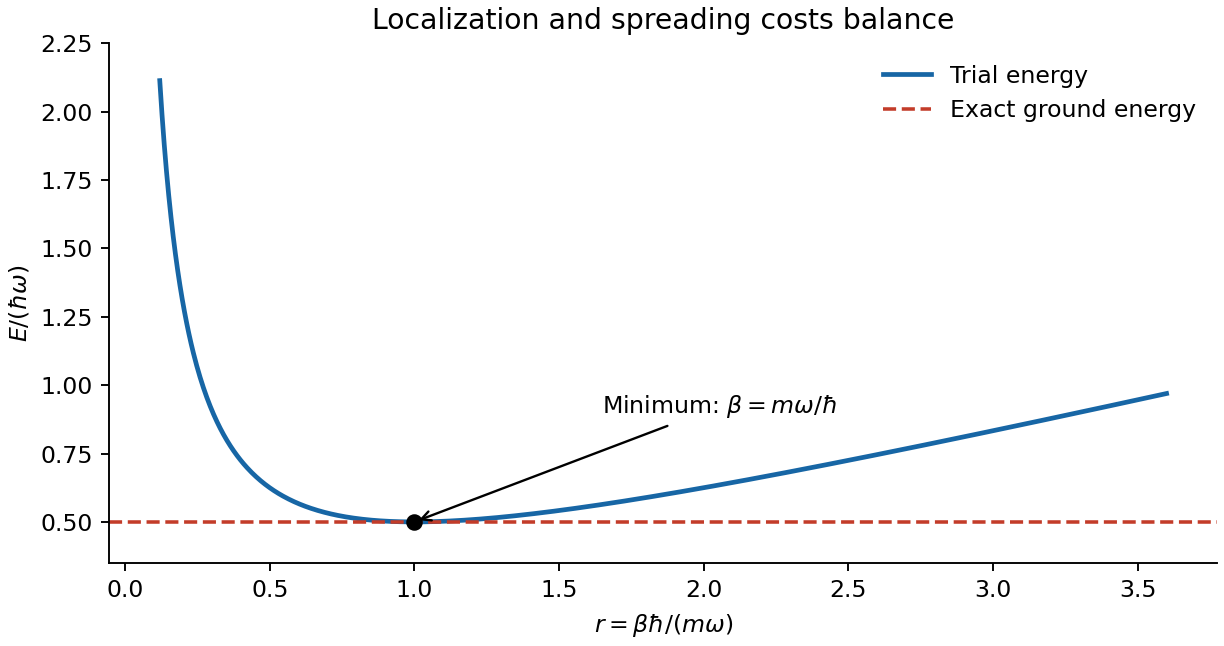
Gaussian variational energy and its exact harmonic-oscillator minimum
. Details. A trial expansion in a finite, possibly nonorthogonal basis gives the generalized eigenvalue problem , with and . Its lowest Ritz value minimizes the quotient in that subspace. For excited states, the excited-state variational constraint imposes exact orthogonality to the lower eigenstates to obtain a corresponding upper bound; the Courant–Fischer min-max principle yields upper bounds for ordered Ritz eigenvalues from a common subspace. orthogonality only to an independently approximate ground state does not automatically provide an excited-state bound: residual true-ground-state contamination can lower the trial energy below the desired excited energy. Symmetry can impose exact orthogonality when the relevant states have different symmetry sectors.
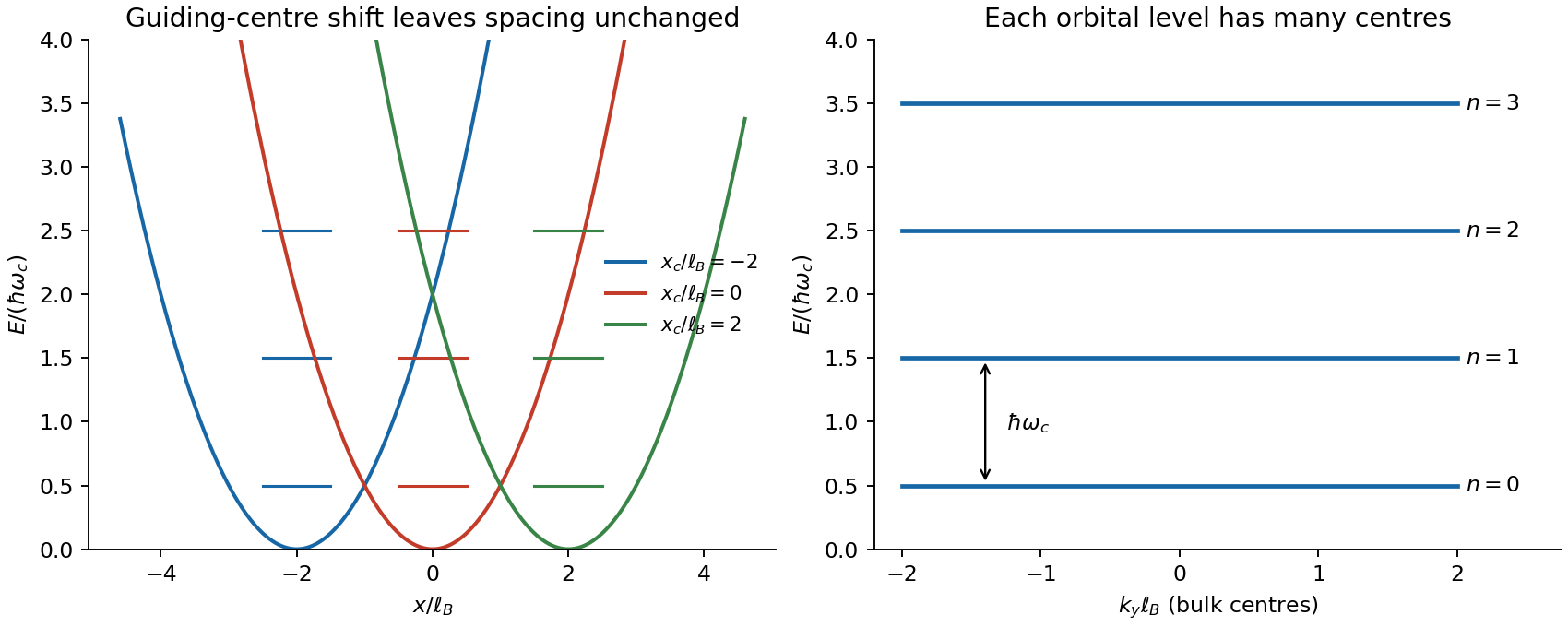
For a particle of charge and mass in a uniform magnetic field , minimal coupling replaces momentum by . Choose Landau gauge and first restrict motion to the plane. Since is conserved,These Landau levels quantize the classical cyclotron motion. The wavefunctions are harmonic-oscillator functions centred at , multiplied by . Changing shifts the guiding centre without changing the energy. Gauge-dependent labels such as are not themselves observables; the level spacing and degeneracy are gauge independent. The magnetic length is the transverse orbital scale.
For a large rectangle of sides , periodicity along gives . Requiring centres inside the sample gives, for each orbital level and each specified spin state,Thus each magnetic flux quantum supplies one guiding-centre state. The continuum bulk count neglects boundary corrections; magnetic periodic conditions on a torus require integer flux count. A finite confining edge lifts the simple flat guiding-centre spectrum near that edge.
spin adds a Zeeman term. For electrons with gyromagnetic factor , its contribution is , with and . If and the orbital mass is , the branches become and : the lowest combined level has one spin branch, while positive levels coincide in pairs. In a material, effective mass and effective need not give that coincidence.
In three dimensions, free motion parallel to adds , so each orbital index labels a one-dimensional continuum rather than an isolated three-dimensional energy. Resolved magnetic quantization requires the spacing to exceed substantial thermal and disorder broadening. The changing occupation of these levels underlies magnetic quantum oscillations; in two dimensions their degeneracy and filling are central to the integer quantum Hall effect. These statements assume nonrelativistic, approximately independent particles, rather than arbitrary interacting or disordered spectra.
A helium atom has two electrons bound to nuclear charge . In the nonrelativistic fixed-nucleus approximation, using atomic units,The last term couples the electrons, so a product of independent hydrogenic orbitals is not an exact solution. The dominant ground configuration is . Its spatial wavefunction is symmetric, so Fermi antisymmetry requires the spin singletA triplet cannot put both electrons in the same spatial orbital. Correlation changes the exact spatial function, including its dependence on , while preserving this ground-state symmetry.
A useful helium variational effective charge takes normalized orbitals for both electrons and multiplies their product by . The energy in Hartree units isThe reduced effective charge expresses screening. Neglecting repulsion gives , while its expectation in the unscreened product gives ; optimizing the orbital improves that trial estimate. The exact ground energy is lower than the optimized product energy, since the product omits explicit electron correlation. This calculation keeps nuclear charge two in ; only the trial orbital parameter is varied.
For a singly excited helium state with distinct orthonormal orbitals and , the spatial combinations areThe symmetric pairs with the antisymmetric spin singlet, while antisymmetric pairs with the symmetric spin triplet. With the same orbitals, their leading energies areHere is the direct Coulomb integral and is the exchange integral. The latter is positive for the Coulomb interaction, so the triplet is lower for this fixed-orbital comparison. singlet-triplet exchange splitting in helium arises from antisymmetry and spatial correlation in the Coulomb interaction, not from inserting a separate classical spin-spin force. Spin-singlet helium states are parahelium; spin-triplet helium states are orthohelium. The two spectra approximately form separate families because the leading electric dipole operator does not change total spin.[ref]
The lowest terms are and , with the triplet lower. The configuration gives and , where the odd parity allows singlet to connect to the even-parity ground singlet by an electric dipole transition. Both levels lack an allowed direct electric dipole decay to : the triplet is spin forbidden, and singlet is forbidden by orbital angular momentum and parity. This explains helium metastability without implying an infinite lifetime once weaker radiative processes or collisions are allowed.
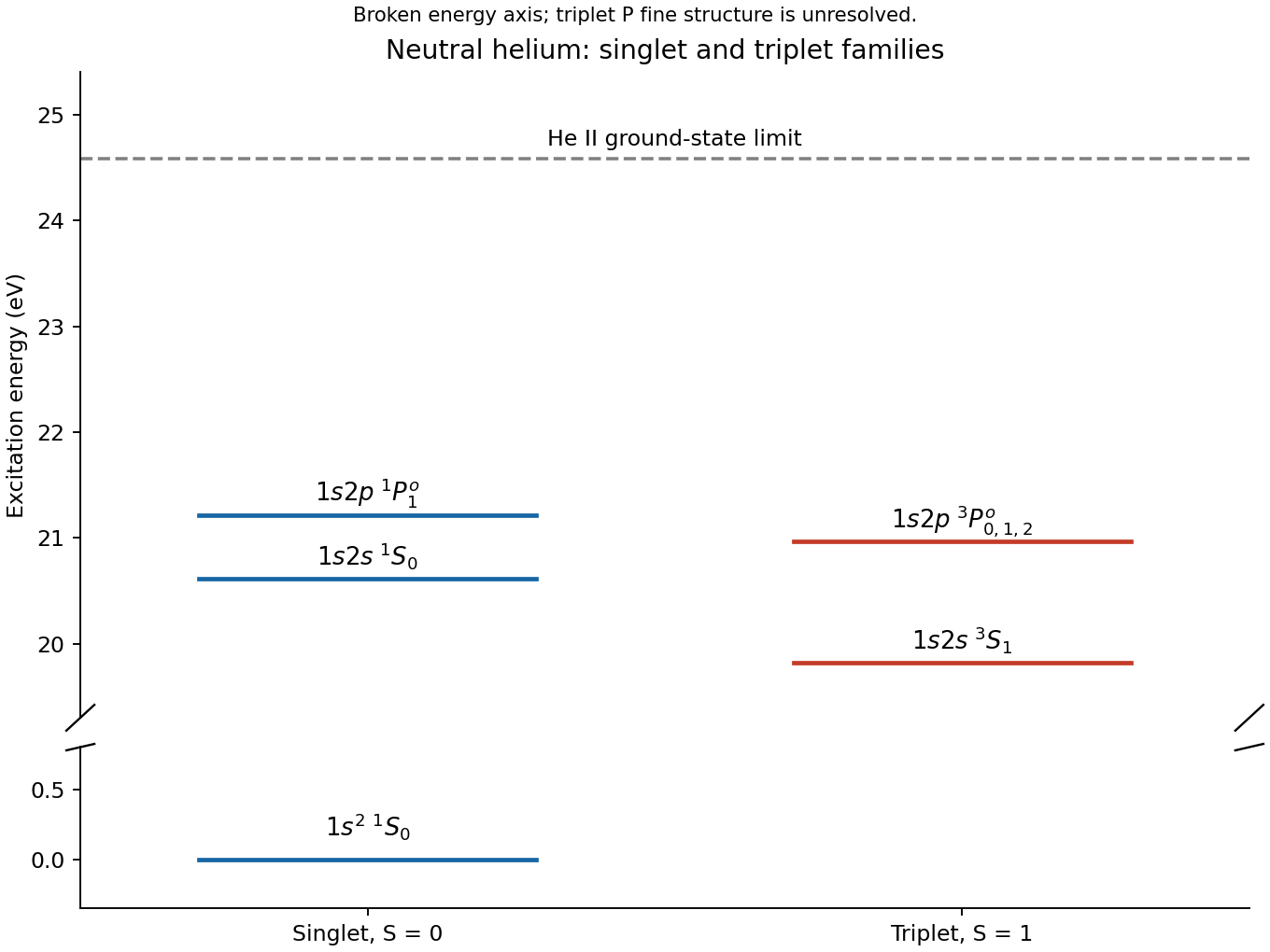


The observed first excitation energies are approximately and for the triplet and singlet, respectively. Higher singly excited Rydberg series approach the He II ground-state ionization threshold; doubly excited states above that threshold can autoionize and are not all stable bound excited levels.[ref]
Energy Levels of Neutral Helium by National Institute of Standards and Technology. 1s2s and 1s2p configuration rows; He II ground-state limit at 198310.6691 inverse centimetres
Articles by others on the same topic
There are currently no matching articles.