Original paper: Advanced Quantum Physics, 27 May 2015; physical PDF pages 343–346.
The Pauli exclusion principle allows each one-particle magnetic substate only once, since the fermions share the other quantum numbers. To maximize the total angular momentum projection, occupy , givingThe corresponding Slater determinant is a highest-weight vector: every attempted raising operation either tries to exceed or duplicates an occupied substate and vanishes. Therefore it belongs to a multiplet with , not the distinguishable-particle value . Equivalently, four particles in a six-state shell have two holes whose maximum angular momentum projection is . The general maximum total angular momentum of equivalent fermions is for .
At incident wave number , low kinetic energy means : the de Broglie wavelength is much larger than the scattering region. A generic finite-range scatterer can then be described to leading order without resolving its angular structure. In partial-wave scattering, this is leading S-wave scattering. The spherical harmonic is constant, whereas the centrifugal term impedes penetration to the potential for .
For a central potential with regular threshold behaviour, the finite-range partial-wave threshold law gives . Thuswhich is independent of scattering angle. For finite nonzero scattering length , and is isotropic. The potential range and scattering length are different quantities. The claim describes the generic leading S-wave scattering limit; tuned vanishing S-wave scattering amplitude or exceptional threshold resonances require separate analysis rather than a universal angular conclusion.
Closed and subshells have . In the open subshell, three electrons can have parallel spins in , and the fourth must have the opposite spin, giving maximum . Treating the shell as two holes gives the same allowed terms as ; at this spin, antisymmetry permits , rather than . One can also see by placing the fourth electron in .
Hund's rules therefore select the term. Since four electrons exceed half filling of the six-state subshell, its lowest atomic fine-structure level has the largest :Its zero-field magnetic degeneracy is . The experimentally tabulated neutral-oxygen ground level has precisely this term and .[ref]
The quantum variational principle turns the ground-state problem into minimization of a Rayleigh quotient:The Hamiltonian must be a self-adjoint operator bounded below, and the nonzero trial state must have finite form energy. Expanding a normalized trial state in exact energy eigenstates gives , a weighted average no smaller than . Equality requires support only in the ground-state eigenspace. The spectral version also accommodates continuous spectrum; a lowest normalizable eigenstate is not required merely to bound the spectral infimum.
The variational method chooses a trial family with the correct boundary conditions, fermionic exchange symmetry and other required quantum numbers, evaluates its energy and minimizes over its parameters. It gives an upper bound on ground-state energy. Enlarging a nested trial family can only improve or preserve its optimal bound. A low energy does not by itself establish a highly accurate wavefunction, especially near degeneracy; energy errors are second order in small admixtures orthogonal to a nondegenerate exact ground state.
For example, a normalized Gaussian trial for a one-dimensional quantum harmonic oscillator is , with . Its energy isThe two terms balance kinetic localization cost against the potential cost of spreading out. This Gaussian variational energy for the harmonic oscillator happens to attain the exact answer because the family contains the exact ground state.
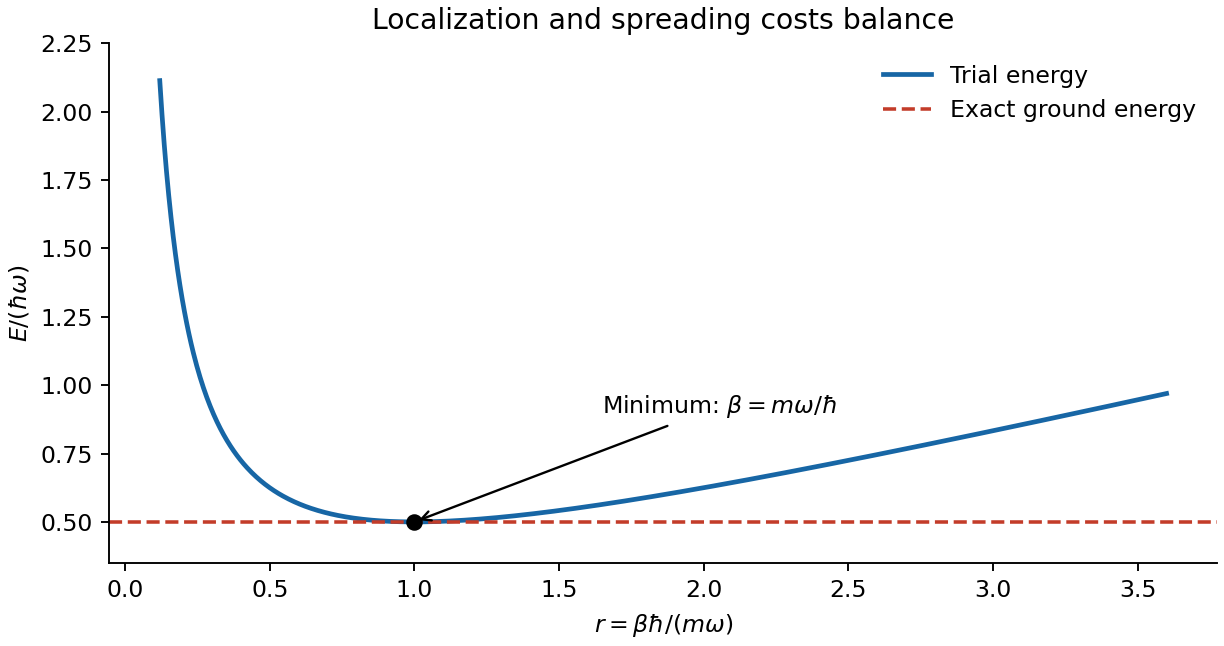
Gaussian variational energy and its exact harmonic-oscillator minimum
. Details. A trial expansion in a finite, possibly nonorthogonal basis gives the generalized eigenvalue problem , with and . Its lowest Ritz value minimizes the quotient in that subspace. For excited states, the excited-state variational constraint imposes exact orthogonality to the lower eigenstates to obtain a corresponding upper bound; the Courant–Fischer min-max principle yields upper bounds for ordered Ritz eigenvalues from a common subspace. orthogonality only to an independently approximate ground state does not automatically provide an excited-state bound: residual true-ground-state contamination can lower the trial energy below the desired excited energy. Symmetry can impose exact orthogonality when the relevant states have different symmetry sectors.
For a particle of charge and mass in a uniform magnetic field , minimal coupling replaces momentum by . Choose Landau gauge and first restrict motion to the plane. Since is conserved,These Landau levels quantize the classical cyclotron motion. The wavefunctions are harmonic-oscillator functions centred at , multiplied by . Changing shifts the guiding centre without changing the energy. Gauge-dependent labels such as are not themselves observables; the level spacing and degeneracy are gauge independent. The magnetic length is the transverse orbital scale.
For a large rectangle of sides , periodicity along gives . Requiring centres inside the sample gives, for each orbital level and each specified spin state,Thus each magnetic flux quantum supplies one guiding-centre state. The continuum bulk count neglects boundary corrections; magnetic periodic conditions on a torus require integer flux count. A finite confining edge lifts the simple flat guiding-centre spectrum near that edge.
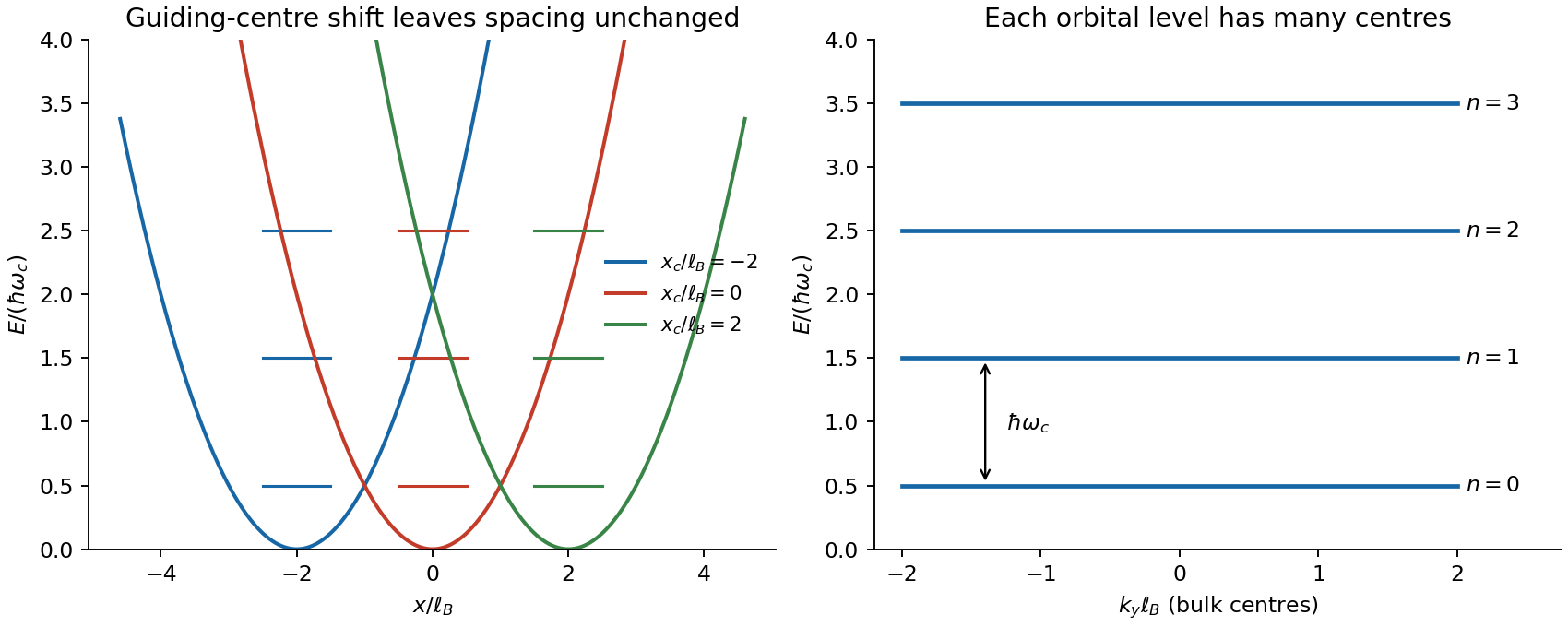
spin adds a Zeeman term. For electrons with gyromagnetic factor , its contribution is , with and . If and the orbital mass is , the branches become and : the lowest combined level has one spin branch, while positive levels coincide in pairs. In a material, effective mass and effective need not give that coincidence.
In three dimensions, free motion parallel to adds , so each orbital index labels a one-dimensional continuum rather than an isolated three-dimensional energy. Resolved magnetic quantization requires the spacing to exceed substantial thermal and disorder broadening. The changing occupation of these levels underlies magnetic quantum oscillations; in two dimensions their degeneracy and filling are central to the integer quantum Hall effect. These statements assume nonrelativistic, approximately independent particles, rather than arbitrary interacting or disordered spectra.
A helium atom has two electrons bound to nuclear charge . In the nonrelativistic fixed-nucleus approximation, using atomic units,The last term couples the electrons, so a product of independent hydrogenic orbitals is not an exact solution. The dominant ground configuration is . Its spatial wavefunction is symmetric, so Fermi antisymmetry requires the spin singletA triplet cannot put both electrons in the same spatial orbital. Correlation changes the exact spatial function, including its dependence on , while preserving this ground-state symmetry.
A useful helium variational effective charge takes normalized orbitals for both electrons and multiplies their product by . The energy in Hartree units isThe reduced effective charge expresses screening. Neglecting repulsion gives , while its expectation in the unscreened product gives ; optimizing the orbital improves that trial estimate. The exact ground energy is lower than the optimized product energy, since the product omits explicit electron correlation. This calculation keeps nuclear charge two in ; only the trial orbital parameter is varied.
For a singly excited helium state with distinct orthonormal orbitals and , the spatial combinations areThe symmetric pairs with the antisymmetric spin singlet, while antisymmetric pairs with the symmetric spin triplet. With the same orbitals, their leading energies areHere is the direct Coulomb integral and is the exchange integral. The latter is positive for the Coulomb interaction, so the triplet is lower for this fixed-orbital comparison. singlet-triplet exchange splitting in helium arises from antisymmetry and spatial correlation in the Coulomb interaction, not from inserting a separate classical spin-spin force. Spin-singlet helium states are parahelium; spin-triplet helium states are orthohelium. The two spectra approximately form separate families because the leading electric dipole operator does not change total spin.[ref]
The lowest terms are and , with the triplet lower. The configuration gives and , where the odd parity allows singlet to connect to the even-parity ground singlet by an electric dipole transition. Both levels lack an allowed direct electric dipole decay to : the triplet is spin forbidden, and singlet is forbidden by orbital angular momentum and parity. This explains helium metastability without implying an infinite lifetime once weaker radiative processes or collisions are allowed.
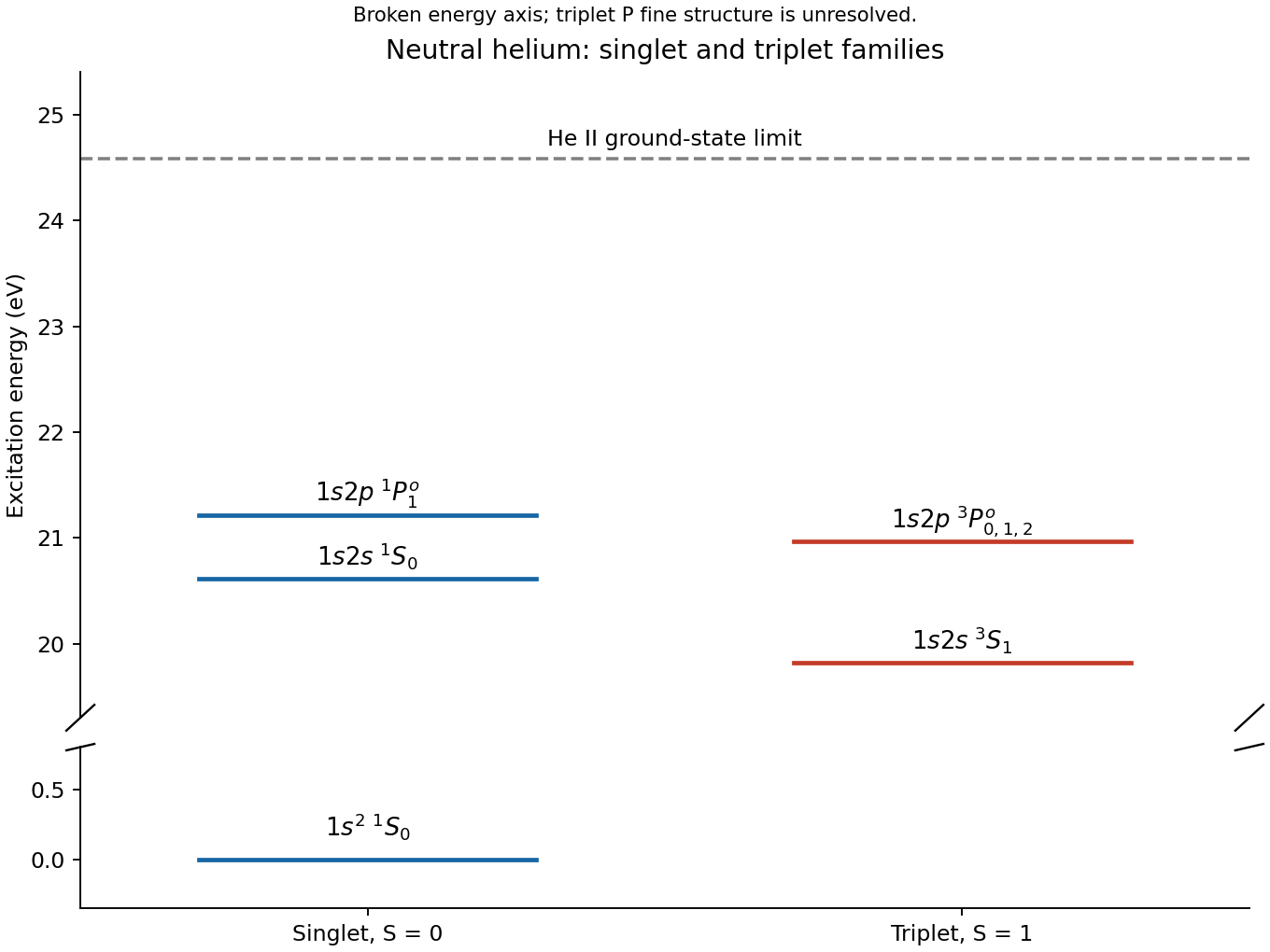
The observed first excitation energies are approximately and for the triplet and singlet, respectively. Higher singly excited Rydberg series approach the He II ground-state ionization threshold; doubly excited states above that threshold can autoionize and are not all stable bound excited levels.[ref]
Energy Levels of Neutral Helium by National Institute of Standards and Technology. 1s2s and 1s2p configuration rows; He II ground-state limit at 198310.6691 inverse centimetres
Introduce a bookkeeping parameter in and expand and . Fix phase and normalization at this order by . The first-order Schrödinger equation isangular momentum projection onto gives . angular momentum projection onto a different eigenstate givesCompleteness therefore yields the first-order nondegenerate perturbation theory resultNonzero energy denominators are essential. The displayed state has unit norm through first order; exact normalization would change terms of second order. A continuum, if present, contributes its corresponding integral as well as any discrete sum.
For the oscillator in a static electric field, electrostatic potential energy is and . parity gives , and the supplied Gaussian wavefunctions giveSince , the two-state first-order ground state isThus , and the induced electric dipole isIt is aligned with the field for either sign of . The harmonic-oscillator electric polarizability is . The position operator connects only to , so the requested two-state calculation contains the complete first-order dipole response, rather than dropping other first-order terms.
Complete the square to find the exact electric-field displacement of a quantum harmonic oscillator:The exact normalized ground wavefunction is , with energy . Its mean displacement is , soThe first-order dipole equals the exact dipole, because the restoring force is exactly linear and translating a harmonic well does not change its width or frequency. This agreement of one expectation value does not make the truncated wavefunction exact. The Hellmann–Feynman theorem provides an independent check: .
For perturbation theory to approximate the state, , or . The exact translated ground state has the original-oscillator expansionIt is a coherent state with mean occupation . Large fields require many oscillator levels, whereas the first-order state retains only two. The normalized two-state truncation of a displaced oscillator instead giveswhich incorrectly tends towards zero for large instead of following the displaced well. In position space the truncated polynomial times Gaussian also develops a node absent from the exact ground state. Taking a linearized formula outside its small-state-correction regime is therefore invalid even though its dipole coefficient happens to be exact.
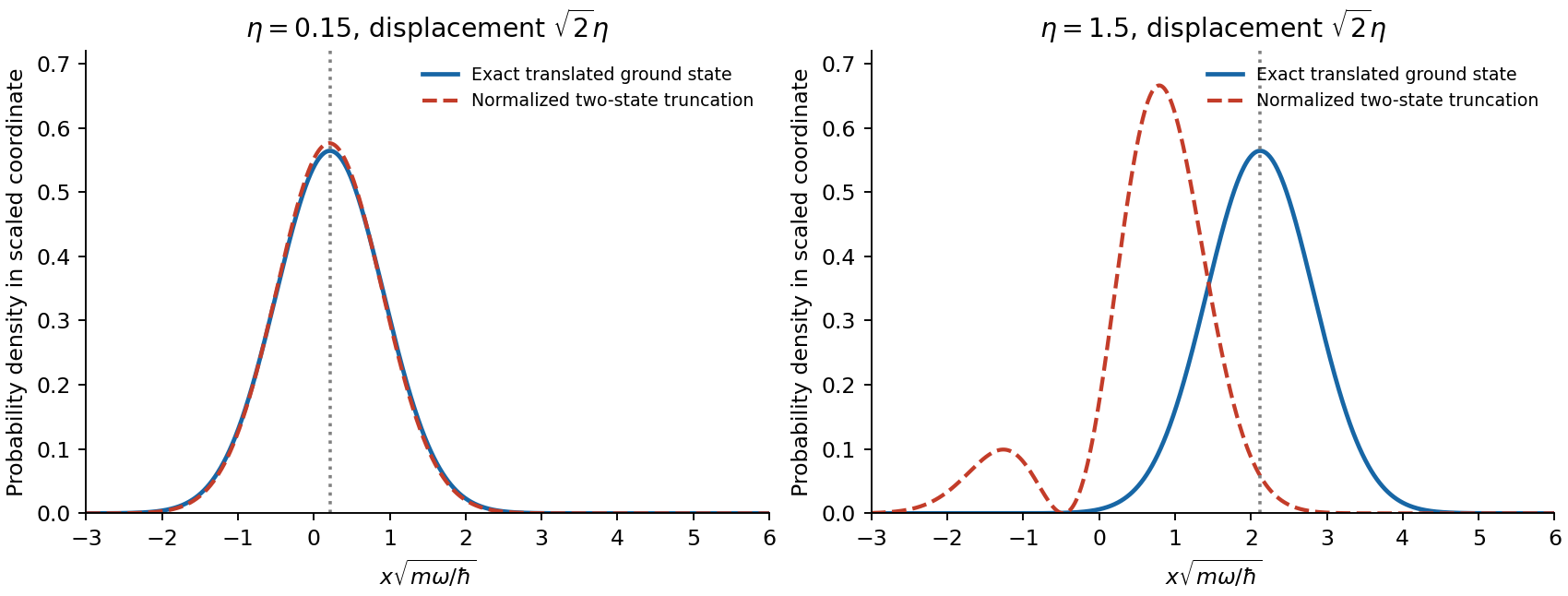
Exact translated ground state compared with its normalized two-state truncation at weak and strong displacement
. Details. Insert the interaction-picture expansion into the Schrödinger equation. The phases multiplying the basis states already solve the unperturbed evolution, leavingHermiticity requires , not unless the coupling is real. Since the diagonal matrix elements vanish and , expanding the cosine givesThe conjugate pair of couplings conserves . Near resonance, the difference frequency is slow while the sum frequency is approximately . Rapid terms alternate sign before an appreciable slow transfer accumulates. The rotating-wave approximation retains the slow terms when ; resonance alone is insufficient for a strong drive. Counter-rotating corrections include small shifts of the resonance and need not remain negligible at arbitrary strength or arbitrarily long times.
For the spin preparation, use and . Choose and to fix helicity, with , and . The initial is the lower state. For negative , reverse the RF rotation sense; pulse areas use , and signed Larmor precession determines the corresponding phase adjustment.
A circularly rotating magnetic drive uses two transverse fields in quadrature during :With , their interaction Hamiltonian is exactly constant,The minus sign in the second RF component selects co-rotation for the specified positive gyromagnetic ratio. Exponentiating this Pauli matrix givesThe laboratory phase of a resonant spin pulse includes free precession. Returning to the laboratory frame and removing a common phase,Unlike a linearly polarized RF field, this exactly co-rotating field has no counter-rotating component. A single linearly polarized field gives the same slow rotation in the weak-drive rotating-wave approximation with . For the circular field above, . Keeping these amplitude conventions distinct avoids a factor-of-two pulse-duration error.
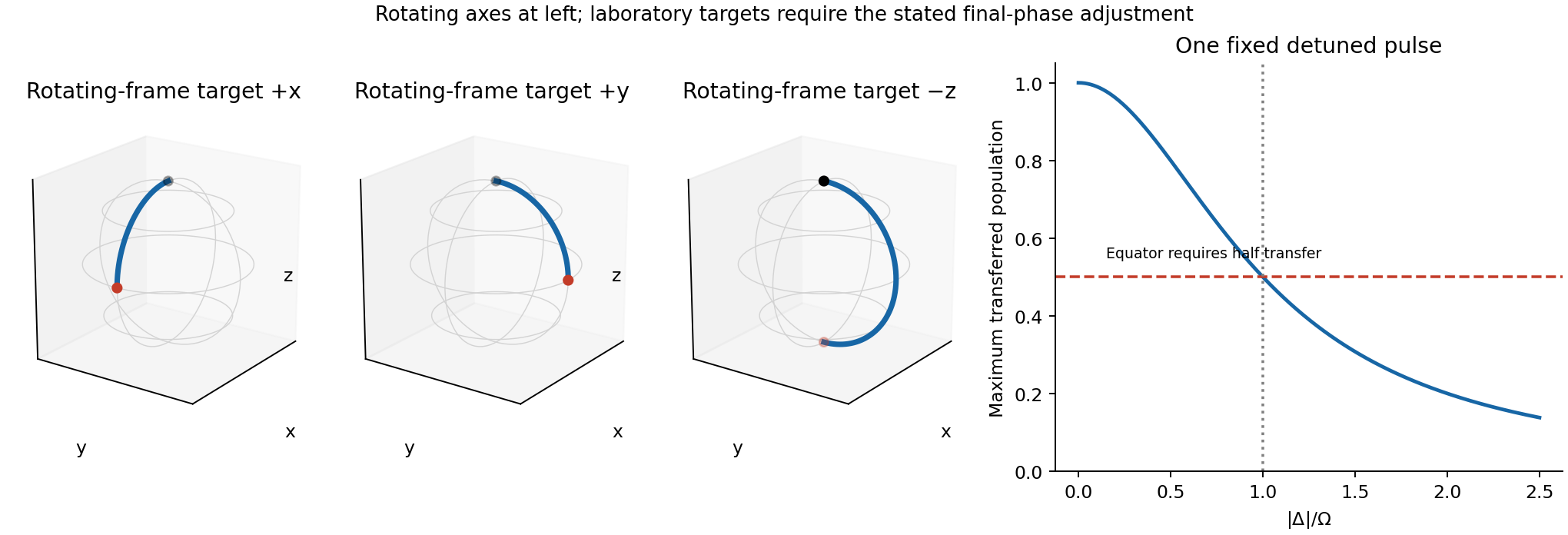


For a single harmonic pulse detuned by , the effective rotating-frame field tilts out of the transverse plane. Its rotation rate becomes , and its maximum population transfer is . Exact inversion to is impossible with one fixed nonzero-detuning pulse. Half transfer, needed for a transverse eigenstate, gives the equatorial reachability of a detuned spin pulse criterion . With that condition, changing the duration and RF phase can still prepare or at the chosen laboratory stopping time. The mere statement does not ensure this condition, because the drive can be much weaker than either frequency. If , neither transverse target is reached by that single pulse. These restrictions concern fixed-frequency, fixed-amplitude single-pulse control; retuning, chirping or phase-controlled composite pulses change the available controls and can remove the restriction. No dissipative spin relaxation is included in this coherent two-state model.
The eigenstate is , since . Use a resonant quarter-turn pulse, , and choose its phase so thatThe laboratory-frame relative amplitude then is , givingIn rotating axes the equivalent target is obtained with ; the extra laboratory phase above compensates Larmor precession during the pulse. After switching the RF field off, the spin continues to precess in the static field, so this statement specifies the preparation instant rather than a state fixed along laboratory forever.
The eigenstate is , with . Use the same duration but phaseThe relative amplitude is now , givingThe two transverse preparations differ by a quarter-cycle of RF phase, not by changing the pulse area. Reversing the desired transverse direction adds to the chosen phase.
For , use a resonant half-turn pulse,The up amplitude vanishes because , while the down amplitude has unit magnitude. Its phase is a common phase of the final state, so any RF phase givesThe final population inversion is insensitive to a free-precession phase, unlike the orientation of a transverse superposition. This is a Rabi pi pulse with the drive-amplitude convention specified above.
Articles by others on the same topic
There are currently no matching articles.