Assume an inviscid barotropic fluid acted on by a conservative body force . Define its barotropic enthalpy function byThe Euler equations for an inviscid fluid are then . Using the vorticity and the vector identitygives , where .
For steady flow, dotting this equation with yields . Thus Bernoulli's equation isThe constant need not agree between different streamlines. If the flow is also irrotational, the vector equation gives , so one common constant applies throughout a connected flow region.
For an isentropic process with , up to an additive constant, equal to the thermodynamic specific enthalpy. For an externally maintained isothermal gas, ; this pressure potential is not the constant thermodynamic enthalpy of a fixed-temperature ideal gas.
If steady flow is not assumed, a useful additional case is unsteady potential flow . The same vector equation integrates spatially toGeneral unsteady barotropic flow does not possess the steady streamline constant without further conditions.
The surface must be a material surface , moving with the fluid; its boundary moves with it as well. The stated barotropic vorticity transport law, with , gives . Expanding its curl therefore yieldsA material tangent vector obeys . Apply the product rule to the cross product of two such tangents to obtain material surface element evolution:Here . The stretching and area-change terms cancel exactly in the transported flux element:Integrate over the fixed particle labels parameterizing the material surface. This proves the conservation of vorticity flux through a material surface:The conserved flux is also the circulation by the Stokes theorem, so this agrees with Kelvin's circulation theorem. The assumptions are smooth inviscid barotropic flow and conservative body forces. A fixed open surface generally exchanges vorticity flux with its surroundings and does not satisfy this conservation statement; compressibility by itself does not invalidate the material-surface result.
Assume a steady spherical outflow of fixed composition. Let be its mean particle mass, and define the constant isothermal sound speed by . Subsonic here refers to this isothermal closure, so . Mass conservation and radial momentum balance giveLogarithmically differentiating the first equation yields . Substitution eliminates the density gradient and gives the isothermal Parker wind equationAt a smooth speed maximum, , while the left prefactor is finite and negative. The right side must vanish, henceFor both the right side and the prefactor are negative, so ; for , . This is a true maximum on a subsonic isothermal breeze, not the accelerating transonic branch.
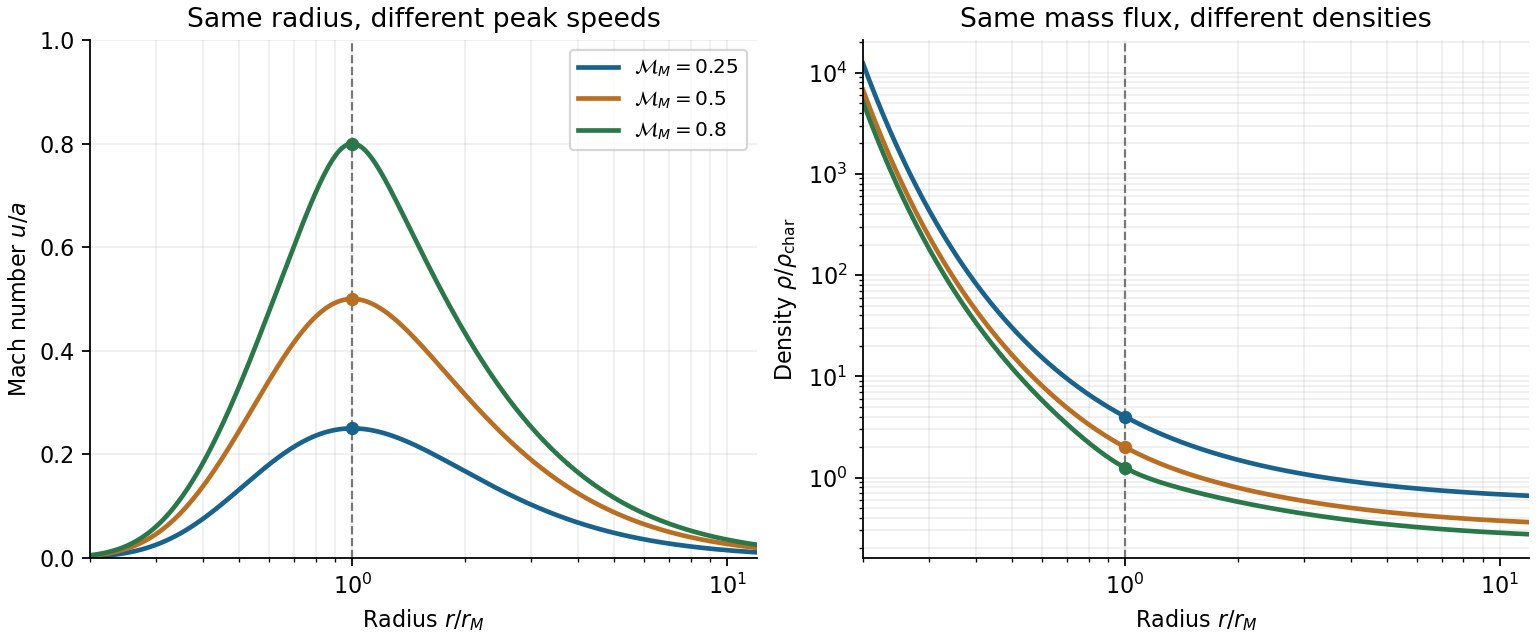
There is an underdetermination in the requested density estimate. Introduce the peak Mach number , where . The density at the maximum speed of an isothermal breeze is exactlyThe hypotheses do not fix . A boundary density or pressure, or an equivalent wind integration constant, is needed. The definite statement following from subsonicity is the lower boundIf a maximum speed of order is intended as an extra estimate, then . A very slow breeze can have a much larger density, so setting as an exact equality would contradict the stated always-subsonic assumption. The mean particle mass is another implicit fixed-composition input needed to express a temperature as a squared sound speed.
One can see the free parameter directly by integrating the wind equation:Different give different subsonic maxima at the same radius. The original plot illustrates this nonuniqueness. These breeze branches require nonzero ambient pressure at large radius; they are not the usual transonic escape into a low-pressure exterior.

Maintaining an isothermal expanding wind generally requires heat exchange; isothermal motion is not adiabatic motion.[ref]
https://nnp.ucsd.edu/the_mhd_muddle/PDF/Parker_1958_Dynamics_Gas_MagneticFields_HL.pdf. PDF p. 4, printed p. 667, section III: uniform temperature maintained by heating
For an unattenuated isotropic point source, the radiation flux is . The radiation pressure force per particle divided by its mass gives the outward accelerationThus the effective inward inverse-square coefficient is . Insert it into the preceding wind equation. The radiative shift of an isothermal breeze maximum isEquivalently, with opacity and an Eddington luminosity , this is . It is an exterior speed maximum only if the radius is positive and lies within the modeled wind region. For , the wind equation's right side is positive at every , so an always-subsonic outflow decreases in speed and has no such interior maximum.
Because is a cross section per particle, its conversion to acceleration requires ; that mass cannot be omitted dimensionally. The requested dependence on the four stated variables therefore assumes a fixed particle species. For the atomic hydrogen of part (e), set before molecule formation.
Retain the preceding isothermal assumption, so the gas temperature remains . When two neutral hydrogen atoms become one molecular hydrogen molecule, the mean particle mass doubles. At fixed mass density and temperature the ideal gas law would halve the pressure, but the flowing gas is free to compress and change speed. It cannot in general keep density, pressure, and velocity all unchanged.
To describe a thin steady transition, label the atomic and molecular sides by and and neglect the integrated external force and radiative recoil across its small thickness. Local mass conservation and momentum conservation requireThe isothermal sound speed changes from to . Dividing the momentum flux by gives , with . The subsonic continuation is thereforeThus the gas becomes denser and slower. In the well-subsonic limit, where ram stresses are small compared with thermal pressure, the useful leading description of isothermal flow through molecular hydrogen formation isThe exact momentum condition gives a small pressure increase at low Mach number, rather than an imposed discontinuous factor-of-two pressure drop. The full expressions above apply when the subsonic speed is not asymptotically small.
Radiation of the molecular binding energy prevents that released energy from automatically heating the gas. It does not, by itself, determine the temperature: the constant-temperature result uses the inherited isothermal closure. If that assumption is relaxed, an energy equation including cooling and molecular degrees of freedom is needed; the wording about emitted binding energy alone does not uniquely determine all four changes.
Articles by others on the same topic
There are currently no matching articles.