In a bacterial transcription complex, RNA polymerase binds a promoter and locally separates the DNA strands into a transcription bubble. The template enters the active site in the to direction, while the complementary RNA grows to . The displaced non-template strand passes around the bubble, downstream DNA re-forms a duplex, and the nascent RNA exits through a separate channel. A short RNA–DNA hybrid is maintained in an elongating complex; the first few nucleotides of an initiating complex do not yet make a full elongation-length hybrid.
The core enzyme has subunit composition ; association with a sigma factor forms a promoter-selective holoenzyme. Sigma recognizes promoter features and assists steps leading from a closed bound complex to the open complex. Different sigma factors redirect transcription towards different promoter classes. The familiar and elements are examples for a major bacterial sigma family, not a universal sequence rule for all sigma factors. Promoter escape changes these contacts, but complete sigma dissociation at one exact transcript length should not be assumed for every complex.
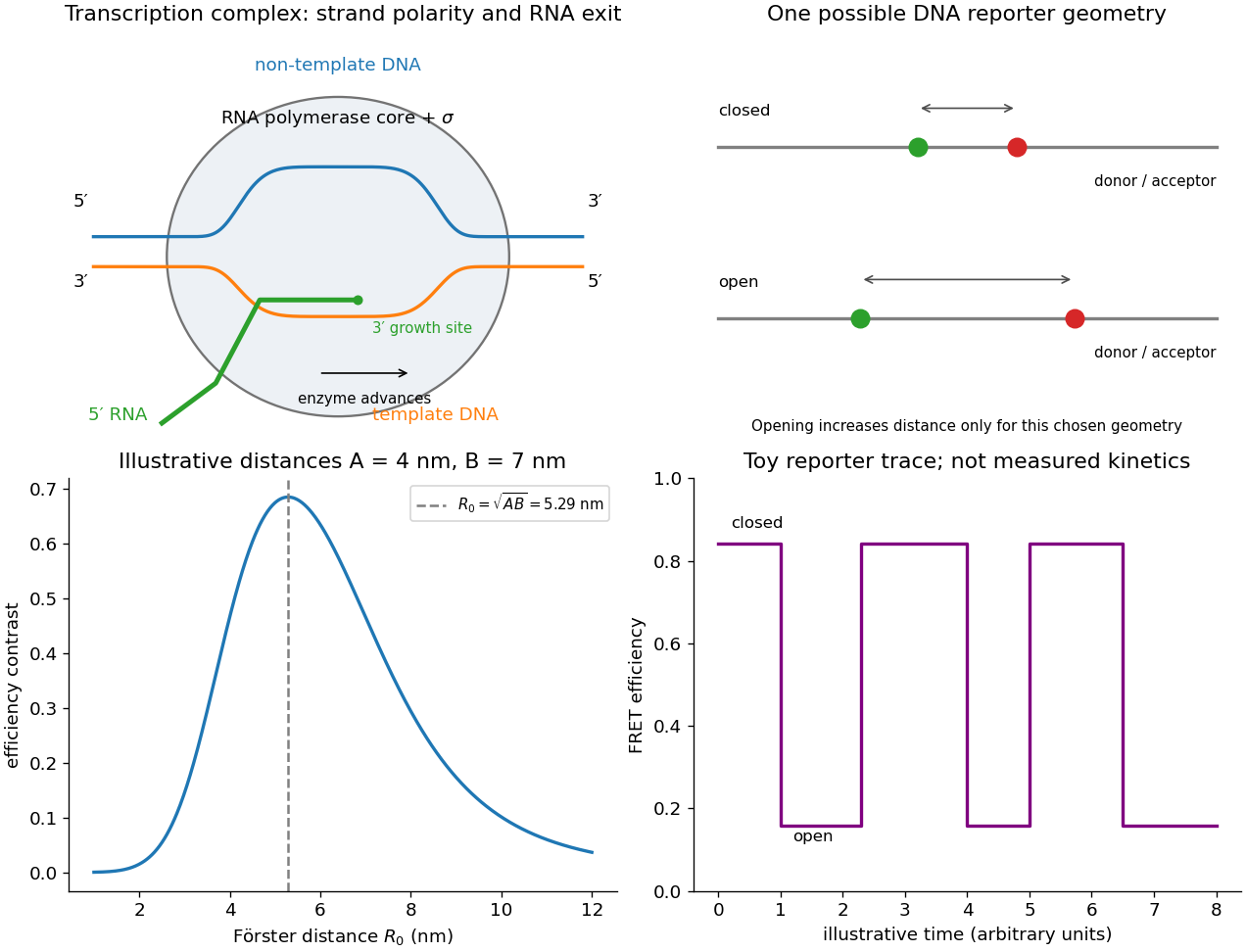
For the supplied non-template sequence, assuming its first base is the first transcribed position, the complementary template runs -TCAGTAAGC-. The RNA has the coding-strand order with uracil replacing thymine. Therefore the first five nucleotides areThe top-left panel of the original schematic in part (d) shows the strand polarities and polymerase organisation; it is not a copied experimental illustration.
The single-block DNA zipper partition function retains one contiguous paired block and ignores multiple separated bubbles. A block of paired bases can start at any of positions. Its first pair has initiation weight , and the remaining pairs each have propagation weight . ThusThe source's symbol in the displayed expressions denotes the same initiation constant as , not Boltzmann's constant. Association and other reference-state factors are absorbed into that statistical weight; the model treats the propagation weights as uniform despite the actual sequence's different bases.
Put . Since counts how many terms of a finite geometric series contain ,ConsequentlyThe apparent singularity is removable: at , the original sum gives , which is for these nine bases.
At , the longest block dominates:Conditional on at least one pair, the fully paired probability approaches one, with leading correction of order . If a fully unpaired reference state of weight one is included, the full partition function is , so a large propagation constant alone does not guarantee predominant duplex if is still very small.
The given sequence contains five A–T and four G–C pairs when fully complementary. Real duplex stability also depends strongly on stacking, sequence context, salt and temperature; it cannot be calculated just by counting two versus three hydrogen bonds. All else comparable, sequences with greater duplex propagation stability resist bubble opening more strongly, while easier-to-open, often A–T-rich start-site regions facilitate initiation. The homogeneous- zipper demonstrates that principle but does not resolve a quantitative sequence-specific melting profile or polymerase's active stabilization of the open state.
To find the optimal Förster distance for two-state contrast, take positive distinct distances and put . The magnitude of the efficiency change isIts derivative has the sign of . It rises from zero, has a single maximum at , then falls back to zero. HenceThe printed form is equivalent, sinceAt this optimum the two efficiencies sum to one and the maximal contrast is . If , there is no distance change and the contrast is zero for every ; the source's unsimplified expression is then and does not specify a unique optimum. For example yields zero contrast regardless of the fluorophore pair. The geometrical-mean result is a design criterion for distinct distances within the assumed fixed-orientation/photophysics FRET law, not a correction for dye-orientation changes.
Place a FRET donor and FRET acceptor on DNA positions whose separation reports start-site opening, using an independently calibrated closed/open geometry and a pair whose Förster distance is near the geometric mean from part (c). Opening may increase or decrease the measured separation depending on where the dyes are placed; anticorrelated donor/acceptor changes need structural and photophysical controls before being assigned to bubble formation.
Single molecules can be observed by low-background fluorescence microscopy while recording FRET donor and sensitized FRET acceptor photons. Correct background, spectral leakage, direct FRET acceptor excitation and unequal detection/quantum-yield factors before calculating efficiency, for example with the corrected intensities. Alternating excitation or independent FRET acceptor observation checks that a low-FRET interval is not simply a dark or bleached FRET acceptor. Intensity anticorrelation, FRET donor lifetime and suitable inactive/closed-state controls strengthen the assignment. The original figure below separates the mechanistic schematic from a purely illustrative model trace.
For the binding-plus-opening first-passage time, a minimal kinetic scheme is , for unbound, closed bound and open bound states. A binding rate , dissociation rate and opening rate already produce multiple waiting-time contributions. With O treated as absorbing during the measurement and starting from U, the mean first-opening time isnot simply . This follows from and . A bound-state marker, or measurements over concentration and a justified kinetic model, helps distinguish binding from opening when unbound and closed DNA share a FRET level.
Fit transitions and dwell distributions with finite time resolution, missed short states, bleaching and censoring included. An open-state exponential dwell can estimate its exit rate under a simple Markov model, while competing closing and dissociation channels require separate observables or additional assumptions. Starting from a defined bound closed state can isolate opening more directly, but dissociation still competes if appreciable. Resolving repeated opening and closing gives forward and reverse kinetics; irreversibility should only be assumed over a demonstrated observation window. The experiment measures a conformational reporter, so a two-level trace alone does not uniquely prove every microscopic step of open-complex formation.

Articles by others on the same topic
There are currently no matching articles.