A major source of ATP is chemiosmosis: an electron transport chain uses downhill electron transfer to establish a proton-motive force, and ATP synthase converts that electrochemical gradient into ATP formation. In aerobic oxidative phosphorylation, reduced carriers supply electrons, ultimately reducing oxygen to water; selected respiratory complexes couple the favorable oxidation-reduction reaction to uphill proton translocation. In a mitochondrion, this takes place across the inner membrane, creating a relatively positive, acidic exterior side and a relatively negative, alkaline matrix. Bacteria use their cell membrane. In photosynthetic systems, light-driven electron transfer can supply the gradient instead. Substrate-level phosphorylation is another ATP-producing route, so the description is not universal to every organism and condition.
The membrane region of ATP synthase contains a rotating ring of c-subunits next to subunit a. Two offset aqueous half-channels expose the ring's proton-binding sites to opposite membrane sides. Proton binding and release bias ring rotation down the electrochemical gradient. The central shaft transfers torque to the catalytic head, while a peripheral stator prevents the head from simply co-rotating. This is the ATP synthase rotary mechanism, rather than unrestricted proton leakage through a pore.
The three catalytic beta subunits cycle through different binding states as the shaft turns: ADP and inorganic phosphate bind, bound ATP is favored, then ATP is released. The binding-change mechanism uses mechanical work to alter binding affinities and product release as well as the chemical step. A full coupled revolution produces three ATP molecules; a ring with c-subunits transfers approximately protons per revolution in the tightly coupled model, or per ATP.[ref]
Structure of a bacterial ATP synthase by Hui Guo and others. Proton-translocation half-channels and rotor architecture
[ref]The overall cycle must have a favorable Gibbs free energy change. If the proton-motive force becomes too small, synthesis stops; under suitable conditions the same molecular motor can reverse, using ATP hydrolysis to pump protons uphill. A catalyst changes kinetics, not the thermodynamic condition for synthesis.
Use the supplied as a standard transformed Gibbs free energy of ATP hydrolysis, rather than replacing it with a different commonly quoted standard value. Approximate thermodynamic activities by concentrations divided by , at an explicitly assumed . The dimensionless reaction quotient isConsequentlyand the reverse synthesis cost is . Substituting bare millimolar numbers in this quotient without the standard state would give the wrong logarithm.
For outside-to-inside proton movement, the membrane potential is and , so . The molar electrochemical potential change isThus the available proton-motive force magnitude is , supplying per transported proton. Assuming one proton per c-subunit per revolution, three ATP per revolution and no leakage, slippage or transport overhead,The smallest integer permitting synthesis is therefore in this ideal budget. A ring of thirteen gives only a small driving margin; inefficiency or sustained finite output could require a larger ring. The result is an energetic lower bound and near-reversible estimate, not a unique structural determination from these data. Reasonable temperatures near – leave the minimum integer thirteen. Additional membrane transport costs have been excluded explicitly.
The given probability density function is the completion-time density for two independent sequential irreversible steps, with exponential distributions of waiting times at rates . Let . The convolution isIt is a two-stage hypoexponential distribution. The density vanishes at zero, initially rises as , peaks, and then decays with a tail governed by the slower rate. Setting its derivative to zero givesNormalization follows either from the convolution of normalized densities or directly from . In the equal-rate limit , the apparent singularity is removable andThis is an Erlang distribution with shape two. If one rate is much faster, its short waiting time becomes hard to resolve and the distribution resembles a single exponential distribution after its initial rise.
The observation supports at least two kinetically resolved stages before the recorded event, rather than one memoryless rate-limiting event. Possibilities include substrate binding followed by a conformational or catalytic step. It does not identify which stage is binding, chemistry, product release or rotation. The density is unchanged by exchanging and , so temporal order and chemical identity cannot be recovered from this fit alone. Other hidden-state mechanisms can also mimic the same density. Dependence of one fitted rate on ATP concentration, for example, would provide additional evidence about assignment, rather than following from the distribution by itself.
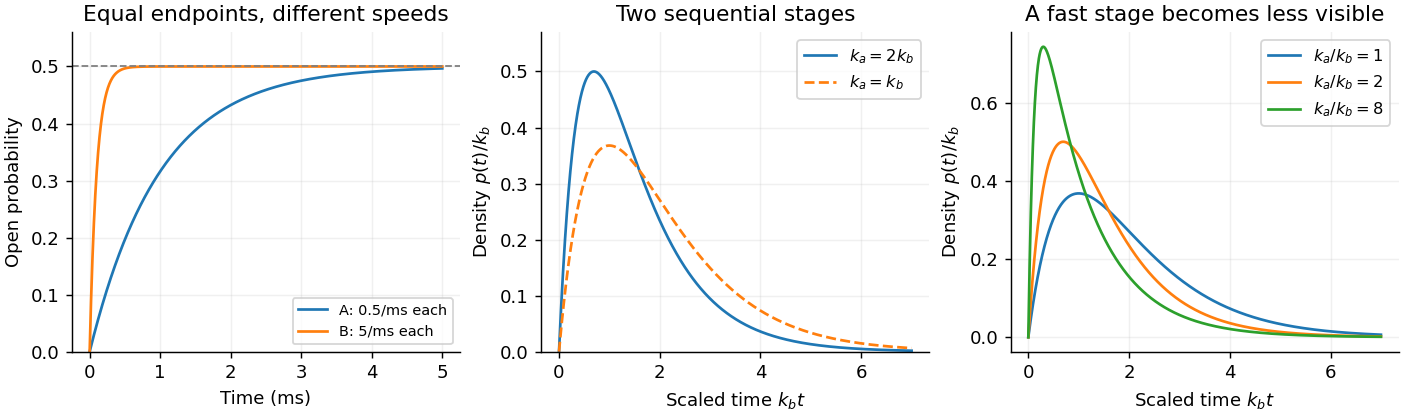

The left panel illustrates b for an initially closed population. The other panels are dimensionless examples of the distributions derived here; none reconstructs the missing source trace.
Articles by others on the same topic
There are currently no matching articles.