For one normal mode, the fundamental is , with other modes initially in their ground levels. In the linear-dipole harmonic approximation, the transition moment is nonzero for , so a vibrational fundamental is normally much stronger than its overtones, provided the mode has vibrational infrared activity.
The first vibrational overtone is , with . It lies near twice the fundamental wavenumber, generally slightly below it because of anharmonicity. The linear-dipole harmonic model forbids it; anharmonic wavefunctions or higher terms in the dipole expansion give a weak intensity. Thus it is generally weaker than the corresponding fundamental.
The second vibrational overtone is , with , near three times the fundamental wavenumber. It requires higher-order departures from the linear-dipole harmonic model and is ordinarily weaker again. These are qualitative intensity trends; resonances can redistribute intensity between nearby vibrational states.
A hot band starts from a thermally populated vibrationally excited state, for example . It can satisfy and need not have a small transition moment, but its lower-state population is reduced by the Boltzmann distribution:It is therefore usually weak at low temperature and grows relative to the fundamental on heating. Anharmonicity shifts its frequency away from the transition; in a polyatomic molecule, excitation in another mode can also produce a hot-band sequence.
A useful vibration-rotation expression, with energies measured from the potential minimum, isHere is the vibrational quantum number, the rotational angular-momentum quantum number, the harmonic spectroscopic wavenumber, a dimensionless anharmonic coefficient, and the vibrational-state-dependent rotational constant. is its equilibrium value and describes vibration-rotation coupling. All wavenumber constants use the same inverse-length units; is the Planck constant and the speed of light.
The elementary harmonic rigid rotor result follows by setting , with and , where . The molecule's electronic energy would add a common constant.
A diatomic molecule has vibrational normal mode: the bond stretch. For hydrogen chloride, opposite longitudinal displacements change the electric dipole moment, so the mode has vibrational infrared activity. The following original sketches show one phase of this motion and the three water modes; arrow lengths are schematic, not mass-weighted amplitudes.
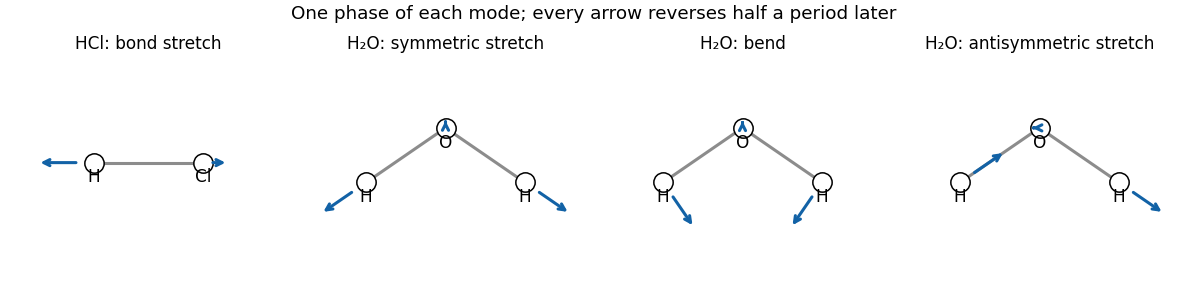

A nonlinear triatomic molecule has vibrational normal modes. For water they are the symmetric O–H stretch, the H–O–H bend, and the antisymmetric O–H stretch, shown above. In the symmetric stretch both O–H lengths increase together; in the antisymmetric stretch one increases while the other decreases; the bend predominantly changes the bond angle. All three change a component of the electric dipole moment and are infrared-active. Every arrow reverses half a period later; motion of oxygen maintains the molecular centre of mass.
This is a rovibrational spectrum: the vibrational excitation is accompanied by quantized molecular rotation. The high-wavenumber R branch has , and the low-wavenumber P branch has . In the simplest common- approximation,Consecutive lines within either branch are therefore separated by roughly , while the gap between P(1) and R(0) is roughly . There is no Q branch: for this diatomic parallel transition, the electric-dipole rotational selection rule allows , and the line strength vanishes.
The intensity envelope comes from rotational populations, approximately , together with the rotational line strengths. The paired peaks arise from the two chlorine isotopologues, and : their different reduced masses shift both rotational and vibrational spacings. The more abundant gives the stronger member. The changing spacing away from the band centre reflects and, at higher , centrifugal distortion; it is not evidence for additional vibrational fundamentals.
Use the two-body reduced mass, rather than the chlorine mass or hydrogen mass alone:The bond force constant givesThe requested “frequency in cm−1” is a spectroscopic wavenumber; the ordinary frequency is the value in s−1 above. This calculation uses the question's force constant in the harmonic model, rather than replacing it with a tabulated spectroscopic constant.
Read the stronger members of the inset doublets at about , and . Their spacings are roughly –, so the common- estimate isUsing the harmonic wavenumber from the preceding calculation and labelling lines by the lower-state ,These are graph-based estimates. Finite reading precision and different upper/lower rotational constants limit their accuracy to a few cm−1; extra decimal places would not be justified. The R1 result refers to , while R0 is the line nearest the high-wavenumber side of the band gap.
Articles by others on the same topic
There are currently no matching articles.