[ref]
https://www.whatdotheyknow.com/request/natural_science_tripos_physics_e_2/response/2340776/attach/2/FOI%202023%20399%20Zahid%20materials.pdf?cookie_passthrough=1. Original public PDF, physical pages 575–577
heating and cooling balance in the interstellar medium depends on density, ionization, radiation and shielding. Write net cooling per volume as . Ultraviolet grain photoelectric heating is important in diffuse neutral gas; photoionization heats ionized regions, cosmic rays penetrate shielded gas, and shock waves from stellar winds and supernovae supply hot gas. Cooling includes collisionally excited atomic lines, fine-structure metal lines at lower temperatures, molecular lines in shielded clouds, and continuum radiation and dust emission where appropriate. The heating efficiency and cooling abundances matter as much as a nominal temperature.
A multiphase interstellar medium can contain a cold neutral medium near , a warm neutral medium and warm ionized medium near , a hot ionized medium near , and still colder molecular clouds. Cold and warm atomic equilibrium branches can coexist at similar thermal pressure over a finite pressure interval; this is a calculated heating/cooling balance, not a requirement that all galactic gas have the same pressure.[ref]
The Neutral Atomic Phases of the ISM in the Galaxy by Mark G. Wolfire and others. Abstract: cold and warm neutral equilibrium temperatures and coexistence between minimum and maximum pressures
For net cooling per unit mass , an isobaric perturbation at equilibrium obeys . Thus a negative constant-pressure cooling derivative is thermally unstable: a cool perturbation cools further and condenses. Sound crossing must be fast enough to maintain pressure balance; thermal conduction suppresses sufficiently short wavelengths. Supernova-driven motions, magnetic pressure, finite cooling times and interfaces make the actual medium dynamic, so equilibrium branches describe useful phases rather than a static collection of perfectly separated components.
differential rotation winds a material arm because . A spiral density wave instead has a pattern speed different from the material speed: stars and gas can pass through its crests. Collective self-gravity, orbital resonances and shear can sustain or repeatedly amplify non-axisymmetric patterns; a visible spiral need not be a single permanent rigid material structure.
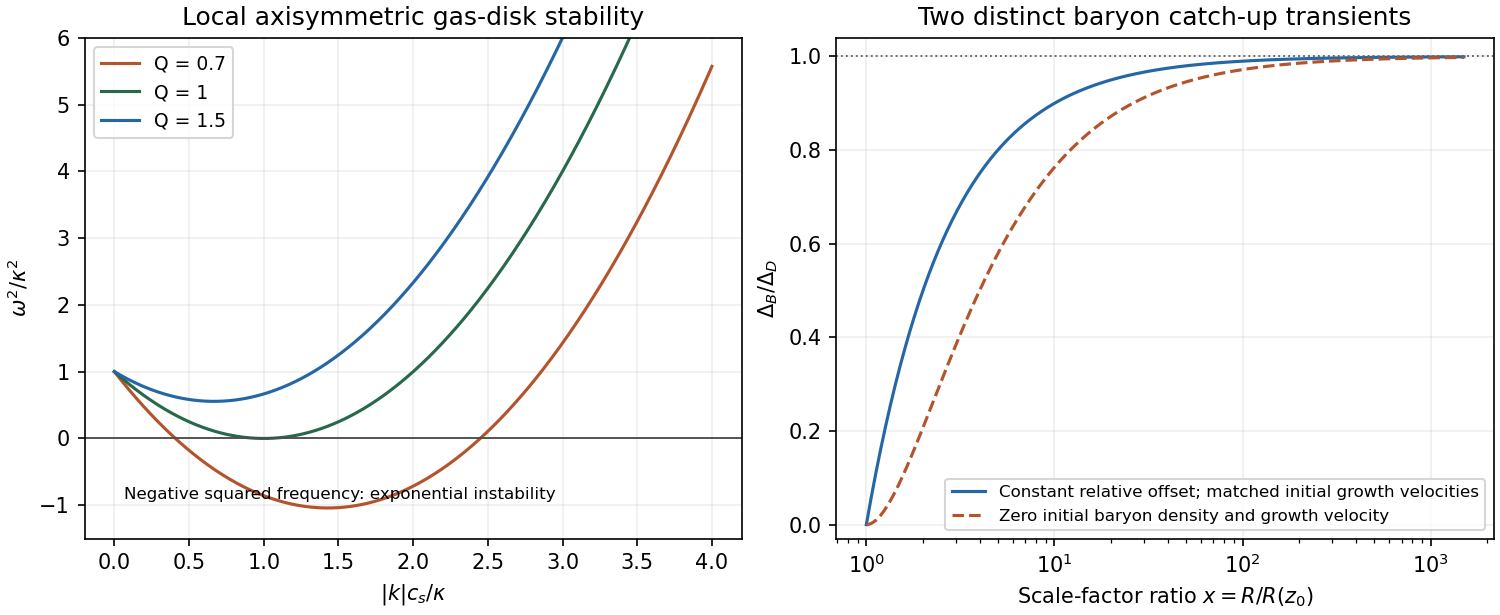
For a razor-thin gas disk, local tightly wound disturbances satisfyRotation stabilizes long wavelengths and pressure stabilizes short ones. Minimizing the axisymmetric right-hand side over gives andfor local axisymmetric stability. A collisionless stellar disk instead has ; the radial random velocity dispersion is not literally a gas sound speed.[ref]
On the Gravitational Stability of a Disk of Stars by Alar Toomre. Abstract: collisionless axisymmetric threshold and coefficient 3.36
Local axisymmetric stability does not guarantee global disk stability. Gas and stars gravitate together, thickness modifies the short-scale force, and a disk with may still have spiral or bar responses. Dissipation in gas can generate shock waves and concentrate star formation near a spiral crest; stellar random motions tend to reduce the collective response.
Galactic star formation is limited by how much gas becomes cold, shielded and self-gravitating, and by how long it remains in that state. A useful local estimate isThe star-formation efficiency per free-fall time absorbs the fact that turbulence, magnetic support and stellar feedback prevent all eligible gas from collapsing in one free-fall time of a uniform sphere. Rotation and disk stability influence the supply of dense clouds, while gravitational collapse and gravitational fragmentation operate inside them.
For galaxy-averaged measurements, the Kennicutt–Schmidt law has , with the classic mixed spiral/starburst sample giving . This empirical relation was obtained using H-alpha and far-infrared star-formation tracers together with atomic-hydrogen and CO gas measurements.[ref]
The Global Schmidt Law in Star Forming Galaxies by Robert C. Kennicutt Jr.. Abstract: sample, tracer combination and fitted index 1.4 plus or minus 0.15
Dust attenuation, contamination by older stellar heating, the stellar initial mass function and the CO-to-molecular-gas conversion must be controlled. A disk-averaged total-gas exponent is not automatically a small-scale cloud law.Young stars then photoionize gas, drive winds and eventually inject supernova energy and momentum. These processes can disrupt clouds, sustain random motions or expel gas; radiative cooling and fresh inflow rebuild the cold supply. Large-scale star formation is a regulated conversion of gas, rather than unimpeded free fall of the entire disk. A long gas-depletion time is compatible with short galactic dynamical times in the dense fraction.
A dense cloud core first collapses when self-gravity overwhelms its effective support. While radiation escapes readily, compression can remain approximately isothermal and the Jeans mass decreases as density rises, encouraging gravitational fragmentation. Angular momentum usually leads to a disk rather than unrestricted spherical infall.
As the central optical depth increases, cooling becomes slower than compression and pressure produces a first hydrostatic core. molecular hydrogen dissociation near absorbs compressional energy and lowers the effective adiabatic response, permitting a second collapse of a protostar. After dissociation the gas stiffens and a much more compact stellar core forms. An accretion shock and surrounding disk then convert infall energy into radiation. A small central core forms before most of the envelope arrives, as demonstrated in radiation-hydrodynamic collapse calculations.[ref]
Numerical Calculations of the Dynamics of a Collapsing Proto-Star by Richard B. Larson. Abstract: nonhomologous central core formation, subsequent envelope accretion and infrared reprocessing
The isothermal inside-out collapse of a singular isothermal sphere model provides one idealized supply law, , but rotation, magnetic fields and an unsteady reservoir modify real accretion. Its luminosity scale is . Dust can absorb the emerging short-wavelength radiation and re-emit it in the infrared, so an embedded source need not have a directly visible stellar photosphere.
As envelope accretion declines, gravitational contraction becomes important on the Kelvin-Helmholtz cooling time . deuterium-burning energy-generation rate can temporarily influence the radius; sustained core hydrogen burning eventually establishes the main sequence if the final mass is sufficient. A low-mass convective object approaches along a Hayashi-like track, while more massive objects need not share that track. accretion, contraction and nuclear burning are distinct energy sources, and a protostar is not generally a fixed-mass object.
mass and energy signs. The enclosed mass is , so . The negative sign printed in that equation cannot describe positive enclosed mass. Use the physical sign and define gravitational potential energy by
Boundary-pressure virial theorem. Multiply hydrostatic equilibrium by and integrate. The left side is , while the right side is . The central boundary contribution vanishes when and the outer pressure is . ThusA finite external pressure is compatible with a gravitationally self-contained cloud, but is not the zero-surface-force notion of isolation. External ram stress or mass flow would require additional terms.
radiation budget of monatomic cloud collapse. For an ideal gas with fixed , the specific internal energy is . Therefore the pressure integral is . Cold monatomic hydrogen has when only translational degrees of freedom matter. With negligible final surface pressure, , so . If the initial cloud is sufficiently extended and cold that , the emitted energy isBeing initially at rest alone does not set its binding energy to zero. If the initial total energy is appreciable, retain ; a different equation of state also changes the half-energy result.
Inside-out accretion. The combination of and with dimensions of mass per time iswhere dimensional analysis leaves the dimensionless coefficient undetermined. An isothermal gas keeps constant, giving constant supply in the self-similar idealization. A front at radius and an isothermal mass scale give the same scaling. The front's swept mass is not automatically the accreted central mass; the coefficient requires a dynamical similarity solution.[ref]
Self-Similar Collapse of Isothermal Spheres and Star Formation by Frank H. Shu. Inside-out similarity model; only the dimensional scaling is required here
constant-radius accretion energy budget. If all available accretion power is radiated at the fixed radius, . Neglecting the seed mass,This equals precisely whenThe positive sign in the final printed energy condition is inconsistent with the earlier use of negative gravitational potential energy. Equivalently its positive right side must denote the binding-energy magnitude . A general structural coefficient leaves a mismatch unless under these other idealizations. Radiation trapped in the object, outflows or release over a different radius also change the budget.
Which temperature? With and fixed , . If this power emerges thermally from area , the accretion-powered effective-temperature scaling iswhen the seed mass is negligible. This is the radiating surface's effective temperature. A homologous ideal-gas interior instead has virial temperature . TODO: the word temperature does not specify surface versus interior. The luminosity argument gives ; an interior temperature requires a structural and transport model, with the corresponding virial scaling only under the stated homology assumptions.
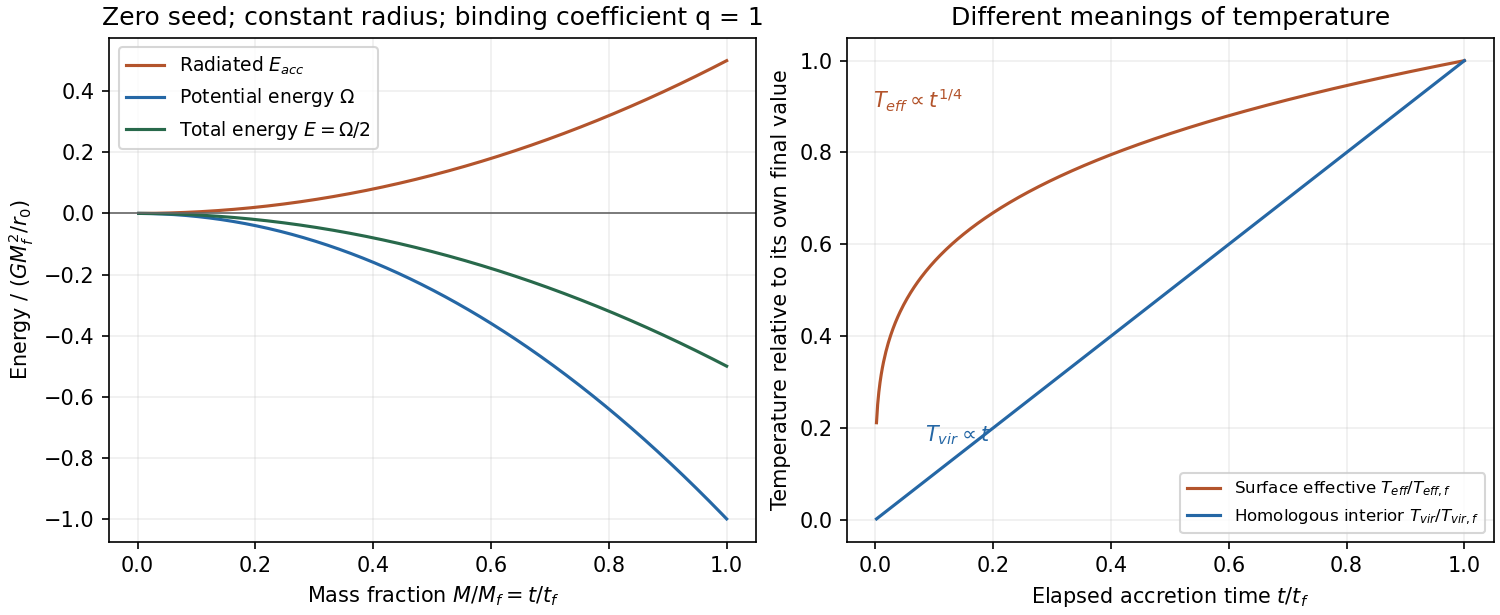
Original constant-radius accretion energy budget and distinct surface-effective and virial temperature scalings
. Details. Growing and decaying modes. Neglect pressure and insert the Einstein-de Sitter background. A trial givesThereforeThe quoted growth law selects the growing mode; arbitrary initial data can also contain the decaying one. In a static homogeneous Jeans model, , so an unstable mode grows exponentially, . Expansion introduces the damping term and a falling background density, yielding power-law growth instead. If the wavevector in the supplied pressure term is comoving, that term would need ; the pressureless result does not depend on this convention.
Amplitude problem. Using the stated recombination epoch, matter-era growth from then until today is only about . A baryonic density perturbation of order would reach merely , far below the order-unity regime needed for nonlinear collapse. photon coupling also prevents baryons from freely collapsing before recombination. The observed microwave temperature contrast is not an exact direct measurement of baryon density contrast at every scale: acoustic transfer and gravitational redshift matter. The estimate expresses the insufficient growth of tiny photon-coupled baryonic seeds, not an exact conversion between the two observables.
Coupled gravitational response. Both pressureless components respond to the same perturbed potential. The equations areTheir difference obeys , where . Thus and, in Einstein-de Sitter, .
Catch-up branch and its condition. With dark matter dominating the source and in its growing mode, write . The full baryon solution isTODO: an initial relative growth velocity is not specified. The requested baryon catch-up approximation after recombination neglects the relative decaying mode, . Defining then givesThis branch applies at and after and has and matched baryon/dark-matter growth velocities at that epoch. It does not follow uniquely from vanishing initial baryon density contrast alone. If both and its initial time derivative vanish at , the zero-initial-baryon-velocity catch-up transient instead givesBoth approach unity for . The displayed target therefore needs its stated no-relative-decaying-mode assumption; a finite baryon fraction modifies the transient further.
Physical consequence. cold dark matter is not held to the radiation by Thomson scattering, and can build gravitational wells before baryon decoupling, with appreciable matter-era growth after equality. Its growing perturbations then attract baryons once pressure and radiation drag become unimportant. The relative offset stays constant or decays while the common mode grows, so baryons catch up. Nonlinear structure need not grow solely from the tiny baryonic perturbation inferred at decoupling. cold dark matter growth during radiation domination is slower than the matter-era law, and the stated formula is neither a radiation-era nor a nonlinear-collapse solution.


Articles by others on the same topic
There are currently no matching articles.