Using the Levi-Civita symbol and the contraction of two Levi-Civita symbols, the th component of the vector triple product isThus the triple-product identity is .
Apply this with the unit vector to obtain . Dot products and scalar multiplication are linear in , so . Its matrix representation isThe fixed-vector equation is equivalent to . Since , all its solutions are . Also . Every vector decomposes as , with orthogonal to . Hence is the orthogonal projection onto the plane through the origin normal to : it fixes that plane and removes the perpendicular component.
A family is linearly independent if forces . For the three specified vectors, direct substitution givesThe coefficients are not all zero, so the vectors are linearly dependent.
For the implication question, using the usual interpretation that a basis contains the listed family as independent entries, the answers in order (i)–(x) areThe key distinctions are that the unrestricted zero combination always exists, whereas linear dependence requires a nontrivial combination; and dependence does not necessarily let the specified third vector be solved in terms of the first two. For example , makes (iii) and (iv) false, while disproves (vi).
There is a set-versus-family qualification in (v). If “contains” is interpreted as literal set containment, repeated nonzero vectors need only occur once in the basis. Then is dependent as a family but all three belong to the basis , so (v) becomes false. With three distinct vectors, or with family-containment as above, basis extension gives (v) true. Implication (x) remains true on either reading.
The definition of a convergent sequence isTo prove the product rule, convergence first gives an eventual bound . ThenChoose sufficiently large that and , as well as the bound on . The right side is less than , proving directly from the limit of a sequence definition.
If , eventually , so the reverse triangle inequality gives . ConsequentlyThus . The condition ensures the reciprocal sequence is defined at every index; the nonzero limit supplies the eventual uniform bound away from zero. Finally has every term nonzero, showing that this termwise property alone does not prevent a zero limit.
Suppose is continuous on , differentiable on and satisfies , with . Apply the extreme value theorem to both and to obtain a maximum and a minimum. If is constant, every interior derivative is zero. Otherwise some value differs from the common endpoint value, so either a maximum or a minimum occurs at an interior point . At an interior maximum, difference quotients are nonpositive from the right and nonnegative from the left; since the derivative exists, it must be zero. The minimum case is identical with the inequalities reversed. This proves Rolle's theorem: for some .
For the mean value theorem, subtract the endpoint chord:Then , so Rolle's theorem supplies with . HenceIf everywhere, applying the mean value theorem to any gives . Thus is strictly increasing. The converse is false: is strictly increasing but .
To find the kernel of a linear map, perform the row operations and , followed by . The equivalent homogeneous equations areThe resulting determinant is . If all coordinates vanish. At only remains; at the equations give , . Therefore kernel bases areThe empty family is the basis of the zero vector subspace.
For the change of basis, let be the matrices whose columns are the two ordered bases in standard coordinates. Then , so with . If and represent the same linear map in the two bases, and also . Therefore , andFor the concrete bases, their vectors satisfy , , . These coordinate columns giveAt , every row of is , so every row of is . Multiplying on the left by the displayed inverse givesThe original PDF asks for this full product; its final factor is missing from the converted TeX.
If , then is equivalent to . Thus the solution set is the affine solution space of a linear equation , and every vector of that form solves the equation.
For the symmetric matrix case, let . Symmetry givesDistinct eigenvalues therefore imply . Normalizing the three vectors gives an orthonormal basis. Expand and , with . The equation becomes for every . Thus solvability is equivalent to , and all solutions areThis proves the claimed orthogonality condition and the full solution family rather than only a particular solution.
For the numerical symmetric matrix, direct multiplication gives for , and for . Their orthogonal complement is spanned by , and multiplication gives . The supplied right side has , so the linear system is solvable. Its other coefficients are and . HenceEquivalently, all solutions are
Complete the square in the real-valued complex plane equation:Dividing by gives center and radiusIf the radicand is zero, the locus is the single point , a degenerate circle. If it is negative, the locus is empty. The absolute value of is essential even when .
For the requested sketch, the five centers and radii are respectively , , , and , all centers on the real axis.
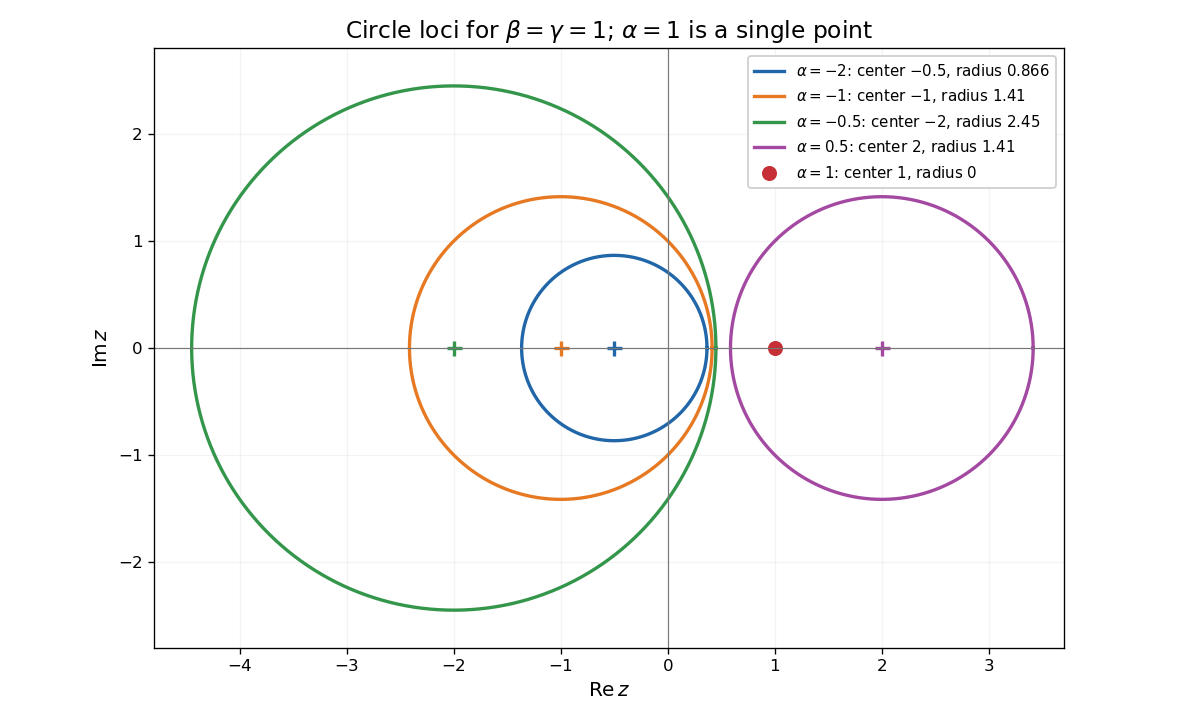

The original PDF's map is ; the converted TeX drops the conjugate on its denominator. Write , so . This is the reflection symmetry of a complex circle equation. It fixes and satisfiesThus it maps every point of the circle into the same circle. Conversely, for any point on that circle, also lies on it and . This proves , including the surjectivity required by the question.
For any three nonempty circles, fix . The triangle inequality gives, for every ,Taking the maximum over proves the requested inequality.
For centers and radii , the maximum separation of two circles is bounded above by . If the centers differ, choose and , where , to attain the bound. If the centers coincide, any unit gives opposite points attaining . ThereforeThe function is not a metric on positive-radius circles, since , even though it satisfies this triangle-type inequality.
The line through the origin is , containing zero and closed under addition and scalar multiplication, so it is a vector subspace. If , then and for some real . Conversely that equality gives the same set after shifting the line parameter. ThusChanging representatives to , changes their sum by and a scalar multiple by . The line classes therefore do not change, proving both operations well-defined. Associativity follows from . The zero vector of this quotient vector space is the entire line , because .
For a basis of , every vector is , so . If this combination equals , then ; independence of the three original basis vectors forces . Hence is a basis of the space of parallel lines as a quotient vector space.
For the specified direction, add to to obtain the representative . Thus its coordinates in the two standard line classes are . The two supplied image classes have coordinates and , while their input coordinates are and . If are the matrix columns, then and . Solving gives
Let bound all and put . ThenThe geometric series converges, so the comparison test for series proves absolute convergence of . This is the bounded power-series terms force interior absolute convergence principle.
Define the radius of convergence byallowing and . If , the supremum supplies a point of convergence with ; convergence makes its terms bounded, so the argument above gives absolute convergence at . If , convergence is impossible by definition. At , no general conclusion follows. Thus the convergence region has a circular interior centered at zero, with boundary behavior depending on the power series.
For ,If , choose strictly between that limit and . Eventually , proving absolute convergence by the geometric series comparison. If , choose below the limit; eventually , so the terms do not tend to zero and the series diverges. The point is harmless. This proves the root test in the needed case and gives
All three examples below have radius of convergence one, because the th roots of their coefficient moduli tend to one.
For convergence everywhere on the boundary, take . On it converges absolutely: for , , whose sum telescopes to a finite value.
For divergence everywhere on the boundary, take . If , every term has modulus one, so the term test for divergence applies.
For mixed boundary behavior, take . At it is the divergent harmonic series; each successive dyadic block contributes at least . At every other point , summation by parts proves convergence. Indeed put , so the finite geometric series gives . ThenThus the partial sums form a Cauchy sequence and converge. This derives the relevant Dirichlet test rather than only naming it.
To prove the intermediate value theorem in this setting, let and . The endpoint inequalities and continuity give an interval immediately to the right of contained in and an interval immediately to the left of disjoint from . Thus . Choose points of tending to ; continuity gives . If , continuity would place some point larger than in , contradicting the supremum. Hence at an interior point.
For a continuous self-map of , define . The range condition implies and . If either is zero, its endpoint is a fixed point. Otherwise apply the just-proved intermediate value theorem to with target zero to obtain and . ThereforeThis proves the fixed-point property of a closed interval without requiring itself to be monotone.
The fixed-point property fails on an open interval. The continuous functionmaps into itself, because . Its only possible fixed point satisfies , hence , which is outside the domain. It is therefore a counterexample even with the self-map requirement retained.
The fixed-point property also fails on the real line. The continuous function maps into itself but has no fixed point, since is impossible.
By continuity of at , for any choose such that whenever . Twice using the fundamental theorem of calculus gives the remainder asThe inner difference is and has modulus at most . Integrating this bound over the interval between and proves, for either sign of ,This is the local quadratic Taylor remainder estimate. The given may enter the bound on the second derivative; no stronger differentiability assumption is needed.
The intermediate value theorem gives a root , unique because makes strictly increasing. We show that Newton root-finding iteration, started at , always stays to the right of . If , the mean value theorem gives for some . Since , is strictly increasing, so . It follows thatInduction gives , so the bounded monotone sequence theorem supplies a limit . The continuous positive is bounded away from zero on , making continuous. Passing to the limit in gives and hence . Uniqueness implies .
For the rate, apply the Taylor theorem with Lagrange remainder to between and :With , rearrangement givesThus the monotone Newton convergence for a strictly convex function has quadratic convergence. More concretely, if , then . Once , induction gives , exhibiting the repeated squaring of small errors.
For a bounded function on a nondegenerate compact interval , a partition has Darboux sumsThe Riemann integrability criterion isEquivalently the supremum of lower sums and infimum of upper sums agree; their common value is the Riemann integral. A bounded nonintegrable example is the Dirichlet function . Every positive-length interval contains rational and irrational points, so every lower sum is zero and every upper sum is .
Suppose the continuous nonnegative function has somewhere. Continuity supplies a positive-length interval within on which ; at an endpoint use a one-sided interval. By monotonicity of the Riemann integral, its contribution to the integral is strictly positive, a contradiction. Therefore under the stated continuous-function assumptions.
For the general integrable case, choose and let while for . This nonnegative indicator function is Riemann integrable with integral zero: isolate in partition intervals of arbitrarily small total length, making the upper sum arbitrarily small while the lower sum stays zero. Yet . This is the single-point changes preserve Riemann integrals phenomenon and supplies the counterexample.
Put . At an interior point and for small enough,By continuity at , the modulus is bounded by the supremum of between and , which tends to zero. Thus the fundamental theorem of calculus givesAt the interval endpoints the same argument supplies the corresponding one-sided derivatives.
For an integrable discontinuous function, the single-point spike from part (i) has , so ; this disproves the derivative identity even when the primitive is differentiable. To see that differentiability itself may fail, take the step function for and for . It is Riemann integrable, but its primitive is and has left derivative zero and right derivative one at . Hence the full assertion is false for general Riemann-integrable functions.
Articles by others on the same topic
There are currently no matching articles.