For a subgroup of a finite group , Lagrange's theorem states . Thus a subgroup's order, and in particular the order of a group element, divides .
For , if every element had order one or two, the order of a finite group of exponent two would make a power of two, a contradiction. Hence an element has order five or ten. In the latter case is the cyclic group . Otherwise choose of order five. Its cyclic subgroup has index two and is therefore a normal subgroup.
In the noncyclic case an element outside has order two: its order divides ten, it cannot have order ten, and an element of order five has trivial image in the order-two quotient group . Every element of is then or . Conjugation by restricts to an automorphism of , say . Since , , so or modulo five.
For , the generators commute and has order ten, yielding the cyclic case. For , these are the relations of the dihedral group of the pentagon. The classification of groups of order ten is therefore exactly and , where the subscript on denotes its order. They are not isomorphic because one is Abelian and the other is not.
The Möbius group consists of maps with , acting on the Riemann sphere . Proportional matrices represent the same map. Thus it is , equivalently after normalizing the determinant. A zero denominator gives the image , while maps to when and stays at infinity when .
Fixing both zero and infinity forces , leaving with . Composition multiplies the parameters, giving a bijective group homomorphism from the multiplicative group of nonzero complex numbers to this pointwise stabilizer.
For the other pair, take , which sends zero to zero and one to infinity. Conjugate the scaling subgroup by this Möbius transformation:Every map fixing zero and one arises this way. Composition again multiplies , proving both subgroups are isomorphic to . This is the Möbius pointwise stabilizer of two points; conjugation changes the selected fixed points without changing its group structure.
Use the Levi-Civita symbol and sum over repeated indices. The contraction of two Levi-Civita symbols and the product rule giveReading the four terms as divergence and directional derivatives proves the curl of a cross product identity
The contraction of two Levi-Civita symbols gives . Similarly . Add the two directional-derivative terms to cancel the last terms, leavingThe product rule has therefore proved the gradient of a dot product identity
For a regular space curve parametrized by arc length , its curvature is , where is the unit tangent. Differentiating the given parametrization givesThe curve approaches the origin as ; the origin is a limiting endpoint. Its arc length measured from that endpoint is , soThis is a logarithmic conical helix. Its unit tangent and derivative areConsequently,The infinitely many turns near the limiting origin have finite total arc length, while the curvature diverges there.
Use for the dihedral group of order twelve and write each element uniquely as or , . The classification of subgroups of a dihedral group organizes the complete list: rotational subgroups are cyclic, and a subgroup containing a reflection is generated by its rotational part and one reflection. The individual lists and quotients follow below.
The involutions in an even dihedral group are the half-turn and the six reflections . Thus the seven order-two subgroups areThe half-turn is central, so only is normal. Indeed , a different reflection; an order-two subgroup has only one nonidentity element, so each reflection subgroup fails the normal subgroup condition.
The remaining proper subgroups areTheir orders are respectively one, three, six, four and six. The order-four groups are Klein four-groups; the last two are dihedral groups of order six, isomorphic to .
For completeness, if contains a reflection, write with . Any other reflection differs from a chosen by an element of this rotational subgroup, so with specified modulo . The choices give respectively the whole group, the two order-six groups, the three order-four groups and the six reflection groups already listed. This proves there are no omitted subgroups.
Thus there are eight remaining proper subgroups. The printed count nine includes one too many; nine would be correct if the whole group were included with these remaining subgroups. Altogether has sixteen subgroups, fifteen proper.
The proper normal subgroups and their quotient groups are as follows. Here the trivial subgroup is included as a proper subgroup.
- gives .
- gives : the rotation has order three and the reflection inverts it.
- gives : the two generators now have order two and commute.
- gives .
- or gives .
The rotational subgroups are preserved by reflection conjugation, and the last three order-six subgroups are normal by index two. The three order-four groups are not normal, since conjugation by changes the reflection exponent by two, which is nonzero modulo three. Part solution excluded the reflection subgroups. These observations, together with the complete subgroup list, prove the normal-subgroup list is exhaustive.
The rotation has order six. The possible cycle types in the alternating group are the identity, a three-cycle, and a product of two disjoint transpositions; their orders are one, three and two. Since a group isomorphism preserves the order of a group element, is not isomorphic to .
A real three-by-three matrix represents a proper rotation in the standard orthonormal basis precisely when and , that is, when . For the supplied integer numerator , direct multiplication gives and , verifying both conditions.
The rotation axis is the eigenspace for eigenvalue one. Solving gives and , sois a unit axis vector; its negative describes the same axis. On its perpendicular plane the rotation matrix has eigenvalues and . The rotation trace formula therefore gives . Since the trace is ,
Let with , allowing complex eigenvectors. A real symmetric matrix is Hermitian, so is real and is real. For eigenvectors of distinct real eigenvalues , self-adjointness gives , hence . Thus the distinct eigenspaces are orthogonal.
Here , where is the all-ones matrix. Since and vanishes on the plane of coordinate sum zero,Every nonzero vector in the indicated eigenspace is an eigenvector. The repeated eigenvalue three has a two-dimensional eigenspace.
A complex symmetric nilpotent matrix provides the requested counterexample:Its characteristic polynomial is , so its only eigenvalue is zero. It is not diagonalizable: a diagonalizable matrix with only zero eigenvalues would itself be zero. Complex symmetry is weaker than the Hermitian condition .
Expanding the characteristic polynomial along the first column givesFor , solving the two nullspace equations givesThese are all the eigenvalues and eigenvectors, with nonzero vectors understood. The three displayed spanning vectors form an eigenbasis, so is diagonalizable.
At , the sole eigenvalue is three, with algebraic multiplicity three but the same two-dimensional . Thus is diagonalizable exactly when . Indeed, at the exceptional parameter, with and , so its Jordan normal form has one block of size two and one of size one. This illustrates how an eigenvalue collision can destroy diagonalizability without changing the two-dimensional eigenspace.
Set . The bound and give . Hence at the origin, proving continuity, and , proving Fréchet differentiability there with derivative equal to the zero linear map.
Along the coordinate axes, direct difference quotients giveThese formulas include the origin. Therefore the two mixed partial derivatives differ:The explicit operator order removes any ambiguity about the notation for mixed derivatives. Also , since the first derivatives restricted to their own axes vanish identically.
All four second-order partial derivatives are discontinuous at the origin. Away from it,Along these are one and minus one, rather than their zero values at the origin. Meanwhile for , whereas its value at the origin is minus one; and for , whereas its origin value is one. This gives a concrete unequal mixed partial derivatives example despite differentiability of the original function.
False. Partial derivatives do not imply continuity; derivatives along coordinate axes need not control nearby non-axis approaches.
False. Directional derivatives do not imply differentiability; the resulting dependence on direction need not be a linear derivative.
False. Unequal mixed partial derivatives can exist when the continuity hypotheses of Clairaut's theorem fail.
An exact differential is a one-form equal to for a single-valued scalar function on the domain. In Euclidean coordinates this means its vector coefficients form . Integrating the first component of with respect to , then matching the other components, givesDifferentiating checks all three components. Since the domain is connected, two such potentials differ only by a constant, so this is the most general potential.
At both specified endpoints the nonconstant terms vanish. The fundamental theorem for line integrals gives zero for the line integral along every path joining the two points.
For the planar field, choose a continuous lift of the polar angle along a curve avoiding the origin. Differentiating the angle givesOn the closed curve the angle increases by times its winding number. ThusThe angle differential is locally exact but not globally exact on the punctured plane: the angle lift need not return to its initial value. This is the nonexact angular one-form, whose nonzero closed-path integral obstructs a global potential.
Choose zero gravitational potential at infinity. Apply superposition to a uniform sphere of positive density and the two voids represented by spheres of negative density. The shell theorem makes every component act as a point mass outside the large sphere. With and ,The volume factors are the cubes of the three radii.
Inside the smaller void, the large sphere and the removed small sphere have interior fields and , where . They combine into the uniform gravitational field in an off-center spherical cavity, . The point is outside the other void's sphere, whose removed mass contributes a repulsive field. ThusAn equilibrium must lie on the line through the two centers. Write with . Its equation is , givingThis point is inside the smaller void, but it is not stable. Let . The field's Jacobian matrix has eigenvaluesThe axial displacement is restoring, while transverse displacements accelerate away from equilibrium. Therefore there is no point in that void where a test particle remains stably at rest. The cavity equilibrium destabilized by a second void is a saddle; existence of a zero force is insufficient for stability.
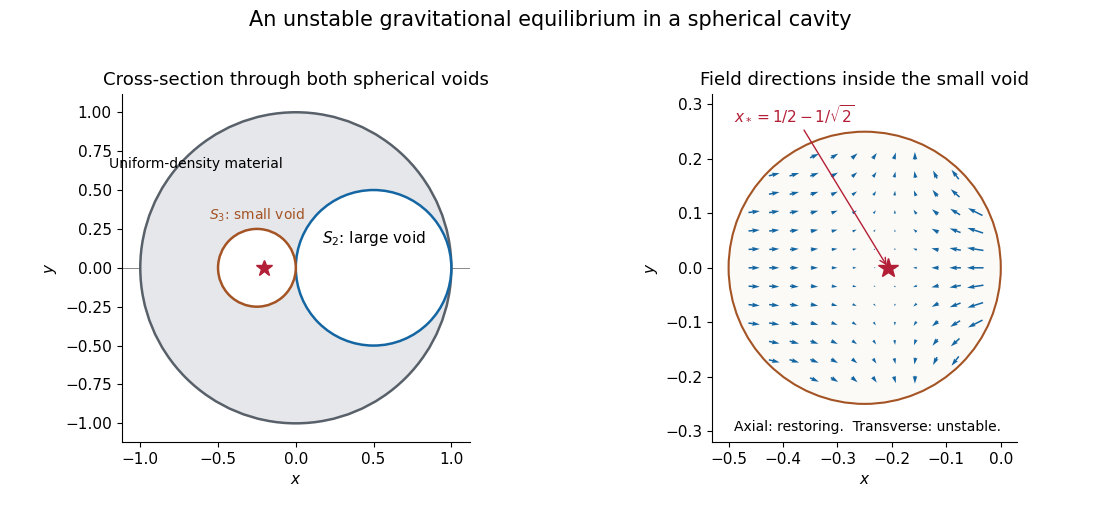
The two spherical voids and the unstable equilibrium inside the smaller void
. Details. 
For a continuously differentiable vector field on a volume and its boundary, the divergence theorem equates to the outward flux . For the given field, , soOn the sphere, , andThus the surface flux is also , verifying the theorem by explicit calculation.
Apply the product rule to , then apply the divergence theorem. This proves Green's first identity:Swap and and subtract. The gradient products cancel, giving Green's second identity:For uniqueness, set . It is a harmonic function with zero Dirichlet boundary conditions. Under the stated smoothness assumptions, Green's first identity with gives . Thus is constant on each connected component, and its boundary value makes every constant zero. The two solutions agree throughout . This is Dirichlet uniqueness for the Poisson equation. For classical solutions merely continuous up to the boundary and twice continuously differentiable in the interior, the maximum principle for harmonic functions gives the same conclusion without requiring boundary derivatives.
Articles by others on the same topic
There are currently no matching articles.