Use both material isotropy and material frame indifference. The polar decomposition in continuum mechanics writes , where is the left stretch tensor. Isotropy removes the reference rotation: . Choose an orthonormal eigenbasis of . A half-turn about any principal axis leaves fixed but reverses appropriate off-diagonal entries of . Frame indifference therefore makes those entries zero. If a principal stretch is repeated, rotations in its eigenspace additionally force the stress to be isotropic there. Thus the principal stresses share the stretch axes: this proves coaxiality of isotropic elastic stress with and with .
For simple shear, the left Cauchy-Green deformation tensor isIts principal axes make an angle with the coordinate axes satisfying when . If the two principal stresses are , rotating their diagonal matrix back givesConsequently the universal simple-shear normal-stress identity isEquivalently, it follows immediately from the off-diagonal entry of . At , the undeformed material has isotropic stress, so the identity holds there too. No particular elastic constitutive equation has been used.
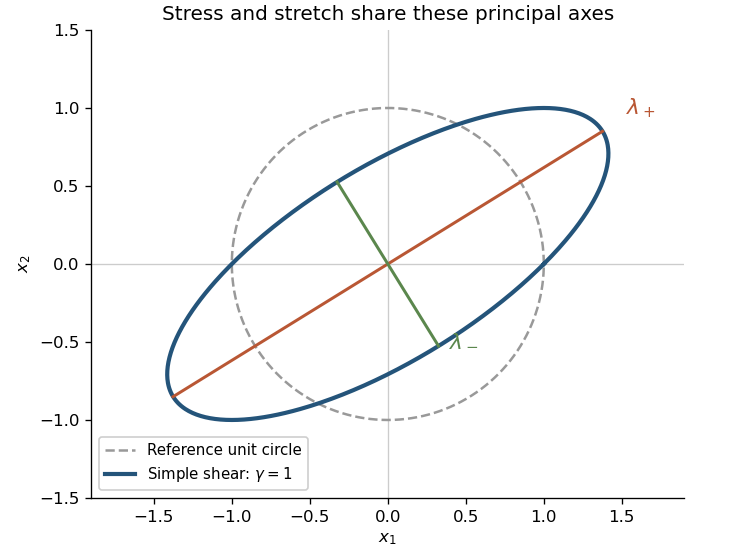
Principal stress and stretch axes of an isotropic elastic material under simple shear
. Details. 
The inextensible fibre constraint gives . Write the fibre direction and its transverse unit direction asThen and . In plane strain, incompressibility gives . Decomposing the second column of the deformation gradient along therefore gives , where . HenceThis is a local rotation followed by simple shear.
The compatibility of the deformation map requires . Since and , this isTaking components gives the compatibility relations for incompressible inextensible-fibre plane strain:Along a reference curve,Thus is constant when . The equivalent condition also covers . Its current tangent is proportional to , so these transverse curves are straight wherever the deformation is regular.
To construct the stress with zero body force, specify the local shear stress as the material's function or functional of under simple shear. The normal stresses are constraint reactions: incompressibility supplies pressure, and the inextensible fibre constraint supplies fibre tension. WriteThe compatible geometry has with , so , , and . Resolving along the two directions givesThe triangular equilibrium construction for inextensible-fibre plane strain now determines by integration along fibres and then along transverse curves. Thus any regular compatible deformation has a local zero-body-force stress construction once the shear law and suitable boundary integration data are supplied. There is no additional constitutive normal-stress law to specify: the two normal components are fixed by force balance and boundary tractions. This does not assert that arbitrary separately prescribed boundary tractions can accompany an arbitrary deformation.
Put and use reference cylindrical coordinates and current coordinates . The deformation map is , , . In the associated orthonormal bases its deformation gradient isIts determinant is one, as required by incompressibility. The radial principal stretch is . The other two squared principal stretches are the eigenvalues of the tangential-axial block of :Writing , they areThe positive square roots give , and .
The strain energy density is per reference volume, so the energy per height isThe work rates per height are from the end torque and from the inner pressure. The outer surface contributes no work because it is traction free, and the fixed height has zero axial work. Thus the virtual work identities for twist and inflation of an incompressible tube are
For a neo-Hookean solid, an irrelevant energy constant can be omitted:Differentiating under the finite integral givesAn antiderivative divided by is . With , the neo-Hookean tube pressure under twist and inflation is thereforeIt vanishes for an untwisted undeformed tube, and the twist contributes the last term at fixed radii.
Use the material-first nominal stress tensor convention , with the deformation gradient. For any fixed reference material subvolume with outward unit normal , conservation of energy isHere is body force per mass, is heat supply per mass and is nominal heat flux. Using momentum conservation to remove the kinetic energy balance gives the integral Lagrangian internal energy balance:The integral Lagrangian entropy inequality iswhere is temperature and is the thermodynamic entropy flux.
Since the subvolume is arbitrary, the divergence theorem givesExpand and eliminate the heat supply between these relations. The Clausius-Duhem inequality becomesUnder the usual local constitutive independence assumptions, the reversible mechanical and thermal variations can have either sign. The Coleman-Noll procedure therefore imposesDefine the thermodynamic force conjugate to an internal variable by . The energy balance and the remaining entropy constraint now give, respectively,
The specific Helmholtz free energy satisfies . For the multiplicative decomposition of the deformation gradient , adopt , consistently with the material-first nominal stress tensor. Differentiating givesConsequentlyorThese relations follow from the chain rule; the transpose convention matters.
Differentiating the dissipation potential, with the Frobenius norm of , givesAn integrating factor yields the exponential memory from tensor relaxation:For , the driving term is continuously zero at .
Taking the product explicitly defined in the question, gives , and hence its requested history functional isThere is a naming error in the PDF: with its convention, the actual second Piola-Kirchhoff stress tensor is , while is the transpose of the Mandel stress tensor, where . Thus if that stress measure is required. This agrees with the stress push-forward used in Question 5; the printed product is fully determined by the history above, whereas recovering also requires the deformation or an invertible elastic constitutive relation.
The multiplicative decomposition of the deformation gradient is used on histories where stays invertible. Thermodynamic admissibility additionally requires : positivity of the constants alone does not ensure this for arbitrary prescribed histories.
Write for the Kirchhoff stress tensor and for the second Piola-Kirchhoff stress tensor. Since and for the velocity gradient,Therefore the upper-convected rate as a stress push-forward is
For the simple shear flow, put and . The velocity gradient and rate-of-strain tensor areTheir upper-convected derivative givesDenote the symmetric extra stress by , and the relaxation time by to distinguish it from . The Oldroyd-B model in the question becomesFor the steady constitutive response, , and . HenceA constant imposed shear rate can still have startup transients; these values describe the steady response.
For circular Couette flow , the velocity gradient in the orthonormal polar basis isFor completeness, in fixed Cartesian coordinates let and . Then and . Along a particle, the polar basis rotates at angular speed . Its contribution to the material derivative cancels the rigid-rotation part of in the upper-convected derivative. The rotating-frame reduction of circular viscoelastic shear therefore leavesThe flow direction is now and the gradient direction is . With , the same simple-shear constitutive calculation gives
Angular force balance implies is constant. Integrating gives . With and ,The radial force balance is . Thus the inertialess Oldroyd-B circular Couette pressure isThe constant is fixed by a pressure or normal-traction boundary condition.
Write , and . On the fixed yield surface, and , where is stress-space arc length. Substituting , , into planar force balance givesThus , with .
For a spatial curve and a function , the chain rule givesHere primes refer to the spatial parameter , not the yield-curve parameter . The displayed row-matrix product being zero is therefore sufficient for to remain constant.
The eigenvectors of are and , with eigenvalues and . Along these slip lines, respectively, and . This proves the stress characteristics for an anisotropic yield curve:
For the velocity relations, the outward normal to the reduced yield curve is proportional to . The associated flow rule, using the symmetric stress work pairing , therefore gives a rate-of-strain tensor proportional toThe off-diagonal stress variation contributes , which ensures this normality calculation uses the correct factor. Direct multiplication gives : neither slip line direction extends instantaneously.
Resolve the velocity as . Since and , its longitudinal derivative along an curve is , and along a curve it is . Setting these extensions to zero gives the Geiringer velocity relations:
Articles by others on the same topic
There are currently no matching articles.