The musical isomorphisms are the pointwise maps induced by the Riemannian metric:In local coordinates they are and . The inverse metric makes these inverse bundle maps, hence inverse maps between smooth vector fields and smooth differential one-forms.
For a covariant two-tensor , its metric trace is in a Riemannian orthonormal frame. The contraction is independent of the chosen frame. There is a terminology distinction here: if is literally an alternating differential two-form, this trace is zero. The object needed below is the covariant two-tensor , generally not alternating. Interpreting that tensor as an alternating form would make the stated divergence construction impossible.
Let be the Levi-Civita connection. The Riemannian gradient, divergence and positive Laplace-Beltrami operator areThus , and in coordinatesThis choice makes the Laplacian eigenvalues nonnegative on a closed Riemannian manifold. The alternative convention reverses all eigenvalue signs, but none of the comparisons below.
For the Riemannian submersion, let and choose orthonormal horizontal lifts of a base frame and an orthonormal vertical frame . The horizontal part of projects to the base Levi-Civita connection; this follows directly from its Koszul formula applied to basic horizontal fields, because their inner products and projected brackets are pulled back from the base. Therefore the horizontal trace of the Riemannian Hessian of is the pulled-back base Hessian trace. Since , its vertical terms areWriting for the unnormalised fibre mean curvature vector givesThe totally geodesic submanifold condition on the fibres makes . Consequently eigenfunction pullback by a Riemannian submersion givesHere the Riemannian submersion is onto, so the map is injective. Its image is exactly the members of the upstairs eigenspace constant on each whole fibre: such a function descends smoothly by local sections of the submersion, and the displayed identity forces the descended function to have the same eigenvalue. In particular, whenever these eigenspaces are finite dimensional, the downstairs multiplicity is no larger than the upstairs multiplicity. The upstairs eigenspace may also contain functions varying along fibres.
A flat torus is with the metric induced by the Euclidean metric, where is a full-rank Euclidean lattice. Its dual lattice is . The characters descend to the quotient and form an orthogonal Fourier basis of on it. Direct differentiation gives the spectrum of a flat torus:with multiplicity equal to the number of dual lattice vectors of each length. In particular zero has multiplicity one.
Let the given four-dimensional isospectral manifolds be and . For , take their products with the same circles of length , equivalently the lattices . The dual lattices are , so their Laplacian eigenvalues areThe given equality of base spectra with multiplicities makes these product spectra identical.
Choose smaller than the shortest nonzero vector length in either original Euclidean lattice. By short-vector cancellation for flat tori, the shortest nonzero vectors in the product lattice are exactly in its new factor. To spell out the nonisometry argument, any isometry of the product flat tori lifts to an isometry of their universal Euclidean covers. This is affine, and its orthogonal linear part maps one product lattice onto the other. It must map the span of their shortest vectors, namely the new -dimensional factor, onto itself; orthogonality then preserves the original four-dimensional factor and maps onto . That would give an isometry of the original flat tori, contrary to the assumption. Isospectral nonisometric flat tori therefore exist in every dimension .
We construct a family by seven-triangle Dirichlet transplantation. Start with a scalene triangle sufficiently close to an equilateral triangle. Its three side lengths are the three independent parameters; restrict to an open set where its angles are distinct and lie between and . Label the sides opposite the corresponding vertices .
For each of two planar domains, begin with tile and attach the remaining congruent copies by Euclidean reflection across the indicated sides. The attachment tables areFor example, in the first row means to reflect tile across its side to obtain tile . Both attachment graphs are trees: there is a central tile with three arms, each consisting of two tiles. Every side not used in the table is an exterior boundary side.
At the equilateral triangle, these seven reflected tile interiors are disjoint; at each central vertex four sectors of angle meet, leaving an exterior gap . Other boundary vertices have angles or , and distinct nonincident pieces are separated. The positive angular gaps and separations persist under sufficiently small perturbations of the three side lengths. Thus this construction really gives connected polygonal planar domains on an open three-dimensional parameter set. Their only reentrant vertices are the central vertices , with interior angles ; all other boundary angles are one or two triangle angles and are less than .
Because these three reentrant angles are distinct, an isometry of the two planar domains would send each labelled central vertex to its counterpart. A planar isometry is the restriction of a Euclidean rigid motion: its differential preserves the Euclidean connection, hence is constant on the connected domain. After aligning the central triangles, such a motion fixes three noncollinear points and is the identity. But the domains are not identical. On the arm attached to side , the point construction attaches the last tile across side , whereas the line construction attaches it across side . The former side is therefore interior in one domain and exterior in the other. This proves the two domains are nonisometric throughout this three-parameter family.
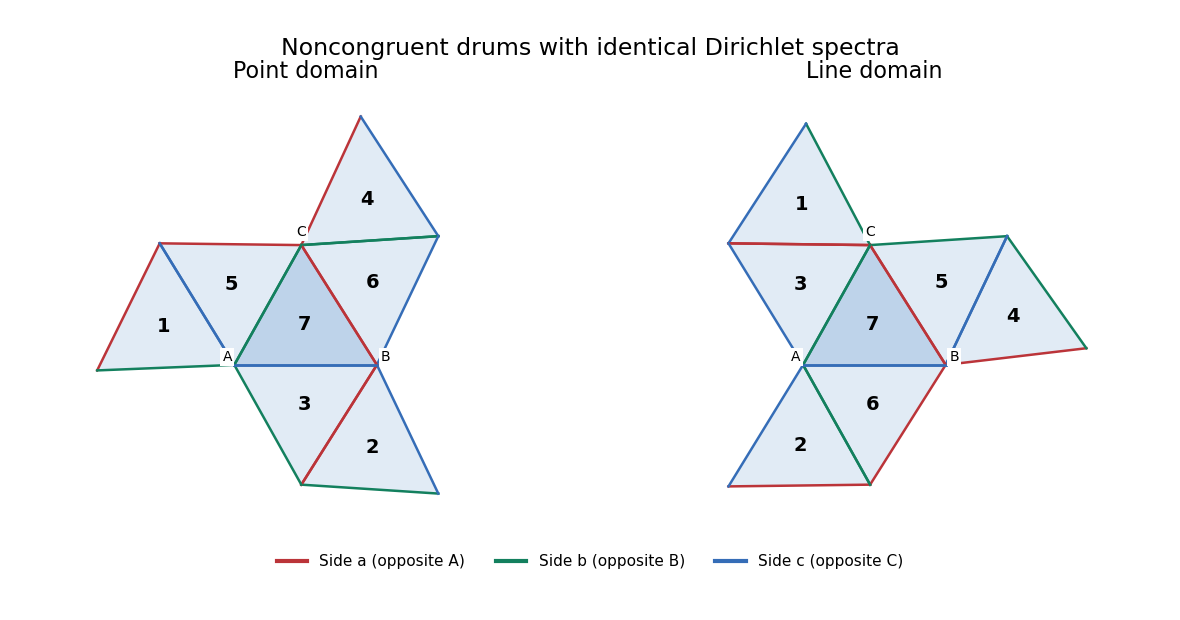
Two noncongruent seven-triangle domains with identical Dirichlet spectra; matching colours label matching sides
. Details. 
We now prove equality of the Dirichlet Laplacian spectra, including multiplicities. Index by the nonzero binary vectors , with integer label . The transformationsare involutions over . Their point permutations are precisely the transpositions in the left attachment table, with the remaining points fixed. On covectors the inverse-transpose transformations give permutations with exactly the right table. Let be the point-line incidence matrix of a set system of the Fano plane:The incidence relation is invariant under transforming and its covector contragrediently, so for all three sides. Each point lies on three lines, and two distinct points lie on exactly one common line. Consequentlywhere is the all-ones matrix. Its eigenvalues are once and six times, so is invertible.
The Dirichlet boundary condition requires a sign change at an unglued side. Give each tile the sign and putThe signs alternate across each glued side in both domains. The signed side matrices are thereforeThey have entry across a glued pair and entry on a fixed exterior tile. The invertible seven-triangle Dirichlet transplantation matrix satisfiesThis is an actual Dirichlet boundary condition intertwiner, not merely the unsigned incidence relation.
To justify the spectral conclusion even at the reentrant corners, use the closed Dirichlet energy form. Pull a function on either domain back to its seven reference triangles and write its components as a vector . The form domain consists of components whose side traces agree on glued pairs and vanish on exterior sides; equivalently on each side for the point domain, and for the line domain. These trace conditions exactly characterize of the glued polygon. Both its norm and its Dirichlet energy are the sums of their seven reference-tile integrals.
Since the signed side matrices are symmetric, the intertwining identities also give . Thus commutes with every , and the polar factoris an orthogonal matrix with . Multiplication of the component vector by this constant matrix preserves the inner product and the integrated squared gradients, and maps the two form domains bijectively. The self-adjoint operators associated with these forms are consequently unitarily equivalent, so their eigenvalues and multiplicities agree. The eigenfunctions are smooth in the interiors; no unwarranted smoothness at polygonal corners is required. We have proved
Use the positive Laplace-Beltrami operator on a compact Riemannian manifold without boundary. Its heat kernel is the smooth integral kernel , , of the solution operators for the heat equation:The last condition holds, in particular, in for smooth initial functions. The heat trace isThe heat invariants are the coefficients in the small-time heat kernel expansion of this trace:Equivalently, the local diagonal coefficients integrate to ; is the scalar curvature. Some normalizations absorb into the coefficients. These definitions here use the displayed normalization consistently.
To prove uniqueness, let satisfy the heat kernel conditions and let be the difference of their solutions with the same smooth initial function. It solves and tends to zero in as . The heat equation energy identity, using integration by parts on the closed manifold, gives for Integrating from to gives ; sending proves . Thus for every smooth test function ,For fixed positive and , smoothness makes this difference a smooth function of . Taking its conjugate as test function shows its squared norm is zero. The heat kernel is unique.
The compact elliptic spectral theorem for the self-adjoint elliptic Laplace-Beltrami operator gives a complete orthonormal basis of smooth eigenfunctions , with discrete eigenvalues counted with multiplicity. Solving the heat equation for initial data gives , so the unique heat kernel has its eigenfunction expansion and its heat trace isThe series converges for every . This proves that the spectrum with multiplicities determines the heat trace.
Conversely, its large-time behaviour recovers the distinct eigenvalues and their multiplicities successively. The multiplicity of zero is . After subtracting the already determined terms, letbe the positive remaining sum, and let be its smallest remaining eigenvalue. ThenIndeed, after factoring , the next distinct eigenvalue is separated from by a positive gap. The remaining tail tends to zero: for fixed its absolute sum is bounded by a constant times , using finiteness of . Induction recovers every spectral term. Thus the heat trace and the spectrum with multiplicities determine one another.
Finally the leading coefficient among the heat invariants is positive, soThe common heat trace of isospectral manifolds therefore forces them to have the same dimension. Once the dimension is recovered, its leading coefficient also recovers their common volume.
Take a finite presentation . For a closed-manifold realization of a finitely presented fundamental group, begin with a five-dimensional ball and attach one-handles, giving a compact oriented five-manifold with fundamental group the free group on the . Represent the relators by disjoint embedded circles in its four-dimensional boundary. General position allows them to be embedded and disjoint, and their oriented normal bundles admit framings. Attach a two-handle along each such circle. The resulting compact five-manifold hasby the Seifert-van Kampen theorem. Now set . It is a compact connected smooth four-manifold without boundary. Turning this handle decomposition upside down gives a relative handle decomposition of with handles of indices three, four and five only. Attaching such handles does not change the fundamental group: there are no new one-handles or two-handle relations. Thus is an isomorphism andThese are the differential-topological handle facts used in the construction; the dimension-five thickening ensures the boundary retains the prescribed fundamental group.
Now assume finite. Choose any smooth Riemannian metric on and lift it to its universal cover . This cover is compact, since its degree is , and simply connected. Its deck transformations give a free isometric -action. For the two Gassmann equivalent subgroups putEach is a closed Riemannian manifold, and is its simply connected universal cover, with deck transformation group . Consequently .
Here is the complete spectral argument behind the Sunada theorem in this situation. Each finite-dimensional upstairs eigenspace is a representation of , because the action is isometric and commutes with the Laplace-Beltrami operator. Functions downstairs correspond exactly to invariant functions upstairs, so their multiplicities are . Averaging the representation matrices over a subgroup is a projection onto its invariant subspace. Taking its trace givesThe character is constant on each conjugacy class of . Gassmann equivalence means for every such class ; summing these equalities also gives . The two averages are therefore equal for every . The quotients are isospectral, with .
If , the map is well defined, invertible and isometric because acts by an isometry upstairs. Conjugate subgroups give isometric quotients.
For an explicit example with different fundamental groups, use the order-sixteen Gassmann pairEmbed each in by left multiplication on its own sixteen elements, identified with the same sixteen-point set. These regular representations are faithful. Both groups have one identity element, three elements of order two, and twelve of order four: in the elements of order dividing two are precisely its four even-coordinate elements; in they are the four elements in . Every remaining element has order four.
In a regular action, an order- element is a product of disjoint -cycles. Thus each subgroup intersects the identity conjugacy class of in one element, the class of type in three, the class of type in twelve, and every other class in zero. They are Gassmann equivalent. However is abelian and is nonabelian, so they are not isomorphic. Apply the preceding construction with fundamental group and these subgroups. It producesIn particular they cannot even be homeomorphic, and therefore cannot be isometric.
Let , and denote element orders. Remove three points from an oriented sphere. Its fundamental group has peripheral generators with . Send them to . Since generate , the kernel defines a connected regular covering of the punctured sphere with degree and deck transformation group .
Complete the lifted punctures by disks. Above the three removed points the monodromy cycles have lengths , respectively, and the disk projection has the local form , or . This gives a closed connected oriented topological surface and an orientation-preserving -action. At the three kinds of filled-in points the stabiliser subgroups are conjugates of , and , respectively. Every other point has trivial stabiliser subgroup. Orders equal to one simply correspond to unbranched filled points.
The punctured sphere has Euler characteristic , so its cover has Euler characteristic . Filling the ends adds disks. This proves the formula for the branched surface action from two generators:
For a subgroup , its quotient map is always regular as a branched quotient. It is an ordinary unbranched normal covering map exactly when acts freely, that is,Necessity follows from the listed stabiliser subgroups. Conversely, these conditions eliminate every possible nontrivial point stabiliser. A free finite action gives a covering space, and its deck transformations are , acting transitively on each fibre; hence the cover is normal. In this caseThe condition concerns regularity of the different map ; it is not needed for when the action of is free.
For the specified order- group, . Set and . Since has order two, and , so is either two or six. The order-two alternative would make the displayed formula give . That is impossible for a connected closed oriented topological surface, whose Euler characteristic is . Thus , and
Each has order eight. By Lagrange's theorem, it contains no element of order three or six, so it meets all conjugates of and trivially. In , the only nonidentity element whose order divides eight is . Since is central, it is also the unique such element in every conjugate of , and it is excluded from both by hypothesis. Both subgroup actions are therefore free. The quotients are closed oriented surfaces with
The branched-cover construction supplies a smooth structure, with the stabilisers acting by rotations in the disk charts. Average a smooth Riemannian metric over to make the whole action isometric. The Gassmann equivalence of then gives isospectral manifolds: for every upstairs eigenspace with character , its downstairs multiplicities are , and these are equal because the two subgroups have equal intersection sizes with every conjugacy class. This proves the spectral assertion for any such invariant metric.
To guarantee nonisometry, choose the invariant metric with curvature markers distinguishing finite-cover quotients. Here are the geometric details, since nonconjugacy alone would not guarantee nonisometry for an arbitrary metric. Choose a small disk in the free locus of the -action, with all its translates disjoint. In that disk choose three noncollinear points in a geodesically convex neighbourhood. Supported conformal smooth bump functions can give them three distinct high values as strict Gaussian curvature maxima, occurring nowhere else in the unmodified metric. Arrange these three maxima as one tight cluster, much closer to each other than to any translated cluster, and copy the same modification to every translate. Curvature and its first few derivatives can be adjusted by the second and higher derivatives of the conformal factor; narrow bumps give high distinguished curvature with small change in metric distances. Further small supported perturbations remove accidental maxima of these exact heights. Thus the resulting metric remains smooth and -invariant, and its marked clusters are intrinsic and uniquely labelled by their three curvature values.
Any proposed quotient isometry must carry a whole labelled cluster to another. Lift its restriction near that cluster to the corresponding two marked disks in , and identify these disks using the appropriate group element . The resulting local isometry fixes all three marked points. Its differential at the first point fixes the two independent directions of the unique geodesics to the other two; hence it is the identity, and the local isometry itself is the identity near that point. If are the quotient maps, we therefore haveon an open set. Both sides are local isometries on the connected complete Riemannian surface . A local isometry is determined along each geodesic by its value and differential at the initial point, so the equality propagates to all of .
For , this equality implies . Evaluating at a free point of the -action shows ; equivalently these maps differ by a deck transformation of . Thus , and equality of subgroup orders gives equality. This contradicts their assumed nonconjugacy. For this marked invariant metric the two quotients are nonisometric, isospectral Riemannian surfaces of genus two. No constant-curvature requirement is imposed or used.
Articles by others on the same topic
There are currently no matching articles.