Use stellar homology: dimensionless density, temperature and luminosity profiles are taken to have the same shape, so the dimensional scale relations follow from the structure equations. Mass conservation and hydrostatic support giveThe ideal gas equation then gives , with the dimensional constants held fixed. The specific stellar energy-generation rate has the prescribed hydrogen factor and temperature exponent, soIndependently, radiative diffusion in a star gives , henceEquating the nuclear supply and radiative transport establishes composition-dependent CNO homology:At one fixed composition, these reduce to and as required.
The Stefan–Boltzmann law gives , so . Thus the logarithmic Hertzsprung-Russell diagram slope along this zero-age main sequence isIncreasing mass moves upward and leftward on the conventional diagram, whose temperature axis is reversed.
For composition changes, neglect the small heavy-element contribution to the mean molecular weight and set . Then . The fixed trace catalyst abundance is absorbed into ; this is not an assertion that an exactly metal-free star can undergo CNO burning. Substitution into the homology laws givesFor a retained, nonnegligible fixed metallicity , the corresponding mean-molecular-weight factor is instead. The displayed requested formula uses the trace-metal approximation.
At fixed mass, differentiating with respect to at the formal reference givesConsequentlyand the initial fully mixed hydrogen-burning evolutionary track has slopeHydrogen depletion has , so both luminosity and effective temperature initially increase. The star therefore moves upward and leftward, on a shallower logarithmic track than the mass sequence. The figure uses dimensionless luminosity and temperature relative to its initial reference star; the track is computed for declining at constant mass.
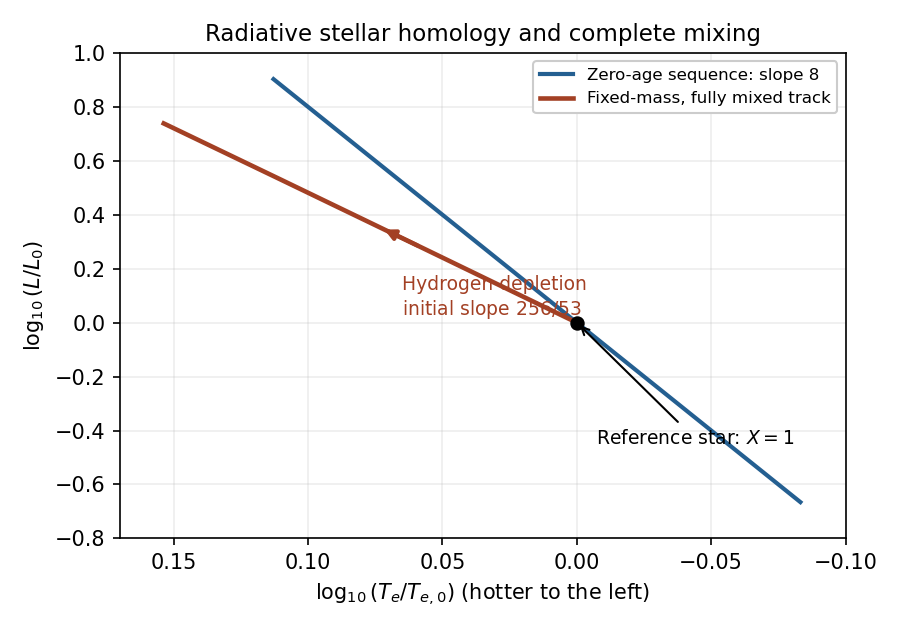

Ordinary cluster main-sequence turn-offs instead evolve toward brighter, cooler, more extended configurations and eventually the giant region. Normal stars are therefore not mixed throughout their entire mass during hydrogen burning: the core composition changes while the envelope retains hydrogen, and composition and entropy gradients develop. Core exhaustion and subsequent shell burning then produce very different structural evolution. Complete mixing is a special evolutionary scenario, not the standard explanation of ordinary giant formation.
These hydrogen-burning scalings must not be extrapolated literally to . Their vanishing nuclear coefficient would make the inferred radius tend to zero and the effective temperature singular; in reality hydrogen exhaustion requires a different structural and energy-generation model. A homogeneous remnant may be helium-rich, but its later structure is not described by the same CNO law. Also, the cover-sheet radiation-pressure expression has a temperature-power typo: the physical term is . Radiation pressure was neglected in this derivation, so that typo does not enter the calculation.
In the radiative layer, take the enclosed mass to be , the transported luminosity to be , and the mean molecular weight to be constant. The envelope's own gravity is neglected. Divide the hydrostatic and radiative temperature equations, and then eliminate density using the gas equation of state:Put and . For , integration givesDefining and yieldsIn the relevant positive-exponent case, writing produces the stated form whenever this integration constant is nonnegative. The exceptional values excluded above lead to logarithms: gives , gives , and both zero give .
For radiative-envelope convection matching, compute the logarithmic gradient of the pressure relation:At the marginal boundary, the Schwarzschild criterion equates this with the ideal-gas adiabatic gradient . HenceThe positive real notation requires a nonnegative bracket; a general signed is the safer integration constant otherwise. For the later case and a monatomic gas, this bracket is , so is of the same order as .
Deep below the convective boundary, with the temperature-power term dominating , the pressure law becomes . Differentiating this approximation and using hydrostatic balance givesThe general temperature is a term proportional to plus a boundary-dependent constant. Well inside the boundary radius, where that term dominates, it reduces toThe inverse-radius profile is an inner approximation, not an assertion that the boundary term vanishes everywhere.
Now take , so , . Then , , and define so that . The luminosity supplied by the thin burning layer isBecause the integral is strongly concentrated near and , the outer term is negligible. ThusThe factor , rather than merely , is essential since the specified energy-generation rate is per unit mass. This integration uses the deep radiative profile as a leading thin-shell approximation.
Crucially, is not independent of luminosity. Its defining relation givesSubstitution into the shell integral therefore yields . The degenerate-core relation gives , soThis degenerate-core shell-burning mass-luminosity relation is specific to the adopted opacity, burning exponent and structural approximations.
Removing some envelope mass while retaining the hydrogen-burning shell and the deep-envelope regime leaves the leading luminosity approximately unchanged at fixed core mass. The envelope can instead change the radius and effective temperature. This independence is not valid for arbitrarily complete stripping: removing the fuel or the pressure-confined shell structure quenches or modifies shell burning, and the assumed giant model then fails.
Write and for the number densities of nickel-56 and iron-54. Both nuclei contain 28 neutrons, while their proton numbers differ by two. Dividing the positive-exponential nuclear statistical equilibrium formulas printed in the PDF therefore gives the nickel–iron nuclear equilibrium ratioThe neutron-density factors cancel. contains the isotope-dependent statistical and translational mass factors suppressed in the supplied proportionality; it is constant in this simplified calculation. The TeX conversion incorrectly reverses the exponential sign, so the PDF sign is essential here.
In the specified restricted composition, equality of total proton and neutron numbers meansConsequentlyDifferentiation, with the suppressed prefactors held constant, givesUsing the paper's supplied signed energy difference producesWith that negative value, tends to zero at both temperature endpoints, increases below this temperature and decreases above it. At the stationary point , so it is indeed a maximum for the printed toy data.
There is a genuine physical-data qualification: the stated negative energy difference is inconsistent with interpreting as the conventional positive total nuclear binding energy of these actual isotopes. Using atomic masses, whose electron masses cancel in this reaction,The masses used are , and , from NIST hydrogen masses, NIST iron masses and NIST nickel masses. Small electronic binding corrections do not change the sign. With a positive , the simplified above is strictly decreasing for and has no finite maximum. Thus the numerical maximum follows from the supplied negative parameter, not from consistent physical binding energies; changing the TeX sign to recover a maximum would not repair the PDF's data.
Nuclear statistical equilibrium is appropriate when the relevant forward and inverse strong or electromagnetic reactions are fast compared with changes of temperature, density and composition. It is useful in sufficiently hot late silicon-burning material and in the hottest explosive burning regions of massive stars. Some burning zones reach only quasi-equilibrium, and cooling or expansion eventually freezes the abundances out; an equilibrium expression cannot by itself predict the full ashes when these timescale conditions fail. Temperature, density, conserved baryon number and the electron fraction in stellar matter must all be specified. Negligible free-particle contributions in bulk bookkeeping are not the same as exactly zero free densities in the equilibrium formula.
Strong and electromagnetic reactions preserve total charge and baryon number, so they conserve the proton-to-neutron ratio. Weak reactions need not: electron capture and beta-plus decay convert protons into neutrons and lower it. Such conversions occur in hydrogen-burning networks and in the nitrogen-to-neon chain during helium burning. At high density in advanced stellar cores and core collapse, electron capture becomes particularly important; neutrino emission also affects energy and lepton loss. Beta-minus decay changes the ratio in the opposite direction and can compete during later relaxation. Nuclear equilibrium for strong reactions does not automatically imply weak equilibrium or a fixed proton-to-neutron ratio throughout all stellar evolution.
Use for the neon-22 mass fraction, temporarily keeping it distinct from the earlier metallicity. Let be the baryon density, ignoring small nuclear mass defects. Equal masses of carbon and oxygen giveCarbon-12 and oxygen-16 each have equal proton and neutron numbers, while neon-22 has ten protons and twelve neutrons. The total proton and neutron numbers per baryon are consequentlyHenceThe equal carbon/oxygen mass split cancels from this result: any mixture of these two symmetric nuclei has the same electron fraction. Taking the paper's metallicity symbol to mean gives its requested expression.
The literal pre-helium-burning nitrogen interpretation, however, needs a correction. Each initial nitrogen-14 nucleus receives two alpha particles, including eight additional baryons, before becoming neon-22; the intervening beta-plus decay also emits a neutrino. Thus, if the entire original metallicity is nitrogen-14 with mass fraction , conservation of the number of seed nuclei givesThis is neon-22 neutron excess from nitrogen-14. The two expressions are compatible only when their arguments are distinguished: the displayed law uses the final neon mass fraction, not literally the earlier nitrogen mass fraction. Treating those fractions as equal is an extra simplifying approximation, not a consequence of the stated capture chain.
A radioactively powered Type Ia supernova light curve rises to a broad maximum over roughly weeks as energy deposited in expanding ejecta diffuses out, then declines over the following weeks and months. Its power comes predominantly from the nickel-56 decay chain, first nickel to cobalt and then cobalt to iron. Gamma rays and charged decay products deposit heat, which is reprocessed into optical and infrared radiation. At later times, declining cobalt decay power and increasing gamma-ray escape shape the tail. It is not sustained nuclear fusion in the expanding ejecta. The amount of radioactive nickel, photon diffusion time and deposition efficiency all matter, so an uncorrected fixed luminosity is only an idealization.
For the requested two-isotope yield calculation, assume the same total processed iron-group mass, namely as inferred from the zero-neon reference. Treat the final freeze-out ashes as nickel-56 and iron-54, neglecting residual light particles and additional weak neutronization. If is the nickel mass fraction, conservation of electron fraction givesSince , this reduces to the metallicity dependence of nickel-56 yieldUnder the paper's intended identification ,If instead denotes the earlier nitrogen mass fraction, retaining the actual capture stoichiometry gives and . The same temperature and density do not alone fix a total burned mass; equality of that mass is also implicit in the comparison. The two-isotope assumption is a bulk-ash approximation, not a complete equilibrium network with all free particles identically absent.
For otherwise comparable explosions, approximate the peak luminosity by a quantity proportional to the radioactive nickel mass. Let be the true distance to an extremely low-neon event, and use the solar calibration . Its measured flux is , but the inferred standard-candle distance isThe source is intrinsically brighter than the calibration, so the distance is underestimated by about , conventionally described here as about . Equivalently, , consistent with the supplied rounded factor . Using the literal nitrogen metallicity instead gives about a underestimate. These are conditional composition effects in this simplified model; real Type Ia distance estimation also standardizes light-curve shape and color.
Since the donor fills its Roche lobe, use and substitute its equilibrium mass-radius relation into the lobe approximation:Kepler's third law then givesso the Roche-lobe period-mass relation for a linear donor radius law isThe total binary mass cancels, rather than being assumed equal to the white-dwarf mass.
The orbital radii about the center of mass are and . Summing the two orbital angular momenta givesWith transferred matter retained by the accretor, total mass is fixed. Logarithmic differentiation givesFor , the separation response is . Since at fixed total mass,The second relation uses the supplied equilibrium donor sequence. As the donor loses mass, . If , its Roche lobe shrinks fractionally faster than this donor radius, so the excess filling increases and drives more transfer: it is positive feedback. If , infinitesimal loss instead reduces overfill on that assumed sequence, so some continuing driver is needed to retain contact.
There are two limits to the literal dynamical interpretation. The given initial range is , so is an extrapolated instability test, not a state inside that range. Also, a true dynamical stability of binary mass transfer test needs the donor's adiabatic stellar radius response exponent , rather than its thermal-equilibrium exponent. In general,Thus is the result for the assumed response. A fully convective idealized donor has , giving a dynamical threshold , already below . The equilibrium radius law alone should not be used to assert a universal dynamical threshold.
One continuing driver is magnetic braking of a binary star. A magnetized wind carries away the donor's spin angular momentum; tides that maintain near-synchronous rotation replenish that spin from the orbit, removing orbital angular momentum. With an external , the lobe response becomesEquating this to the donor response proves the binary mass-transfer contact equation in this model:A negative torque therefore drives mass loss while maintaining contact for , subject to the chosen donor response and braking assumptions.
To obtain the specified expansion, use the usual nova-ejection prescription: the escaping material is expelled isotropically from the white dwarf and carries its specific orbital angular momentum, with no additional torque. This is isotropic re-emission from a binary star. Circularity alone does not determine the angular momentum carried by the ejecta; the prescription is an additional physical assumption.
The accretor's orbital radius is , so its specific angular momentum satisfiesDuring ejection, take , and , where . ConsequentlyDifferentiate to first order:Using yieldsThe same lobe law now has changing total mass but unchanged donor mass, soThe donor radius is unchanged on the short eruption timescale, whereas its lobe expands. It therefore falls inside the lobe and Roche-lobe overflow stops in this idealized model. This is nova-induced binary detachment.
The need for the ejection prescription can also be seen algebraically. If the ejecta instead have mean specific angular momentum , the same circular-orbit differentiation givesThe requested coefficient is obtained only when . Other prescriptions can produce a different expansion or a contraction; the stated circularity condition does not rule them out. The ejection may be short compared with the transfer time while remaining slow compared with an orbit, consistent with circularity. If truly impulsive, an eccentricity is generally excited unless an additional circularization assumption is made.
Now put for the constant external torque. Keep the masses, mass ratio and torque coefficients fixed to leading order over one small- cycle; corrections in those coefficients affect the calculated times only at the next order. During detachment there is no transfer, so fixed component masses giveThe fractional lobe gap closes in timeDuring the semi-detached accumulation phase, use the same external torque and the equilibrium donor contact equation derived in (a):Accumulating the next layer therefore takesDivision cancels the layer mass, torque and angular momentum:The result uses for a positive steady accumulation rate, unchanged donor structure during the eruption and the same external torque in the two phases. Here the given ensures a positive denominator. It describes an idealized nova cycle; extra frictional loss, irradiation-driven donor changes or a different ejection angular momentum would change the ratio.
Articles by others on the same topic
There are currently no matching articles.