Use geometric units , metric signature , and a four-velocity normalized by the physical metric. Write , where . For a pressureless perfect fluid, the dust stress-energy tensor is and . Since , its background trace isConsequently the field equation is . Neglecting time derivatives and higher weak-field orders gives the Newtonian limit of Nordstrom gravity:The constant shift between and does not affect the Poisson equation or the force. Here is the physical rest density; if fluid indices are instead defined using the background metric, the intermediate powers of change but the same leading-order equation results.
For the motion, the Levi-Civita connection of the conformally flat metric isIn particular . Replacing the affine parameter in the geodesic equation by coordinate time gives, with and ,At small speeds and for a nearly static field, this becomesThus the Newtonian gravitational potential and freely falling trajectories agree to the stated weak-field, slow-motion order. The comparison is an approximation, not an exact equivalence of relativistic trajectories.
Yes, at the weak-field accuracy of the experiment. The Pound-Rebka experiment measures gravitational redshift, which Nordstrom theory of gravitation predicts even though it does not predict bending of light.
In a static field, a stationary clock has . A photon has constant Killing energy , and an observer at rest has . Its measured frequency is proportional to . Emission at and reception at therefore giveAn upward ray has when ordinary units are restored, so . This is the shift tested using the Mössbauer effect. The gravitational redshift follows from the physical clock rates; a claim that straight light paths imply no frequency shift would confuse two different observables.
No: the theory predicts zero gravitational deflection of light. The reason is conformal preservation of null geodesic paths. Along a null geodesic with tangent , the geodesic equation for a conformally flat metric reduces tobecause . The acceleration is parallel to the tangent and changes only its parametrization. Equivalently, with , , so the unparametrized ray is a straight null geodesic of Minkowski spacetime. A positive conformal factor also preserves local angles, so this straight-path result cannot be hidden by changing the local angle measurement. It contradicts the nonzero solar deflection observed in gravitational lensing, while remaining compatible with the gravitational redshift in part (b).
A linearized coordinate gauge transformation changes the identification of points of the perturbed spacetime with its Minkowski spacetime background. With , the same physical metric has perturbationThese changes are coordinate freedom, not extra physical gravitational wave polarizations. Raising indices with , define and the trace-reversed metric perturbation . Then
The first-order Levi-Civita connection is . Contracting the Riemann curvature tensor in the stated convention givesPut . The corresponding Einstein tensor isUnder the linearized coordinate gauge transformation, . Choosing a solution of imposes Lorenz gauge in linearized gravity, . Thus the vacuum Einstein field equations reduce toThere remains residual gauge symmetry of linearized gravity with .
For the transverse profiles, write both symmetric off-diagonal entries as and the diagonal entries as . The trace-reversed metric perturbation has zero trace and therefore equals . Its divergence vanishes: its only nonzero index directions are , while its coefficients depend only on . Also for every twice differentiable profile . These are consequently plane gravitational waves in linearized gravity in transverse-traceless gauge, with the two independent gravitational wave polarizations and .
To calculate the detector response, use a parallel-propagated orthonormal frame along the centre of a short nonrotating stick. To first order its clock reads , and the tidal curvature isFor a sliding-bead gravitational wave detector, the stick constrains transverse motion but supplies no axial restoring force. Projecting geodesic deviation along an -directed stick givesHere is the proper separation and , with . Integrating with those actual initial conditions yieldsFor beads at rest before an incident wave, both initial profile terms vanish and the familiar result is . The cross polarization produces a transverse tidal force, balanced by the guide, and no axial first-order displacement in this orientation. In transverse-traceless gauge the same plus response can be read from the proper line element, ; coordinate distances alone are not measured distances. When a cross polarization is present, keeping the guide physically nonrotating may require transverse coordinate adjustments, which do not change the axial answer at this order.
For a -directed stick, and the wave is transverse. Therefore beads initially at rest retain their proper separation to first order: . The tidal calculation is the usual linear detector limit, with bead spacing small compared with the wavelength; it does not treat a macroscopic rigid body as exactly rigid over arbitrary relativistic distances.
Assume and use geometric units. The stationary Killing vector field gives the conserved Killing energy . For radial motion, normalization of the four-velocity gives . Combining these identities yieldsAt rest at infinity, and , so . Choose the inward branch . Its proper time from the Schwarzschild event horizon to the curvature singularity isIn ordinary units this is . The endpoint is not a regular centre of the spacetime. This is the Schwarzschild horizon-to-singularity proper time for fall from infinity, rather than a universal time for all infall energies.
For this geodesic congruence, set . Its four-velocity and metric dual areThe right side is an exact one-form because depends only on . Thus , with free-fall proper time in Schwarzschild spacetime determined byIndeed , so this scalar advances by the actual proper time on every member of the infalling geodesic congruence, with a synchronized choice of additive offsets.
Substitution of in the Schwarzschild metric givesUsing , the Painlevé–Gullstrand coordinates therefore haveAll coefficients are finite at ; the determinant of the block is . Hence the horizon is a coordinate singularity of Schwarzschild time, not a degeneracy of the metric. The new spatial slices have , the flat Euclidean metric, and makes their normals the freely falling four-velocities. By contrast, the curvature scalar diverges at ; this genuine singularity is not removed.
For ingoing Eddington-Finkelstein coordinates, use with , for example . ThenBoth constructions cross the future horizon. Their time functions have different meanings: is an ingoing null hypersurface, whereas is a flat spacelike hypersurface orthogonal to the infallers. Thus the former is adapted to ingoing null geodesics, and the latter to a timelike free-fall clock congruence.
For the Kruskal diagram, choose Kruskal–Szekeres coordinates with , in the right exterior and extend them across its horizon. They obeyThe four regions of Kruskal spacetime are I, the right exterior ; II, the future black hole ; III, the other exterior ; and IV, the past white hole . The null axes are horizons, their intersection is the bifurcation two-sphere, and the spacelike boundaries are the future and past curvature singularities. A point in this radial diagram represents a symmetry two-sphere.
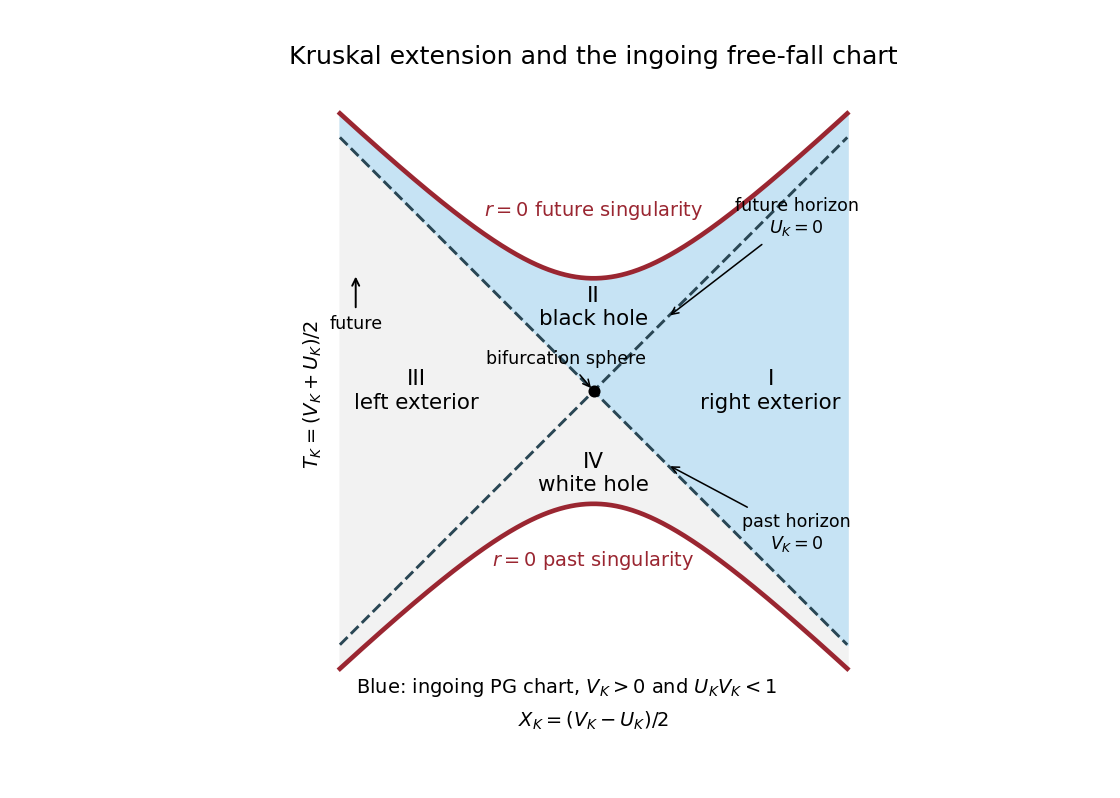
Kruskal extension with both exteriors, black hole and white hole; the ingoing Painlevé-Gullstrand domain is shaded blue
. Details. 
The domain of the ingoing Painleve-Gullstrand chart is region I together with region II and their common future horizon. More precisely, it is , , or with finite . To verify the boundary rather than infer it from the locally regular metric, put and writeThis follows by subtracting from the preceding radial primitive, and is finite at . Thus throughout the chart. Conversely every point with and gives a finite . The past horizon , the bifurcation sphere, region III and region IV are absent. Reversing the sign of the radial term produces the outgoing chart through the white hole instead.
The radial part of the Minkowski metric becomes , and . With , and the positive conformal factor , multiplication by givesConsequently the Minkowski conformal compactification isThe spatial metric is the round unit three-sphere. The extended unphysical metric is therefore that of the Einstein static universe, with unit spatial radius. Physical Minkowski spacetime occupies only the diamond-shaped causal patch of this cylinder, or a triangle after restricting to nonnegative spherical radius; it is not the whole cylinder.
The complete coordinate ranges and joint restrictions areThe polar angles have the usual coordinate degeneracies at their poles and at . In the extended Einstein static universe one may let and , but these are not the ranges of the original physical patch. In its interior . The line is the regular centre , not a component of infinity.
The conformal completion has future timelike infinity , past timelike infinity , and spacelike infinity . The open sloping boundaries arenamely future null infinity and past null infinity. Each ordinary interior point of the radial diagram represents a two-sphere, and each point on either open null boundary represents a two-sphere of null directions.
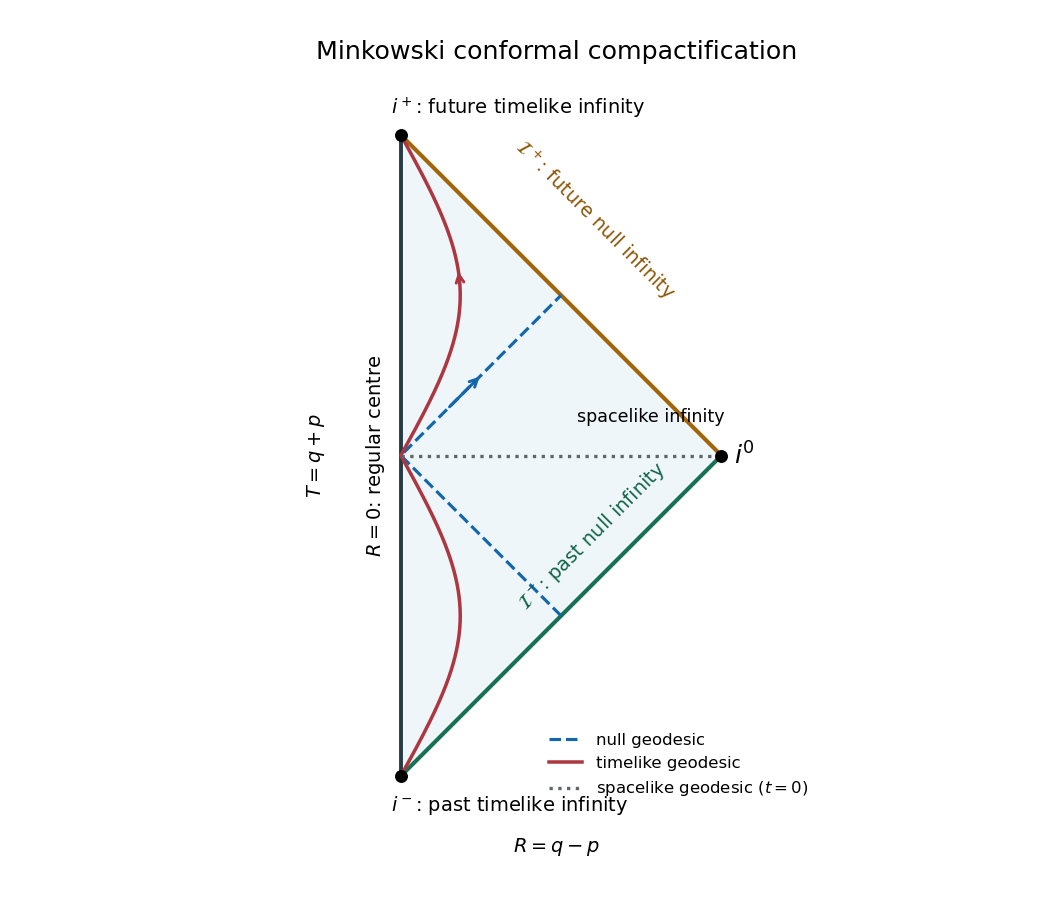
Minkowski Penrose triangle with timelike, spacelike and null infinities, the regular centre and representative causal and spacelike geodesics
. Details. 
A timelike geodesic is an inertial worldline with . As , both and tend to , giving and endpoint . At past infinity both tend to , giving . These endpoints are reached at infinite physical proper time, although at finite conformal coordinate time . A null geodesic has . In its outgoing future, approaches a finite retarded time while , giving an endpoint on ; in its incoming past, has a finite limit and , giving an endpoint on . A spacelike geodesic is a straight line with spatial tangent larger than its temporal tangent, so , at either end and both endpoints are in the compactified radial description. All these physical geodesics are complete. Only the unparametrized null geodesics are necessarily preserved as geodesics of the unphysical metric; timelike and spacelike images need not be its geodesics.
For horizons, distinguish a property of the spacetime from a property of an observer or of an initial-data hypersurface. Complete inertial observers have no particle horizon: in the flat cosmological slicing , the past light-travel distance is infinite. There is no finite-age initial singularity truncating communication between comoving observers. This statement does not say that an event receives signals from spacelike-separated events at the same time.
There is also no black-hole event horizon, because every event can send a future-directed null ray to future null infinity. Nevertheless accelerated timelike observers can have both future and past observer event horizons. For an entire observer worldline , define them by and , using its complete future and past respectively. An inertial observer's chronological past and future of the whole worldline are both all of Minkowski spacetime. By contrast, for the uniformly accelerated worldline in a Cartesian spatial direction,its null coordinates obey and . An event with can signal to a sufficiently late point of this worldline, whereas an event with cannot; finite transverse displacements do not change that conclusion as . Similarly the worldline can signal to precisely the events with . Thus its two observer event horizons areThey are the Rindler horizons, and their accessible common region is . They do not indicate a curvature singularity or a failure of global predictability.
Finally Minkowski spacetime is a globally hyperbolic spacetime: every inextendible causal curve crosses each complete spacelike plane exactly once. Indeed is strictly monotone along future-directed causal curves, and the speed bound prevents an inextendible curve from ending at finite by escaping to spatial infinity. Its time range is therefore all of . These planes are Cauchy hypersurfaces with full domain of dependence, so there are no Cauchy horizons associated with complete Cauchy data.
A Cauchy horizon is, however, defined relative to a specified initial surface. Under a literal existence reading of “admits”, non-Cauchy initial surfaces can have such horizons even in flat spacetime. For example the edgeless spacelike hyperboloid has . To see this, inside the future light cone and are positive and nondecreasing on future-directed causal curves. Their product increases past on every future-inextendible curve from below the hyperboloid; every past-inextendible curve from above it crosses down through before leaving the cone. Outside the cone there is an inextendible null curve avoiding the hyperboloid. The future light cone itself is its past Cauchy horizon. The time-reversed hyperboloid gives a future Cauchy horizon. This is the dependence of a Cauchy horizon on the initial hypersurface, not an intrinsic loss of predictability of full Minkowski spacetime. Thus a categorical claim that no choice of partial initial surface can ever have a Cauchy horizon would be too strong.
Articles by others on the same topic
There are currently no matching articles.