A loss network models calls that need several resources simultaneously and are rejected, rather than queued, when insufficient capacity remains. Take finite resource and route sets. Let be the integer amount of resource required by a route- call, its capacity, andUnder fixed routing, each arriving call has a predetermined resource requirement. Take independent Poisson processes of rates and independent holding times with exponential distribution of rates . A feasible arrival changes to at rate ; a departure changes it to at rate . Put and assume each route uses a finite positive-capacity resource, so the state space is finite.
The product-form stationary distribution of a loss network isFor any feasible adjacent pair,These detailed balance equations prove stationarity and make the process a reversible Markov chain. Equivalently, Independent random variables with Poisson distributions of means are conditioned on satisfying the joint capacity constraints. The conditioning makes resource occupancies dependent even though the unconstrained counts are independent.
By Poisson arrivals see time averages, a route- arrival sees acceptance probability , interpreting the numerator as zero for a negative capacity. Hence its blocking probability is and the expected value of its number in service is . This connects a stationary occupancy law to observable rejection and carried traffic.
The insensitivity of loss networks extends this occupancy formula to independent general holding-time distributions with the same expected values, under the usual fixed resource requirements and admission rule. Counts alone then need not be a Markov chain; residual holding times belong in a Markov description. The invariant occupancy formula survives. This is useful because detailed call-duration distributions can be difficult to estimate, while their means are much easier to measure.
The exact normalizing sum can be expensive on a large loss network. The Erlang fixed point approximation replaces joint resource acceptance by a product of marginal acceptances. Here consider unit requirements , positive integer capacities and finitely many fixed routes. Let be resource blocking and . A route- call contributes to the offered traffic at resource after surviving the other resources on its route. Thus the reduced-load approximation iswhere the Erlang B formula isThe estimated route acceptance is . This is an independence approximation, not an alternative exact factorization of the stationary law in part (i).
Uniqueness follows from a convex potential for the Erlang fixed point. For a single resource, the carried load of an Erlang loss resource is . It increases strictly from zero to as increases: differentiating the expected value of its upper-truncated Poisson distribution with respect to gives the strictly positive occupancy variance. Blocking also increases strictly, as is evident on dividing the Erlang denominator by its final term.
Use . Let be the unique offered load with , and set , with . This function is strictly increasing and tends to . DefineEach exponential term is a convex function, and each integral is a strictly convex function because its derivative is strictly increasing. Therefore is a strictly convex function. It is also a coercive function on the nonnegative orthant: an unbounded coordinate makes its integral grow asymptotically linearly with positive slope . A unique minimizer exists.
If resource carries some positive offered route, its inward derivative at is negative, so its minimizing coordinate is positive. At such a coordinate the first-order equation isDividing by gives precisely . A resource with no positive offered route uniquely has , hence . Thus the minimizer and the fixed point coincide, proving existence and uniqueness of the Erlang fixed point for fixed unit-resource routing. This does not by itself guarantee convergence of every simultaneous substitution algorithm; the uniqueness claim concerns the solution of the equations.
With alternative routing, a rejected direct call can try a longer route. The attempt rates now depend on blocking itself, giving an additional feedback absent from fixed routing.
For an explicit example, take three nodes with a unit-resource link between each pair, all of capacity . For every unordered pair, direct calls arrive at rate and have mean holding time one. A call first tries its direct link; if that link is full, it tries the unique two-link route through the third node, and otherwise is lost. Under a symmetric Erlang fixed point approximation, all links have blocking . A given link sees its own direct load . It can also carry overflow from either of the other two pairs; each contributes reduced load , since the direct link must block and the other link of the alternative route must accept. HenceThis is an instance of multiple Erlang fixed points under alternative routing. Put . Evaluation using the positive Erlang B formula recurrence , givesThe sign statements can be certified with rational arithmetic at these rational arguments. The intermediate value theorem gives a distinct root in each of , and ; numerical roots are approximately , and .
Thus the alternative-routing fixed point is not unique. The mechanism is extra link occupancy from overflow: moderate blocking stimulates two-link calls and can reinforce congestion. This multiplicity belongs to the approximation. The exact finite stochastic model has a unique stationary law on its reachable communicating class; the extra approximate solutions do not create three exact invariant distributions.
For a steady flow network, let each origin-destination class have fixed demand . Route flows satisfy . The link flow is , and a link has continuous travel delay . Its route delay is .
A Wardrop equilibrium describes nonatomic traffic: each traveler is too small to alter aggregate delays by changing route. For each class there is a minimum delay such thatThus all used routes of one class have equal minimum cost, and an unused route cannot offer a shorter trip. The condition concerns private travel time, rather than total network delay.
Equivalently, for every feasible route vector ,Indeed, each used route has class minimum cost, so reallocating demand cannot reduce the cost evaluated at the original flows; conversely a positive flow on a non-minimum route gives an improving transfer. This variational inequality form remains meaningful even when route costs are not separable link functions.
When link delays are separable and nondecreasing, Wardrop equilibria minimize the Beckmann potentialover the feasible route-flow polytope. Its derivative with respect to is . Since the integrals are convex, the first-order inequality for a global minimum is exactly the Wardrop equilibrium inequality in part (a). Alternatively, the Karush-Kuhn-Tucker conditions equate used-route derivatives to the multiplier for their demand constraint, with larger derivatives on unused routes. Continuity gives existence on the compact feasible set. Strictly increasing link delays give unique link flows, although different route decompositions can still give route-flow nonuniqueness at a Wardrop equilibrium.
The system objective is instead total travel time,For differentiable delays its marginal cost is , not simply . Thus an equilibrium optimizing the Beckmann potential generally fails to minimize total delay. A marginal external cost toll makes travelers face the social marginal cost and implements a system optimum under the appropriate convexity assumptions.
These formulations clarify the modeling distinction: nonatomic users optimize their own paths; a planner optimizes total delay. For nonseparable or nonmonotone costs, the variational description can remain applicable while the Beckmann potential argument, existence or uniqueness needs new hypotheses.
Braess paradox is the possibility that adding a route reduces the attainable equilibrium performance, despite enlarging the feasible set for a planner.
Take unit demand from to . Initially the routes are and . The links and have delay equal to their own flow; and have constant delay one. If the upper route has flow , its delay is , while the lower delay is . The Wardrop equilibrium therefore splits traffic equally and hasNow add a directed zero-delay link . Let upper, lower and middle route flows be with . Their delays are respectively , and . If , its route would be strictly more expensive than the middle route; likewise is impossible at equilibrium. Hence , . All three routes then have delay two, so this is an equilibrium, andThe cheaper-looking cross-link tempts everyone onto both flow-dependent links. No individual can improve after congestion has built up. A planner could retain the old split and ignore the new link, so the feasible optimum cannot worsen. The paradox concerns selfish equilibrium, not the physical disappearance of the earlier allocation.
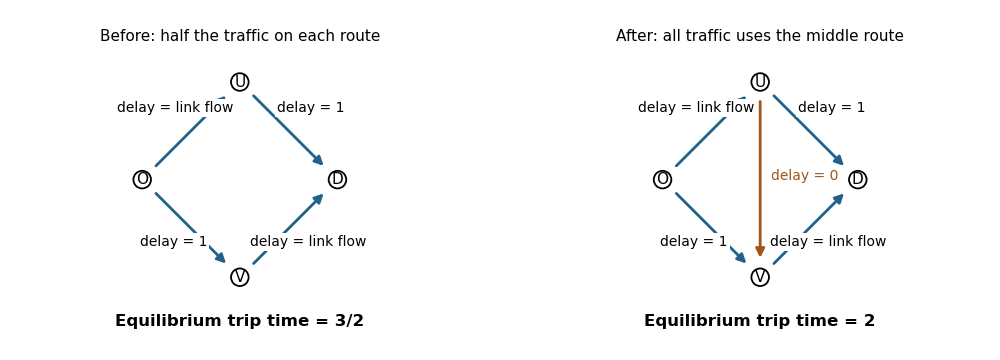
Braess paradox: equilibrium delay rises from three halves to two after adding a free directed cross-link
. Details. 
In the slotted ALOHA model, a station retains one packet until it successfully transmits. Conditional on , take fresh independent trials with a Bernoulli distribution of parameter for the backlogged stations. Let arrivals be independent across slots and independent of these trials, with Poisson distribution of mean . New arrivals join the next slot's backlog. An idle slot serves nobody, exactly one attempt serves one packet, and a collision serves nobody. Consequently the backlog changes by arrivals minus the success indicator.
Under these independence assumptions, is a time-homogeneous Markov chain: the feedback probabilities and the independent arrival law depend only on its current state. Merely specifying Poisson arrival marginals would not suffice. For example, take , , , and arrivals , , for independent random variables with Poisson distributions. Histories with and both have current backlog two, but the next backlog is respectively two and four. The usual model therefore includes fresh arrivals as an assumption.
Write and . Set for , and use their exact binomial distribution probabilities at . Away from the clipping boundary, the conditional drifts areNear , the latter must use for each update , rather than itself.
When both coordinates are large with , the Poisson limit theorem approximates the attempt count, which has a binomial distribution, by a Poisson distribution of mean . Thus and . Rescaling state by and slot time by motivates the fluid approximation of slotted ALOHAThis is an interior fluid approximation of slotted ALOHA, not the exact conditional drift at a clipped boundary.
Here is one explicit set of sufficient conditions, independent of the arrival rate within the subcritical range:Put . ThenHence is negative below one and positive above one: the controller decreases the attempt denominator when offered contention is too small, and increases it when contention is too large.
Use the ratio time change for a homogeneous fluid model, . The equations becomeFor ,since and . Also . Therefore is negative on , and by continuity on for some . Its value at zero is , so nonnegative backlog is preserved.
The ratio remains bounded by and eventually enters : on the compact interval , its derivative is bounded above by a strictly negative number. Once inside it cannot cross upward. The bounded ratio and smooth coefficients make the transformed equations exist for all . In this region , so decreases at least exponentially in . The original time satisfies and has a finite limit ; boundedness of gives as well. Thus every nonnegative interior fluid trajectory drains to the origin in finite fluid time. At the origin the ratio equation is undefined; the usual stopped fluid trajectory is held there afterward. A state with enters the interior under the continuous limiting boundary drift ; the same argument then applies.
This proof supplies sufficient conditions, not a characterization of every stabilizing triplet. It also does not assert the positive recurrent Markov chain property of the original stochastic chain solely from the heuristic ODE.
If , the ALOHA throughput bound givesNo choice of the three feedback increments can make this fluid backlog drain, since . For the displayed controller, the supercritical fluid trajectory is global and grows instead of draining. At the ray consists of stationary fluid states, explaining why the strict load inequality matters.
For any , on the event one has . The Markov inequality therefore gives , including the trivial value one at . Taking the infimum proves the Chernoff bound.
For with finite moment-generating functions, independence givesConsequentlyAn effective bandwidth is an exponential-moment measure of demand at a chosen tail parameter : independence makes these quantities additive. The spare capacity pays for the desired exponential tail bound. For a cumulative-demand process over time , the corresponding bandwidth would be ; here the time horizon is one. It is generally larger than mean demand because it charges for fluctuations, and mathematical optimization over selects the useful tradeoff.
For independent normal distributions, putThe Gaussian effective bandwidth is . For and , the sufficient condition becomes . Its left side is minimized at , givingThis is a sufficient Chernoff safety margin, not the exact normal tail quantile.
Indeed , so, writing for the standard normal distribution function,The exact Gaussian chance constraint is thereforeThis is necessary and sufficient when , even when is negative. The Chernoff coefficient is more conservative.
There is an important boundary qualification. If , then deterministically, and for the exact requirement is , not . For example, , , satisfies the printed square-root condition but has . Thus both Gaussian non-strict displayed forms require positive total variance, which follows if at least one flow is present and its variance is positive. With no positive variance, the deterministic boundary in an upper-tail chance constraint must be treated separately. If , the target upper bound is at least one and imposes no restriction; the displayed square-root discussion naturally assumes .
Let be the rate of each individual flow on route , so its aggregate rate is . The feasible allocations satisfy . An allocation has proportional fairness if, for every feasible ,Equivalently it maximizes over positive active-route rates. This is the first-order optimality condition for a concave objective on a convex set. Rates for absent flows can be set to zero.
For the linear flow network, put and . If , unused capacity on link could increase , soWhen , write . For active local routes their aggregate rates are , and the objective, up to constants independent of , isFor , differentiation gives , hence ; when the maximizing endpoint is , giving the same answer. Thus the proportionally fair allocation on a linear flow network isIf and , this gives on every active local route, as expected. No departure occurs at the empty state.
Independent Poisson processes of flow arrivals and independent exponential distributions of document sizes make the count vector a continuous-time Markov chain. By the memoryless property, a surviving residual size with exponential distribution still has rate per unit of transferred data, so each route- flow completes at instantaneous rate . The transition intensities areHence the through-route departure rate is and each active local route's rate is .
To obtain the stationary law of a linear flow network, defineFor a through departure ; for an active local departure . These are exactly the aggregate service rates, so the detailed balance identities hold. This also shows why the binomial coefficient is essential; a factor would not have the required ratios.
For fixed local counts with total , the negative binomial series givesSum the remaining independent geometric series to findThe given load conditions make every series converge. Setting provesThe chain has bounded total departure rate, finite arrival rate and no explosion. With positive arrival rates it is irreducible, and this normalized invariant law gives the positive recurrent Markov chain property; zero arrival rates restrict the stationary support to the corresponding reachable class.
Summing out shows local-count independence in a linear flow network: the local counts have independent geometric distributions on with ratios . ThereforeThey are independent of one another under the stationary marginal, despite sharing the random through-flow population. The through count is generally dependent on them.
Articles by others on the same topic
There are currently no matching articles.