Write , with . Independent variations of and give the Euler-Lagrange equation . Away from its unique endpoint solution isIntegration by parts cancels the linear fluctuation terms and gives . On the classical solution, the action is the boundary term . Substituting the endpoint derivatives therefore givesThe remaining Gaussian path integral contains two real fluctuation coordinates per mode, so it contributes an inverse functional determinant, rather than its inverse square root. Thus , with the measure normalization fixing the otherwise arbitrary constant.
For Dirichlet boundary conditions, the normalized sine modes have eigenvalues , . Their determinant ratio is the convergent Dirichlet oscillator determinant ratioThe last equality is the sine infinite product. With the prescribed free determinant this givesThe kernel uses the Feynman i-epsilon prescription; at a caustic it is a distributional limit, not an ordinary finite function. Its limit is .
There is a sign error in the printed complex-integral hint. For a positive damping parameter , polar integration gives the regulated complex Fresnel integralThis regulated value, together with the stated free-kernel normalization, fixes the phase consistently.
For and positive imaginary-time length , Wick rotation givesPut with and use the convergent real Gaussian integral. Writing givesThis is the parity-twisted oscillator thermal trace. The complex coordinate describes two independent real quantum harmonic oscillators, each with mass two in these units. Their total energy is ; level has degeneracy , and spatial inversion has parity operator eigenvalue . The plus sign is ; the minus sign is . The alternating trace inserts parity into a bosonic system; it does not change the oscillators into fermions.
Normalize the vacuum path integral by . The scalar two-point correlation function is , and the spinor two-point correlation function is . Vacuum boundary conditions make these time-ordered Feynman propagators. After integration by parts, the scalar quadratic action is .
The Schwinger-Dyson equation follows by integrating a functional derivative of : the derivative of the insertion supplies , and the action derivative supplies the kinetic operator. The analogous left Grassmann derivative calculation, or differentiation of the Grassmann Gaussian integral, givesUsing and the Clifford algebra, . ConsequentlyThe free quantum effective action is quadratic, so all scalar one-particle-irreducible vertices with vanish. Its two-point vertex is the stated inverse kinetic form .
For the Yukawa interaction, two vertices contribute , and a closed fermion loop contributes an extra minus sign. Tracing the two spinor numerators gives , since the one-gamma traces vanish. Removing the overall from the amplitude gives the displayed loop integral. DefineThe numerator decomposition and translation invariance of dimensional regularization reduce it toThe supplied tadpole pole is . A Feynman parameter combines the two bubble denominators. Shifting its loop momentum gives mass squared ; differentiating the tadpole integral with respect to this squared mass gives the double-denominator pole , independent of . Thus andThe counterterms contribute , so their minimal pole parts areCombining the kinetic terms gives wavefunction renormalization , and combining the mass terms gives . ThereforeThese are the Yukawa scalar self-energy pole coefficients; finite parts depend on the chosen renormalization condition.
The four-point graph is a Yukawa fermion box, with four external scalar legs attached to a closed spinor loop:
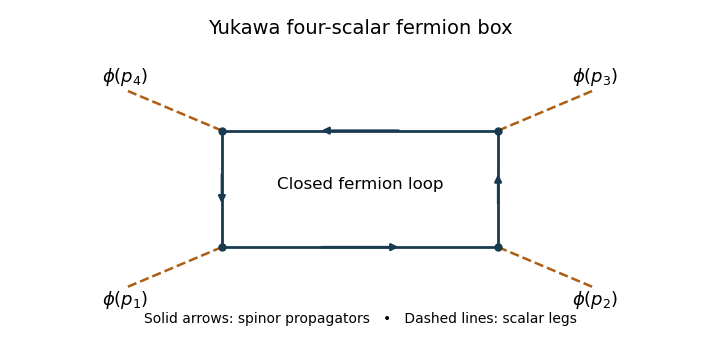

Each high-momentum dirac propagator is . The product of four is , and the leading gamma matrix trace identities is nonzero. The four-dimensional radial integral therefore contains : a logarithmic ultraviolet divergence. This local four-scalar divergence cannot be absorbed by scalar mass or field normalization. Add , and, using the stipulated four-point pole normalization, take so that cancels it.
For literal cancellation of every one-loop divergence with , counterterm closure of a massive Yukawa theory also requires the allowed scalar linear and cubic terms. A constant scalar background shifts the fermion mass to ; the divergent local fermion contribution contains a polynomial proportional to . Its linear and cubic terms are not forbidden by a symmetry when the fermion mass is nonzero. A closed renormalizable family therefore haswith field, mass and coupling redefinitions for both scalar and spinor fields. A tadpole condition can set the renormalized to zero, but its counterterm still exists. The vacuum constant is needed if vacuum energy is retained. If an exact discrete chiral symmetry is imposed with , the scalar potential can be even and the odd terms are forbidden; the essential new interaction is then the quartic one.
A regulator and a renormalization condition introduce the reference mass scale , even when the classical theory has no mass. Loop amplitudes contain dimensionless logarithms of momentum or distance ratios involving . The resulting running coupling and field normalization compensate changes of this arbitrary reference scale.
Let and . Hold the bare parameters fixed and define and . Assuming multiplicative field renormalization and no mixing or additive contact terms for the correlator, differentiating gives the Callan-Symanzik equationFor the dimensionless two-point factor put . Its equation is . LetThe characteristic solution of the multiplicative Callan-Symanzik equation isTo check the sign, equals . The characteristic flow and its accumulated multiplier give precisely this evolution. Changing changes the dimensionless momentum and renormalized ; the same bare two-point correlation function is recovered after the compensating field normalization. An unnormalized renormalized correlator need not remain numerically identical under that change, but physical predictions do.
With a mass, write and define its running mass by , . The dimensionless equation becomesIts flow is thereforeThe renormalization-group mass suppression criterion is , for example an eventual bound with . Then the mass argument on the right tends to zero. A regular massless limit, uniform along the limiting coupling trajectory, makes the mass negligible at high energies. Merely calling small without controlling this integrated exponent is insufficient.
For , the positive beta function makes the running coupling increase toward the ultraviolet fixed point . Assume a continuous locally Lipschitz beta function, a continuous anomalous dimension at the fixed point, and a finite nonzero reference value . Then andThus the high-momentum factor has exponent in , and the propagator scales as up to slower corrections. If the fixed point is simple and attractive, , the approach is exponential; suitable smoothness then gives with finite . The stated beta-function information alone supplies no numerical value for the anomalous dimension and does not exclude slower corrections at a nonsimple fixed point. This is two-point scaling at an ultraviolet fixed point.
For the asymptotically free beta function, separation of variables givesThe anomalous-dimension integral is elementary:For a reference two-point factor regular and nonzero at the free coupling, , so the large-momentum correction is a power of . These are asymptotic freedom and logarithmic two-point scaling from a cubic beta function. If the supplied beta and gamma expressions are leading small-coupling terms rather than exact functions, they fix the leading logarithmic exponent, while subleading corrections and the prefactor depend on higher orders.
Fix the current sign convention by defining the localized variation as . For a first-derivative Lagrangian invariant without a boundary term under constant parameters, this means ; include the usual improvement term if the constant variation is a total derivative. On solutions, arbitrary compactly supported parameters imply . The Noether charge is and is conserved if the spatial flux vanishes. This sign convention matches the printed Ward identity; reversing the current also reverses the corresponding generator convention.
Assume an invariant regulated functional measure, invariant vacuum boundary conditions and no quantum anomaly. Changing variables in the normalized path integral gives . Integration by parts then yieldsFor a product of scalar fields, the local Ward identity contact terms areAway from the insertions this is current conservation. Time-ordering or the distributional functional identity supplies the contact terms.
For the gauge theory write and use the left-acting BRST differential , with . It obeys the graded Leibniz rule andAssume the structure constants satisfy the Jacobi identity and the dot product is invariant; antisymmetry alone would not be enough. Since and are odd, their Lie brackets are symmetric in these two arguments. ConsequentlyAlso . The graded Jacobi identity gives , so ; the other three fields have zero second variation immediately. For independent odd parameters, . These are off-shell BRST nilpotence identities because the Nakanishi-Lautrup field is retained.
The Yang-Mills theory variation is proportional to . The gauge-fixing variation is , while the ghost variation is its negative; the term does not vary. Equivalently these terms are for the gauge-fixing fermion . BRST nilpotence makes this expression invariant. Ghost-number scaling also leaves every term invariant: the ghost and antighost factors carry opposite weights.
Here are the two explicit currents in the same sign convention as the Ward identity. Localizing the even ghost parameter gives coefficient . Localizing the odd parameter, keeping it on the left, gives coefficientThe last sign comes from moving the odd parameter through the odd antighost derivative. Since the current was defined as minus this coefficient,These are the ghost-number Noether current and the BRST current in derivative-b gauge fixing. If the opposite Noether sign is used, both displayed currents acquire an overall minus sign. Integrating the gauge-fixing term by parts changes the Noether representative by the associated boundary improvement; mixing the two Lagrangian conventions without that improvement gives incorrect signs.
With no BRST anomaly, the conserved odd BRST charge has . The BRST cohomology identifies closed states modulo exact states . Nilpotence puts every exact state in the closed space. In the usual indefinite gauge-fixed state space, a Hermitian BRST charge makes exact states orthogonal to closed states; the standard no-ghost/positivity assumptions then give a physical inner product on the quotient. The physical sector is its ghost-number-zero component,The ghost number assigns to , to and zero to gauge and auxiliary fields. Gauge-invariant observables and the chosen vacuum have ghost number zero; unphysical ghost excitations are removed in BRST pairs. Thus physical representatives are expected to satisfy . This zero-grading selection is part of the physical-state prescription, not a consequence of nilpotence alone.
Articles by others on the same topic
There are currently no matching articles.