Along the downward gradient flow, the gradient-flow dissipation identity, the chain rule and the defining property of the Riemannian gradient giveA smooth vector field on a compact manifold is complete, so the trajectory exists for every . In particular, its function value never increases.
If the trajectory is still in at time , its monotone function value has stayed in throughout . ConsequentlyThus a uniform exit bound isThe trajectory is outside the closed band for every . Once it leaves below level , monotonicity prevents its return. The argument also covers the zero-width band .
For the total occupation-time bound for a gradient flow, let and , which exist by compactness. For every , the same gradient flow identity givesTaking , by monotone convergence theorem, gives the total occupation-time boundThis allows arbitrarily many visits to ; it bounds their total duration. Neither of these two estimates needs the Morse function hypothesis.
For exponential convergence of a Morse gradient flow, first observe that a limiting point is a critical point. Indeed, writing for the flow and using continuous dependence on initial data,Differentiation at gives .
We use the Morse lemma: near a nondegenerate critical point of Morse index , there are coordinates in whichChoose a Riemannian metric equal to the Euclidean metric on a smaller ball in these coordinates. Such a global Riemannian metric exists by a partition of unity: patch this metric to any background metric outside a slightly larger ball. One can do this simultaneously at every critical point, since a Morse function on a compact manifold has only finitely many critical points. The metric is chosen before forming its gradient flow; changing the metric can change trajectories.
For this metric, any trajectory converging to eventually remains in the smaller coordinate ball. From some time onward its equations are exactlyConvergence forces , and thenThe straight radial segment stays in the coordinate ball, so its length bounds the Riemannian distance from above:Increase beyond both and . Then the requested strict estimate holds for all :This proof uses the Morse lemma, existence and uniqueness for smooth ordinary differential equations, continuous dependence on initial data, and the existence of a partition of unity. The expanding coordinates explain why convergence to a saddle occurs only along its stable manifold.
For a counterexample, use an arc coordinate around a point of the circle, its flat local metric, and a globally smooth function that equals on this arc. Such a function can be made by a smooth cutoff, agreeing with a positive constant outside a larger arc. For sufficiently small the downward gradient flow remains in the arc and isIt converges to the degenerate critical point , and its Riemannian distance from is for sufficiently large . For every , , so no exponential bound is possible. This counterexample is on a compact manifold as well.
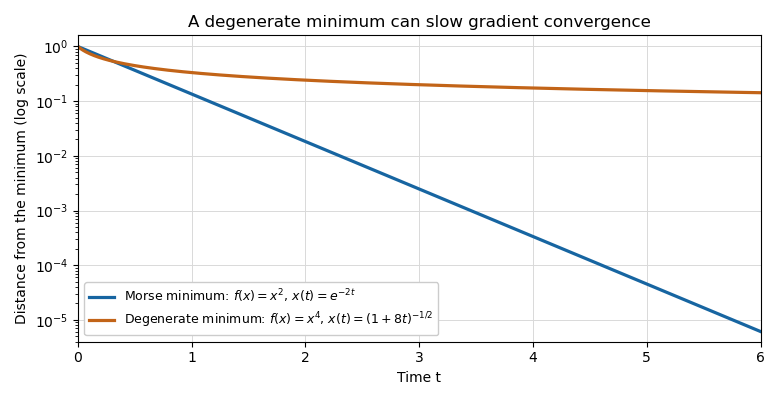
Exponential decay near a Morse minimum and algebraic decay near a degenerate quartic minimum, on a logarithmic vertical scale
. Details. 
An index- handle is , attached along . Its attaching sphere is with its attaching framing of an embedded sphere, and its belt sphere in the new boundary is . A handle decomposition is an ordered sequence of such handle attachments.
A handle slide of one -handle over another replaces its framed attaching sphere by a band sum with a parallel framed copy of the second attaching sphere, along a band in the boundary of the previously attached handles. The second handle stays fixed. The band transports the framing of an embedded sphere. The union of the two handles and their attaching collars can be reidentified by a diffeomorphism, so this changes the decomposition, rather than the underlying manifold. A sequence of these moves, allowing the usual isotopies of attaching data, gives handle decompositions related by slides. Reading the decomposition backwards interchanges attaching spheres and belt spheres; a slide of dual handles is a slide of the corresponding original handles.
For the standard handle-calculus assertion, take , so both the relevant attaching and belt spheres are connected. We need the local geometric move behind handle-slide isolation of a cancelling pair. Write . If is an intersection of some , , with , choose an arc on from to , and take a narrow parallel band to the unique sheet of at . Slide over an appropriate parallel copy of . Choose the copy's orientation so that the new sheet at has the opposite local smooth intersection number to the sheet at .
Within a thin neighbourhood of the arc, the old sheet at and the added sheet at are the two ends of one band. An isotopy pushes that band through the neighbourhood of and removes both ends. Outside this neighbourhood the original is unchanged, apart from the added copy of the parts of away from . Since meets only at , this copy contributes no further intersections with . Thus one slide followed by an isotopy removes one original geometric intersection with . This is a local band move, not an appeal to handle cancellation or to an algebraic cancellation of signs.
The arcs and bands may be chosen one at a time; in the one-dimensional sphere case, start with an intersection adjacent to , so that the arc interior contains no other intersection. Perturb to make all intersections transverse. The relevant spheres are compact, so there are only finitely many intersections. Repeating the move for every leaves and fixed and givesThe bands can avoid the remaining attaching data; any consequent change to intersections with other belt spheres is allowed at this stage.
For the second stage, view the same interface from the dual decomposition. Now are attaching spheres and are belt spheres. Apply the same local move to each intersection of , , with , sliding that dual handle over the one with attaching sphere . This changes the original -handles. It keeps and fixed, while removing the unwanted intersections with . The parallel copies and bands may be taken disjoint from all , , because those spheres are already disjoint from and from . Hence their intersections with remain empty. We obtainNo handle has been removed.
There is an implicit index-range qualification in this geometric assertion. If arbitrary zero-handles are included, the second conclusion need not hold: two zero-handles joined by one one-handle have an attaching zero-sphere with one endpoint on each zero-handle belt sphere. Slides preserving this handle inventory cannot make its second endpoint avoid both belts. The dual obstruction occurs for top-index handles. Thus the argument uses the customary intermediate-index setting of the handle-slide lemma; the unqualified assertion at the extreme indices would require additional hypotheses or additional moves.
For the numerical formula, fix coherent orientations for the integer smooth intersection numbers, and letKeep the orientation at the surviving point, so its number remains . A slide of a -handle adds or subtracts the first row of the intersection matrix. Removing all geometric intersections in the first column has net row operationEven if opposite-sign intersections require extra slides, their net signed coefficient is the displayed one. In particular,The dual slides then perform the column operationsSince , these operations leave the lower-right block unchanged. Thus the final answer, including both stages of slides, isThe remaining block is the Schur complement of the unit pivot . If the original orientation is chosen so that , it is simply . For unoriented handles use intersection numbers modulo , with the same formula interpreted in .
Use the Riemann curvature tensor convention . A Jacobi field is a smooth vector field along satisfyingwhere is the covariant derivative along a curve for the Levi-Civita connection. Differentiating a geodesic variation gives this equation, and conversely every Jacobi field arises from a geodesic variation by varying its initial point and velocity.
Choose a parallel frame along and write . The Jacobi equation becomes the linear systemThe existence and uniqueness theorem for linear ordinary differential equations says that each pair determines exactly one solution on . Addition and scalar multiplication preserve the equation. Thus evaluation of initial position and covariant velocity is a linear isomorphismand the dimension is
For the convexity assertion, use the convex-normal meaning of a geodesically convex open set: its points are joined by a unique geodesic within the set, and the joining geodesic depends smoothly on its endpoints. Equivalently, the appropriate star-shaped restriction of is a diffeomorphism onto the set. The convex-normal-neighbourhood theorem supplies such sets around every point. Mere existence of some minimizing geodesic, without this uniqueness and normality, would not imply the assertion.
Let and . For a Jacobi field with and , differentiating gives the standard differential-of-the-exponential map identityIn a convex normal neighbourhood, is invertible. Therefore a Jacobi field vanishing at both endpoints has and hence is identically zero. The difference of two fields with the same endpoint values consequently vanishes. More precisely, the mapis an isomorphism: it is injective and both spaces have dimension . The constant-geodesic case follows directly from . This uses the convex-normal-neighbourhood theorem, the differential-of-the-exponential map identity, and linear ordinary differential equation uniqueness.
For the special unitary group example, use Jacobi fields from conjugation at a central endpoint. WriteThe endpoints of are and . The latter is central. For every considerConjugation is an isometry for a bi-invariant Riemannian metric, and geodesics of a bi-invariant metric are one-parameter subgroups. Thus is a geodesic variation. Its Jacobi field iswhich vanishes at and because both endpoints are central. Its initial covariant derivative is .
The linear map has kernel equal to the centralizer of an element of a Lie algebra of . Indeed, implies on differentiating at , and that commutation conversely implies . The repeated first two eigenvalues giveAs , rank-nullity theorem givesExplicit independent generators are the fields belonging to , , and . Their initial derivatives are independent because the eigenvalue differences in the and entries are . This also demonstrates directly why the endpoint-value conclusion fails along this geodesic.
Take the normalizationThe first variation of geodesic energy says that the critical points on the fixed-endpoint path space are exactly the affinely parametrized geodesics. The kernel of the second variation of geodesic energy, or Riemannian index form, is the space of Jacobi fields vanishing at both endpoints. Hence a geodesic is a nondegenerate critical point exactly when that space is zero, or equivalently when its terminal endpoint is not a conjugate point to its initial endpoint along the given geodesic.
The Morse index theorem states that the index is the sum of the multiplicities of all conjugate points strictly inside the parameter interval:The multiplicity at the terminal endpoint gives nullity rather than an additional contribution to the index. These statements use the usual Sobolev completion of the path space; smooth paths have the same homotopy type.
First suppose as well as , and put . There is a unique great circle through these two points. Every critical path runs along it with constant speed, possibly passing around it extra times. Ifthen a complete enumeration without repetitions isIts length is . Equivalently the two positive length lists areThere are no other critical paths, because a nonconstant geodesic of the round sphere is a constant-speed great circle and its plane must contain .
To compute conjugate points and indices of round-sphere geodesics, the round unit sphere has constant sectional curvature . Along a geodesic of speed , a normal Jacobi field in a parallel direction satisfies . A field with is therefore a constant multiple of in each of the normal directions. Its tangential component satisfies and contributes no endpoint-vanishing field. Consequently the conjugate points occur at , each with multiplicity . Since neither length list contains an integer multiple of , all the displayed critical paths are nondegenerate, and the Morse index theorem gives
The permitted case requires separate treatment. There is a constant geodesic, which has index and nullity zero. All other critical paths areFor each , this is a family parametrized by ; both directions of traversal are included through and . The interior conjugate points number , and the endpoint is also conjugate. ThusThese are Morse-Bott critical manifolds for , rather than nondegenerate critical points. For the same formulas give zero index and nullity, with the two isolated directions comprising .
For the requested homology calculation, choose distinct nonantipodal endpoints. Concatenation with a fixed path back to the basepoint gives a homotopy equivalence between this fixed-endpoint path space and the based loop space . We use the Morse cell-attachment theorem for geodesic energy: on a complete compact Riemannian manifold, the fixed-endpoint energy, when all its critical points are nondegenerate, gives a CW complex of the same homotopy type with one cell of dimension equal to the index of each critical point. One can obtain this theorem from finite-dimensional broken-geodesic approximations and ordinary Morse theory; critical energy values tend to infinity here.
The two index lists interleave to give exactly one cell in every dimension , . If , these dimensions are separated by at least two. The cellular homology groups therefore have zero boundary maps, since no occupied cell dimension has an occupied dimension one lower. With integer coefficients,This determines the graded abelian groups. The argument does not need an identification of the multiplication on loop-space homology.
Finally apply the Freudenthal suspension theorem: for an -connected based CW complex , , the suspension homomorphismis an isomorphism for and a surjection for . A sphere is -connected, and its reduced suspension of a topological space is homeomorphic to . HenceThe isomorphism is the suspension map. Its stable range is also reflected by the Morse theory cell structure of : after its bottom -cell, the next positive-dimensional cell has dimension . For the stated homology problem , all the connectivity hypotheses apply.
Fix a reference path from to . By path connectedness, a path can be joined to it by a smooth homotopy strip withSmooth homotopies may be used by the relative smoothing theorem; piecewise smooth homotopies give the same integrals. Orient the square by and define the Lagrangian path-area functional byHere denotes the functional called in the question. The minus sign is the convention for which downward gradient flow is -holomorphic on the standard oriented strip.
For relative symplectic-area independence, glue two choices, with one orientation reversed, along their common reference and final paths. The resulting oriented surface is a relative -cycle in . Since , it bounds a relative -chain: as an absolute chain, for a chain supported in . The symplectic form is closed, and it restricts to zero on each Lagrangian submanifold. Using piecewise smooth relative chains, Stokes theorem givesEquivalently, integration of the closed symplectic form defines the zero pairing on the zero relative homology group. The two strips therefore define the same value of .
Choosing a different reference path changes every value by the negative area of one fixed connecting strip, independent of . Changing the initially assigned reference value also adds a constant. Path connectedness ensures that this is one global constant, rather than an independent constant on each component.
For the first variation, let be a variation vector field along , with and . Differentiate the defining strip integral. Stokes theorem, or the variation formula for the integral of a closed differential form, reduces it to the final edge; the side edges give zero because their variations and tangent vectors lie in the Lagrangian submanifolds. With the chosen sign,If this vanishes for every admissible , it in particular vanishes for every field supported in . Nondegeneracy of the symplectic form, together with the fundamental lemma of the calculus of variations, forces in the interior and hence everywhere by smoothness. Conversely, a constant path makes the displayed integral zero. The constant must lie in both endpoint submanifolds. ThusNo transverse-intersection assumption is required; the critical set can be empty or have positive dimension.
A compatible almost complex structure is a smooth bundle map such thatThese conditions makea Riemannian metric. Its symmetry follows from the -invariance and skew symmetry of , and its positivity is the final compatibility condition. It also satisfies .
Use the formal metric on the path space,The variation formula becomesThus a formal downward flow satisfiesPut the standard complex structure on the strip, with . The J-holomorphic curve equation says , which is equivalent to the displayed flow equation because . The converse is identical: a smooth J-holomorphic curve on the strip with the specified Lagrangian boundary conditions gives a formal downward trajectory of .
As a sign check, along such a strip,The drop in therefore equals the positive symplectic area swept out by the strip. The word formal matters: the calculation gives the interior equation and its Lagrangian boundary conditions; it does not assert that arbitrary smooth initial paths produce a well-posed ordinary flow on the smooth path space. In particular, the expression need not satisfy the endpoint tangent restrictions for an arbitrary initial path. The claimed correspondence concerns smooth solutions of the strip equation.
Articles by others on the same topic
There are currently no matching articles.