Use spherical coordinates about the fixed pivot, with fixed rod length , polar angle measured from the downward vertical, and azimuth . The bob's position iswhen the Cartesian axis points upward. Differentiation gives kinetic energy . Taking zero gravitational potential energy at pivot height gives . The spherical pendulum's Lagrangian is thereforeThe rod is light, rigid and of fixed length; pivot friction and air drag are neglected. A rigid rod, unlike a string, may sustain either tensile or compressive constraint force.
The azimuth is a cyclic coordinate, since . Its Euler-Lagrange equation gives conservation of the vertical component of angular momentum:This is the actual angular momentum, not specific angular momentum. The Lagrangian also has no explicit time dependence. The conserved energy isAlong solutions, . These are the conserved quantities associated with rotational symmetry about the vertical and time-translation symmetry, respectively.
The Euler-Lagrange equation readsHenceThe first term reflects the coupling to azimuthal motion; the second is the gravitational restoring contribution for an angle measured from the downward vertical.
Constant azimuth. If is constant, and the motion is a planar simple pendulum:For the small-angle approximation, , giving simple harmonic motion withThe harmonic angular frequency requires small amplitude. At finite libration amplitude , the exact oscillation period is , where is the complete elliptic integral of the first kind; the nonlinear pendulum does not have the same amplitude-independent period.
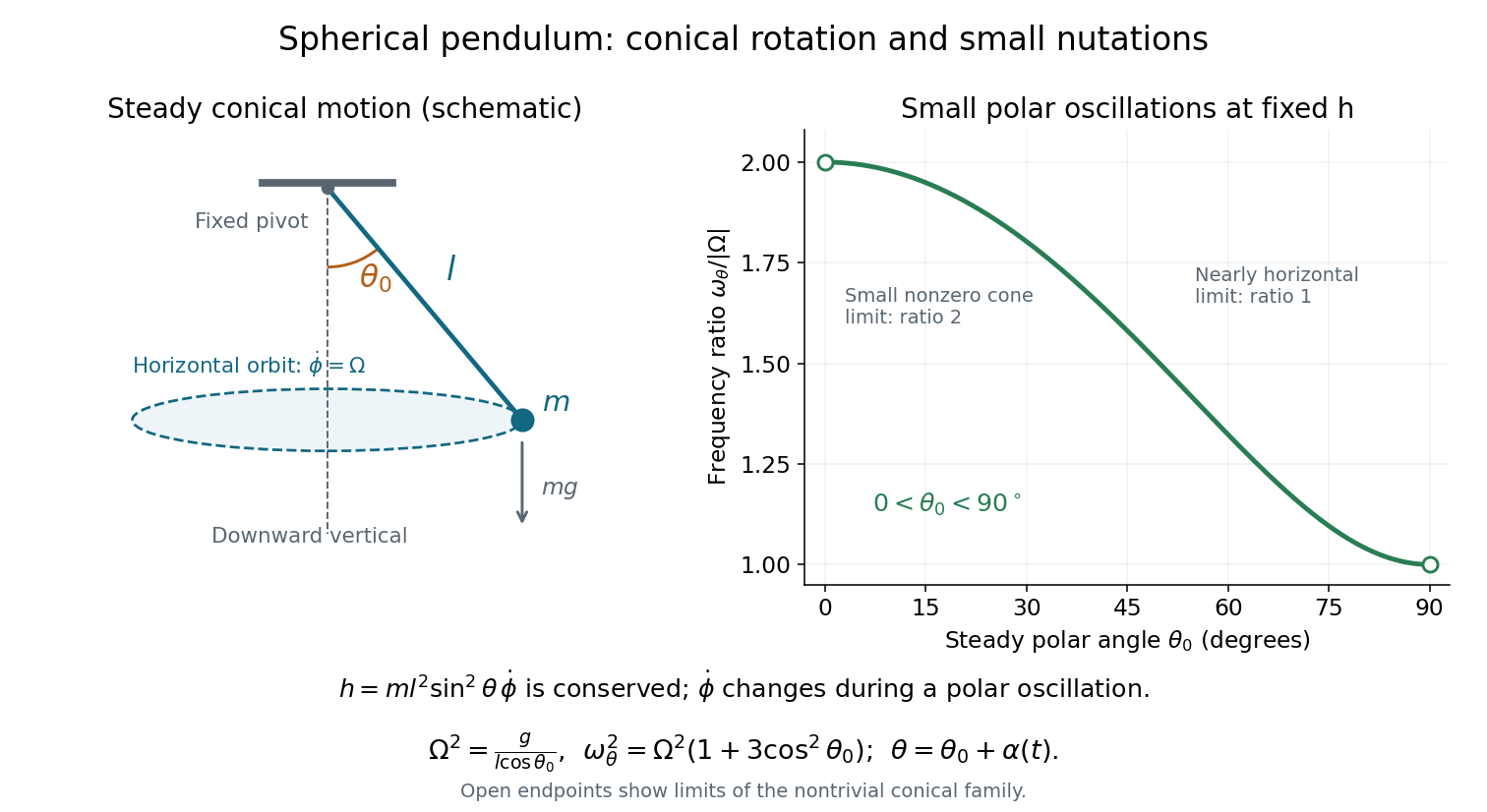
Constant polar angle. If is nonzero and constant, the bob traces a horizontal circle: this is a conical pendulum. Setting and dividing by givesThe sign distinguishes the two senses of rotation. The exactly downward configuration is stationary; its azimuth is undefined and it must not be obtained by dividing by . A nontrivial constant-angle orbit of this gravity-only system needs even though the supporting rod can also push.
Fixed-angular-momentum form. Eliminating using the conserved angular momentum givesEquivalently, the polar motion has effective potentialFor the steady conical pendulum at , , soThe sign of agrees with the sign of ; substituting verifies the constant-angle result in part (d).
Period of small polar oscillations. Put , with and held fixed. This is the appropriate small nutation about a conical pendulum; keeping fixed instead would violate the angular momentum constraint during the oscillation. Ifthen andThe linearization is , givingSince , the coefficient is positive and these small polar oscillations are stable. To first order, , making the compensating change in azimuthal angular velocity explicit. The limit as concerns radial modulation of a small nonzero circular orbit; the exactly planar pendulum is a different, degenerate limit of these polar coordinates.

Articles by others on the same topic
There are currently no matching articles.