The massless inextensible string has hanging length , measured downward from the table. Thus . In polar coordinates, the tabletop mass has squared speed . Adding the two kinetic energies and setting the hanging gravitational potential energy to givesand the Lagrangian isThe canonical momenta are and . Performing the Legendre transform gives the HamiltonianIt equals the total mechanical energy and is conserved because has no explicit time dependence. Also is a cyclic coordinate, so is conserved angular momentum about the vertical through the hole. The table and the string guide supply external forces; conservation of the system's total linear momentum does not follow. These are the two independent generic integrals needed for the reduced tabletop mass coupled to a hanging mass.
The radial and angular Euler-Lagrange equations areWriting the conserved angular momentum aswe obtainA positive constant radius requires zero radial acceleration. Hence the circular motion hasprovided and . Its angular velocity is . No positive circular radius exists for with .
For later use, the conserved radial energy isThe effective potential has , so its stationary radius is a stable minimum. The tension remains positive in the ideal allowed region: the hanging Newton's second law gives .
Initially , and , so the conserved angular momentum is . For , the effective potential contains the centrifugal barrierThe finite conserved energy therefore forbids the hole from being reached:The exceptional case has no centrifugal barrier. Then and ; starting at rest at , the tabletop mass reaches the hole after . The model ends at that event. Thus the usual nonzero initial tangential speed assumption matters.
The initial angular momentum is , and the initial total energy isWhen the hanging mass reaches the table, . Conservation of angular momentum fixes the tabletop tangential speed there to . At the limiting case of just reaching, radial velocity is zero. Equating the two energies,yieldsMore generally, the boundary radial kinetic energy isso reaching requires , with equality for just reaching and strict inequality for nonzero outward radial speed at contact. This condition is also sufficient: is strictly convex, and the allowed interval connecting the initial radius to has no intervening higher effective potential barrier. At the threshold the initial radial acceleration is outward and is the outer turning point.
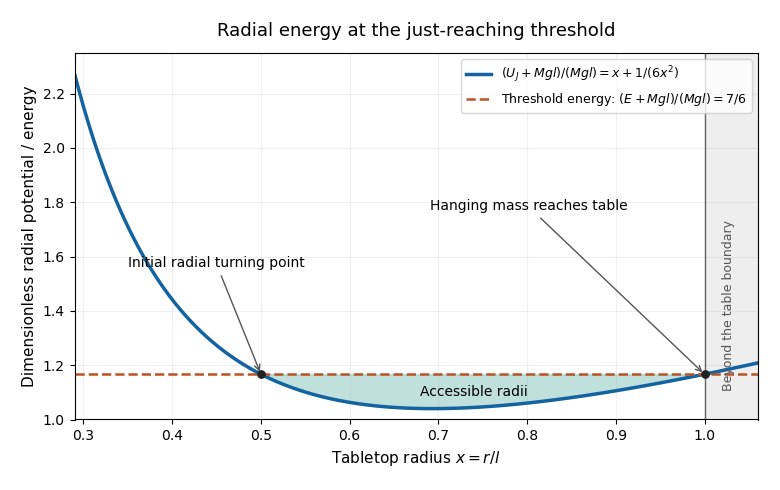
Effective radial potential at the threshold for the hanging mass to reach the table
. The horizontal energy level intersects the effective potential at r/l equal to one half and one. The interval between them is accessible. The curve is shifted by the irrelevant constant Mgl and normalized by Mgl; the physical region ends at r/l equal to one. Details.
For the initial radius to be circular, the radial equation requiresConsider a small radial perturbation at fixed conserved angular momentum . Using and in the radial equation givesConsequently the linearized radial motion is simple harmonic motion:The positive curvature of the effective potential establishes radial stability. This is the small-amplitude limit, not an exact finite-amplitude sinusoid. A perturbation that changes shifts the circular radius; its radial oscillations are about the new radius to the same order. A radial displacement or radial impulse preserving gives the stated oscillations about .
Articles by others on the same topic
There are currently no matching articles.