The dimensions of mass density, time and energy are , and . Matching powers in the proposed dimensional analysis givesThusThis is the Sedov-Taylor blast wave scaling for a fixed released energy. Dimensional analysis cannot determine the dimensionless ; that requires the fluid equations and thermodynamic assumptions. The assumed list of controlling parameters excludes, for example, an independent ambient sound speed or a continuing energy supply.
Write the linear drag as , with , and let be the projectile's mass. Taking upward as positive, Newton's second law givesThe downward terminal velocity is , whereEquivalently, if the drag acceleration is specified as , then . Solving the first-order equation,The highest point occurs at , soFor an upward launch this root is positive and there, confirming a maximum height. As , expanding the logarithm gives the drag-free result . A horizontal launch has its highest point at launch; a downward launch from the ground does not have a later airborne maximum.
Treat the asteroid as a point mass with negligible influence on the planet. Outside a spherical planet, Newton's law of universal gravitation gives the specific gravitational potential . The conserved specific energy and specific angular momentum areAt the periapsis , the radial velocity vanishes, so conservation of energy givesThe right-hand side increases with . The grazing threshold is therefore the grazing impact parameter in gravitational focusing relation. For its equivalent speed isThe threshold is customarily called the minimum avoiding speed, with tangency counted as its limiting boundary. If any contact with the surface counts as a hit, it is an infimum, not an attained minimum. For , no finite incoming speed avoids contact: gravitational focusing bends the path inward, and even its infinite-speed straight-line limit has closest approach . The finite radius of the asteroid has been neglected.
Use Cartesian coordinates along the edges from the pivot. With surface mass density , the moment of inertia isEquivalently, the moment of inertia of a uniform square plate about its central perpendicular axis is , and the parallel axis theorem adds .
The source figure measures from the upward vertical to , with . The centre's height above the pivot is . The smooth fixed pivot does no work. Conservation of energy, with the initially upright configuration as reference, givesFor rotation in the positive direction on the first descent, take the positive root. Its equivalent form is for .
Strictly, release from rest at a small angle replaces by . The displayed result is the limiting energy relation. Exactly upright and exactly at rest is an unstable equilibrium; without a perturbation it stays there. This distinction prevents the infinitesimal displacement convention from being mistaken for spontaneous motion.
The retained mass at time is . Incoming rain has zero horizontal momentum in the ground reference frame. During , horizontal momentum conservation for the carriage and the rain about to enter givessoThis is a variable-mass system: the entering mass must be accelerated horizontally, even though no external horizontal force acts on the carriage-plus-rain system. Integrating the velocity,For this is also the distance travelled. Its limit is . Vertical impact can dissipate kinetic energy; horizontal momentum conservation does not require kinetic energy conservation.
Put and , the common Lorentz factor. The initial total relativistic energy and momentum areAssume that coalescence emits no additional radiation. By four-momentum conservation, the final rest mass is the rest mass of a coalescing relativistic collision:The final velocity is , the centre-of-momentum frame velocity.
For ,The leading term is the classical sum of masses. The first correction is the internal energy retained after sticking, divided by : the initial classical kinetic energy is , while the common-motion kinetic energy is . Their difference is , consistent with mass-energy equivalence.
Let be the train's proper length, the tunnel's length in the track reference frame, and . The Lorentz factor is . At one track-frame time, length contraction makes the trainYes, the whole train fits inside at a single track-frame time. Set when the rear enters the near portal. Until the front reaches the far portal, the rear and front are at and , respectively. Complete containment lastsa track-frame interval of approximately , counting boundary contact.
In the train's reference frame, its length is , while the moving tunnel has simultaneous length . No single train-frame time has the whole train between the portals. The two answers refer to different simultaneity slices.
For an explicit check, denote the rear-entry event by and the front-exit event by . In track coordinates,The Lorentz transformation givesThus the front leaves before the rear enters in train coordinates. These spatially separated events have a frame-dependent order, as allowed by relativity of simultaneity; neither answer asserts a different local event at a portal. No collision with closed doors has been stipulated.
In the laboratory frame, the initial target is at rest and the outgoing directions are directly related to detector positions. The centre-of-momentum frame has zero total momentum, so the two outgoing momenta are equal and opposite; it cleanly separates bulk motion from relative kinetic energy. Transforming back is needed to predict laboratory angles and speeds. Neither reference frame removes the need for an appropriate collision law.
Take the incident direction as and put . Momentum conservation fixes the centre-of-momentum frame velocity, and a Galilean transformation gives the initial velocities in that frame:After the collision, . Hence both particles have the same final-to-initial speed ratio,The relative kinetic energy is multiplied by . This common ratio exists independently of how the outgoing direction is selected.
The meaning of restitution matters here. The usual coefficient of restitution is a ratio of normal separation and approach speeds, not total speeds. In a smooth oblique collision, the tangential relative velocity is unchanged. If the incoming relative velocity makes angle to the contact normal, thenFor example, and give . Therefore the requested identification is not generally true with the standard normal definition. The printed equation is valid if its denotes the relative speed retention in an oblique collision, namely , or if an additional collision model supplies that equality. The elastic cases have and are unaffected by this qualification.
To derive the scattering formula under that convention, write . Its components give the laboratory scattering circleSolving the resulting quadratic for the nonnegative speed yieldsWith , this is the requested formula. A real square root and are both necessary: a negative algebraic root is not a second physical speed, and does not define a scattering angle. The subsequent limits are taken using this laboratory scattering circle.
For equal masses and an elastic collision, andThus the nonzero outgoing branch isand the other nonnegative algebraic root is . The latter is the head-on transfer of the incoming momentum and kinetic energy to particle 2: . A stationary particle has no defined outgoing direction, so this root is not a separate physical outcome for every chosen .
On the nonzero branch, momentum conservation givesThe two nonzero outgoing velocities are perpendicular: squaring momentum conservation and comparing with kinetic energy conservation gives . For , the nonzero root is negative and must be rejected; backward scattering of a moving incident particle is impossible in this equal-mass, initially stationary-target case.
For an elastic collision with , the positive root in the laboratory scattering circle formula is the only nonnegative one. With ,ConsequentlyThe heavy target can absorb a finite momentum with negligible velocity and negligible kinetic energy. Thus the projectile may change direction substantially while retaining its speed; a backward reflection also has .
A totally inelastic collision in the sticking sense has zero final relative velocity, so . Both velocities are the conserved centre-of-momentum frame velocity:Thus the bodies move together along the original incident direction; the moving projectile has . The common outgoing state is stationary in the centre-of-momentum frame. The lost translational kinetic energy iswhich can become internal energy. As explained in part 8, setting only the normal coefficient of restitution to zero in a smooth oblique collision does not force sticking: tangential relative motion can remain.
Set in the laboratory scattering circle formula. For , a real outgoing speed requiresAlso excludes the backward-angle interval: the square root is smaller than when , so both roots would be negative for . ThereforeAt this boundary the two possible speeds coincide, with . Geometrically the outgoing ray is tangent to the laboratory scattering circle. As the maximum tends to zero, while it approaches as the masses approach equality from .
For a particle of rest mass and velocity , the relativistic energy and momentum areFor a photon of wavelength travelling along ,Here is Planck constant and is the speed of light.
Let and be the incident and scattered photon energies. The stationary electron initially has energy . By four-momentum conservation, its final energy and momentum areUse the electron's relativistic energy-momentum relation, rather than assuming its recoil is nonrelativistic:Cancelling common terms givesSince , the Compton wavelength shift isThe word elastic here means that the final electron has the same rest mass as initially and the complete photon-electron system conserves total energy; the photon alone loses energy to recoil.
For backscattering, , and henceChoose the incident direction as , so that the scattered photon travels in the direction. An observer moving with velocity meets that photon head-on. The Lorentz transformation of four-momentum gives the observed energyThis is the approaching-observer relativistic Doppler effect. Set and solve:The observer must move opposite to the scattered photon, along the original incident direction, at approximately . Moving with the scattered photon would redshift it instead.
The massless inextensible string has hanging length , measured downward from the table. Thus . In polar coordinates, the tabletop mass has squared speed . Adding the two kinetic energies and setting the hanging gravitational potential energy to givesand the Lagrangian isThe canonical momenta are and . Performing the Legendre transform gives the HamiltonianIt equals the total mechanical energy and is conserved because has no explicit time dependence. Also is a cyclic coordinate, so is conserved angular momentum about the vertical through the hole. The table and the string guide supply external forces; conservation of the system's total linear momentum does not follow. These are the two independent generic integrals needed for the reduced tabletop mass coupled to a hanging mass.
The radial and angular Euler-Lagrange equations areWriting the conserved angular momentum aswe obtainA positive constant radius requires zero radial acceleration. Hence the circular motion hasprovided and . Its angular velocity is . No positive circular radius exists for with .
For later use, the conserved radial energy isThe effective potential has , so its stationary radius is a stable minimum. The tension remains positive in the ideal allowed region: the hanging Newton's second law gives .
Initially , and , so the conserved angular momentum is . For , the effective potential contains the centrifugal barrierThe finite conserved energy therefore forbids the hole from being reached:The exceptional case has no centrifugal barrier. Then and ; starting at rest at , the tabletop mass reaches the hole after . The model ends at that event. Thus the usual nonzero initial tangential speed assumption matters.
The initial angular momentum is , and the initial total energy isWhen the hanging mass reaches the table, . Conservation of angular momentum fixes the tabletop tangential speed there to . At the limiting case of just reaching, radial velocity is zero. Equating the two energies,yieldsMore generally, the boundary radial kinetic energy isso reaching requires , with equality for just reaching and strict inequality for nonzero outward radial speed at contact. This condition is also sufficient: is strictly convex, and the allowed interval connecting the initial radius to has no intervening higher effective potential barrier. At the threshold the initial radial acceleration is outward and is the outer turning point.
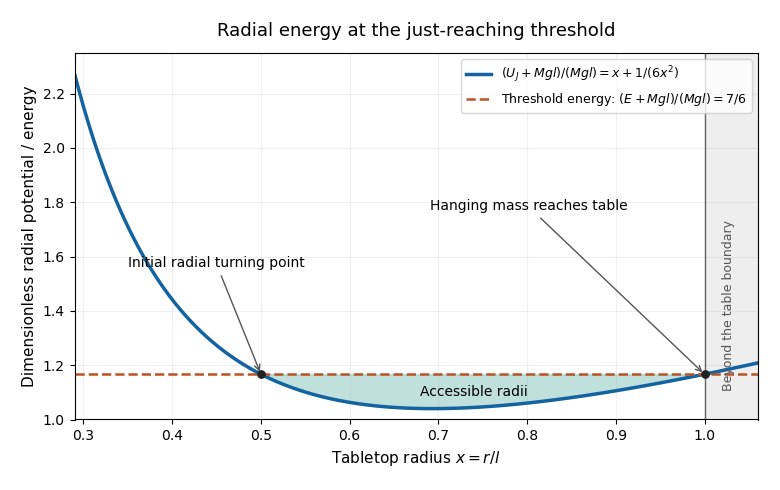
Effective radial potential at the threshold for the hanging mass to reach the table
. The horizontal energy level intersects the effective potential at r/l equal to one half and one. The interval between them is accessible. The curve is shifted by the irrelevant constant Mgl and normalized by Mgl; the physical region ends at r/l equal to one. Details.
For the initial radius to be circular, the radial equation requiresConsider a small radial perturbation at fixed conserved angular momentum . Using and in the radial equation givesConsequently the linearized radial motion is simple harmonic motion:The positive curvature of the effective potential establishes radial stability. This is the small-amplitude limit, not an exact finite-amplitude sinusoid. A perturbation that changes shifts the circular radius; its radial oscillations are about the new radius to the same order. A radial displacement or radial impulse preserving gives the stated oscillations about .
About a fixed origin in an inertial frame, the angular momentum and torque areFor a specified fixed axis with unit vector , use the projections and . The mass is constant. Differentiating and applying Newton's second law,Hence for the fixed axis. If the net torque vanishes, the corresponding angular momentum is conserved. Fixing the origin and axis is essential to this unmodified form of the law.
Take rightward translation as positive and counterclockwise angular acceleration as positive. Let denote signed ground friction, positive to the right. The source's lower-tangent winding makes the tension exert counterclockwise torque . For a horizontal pull, translation and rotation obeyThe final relation is the rolling without slipping constraint. Eliminating and givesThus the requested magnitude of static friction isIt acts leftward. Released from rest, the spool accelerates rightward, toward the pulling hand, and rotates clockwise. There is no contradiction between leftward friction and rightward motion: static friction prevents slipping of the contact point, and the horizontal tension is larger than because .
Keep the signs of part i. The tension has horizontal component but still has counterclockwise torque , since it is tangent to the axle. ThusSolving these equations gives the critical pulling angle of a rolling spool lawThe zero-acceleration angle is thereforeAt this angle the line of action of the pull passes through the ground contact, so its torque about that point vanishes. A spool initially at rest stays at rest while the contact constraints hold; one already rolling has zero acceleration, rather than being brought to rest.
For equilibrium the vertical normal force is and . The static friction inequality becomesHence, for ,At this limit the normal force is still nonnegative; for finite and positive it is positive. For , the numerator of is negative. Released from rest, the spool rolls leftward, away from the pulling hand, with counterclockwise rotation, provided the assumed rolling without slipping and ground contact remain possible. The nonzero acceleration is not obtained by assuming that friction simply opposes the centre's motion.
Articles by others on the same topic
There are currently no matching articles.