The canonical commutation relations are , with . Operators from different Cartesian modes commute, so and . Thus is Hermitian and represents an observable on the usual oscillator domain.
Introduce annihilation operators and similarly . Set , and . The Schwinger boson representation givesFor and , and . ThereforeThe two-mode oscillator Casimir identity isSince , , and is conserved. However, is not the zero operator, so there is no general joint eigenbasis. The exception is important: a common eigenstate of two angular-momentum components must satisfy , then the other commutators force . Thus only the sector admits a common state; here that is the oscillator ground state.
Using , with , and selecting the positive energy branch givesEquivalently , so and the degeneracy is , corresponding to .
For observables with finite variances, the Heisenberg uncertainty principle gives ; in particular . It concerns the spreads of measurements in a prepared state, rather than only disturbance by a measuring device. Identical integer-spin particles have symmetric full states and Bose-Einstein statistics; half-integer-spin particles have antisymmetric full states and Fermi-Dirac statistics. The latter imply Pauli exclusion from one complete single-particle state, including spin.
Inside an infinite square well, solutions satisfying both zero boundary conditions arewith zero wavefunction outside. For the ground state, direct integration givesThe infinite-well ground-state uncertainty product follows:The ground state is not a minimum-uncertainty Gaussian. Here momentum variance is the usual kinetic-momentum second moment of the confined state; the hard-wall momentum operator has domain subtleties that do not alter this kinetic-energy result.
For spin degeneracy in filling a one-dimensional well, let and assume the spin levels are degenerate and available. Four spin-zero bosons all occupy the lowest orbital, giving . Four spin- fermions fill two spin states in each of , giving . Spin- fermions have four spin projections, so all four can occupy in different complete states, giving . These fillings do not impose full spin polarization.
matrix multiplication gives , hence . For physical neutron spin, use , so , , and measurement along any axis gives .
For the specified field, . The Time-dependent Schrödinger equation is with . The uniform-field spin precession follows from :
The measurement direction is , as confirmed by the original diagram. Write and . The spinors and have unit norm and inner product . Applying gives eigenvalues and . At they are the usual basis; at they are the basis up to a phase; at the up/down roles are exchanged, with a factor ; and at both return with a minus sign. A spinor changes sign under a full rotation, while its isolated-state measurement probabilities are unchanged.
For spin measurement in the yz plane, projection givesFor these are ; for both are at all times; for they are exchanged; and for they are the same as at zero angle. The constant probabilities also follow from conservation of .
For the two inline operator labels, (a) has eigenvalue , and (b) has eigenvalue , with and . The subscript distinguishes the magnetic quantum number from the electron mass.
Put and . For the proposed radial shape,The angular-momentum term cancels the inverse-square part. The inverse-radius coefficient vanishes if . ThereforeThis nodeless Coulomb radial eigenstate has principal quantum number , not the complete set of hydrogen radial states. Since the spherical harmonic is normalized, radial normalization requiresup to an arbitrary phase.
For the hydrogen ground-state nuclear-volume probability, use . With ,No numerical proton radius is supplied or required. A sharp proton boundary is an approximation to a charge distribution, and the point-Coulomb potential changes inside an extended proton. Finite proton mass, relativistic and electromagnetic corrections also limit the ideal wavefunction's precision.
Classically the kinetic energy must satisfy . For this demands . The hydrogen ground-state probability beyond the classical turning point isA substantial probability lies beyond the classical turning radius; the bound-state wavefunction decays there rather than vanishing.
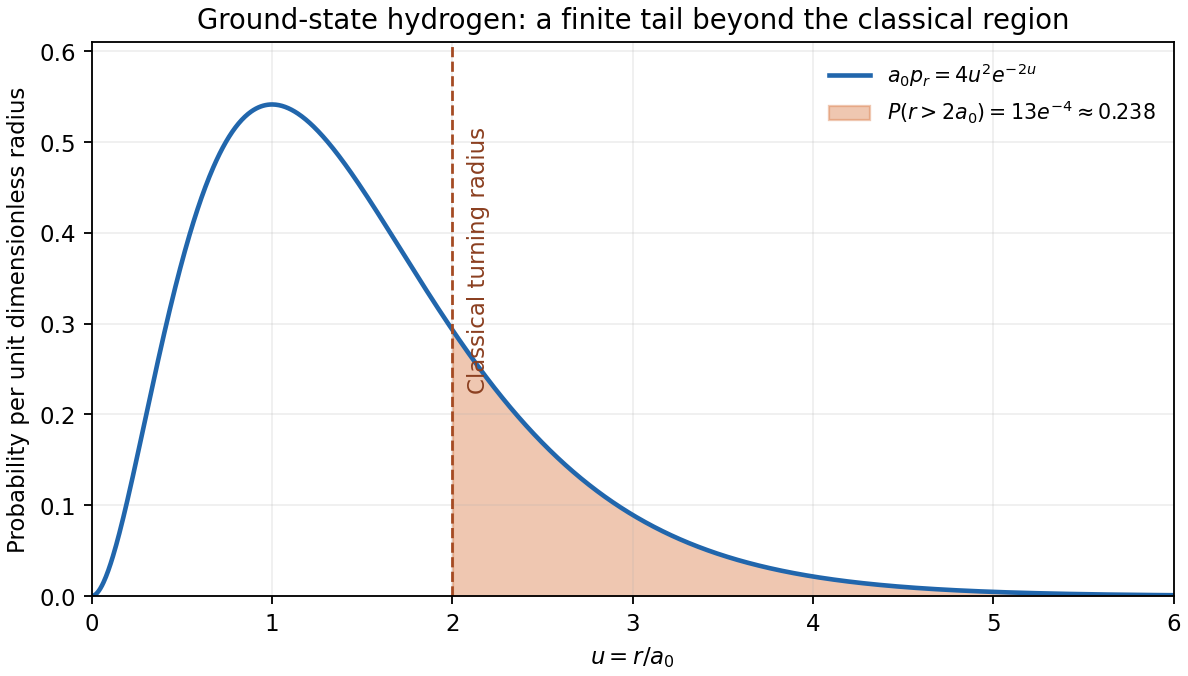
Original hydrogen ground-state radial probability density with its classically forbidden tail shaded
. Details. 
Articles by others on the same topic
There are currently no matching articles.