For the attractive inverse-square force, choose zero potential energy at infinity, so . At either radial turning point , the kinetic energy is purely tangential, with conserved angular momentum . ThusIts two roots are the periapsis and apoapsis distances. Their sum is , whereas the ellipse has . Therefore , with for a nondegenerate bound ellipse. The circular case follows by the double-root limit.
For the two-body problem, define , total mass , reduced mass , and center of mass . The relative equation is , while the isolated center of mass has . Once the relative orbit is known,The relative energy uses in its kinetic energy and in the gravitational potential energy.
In the equal-mass case the initial relative speed is , , and the center-of-mass velocity is half B's initial velocity. ThusNegative relative energy requires . The escape threshold is ; equality is marginal parabolic escape, so a strictly bound pair has .
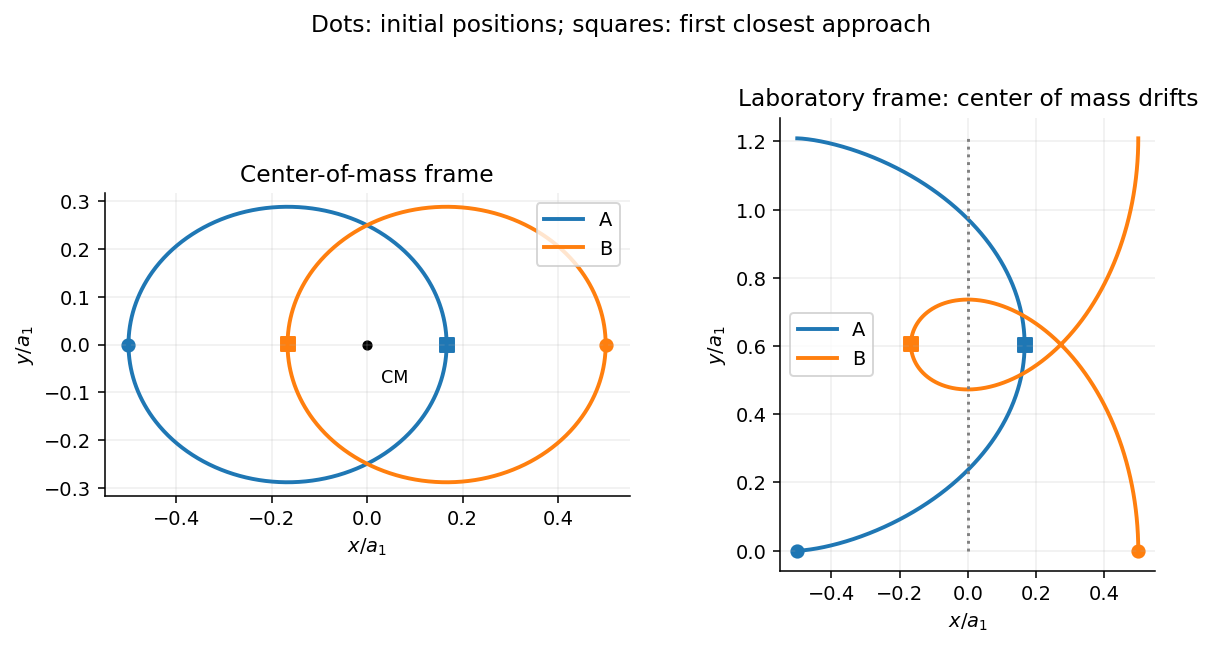
For , and the relative semimajor axis is . The initial transverse speed is below the relative circular value , so the initial turning point is apoapsis. HenceChoose the initial separation along from A to B, with B's initial velocity . Conservation of angular momentum gives relative periapsis speed . At the opposite end of the ellipse the direction is , soThus B has the same speed as initially but the opposite velocity. A has at that instant. A value for B would be its center-of-mass-frame speed, not the requested initial laboratory frame result.
The relative orbital period follows from Kepler's third law with total gravitating mass :In the center-of-mass frame each star follows an ellipse of semimajor axis and eccentricity , with the center of mass at a focus; they remain opposite on their simultaneous position vectors. In the laboratory frame add the uniform drift along . The laboratory paths of an equal-mass binary are therefore not closed ellipses, even though their relative motion repeats.

Articles by others on the same topic
There are currently no matching articles.