Take a long strip along , occupying in , with uniform surface current . Above the strip's centre, the contributions odd in cancel, while the Biot-Savart law gives the magnetic field of a uniformly conducting stripThe field reverses below the strip. Its field lines wrap around the longitudinal current: nearly parallel to the faces near the centre, then curving round the edges and approaching circles at large distances. The sketch is an original field integration; the conductor thickness is idealized as negligible.
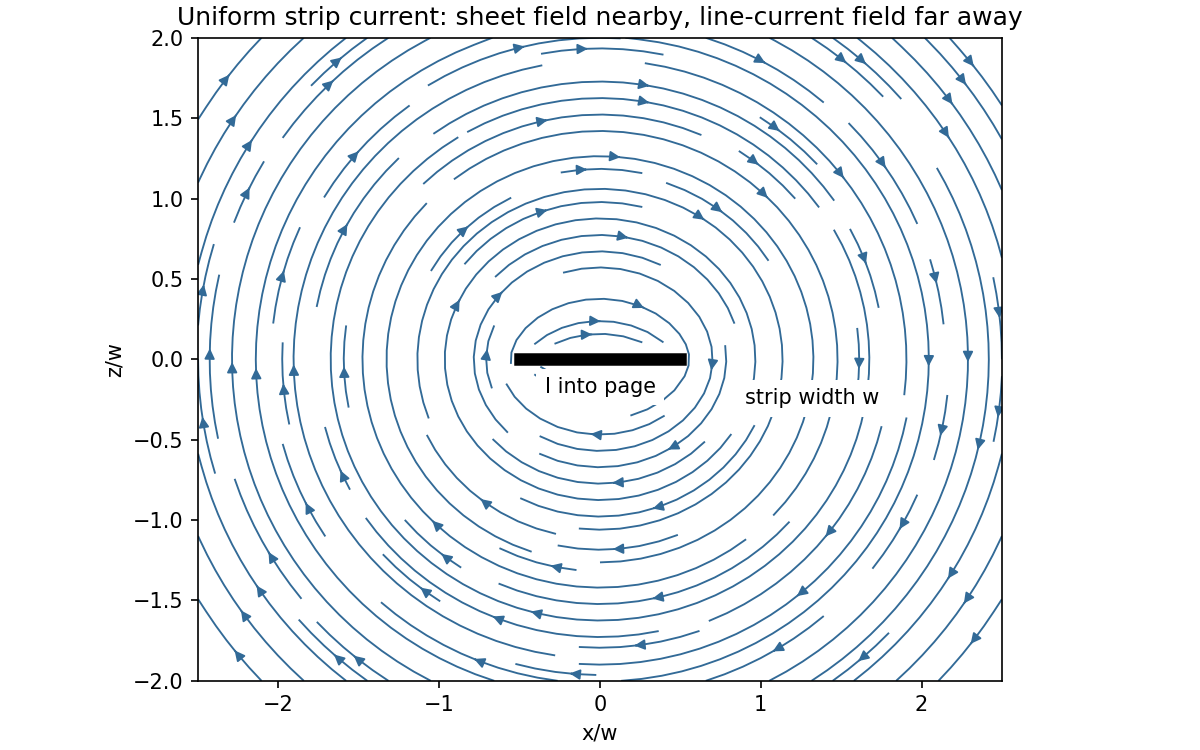
Original magnetic field-line integration for a uniformly current-carrying thin strip
. Details. 
At distance , the strip is indistinguishable to leading order from a straight line current. Ampère's law on a large circular contour gives , directed tangentially around the strip's longitudinal axis by the right-hand rule. On the perpendicular centreline this also follows by expanding .
At perpendicular distance from the middle of a face, but outside the conductor, the strip approximates an infinite current sheet. The tangential field jump is and symmetry gives equal opposite fields on the two sides. Hence on either side. The centreline integral gives the same limit as . Uniform current across the width and distance from the strip edges are implicit in this sheet approximation; a nonuniform surface current would require its local value instead.
Let be the initial plan area and take compression normal to the sheet. Smooth plates exert no lateral traction, so the uniaxial stress is and the two lateral strains are . To first order in strain,This area expansion under uniaxial compression is the increase of the sheet's plan area, equivalently the area of either broad face. Counting the sum of both broad faces would give twice this change; edge area would require thickness information. The cancellation of is a small-strain linear-elastic result, not a statement that arbitrarily large compressions need no geometry data.
Use a cold, unmagnetized, collisionless plasma with a sharp interface, and take the incident medium to be vacuum. Its relative permittivity is , so at the stated frequencies . Conservation of tangential wavenumber givesFor oblique total reflection at an unmagnetized plasma, require , or . Thus total reflection occurs for measured from the normal, up to grazing incidence. At the ideal critical angle the transmitted normal energy flux also vanishes, so the lossless reflectance reaches unity there. Collisions or an imposed magnetic field change this simple criterion. The constitutive response used here follows the electron-motion derivation in the cited university notes.[ref]
Oscillations and Waves by Richard Fitzpatrick. Section 9.7, equations 9.27–9.30, unmagnetized-plasma dispersion and refractive index
To obtain the maximum work from two finite heat reservoirs, operate a reversible heat engine between the bodies until their temperatures coincide. Include the work store in the isolated total system: no heat enters from outside, while the bodies can transfer energy to that store. With the stated constant heat capacities, reversibility requiresNumerically, . The decrease of the bodies' internal energy isDirect thermal equilibration without an engine would instead reach the arithmetic heat-capacity-weighted temperature and deliver no work. entropy production can only raise the final common temperature above the value for zero entropy production and reduce extractable work.
A stationary person relative to the rim has centripetal acceleration . If is a signed walking speed relative to the rim, the inertial tangential speed is , so the inward normal reaction satisfiesConsequently the support force per mass, and hence apparent weight, is for and zero for . In the latter case the walker has zero inertial speed and needs no centripetal support; ordinary weight-bearing contact cannot be assumed to persist without a restraint. For artificial gravity in a rotating ring, the centrifugal force and the Coriolis force alone are insufficient: the walker also has relative-path centripetal acceleration . Omitting it would give the wrong apparent weights at these large walking speeds.
Articles by others on the same topic
There are currently no matching articles.