Use an ideal gas to illustrate the Carnot cycle, with hot and cold heat baths at and . The four processes are all reversible thermodynamic processes. Lettered states below belong only to this illustration; the engine later in the question uses numbered states.
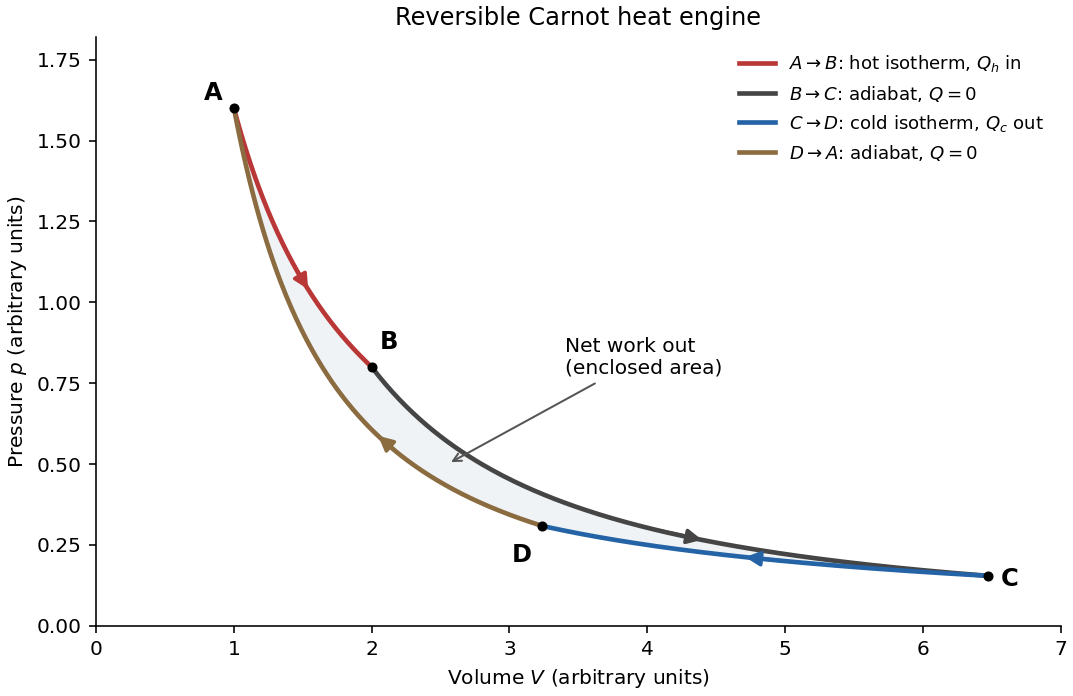
Starting at , perform the following four stages:
- : isothermal expansion at . The gas absorbs heat from the hot heat bath and does work. Its internal energy is unchanged, so .
- : reversible ideal-gas adiabat during expansion. Insulation prevents heat transfer; work done by the gas reduces its internal energy and lowers its temperature from to .
- : isothermal compression at . Work done on the gas is rejected as heat to the cold heat bath, with .
- : insulated adiabatic compression, performed reversibly, raises the temperature back to and closes the cycle.
Because the working substance returns to its original thermodynamic state, its net entropy change is zero. There is no entropy change on either reversible ideal-gas adiabat; on each isothermal process the entropy transfer is the exchanged heat divided by the bath's absolute temperature. HenceThe first law of thermodynamics over a complete cycle gives . The thermal efficiency is thereforeThe use of kelvins is essential. This result does not depend on the working substance. For the ideal gas illustration, the two reversible ideal-gas adiabats imply , so ; the explicit heat expressions in (a) give the same ratio.
The complete cycle must be a reversible thermodynamic process: no friction, viscous dissipation, unrestrained expansion, or other source of entropy. Each moving boundary must be arbitrarily close to mechanical equilibrium. Heat transfer to or from a bath must occur across an infinitesimal temperature difference, and the insulated stages must be genuinely adiabatic processes. There must also be no direct heat leak between the heat baths.
For an engine exchanging heat only with these two heat baths, the Second law of thermodynamics givesand thusPractical engines generate entropy through finite temperature differences, friction and other dissipative effects. They therefore fall below the Carnot cycle limit. Approaching reversible heat exchange generally requires vanishingly slow operation for a finite heat-transfer apparatus, limiting useful power.
For the numbered engine, denote the low and high pressures by and . Let denote the molar gas constant. The ideal gas law makes the constant-pressure branches straight rays in a temperature-volume diagram:The high-pressure ray is steeper. For a constant heat capacity ratio , each reversible ideal-gas adiabat obeysConsequently curves upward and left during compression; goes upward and right along the steeper ray; curves downward and right during expansion; and goes downward and left along the shallower ray.
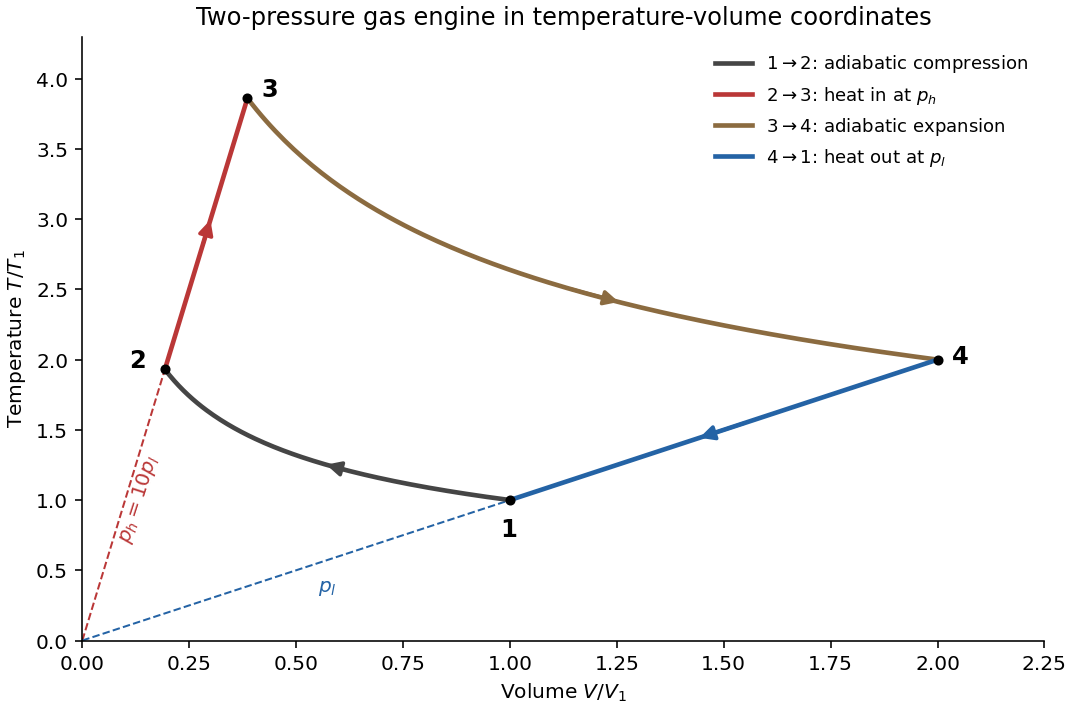


The plot is an original calculation for , and ; its state directions follow the original paper. The dashed extensions identify the two constant-pressure rays, not additional stages of the cycle.
This is the Brayton cycle. Assume fixed gas amount, constant heat capacities, and internally reversible adiabatic processes, as intended by the ideal engine model. Put andCombining with the ideal gas law gives along either reversible ideal-gas adiabat. ThereforeDuring a constant-pressure process the heat supplied equals the enthalpy increase. If is the molar heat capacity at constant pressure, the positive heat input and output areThe insulated branches exchange no heat, so the first law of thermodynamics gives . HenceAn adiabatic process alone need not be an isentropic process; the relations used here also require internal reversibility. Dissipative compression or expansion would require extra information and would not, in general, obey this efficiency formula.
For a diatomic ideal gas in the usual regime with three translational and two rotational quadratic degrees of freedom, but frozen vibrational excitation, the equipartition theorem givesThe Brayton cycle efficiency is thereforeThe constant-pressure expansion has , while the compression has . The same relations give . Thus, in units of the minimum temperature,The maximum and minimum temperatures are and . A Carnot cycle between those extremes hasThe difference is about percentage points. In the Brayton cycle, heat is supplied and rejected over ranges of temperature; the whole input is not supplied at , nor is the whole rejection made at . This explains the lower efficiency even for mechanically ideal stages. Absolute state temperatures are not supplied, so is an explicit standard diatomic-gas approximation rather than a conclusion about all possible rotational and vibrational excitation regimes.
Articles by others on the same topic
There are currently no matching articles.