Use an ideal gas to illustrate the Carnot cycle, with hot and cold heat baths at and . The four processes are all reversible thermodynamic processes. Lettered states below belong only to this illustration; the engine later in the question uses numbered states.
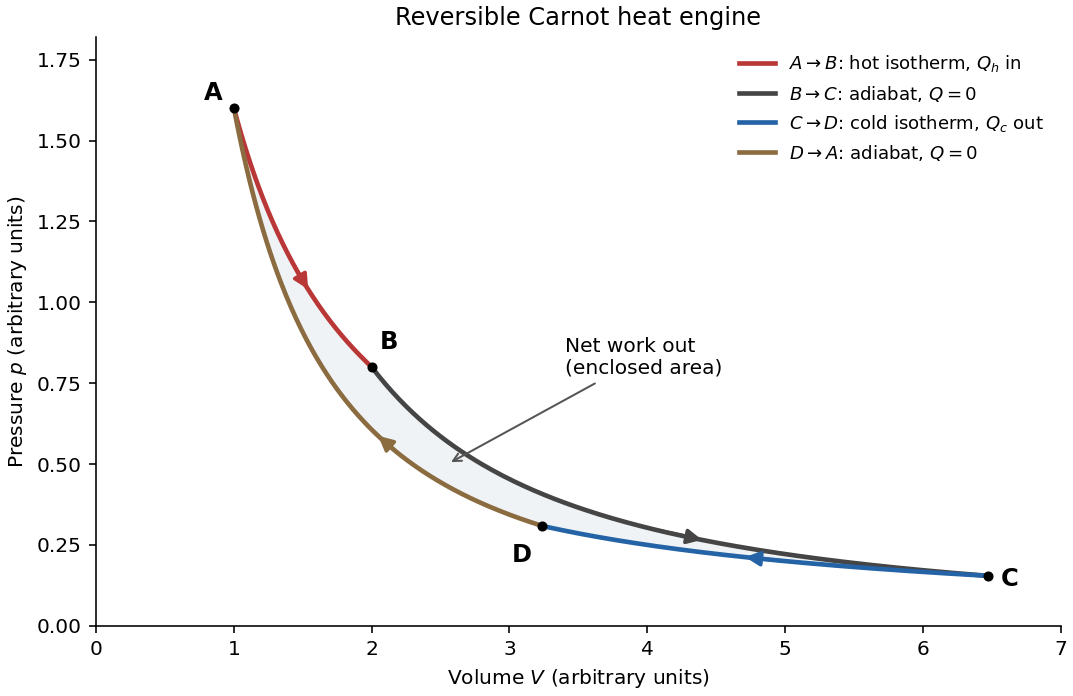
Starting at , perform the following four stages:
- : isothermal expansion at . The gas absorbs heat from the hot heat bath and does work. Its internal energy is unchanged, so .
- : reversible ideal-gas adiabat during expansion. Insulation prevents heat transfer; work done by the gas reduces its internal energy and lowers its temperature from to .
- : isothermal compression at . Work done on the gas is rejected as heat to the cold heat bath, with .
- : insulated adiabatic compression, performed reversibly, raises the temperature back to and closes the cycle.
Because the working substance returns to its original thermodynamic state, its net entropy change is zero. There is no entropy change on either reversible ideal-gas adiabat; on each isothermal process the entropy transfer is the exchanged heat divided by the bath's absolute temperature. HenceThe first law of thermodynamics over a complete cycle gives . The thermal efficiency is thereforeThe use of kelvins is essential. This result does not depend on the working substance. For the ideal gas illustration, the two reversible ideal-gas adiabats imply , so ; the explicit heat expressions in (a) give the same ratio.
The complete cycle must be a reversible thermodynamic process: no friction, viscous dissipation, unrestrained expansion, or other source of entropy. Each moving boundary must be arbitrarily close to mechanical equilibrium. Heat transfer to or from a bath must occur across an infinitesimal temperature difference, and the insulated stages must be genuinely adiabatic processes. There must also be no direct heat leak between the heat baths.
For an engine exchanging heat only with these two heat baths, the Second law of thermodynamics givesand thusPractical engines generate entropy through finite temperature differences, friction and other dissipative effects. They therefore fall below the Carnot cycle limit. Approaching reversible heat exchange generally requires vanishingly slow operation for a finite heat-transfer apparatus, limiting useful power.
For the numbered engine, denote the low and high pressures by and . Let denote the molar gas constant. The ideal gas law makes the constant-pressure branches straight rays in a temperature-volume diagram:The high-pressure ray is steeper. For a constant heat capacity ratio , each reversible ideal-gas adiabat obeysConsequently curves upward and left during compression; goes upward and right along the steeper ray; curves downward and right during expansion; and goes downward and left along the shallower ray.
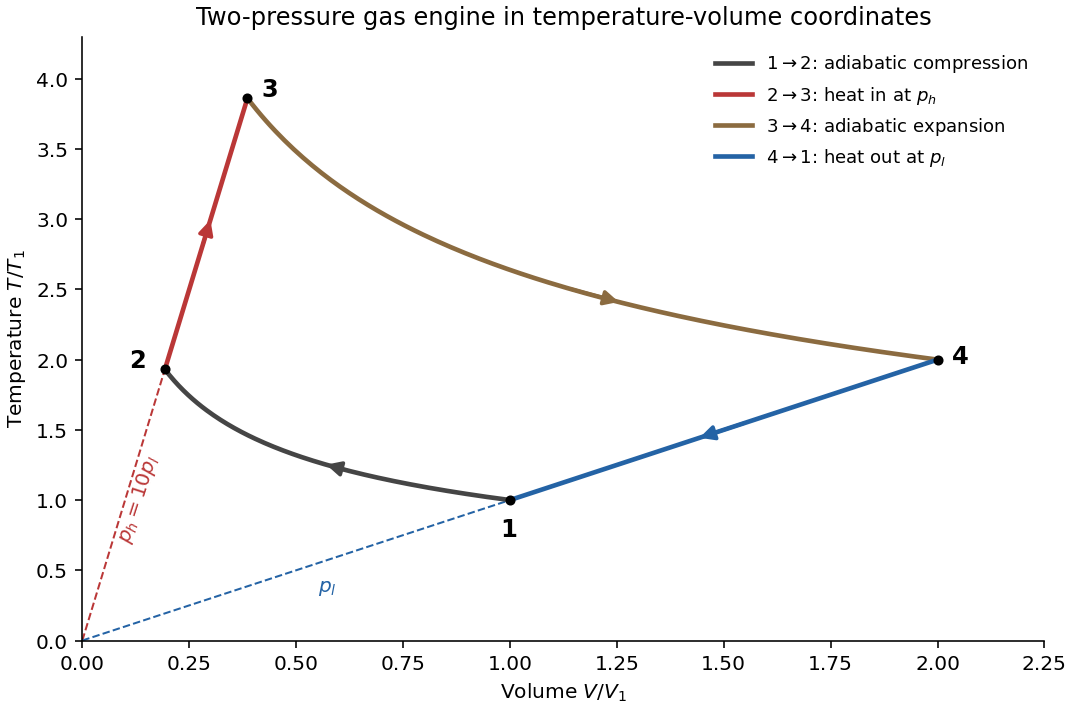


The plot is an original calculation for , and ; its state directions follow the original paper. The dashed extensions identify the two constant-pressure rays, not additional stages of the cycle.
This is the Brayton cycle. Assume fixed gas amount, constant heat capacities, and internally reversible adiabatic processes, as intended by the ideal engine model. Put andCombining with the ideal gas law gives along either reversible ideal-gas adiabat. ThereforeDuring a constant-pressure process the heat supplied equals the enthalpy increase. If is the molar heat capacity at constant pressure, the positive heat input and output areThe insulated branches exchange no heat, so the first law of thermodynamics gives . HenceAn adiabatic process alone need not be an isentropic process; the relations used here also require internal reversibility. Dissipative compression or expansion would require extra information and would not, in general, obey this efficiency formula.
For a diatomic ideal gas in the usual regime with three translational and two rotational quadratic degrees of freedom, but frozen vibrational excitation, the equipartition theorem givesThe Brayton cycle efficiency is thereforeThe constant-pressure expansion has , while the compression has . The same relations give . Thus, in units of the minimum temperature,The maximum and minimum temperatures are and . A Carnot cycle between those extremes hasThe difference is about percentage points. In the Brayton cycle, heat is supplied and rejected over ranges of temperature; the whole input is not supplied at , nor is the whole rejection made at . This explains the lower efficiency even for mechanically ideal stages. Absolute state temperatures are not supplied, so is an explicit standard diatomic-gas approximation rather than a conclusion about all possible rotational and vibrational excitation regimes.
A cubic reflecting cavity supports standing waves with positive integer mode indices and wavevector components . A cell in mode space has volume . In the continuum approximation, a spherical shell of radius and thickness has one-eighth of its volume in the positive octant. There are two independent transverse photon polarizations for a generic wavevector. HenceThe photon energy is , so . ThereforeThis is the leading bulk density of states, valid when the cavity is large compared with the relevant wavelengths and many modes lie in the counting interval. A finite cavity has a discrete mode spectrum, with boundary corrections beyond this approximation. Modes with vanishing indices require separate boundary counting but do not change the leading term. Here is the reduced Planck constant, as printed in the original PDF; replacing it by would introduce an erroneous factor of .
Each independent cavity mode is a quantum harmonic oscillator of angular frequency . Its occupation numbers represent the numbers of photons in that mode. At thermal equilibrium, photons can be absorbed and emitted by the walls, so their number is not conserved and the photon chemical potential is zero. The Boltzmann distribution of the oscillator excitations then givesThe expression supplied in the paper is the thermal excitation energy. The oscillator's temperature-independent zero-point energy is excluded from the emitted thermal radiation.
Putting and into the mode count from (a) gives the number of modes per unit cavity volume:Multiplying by the mean thermal energy in each mode yields Planck's law in the angular-frequency convention:The two photon polarizations are already included in the density of states; no further factor of two is needed. has units , whereas has units .
The equilibrium photon gas is isotropic, so the energy density per unit solid angle in a narrow angular-frequency interval is . For rays making angle with an outward surface normal, a surface element is crossed in time by rays initially in a volume . Only the outward hemisphere contributes. ThusThe hemispherical restriction supplies a factor and the directional projection supplies another . A small aperture in a cavity therefore emits this spectral power per unit area. A blackbody at the same temperature emits the same amount: otherwise radiation exchange between it and the aperture would violate thermal equilibrium.
Integrating Planck's law over all positive angular frequencies gives the total emitted heat flux densitySet . ThenThe remaining integral is independent of temperature, proving . Its value follows by expanding and integrating termwise:Consequently the Stefan–Boltzmann law isThis is emitted power alone. A body in a radiation environment also absorbs incoming radiation, which must be included when calculating net radiative cooling.
Let the spacecraft radius be , and assume that heat redistribution keeps its whole surface at a common temperature . Neglect background radiation, and let . The Sun's luminosity, from the Stefan–Boltzmann law, isAt distance , the incident irradiance is . The spacecraft intercepts radiation over its projected disc, area , but emits from its whole spherical area . The radiative equilibrium condition is thereforeCancelling the common factors givesThe radius of the spacecraft cancels. The factor follows from the ratio of absorbing projected area to emitting surface area. Uniform surface temperature is the intended additional idealization behind a single equilibrium surface temperature. A poorly conducting spacecraft would have position-dependent temperatures; for example, a locally reradiating patch facing the Sun would instead have , and a different maximum-temperature constraint.
Kirchhoff's law of thermal radiation equates spectral absorptivity and spectral emissivity at the same wavelength and direction. A surface that is a poor absorber in the thermal infrared is also a poor emitter there; a coating cannot be assigned its solar absorption independently of its thermal emission spectrum.
(i) All-wavelength black paint. It absorbs the sunlight and also radiates maximally at the spacecraft's own temperature. With the isothermal-sphere assumptions of (d), the limiting black-surface distance isThe spacecraft can operate at in this model. A surface already assumed to be a blackbody is not improved by another black coating; relative to option (ii), however, this paint permits closer operation.
(ii) Black at short wavelengths and grey in the infrared. By Wien's displacement law, changing the black-body radiation temperature from to shifts the wavelength peak from about to about . Most solar power is therefore in the highly absorbing short-wavelength band, whereas most spacecraft emission lies beyond , where the spectral emissivity is reduced. The coating retains most of the heating but suppresses much of the cooling. Under the intended two-band grey body approximation, option (ii) makes the spacecraft hotter at the same distance and requires a larger minimum distance than black paint.
To express the comparison without inventing a grey absorptivity, let be radiometric absorptance averaged over the solar spectrum and be emissivity averaged over the spacecraft's own thermal spectrum. The radiative equilibrium equation becomesAt the failure threshold,For an ideal two-band coating take a constant radiometric absorptance beyond , and unity below it. If is the fraction of the power emitted by a blackbody below , Planck's law givesSince , this model has and hence . The paper supplies neither a numerical value of nor a detailed spectrum, so no unique numerical distance for the grey paint follows. If its long-wavelength absorption is not approximately grey, the spectrum must be integrated explicitly rather than inferred from a peak alone. A coating designed to improve close approach would instead reflect much of the solar radiation while retaining strong thermal infrared emission.
Articles by others on the same topic
There are currently no matching articles.