Interpret the applied pressure as a uniform increase of external hydrostatic pressure on all six faces, and approximate the rock by an isotropic material obeying linear elasticity. Taking tensile stress as positive, . By Hooke's law, the strain along any one axis isTo first order in the small strain, the fractional volume change is the sum of the three axial strains:Thus the bulk modulus is . Using the specified Young's modulus, Poisson's ratio, and givesThe sign indicates contraction. This is the change relative to the unloaded reference state; simply maintaining a specimen already equilibrated at this same pressure would produce no further change.
Use the pipe-diameter convention for the Reynolds number, with mean velocity , density and dynamic viscosity :The Reynolds number compares inertial and viscous effects in the fluid flow. A conventional estimate for the onset of turbulence in a pipe is , givingHence the usual onset estimate is . Using the also common transition criterion gives , whereas , used for established turbulence, gives . There is no universal sharp minimum: inlet disturbances and pipe conditions affect the transition from laminar flow, so the threshold convention must accompany the answer.
(a) Treat the lake as a heat bath at fixed temperature and the block's heat capacity as constant. Its initial temperature is , and . Although the cooling is irreversible, entropy is a state function, so evaluate the block's change along an imagined reversible thermodynamic process:The lake receives heat , and thereforeAdding the two contributions givesThe positive result is consistent with the Second law of thermodynamics for heat transfer across a finite temperature difference. The calculation uses exactly as printed in both the original PDF and the transcription; it does not replace the supplied value by a tabulated value for lead.
(b) The block starts and eventually finishes at the lake's temperature, so its net entropy change is approximately zero. Neglecting buoyancy, air resistance and the final immersion depth, the lost gravitational potential energy becomes internal energy in the lake after the motion and waves have dissipated. The lake remains at , givingTemporary heating of the block or temporary storage in kinetic energy does not change this final energy and entropy balance once thermal equilibrium is restored.
For a fixed amount of a simple compressible system, write the internal energy as . Its exact differential isAssuming the thermodynamic potential has continuous second partial derivatives, equality of its mixed partial derivatives yields the first Maxwell relation:For the second Maxwell relation, use the Legendre transform , the enthalpy. Its natural variables are sinceThus and . Equality of the mixed partial derivatives now gives
Let be the upper- and lower-level populations and their degeneracy factors. At thermal equilibrium, the Boltzmann distribution givesNo degeneracy factors are supplied, so the numerical answers use equal degeneracy factors. Stating the ratio as upper population divided by lower population removes an otherwise arbitrary inversion.
(a) At ,The two populations are nearly equal because the level separation is much smaller than the thermal energy .
(b) At ,Almost every atom occupies the lower level. If the levels have unequal degeneracy factors, each boxed ratio must be multiplied by ; their individual values cannot be inferred from the paper.
Newton's second law takes its familiar form in an inertial frame. Axes fixed to a turning apparatus or to the Earth form a rotating reference frame. Extra inertial forces account for the acceleration of these coordinates. Their values depend on the chosen reference frame; physical interactions such as gravity, tension and contact forces must still be included separately.
Let the rotating origin have inertial acceleration , and let its axes have angular velocity . For any vector , the rotating-frame derivative formula isEach rotating basis vector changes by , which proves this rule by expanding in that basis. Apply it twice to the position relative to the moving origin. With and measured in the rotating axes,Consequently the equation in the rotating reference frame isThe additional terms are the translational inertial force, Coriolis force, Euler force and centrifugal force, respectively. The last two simplify when the angular velocity is constant: the Euler force vanishes, while the other rotation terms remain.
The centrifugal force points away from the rotation axis. If is the perpendicular displacement from that axis, thenFor uniform rotation it has potential energyA mass at rest relative to a turntable can therefore be described as having an inward tension or friction balancing its outward centrifugal force. In an inertial frame, the inward physical force instead produces the required centripetal acceleration. These are two descriptions of the same motion; one must not insert the rotating-frame outward term into the inertial equation as an additional physical interaction.
A rotating liquid gives a useful quantitative example. For a liquid in hydrostatic equilibrium relative to a vessel rotating uniformly about the vertical axis,Along the free surface the pressure is constant, so andThe surface is a elliptic paraboloid. This is the balance of gravity and the centrifugal force in the rotating description. On the Earth, the same outward acceleration reduces effective gravity, most strongly at the equator, and contributes to the planet's equatorial bulge.
The Coriolis force depends on relative motion:It is perpendicular to both and , vanishes for motion along the rotation axis, and reverses when the relative velocity reverses. The dot product givesThus the Coriolis force does no work in the rotating reference frame: it changes the direction of motion rather than directly changing the rotating-frame kinetic energy. For example, on a horizontal turntable rotating anticlockwise as viewed from above, an outward-moving slider has a clockwise Coriolis acceleration, whereas an inward-moving slider has an anticlockwise one. The deflection can be observed by comparing a laboratory camera with a camera rotating with the table.
For slow horizontal motion on the Earth at latitude , keep the vertical component of its angular velocity. In east-north coordinates the horizontal Coriolis acceleration isIt deflects motion to the right in the northern hemisphere and to the left in the southern hemisphere. In large-scale atmospheric and oceanic motion it can balance a horizontal pressure gradient, giving geostrophic balance. With upward, the steady horizontal equation without friction isThe resulting velocity runs along lines of equal pressure. This approximation requires rotation to dominate local inertial changes; it is inappropriate close to the equator where tends to zero.
The Foucault pendulum gives another terrestrial example. In the small-angle approximation, its horizontal coordinates satisfyTo first order in the small ratio , the oscillation plane precesses relative to the ground at angular rate : clockwise in the northern hemisphere, zero at the equator, and one revolution per sidereal day at a pole. The Coriolis force explains this changing orientation without requiring energy input. Together these examples show why inertial forces are useful whenever the apparatus or environment supplies naturally rotating coordinates.
The examination asks for three notes. All four options are worked below so that each topic has a complete study answer.
The method of images solves certain electrostatics problems by replacing a conductor by fictitious electric charges outside the region where the solution is required. The replacement must satisfy the actual boundary values of the electric potential as well as the prescribed sources. The uniqueness of Poisson equation then establishes that the constructed electric potential equals the physical one in that region. The image locations are mathematical devices; they are not real charges inside the metal.
For a point charge at above an infinite grounded conducting plane , put an image charge at . In a cylindrical coordinate system with coordinates the potential in the physical region isThis vanishes at , has the required singularity at the real charge, and tends to zero at infinity. With electric field , the induced surface charge density follows from the normal field immediately above the conductor:The force on is the field of the image evaluated at the real charge:The electrostatic energy relative to infinite separation is . The factor accounts for the fact that the induced charge changes as the real charge is assembled; treating the image as an independently fixed physical charge would give the wrong energy.
A second standard geometry is a grounded conducting sphere of radius with a charge a distance from its centre. Its exterior field is generated by an image at distance from the centre on the line towards the real charge. On the sphere the distances to the real and image charges are in the ratio , making their potentials cancel. For an isolated neutral sphere, an additional central image makes the total induced charge zero and leaves the surface an equipotential. The construction is powerful for suitable symmetric boundaries, but arbitrary boundaries do not in general admit a finite image system.
An electrical insulator has no freely conducting bulk charge in the ideal static description, but an applied electric field can displace bound positive and negative charge relative to one another. The resulting electric dipole moments per unit volume define the polarization density . Distortion of electronic charge clouds, relative displacement of ions, and partial alignment of permanent molecular electric dipoles can all contribute. Thermal agitation opposes the last mechanism.
For a weak field in a linear isotropic dielectric, the constitutive law isHere is the electric susceptibility, is the permittivity, and is the electric displacement field. In an anisotropic material, is a tensor and need not be parallel to . These response laws describe the macroscopic field, not necessarily the microscopic field acting on one molecule.
Spatial variation and surface termination of the polarization density give bound charge and bound current through the bound charge densitieswhere is outward from the material. Thus uniform polarization density has no bulk bound charge, but generally has opposite bound charges on opposing surfaces. Gauss's law can be rewritten asWith no free surface charge, the normal component of is continuous across an interface; the tangential electric field is continuous in electrostatics.
For example, fill a parallel-plate capacitor of plate area and gap with a uniform dielectric, neglecting fringing. At fixed free plate charge , , soThe induced bound surface charges oppose the original field, reducing the electric field and potential difference at fixed . At fixed applied potential difference, the field remains and the battery instead supplies more free charge. The electric displacement field separates these free-charge and bound-charge roles.
Because the magnetic field obeys , it can be represented locally as the curl of a magnetic vector potential:This automatically enforces the absence of magnetic monopoles. It is also a global representation throughout ordinary all-space problems without monopole singularities. It is not unique: the gauge transformationleaves unchanged because the curl of a gradient vanishes. In a time-dependent problem,makes the same transformation leave both physical fields unchanged and automatically satisfies Faraday's law.
In vacuum magnetostatics, choose the Coulomb gauge . Substitution into Ampère's law and the identity givesfor a localized steady electric current density and a potential vanishing at infinity. Taking the curl recovers the Biot-Savart law. The magnetic vector potential converts a constrained vector field problem into componentwise Poisson equations once a gauge is chosen.
For a uniform magnetic field, is a convenient choice. For a localized magnetic dipole moment , the leading far-field potential isAnother useful relation is Stokes theorem, which relates a closed-path integral to the magnetic flux through a spanning surface:The units of are , equivalently .
An incident electromagnetic wave generally produces reflected and transmitted waves because the two media have different electromagnetic response. Consider a flat interface between homogeneous, linear, lossless media with permittivities and magnetic permeabilities . Their wave speeds and wave impedances areFor each plane electromagnetic wave, . With no free surface charge or current, the interface conditions for electromagnetic fields require continuous tangential and normal . Equality of the phase at every point on the boundary gives equal angular frequencies and tangential wavevectors. Hence the reflection angle equals the incidence angle and Snell's law iswhere and each angle is measured from the normal.
At normal incidence use the same tangential axis for all electric amplitudes. The two independent boundary equations areSolving gives the amplitude Fresnel equationsFor nonmagnetic media, these become and . Reflection into a medium of larger refractive index therefore reverses the electric amplitude's sign at normal incidence.
The normal Poynting vector determines the reflected and transmitted fractions of incident power. At normal incidence,It is the power fractions, rather than the squared electric amplitudes alone, that add to unity.
At oblique incidence separate transverse electric polarization (, electric field perpendicular to the incidence plane) from transverse magnetic polarization (, electric field in that plane). For nonmagnetic media, writing and , the Fresnel equations areHere choose a common direction and, for each ray, the direction as . This makes the reflected basis reverse its tangential direction at normal incidence, explaining why the displayed then has the opposite sign to . Physical reflectance is independent of this sign convention. For either polarization with propagating transmission,For polarization, zero reflection occurs at the Brewster angle . If , incidence above the critical angle for total internal reflection produces an evanescent field in total internal reflection and for an isolated lossless interface. A lossy second medium requires complex response coefficients and an absorption term in the energy balance.
Use an ideal gas to illustrate the Carnot cycle, with hot and cold heat baths at and . The four processes are all reversible thermodynamic processes. Lettered states below belong only to this illustration; the engine later in the question uses numbered states.
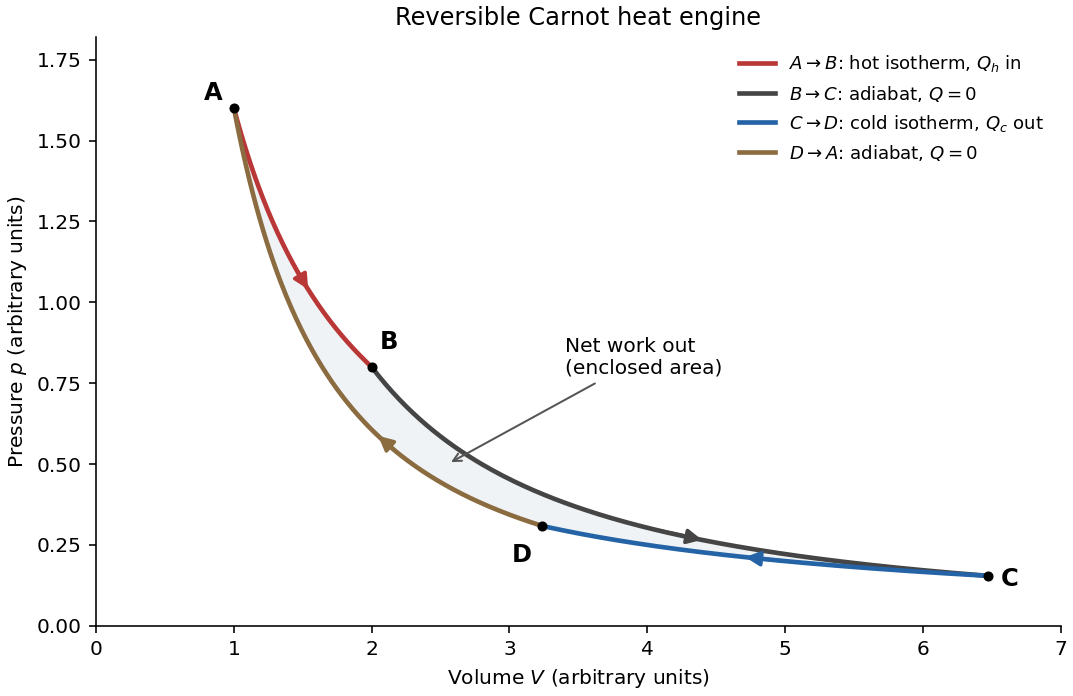
Starting at , perform the following four stages:
- : isothermal expansion at . The gas absorbs heat from the hot heat bath and does work. Its internal energy is unchanged, so .
- : reversible ideal-gas adiabat during expansion. Insulation prevents heat transfer; work done by the gas reduces its internal energy and lowers its temperature from to .
- : isothermal compression at . Work done on the gas is rejected as heat to the cold heat bath, with .
- : insulated adiabatic compression, performed reversibly, raises the temperature back to and closes the cycle.
Because the working substance returns to its original thermodynamic state, its net entropy change is zero. There is no entropy change on either reversible ideal-gas adiabat; on each isothermal process the entropy transfer is the exchanged heat divided by the bath's absolute temperature. HenceThe first law of thermodynamics over a complete cycle gives . The thermal efficiency is thereforeThe use of kelvins is essential. This result does not depend on the working substance. For the ideal gas illustration, the two reversible ideal-gas adiabats imply , so ; the explicit heat expressions in (a) give the same ratio.
The complete cycle must be a reversible thermodynamic process: no friction, viscous dissipation, unrestrained expansion, or other source of entropy. Each moving boundary must be arbitrarily close to mechanical equilibrium. Heat transfer to or from a bath must occur across an infinitesimal temperature difference, and the insulated stages must be genuinely adiabatic processes. There must also be no direct heat leak between the heat baths.
For an engine exchanging heat only with these two heat baths, the Second law of thermodynamics givesand thusPractical engines generate entropy through finite temperature differences, friction and other dissipative effects. They therefore fall below the Carnot cycle limit. Approaching reversible heat exchange generally requires vanishingly slow operation for a finite heat-transfer apparatus, limiting useful power.
For the numbered engine, denote the low and high pressures by and . Let denote the molar gas constant. The ideal gas law makes the constant-pressure branches straight rays in a temperature-volume diagram:The high-pressure ray is steeper. For a constant heat capacity ratio , each reversible ideal-gas adiabat obeysConsequently curves upward and left during compression; goes upward and right along the steeper ray; curves downward and right during expansion; and goes downward and left along the shallower ray.
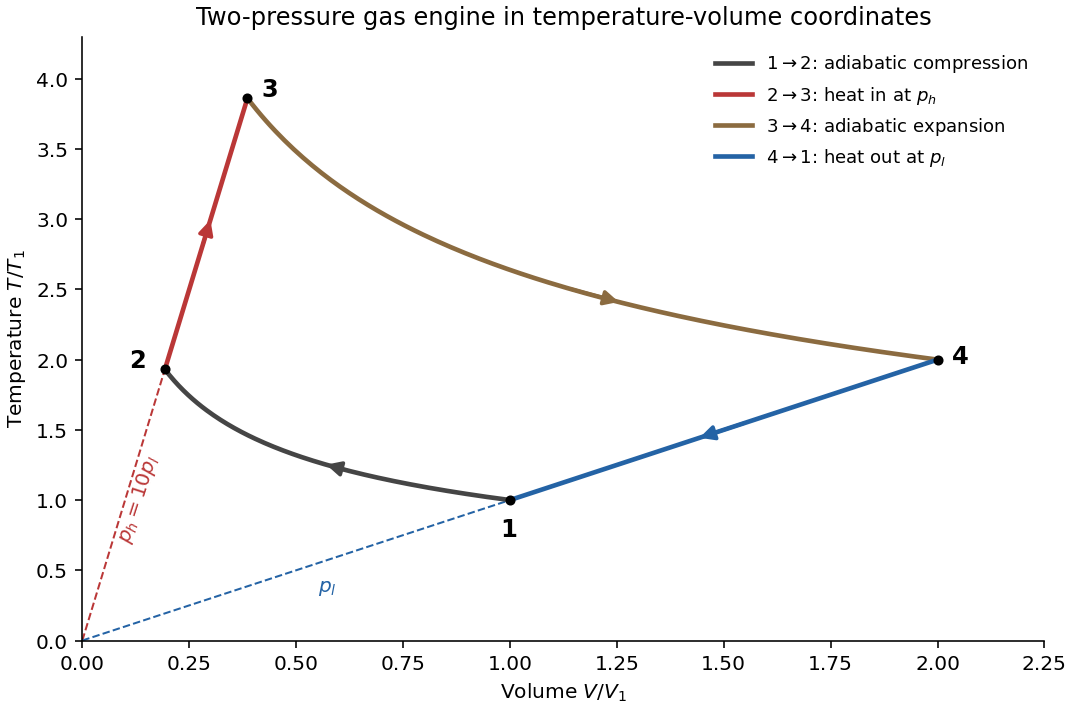


The plot is an original calculation for , and ; its state directions follow the original paper. The dashed extensions identify the two constant-pressure rays, not additional stages of the cycle.
This is the Brayton cycle. Assume fixed gas amount, constant heat capacities, and internally reversible adiabatic processes, as intended by the ideal engine model. Put andCombining with the ideal gas law gives along either reversible ideal-gas adiabat. ThereforeDuring a constant-pressure process the heat supplied equals the enthalpy increase. If is the molar heat capacity at constant pressure, the positive heat input and output areThe insulated branches exchange no heat, so the first law of thermodynamics gives . HenceAn adiabatic process alone need not be an isentropic process; the relations used here also require internal reversibility. Dissipative compression or expansion would require extra information and would not, in general, obey this efficiency formula.
For a diatomic ideal gas in the usual regime with three translational and two rotational quadratic degrees of freedom, but frozen vibrational excitation, the equipartition theorem givesThe Brayton cycle efficiency is thereforeThe constant-pressure expansion has , while the compression has . The same relations give . Thus, in units of the minimum temperature,The maximum and minimum temperatures are and . A Carnot cycle between those extremes hasThe difference is about percentage points. In the Brayton cycle, heat is supplied and rejected over ranges of temperature; the whole input is not supplied at , nor is the whole rejection made at . This explains the lower efficiency even for mechanically ideal stages. Absolute state temperatures are not supplied, so is an explicit standard diatomic-gas approximation rather than a conclusion about all possible rotational and vibrational excitation regimes.
A cubic reflecting cavity supports standing waves with positive integer mode indices and wavevector components . A cell in mode space has volume . In the continuum approximation, a spherical shell of radius and thickness has one-eighth of its volume in the positive octant. There are two independent transverse photon polarizations for a generic wavevector. HenceThe photon energy is , so . ThereforeThis is the leading bulk density of states, valid when the cavity is large compared with the relevant wavelengths and many modes lie in the counting interval. A finite cavity has a discrete mode spectrum, with boundary corrections beyond this approximation. Modes with vanishing indices require separate boundary counting but do not change the leading term. Here is the reduced Planck constant, as printed in the original PDF; replacing it by would introduce an erroneous factor of .
Each independent cavity mode is a quantum harmonic oscillator of angular frequency . Its occupation numbers represent the numbers of photons in that mode. At thermal equilibrium, photons can be absorbed and emitted by the walls, so their number is not conserved and the photon chemical potential is zero. The Boltzmann distribution of the oscillator excitations then givesThe expression supplied in the paper is the thermal excitation energy. The oscillator's temperature-independent zero-point energy is excluded from the emitted thermal radiation.
Putting and into the mode count from (a) gives the number of modes per unit cavity volume:Multiplying by the mean thermal energy in each mode yields Planck's law in the angular-frequency convention:The two photon polarizations are already included in the density of states; no further factor of two is needed. has units , whereas has units .
The equilibrium photon gas is isotropic, so the energy density per unit solid angle in a narrow angular-frequency interval is . For rays making angle with an outward surface normal, a surface element is crossed in time by rays initially in a volume . Only the outward hemisphere contributes. ThusThe hemispherical restriction supplies a factor and the directional projection supplies another . A small aperture in a cavity therefore emits this spectral power per unit area. A blackbody at the same temperature emits the same amount: otherwise radiation exchange between it and the aperture would violate thermal equilibrium.
Integrating Planck's law over all positive angular frequencies gives the total emitted heat flux densitySet . ThenThe remaining integral is independent of temperature, proving . Its value follows by expanding and integrating termwise:Consequently the Stefan–Boltzmann law isThis is emitted power alone. A body in a radiation environment also absorbs incoming radiation, which must be included when calculating net radiative cooling.
Let the spacecraft radius be , and assume that heat redistribution keeps its whole surface at a common temperature . Neglect background radiation, and let . The Sun's luminosity, from the Stefan–Boltzmann law, isAt distance , the incident irradiance is . The spacecraft intercepts radiation over its projected disc, area , but emits from its whole spherical area . The radiative equilibrium condition is thereforeCancelling the common factors givesThe radius of the spacecraft cancels. The factor follows from the ratio of absorbing projected area to emitting surface area. Uniform surface temperature is the intended additional idealization behind a single equilibrium surface temperature. A poorly conducting spacecraft would have position-dependent temperatures; for example, a locally reradiating patch facing the Sun would instead have , and a different maximum-temperature constraint.
Kirchhoff's law of thermal radiation equates spectral absorptivity and spectral emissivity at the same wavelength and direction. A surface that is a poor absorber in the thermal infrared is also a poor emitter there; a coating cannot be assigned its solar absorption independently of its thermal emission spectrum.
(i) All-wavelength black paint. It absorbs the sunlight and also radiates maximally at the spacecraft's own temperature. With the isothermal-sphere assumptions of (d), the limiting black-surface distance isThe spacecraft can operate at in this model. A surface already assumed to be a blackbody is not improved by another black coating; relative to option (ii), however, this paint permits closer operation.
(ii) Black at short wavelengths and grey in the infrared. By Wien's displacement law, changing the black-body radiation temperature from to shifts the wavelength peak from about to about . Most solar power is therefore in the highly absorbing short-wavelength band, whereas most spacecraft emission lies beyond , where the spectral emissivity is reduced. The coating retains most of the heating but suppresses much of the cooling. Under the intended two-band grey body approximation, option (ii) makes the spacecraft hotter at the same distance and requires a larger minimum distance than black paint.
To express the comparison without inventing a grey absorptivity, let be radiometric absorptance averaged over the solar spectrum and be emissivity averaged over the spacecraft's own thermal spectrum. The radiative equilibrium equation becomesAt the failure threshold,For an ideal two-band coating take a constant radiometric absorptance beyond , and unity below it. If is the fraction of the power emitted by a blackbody below , Planck's law givesSince , this model has and hence . The paper supplies neither a numerical value of nor a detailed spectrum, so no unique numerical distance for the grey paint follows. If its long-wavelength absorption is not approximately grey, the spectrum must be integrated explicitly rather than inferred from a peak alone. A coating designed to improve close approach would instead reflect much of the solar radiation while retaining strong thermal infrared emission.
Articles by others on the same topic
There are currently no matching articles.