In a photoelectric effect experiment, illuminate a clean metal photocathode with monochromatic light and use a retarding voltage to measure the maximum emitted-electron kinetic energy. The relation has a frequency threshold and a slope . Increasing intensity chiefly changes the number emitted, while increasing frequency increases the available energy per emission. This supports energy transfer in units , with the work function. The retarding-potential measurement distinguishes the electron energy from the photocurrent; the two respond differently to changes of the light.
In electron diffraction, accelerate electrons through a known voltage and measure the angular scattering pattern from a crystal. Distinct diffraction maxima occur where the periodic atomic arrangement gives constructive interference. Their positions give a wavelength through the crystal spacing and diffraction geometry, agreeing with the de Broglie wavelength , with in the nonrelativistic regime. Varying the accelerating voltage shifts the maxima in the predicted way. A localized classical projectile model alone would not explain this wavelength-dependent interference pattern.
For independent Poisson random variables with known expected counts , the model variance is . The Pearson chi-squared statistic is thereforeThere are six independently specified bins and no parameters fitted from them, giving approximately six degrees of freedom. This is far above its expected value six; the approximate chi-squared distribution tail probability is . The discrepancies are much too large for a good Poisson-noise fit. Replacing model variances by the observed-count estimates gives the alternative statistic , with the same qualitative conclusion. There is no fitted normalization to justify subtracting a degree of freedom or rescaling the model to the observed total.
One conduction electron per atom gives number density . Filling two spin states per momentum state in the three-dimensional Fermi gas gives andThe Fermi temperature greatly exceeds ordinary temperatures, explaining why these conduction electrons are degenerate rather than a classical Maxwell gas. The numerical result uses the stipulated free-electron band and bare electron mass, rather than a detailed copper band structure.
For equally nondegenerate levels, the partition function is . The mean energy per particle is , so the Schottky anomaly has heat capacityAt low temperature, because excitation is suppressed. At high temperature, because the two populations approach equality and the energy saturates. The peak is about at . The common offset does not affect heat capacity. Multiply by particle number for the total heat capacity, or divide by the corresponding mass for a mass-specific quantity.
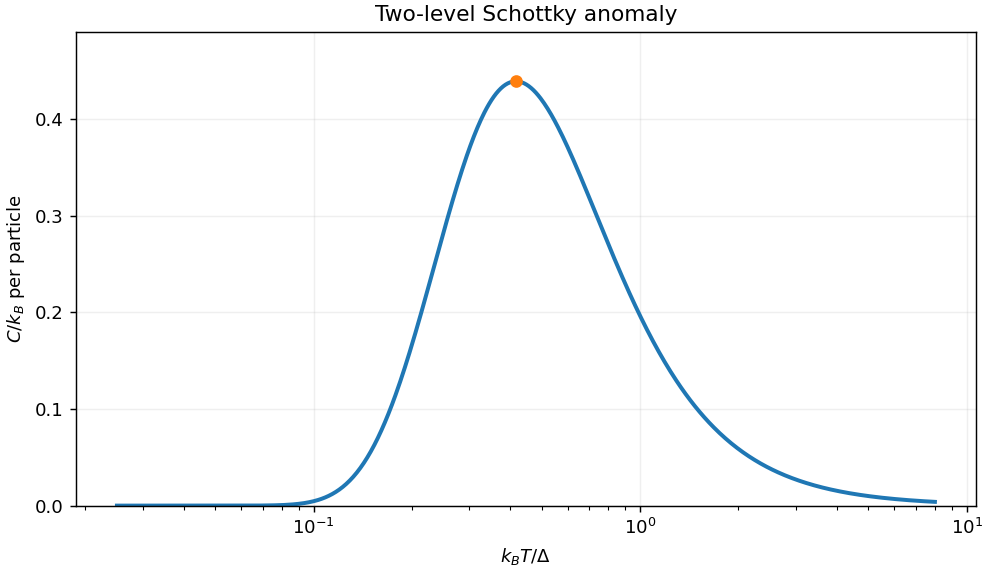
Two-level Schottky heat capacity and its low- and high-temperature suppression
. Details. The infinite square well levels for width are . Starting in the ground state, the smallest excitation is , and its electric-dipole matrix element is nonzero. It therefore sets the longest absorption wavelength:The corresponding energy separation is about . Elastic scattering of light is a different process from the stipulated absorption into an excited well state.
The quoted angular diameter gives half-angle . At distance , the uniform beam covers area . Its intensity is . For a vacuum electromagnetic wave, , soNo extra factor two belongs in this rms relation. The frequency fixes the wavelength but is unnecessary once the total power and stipulated beam divergence are specified. This is the ideal directed-beam estimate, before propagation or receiver losses.
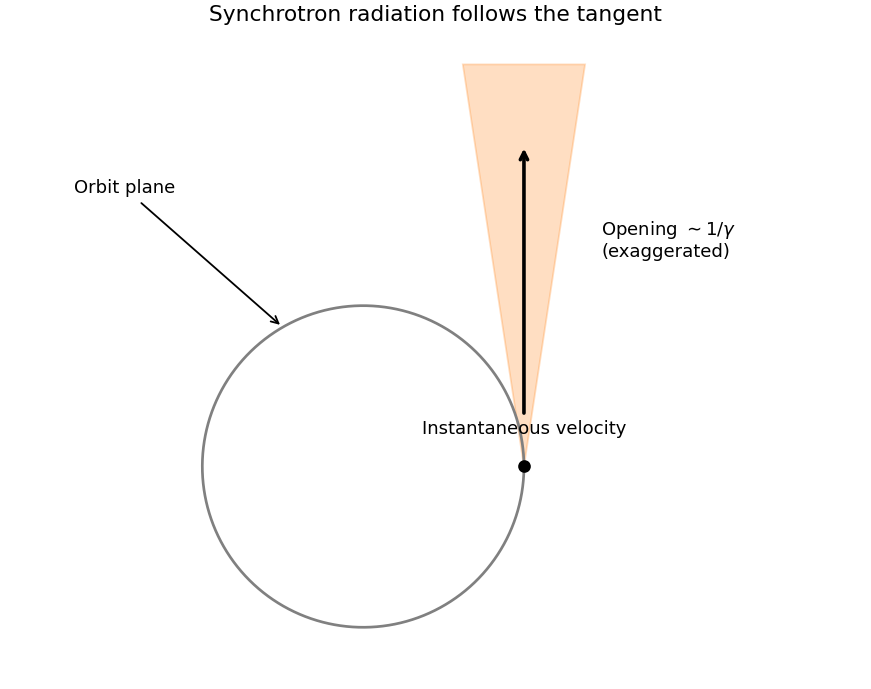
Relativistic synchrotron radiation is concentrated within angle of order around the instantaneous velocity, tangent to the circular orbit. The narrow instantaneous beam sweeps around with the particle; over a whole orbit the emission forms a thin fan about the orbital plane. With , . Since , the supplied characteristic-frequency scaling givesThis is subnanometer X-ray radiation, with a beaming angle of order . The conventional critical-angular-frequency normalization gives instead; the question's order-of-magnitude frequency prescription does not distinguish these order-one factors.


Use local east, north and upward axes. At the equator, Earth's angular velocity points north. To first order in its magnitude , the falling object has , so the Coriolis acceleration points east and has magnitude . Integrating from zero initial eastward velocity and displacement givesFor , and ,Local measured includes the stationary centrifugal correction. Corrections involving the acquired horizontal velocity or the height dependence of effective gravity are beyond this leading estimate. If the printed centrifugal term is read as , its sign is opposite the usual outward inertial force; it does not affect the retained first-order Coriolis result.
The transverse-wave impedance of a string is for common tension . The density ratio four gives . Continuity of displacement and transverse force gives transmitted amplitude ratio . The power transmission coefficient includes the impedance ratio:The reflected fraction is , checking energy conservation. Squaring the displacement amplitude alone would give the wrong transmitted power.
For photons emitted back to back in the measurement frame, their total invariant mass obeys . ThusThe parent's total laboratory energy is consequently about , exceeding its rest energy. The measured-frame opposite-directions condition is essential: opposite directions only in the parent's rest frame would hold automatically and would not determine the second laboratory energy by itself.
Articles by others on the same topic
There are currently no matching articles.