[ref]
https://www.whatdotheyknow.com/request/natural_science_tripos_physics_e_2/response/2340776/attach/2/FOI%202023%20399%20Zahid%20materials.pdf?cookie_passthrough=1. Original public PDF, physical pages 563–566; dated 15 January 2013
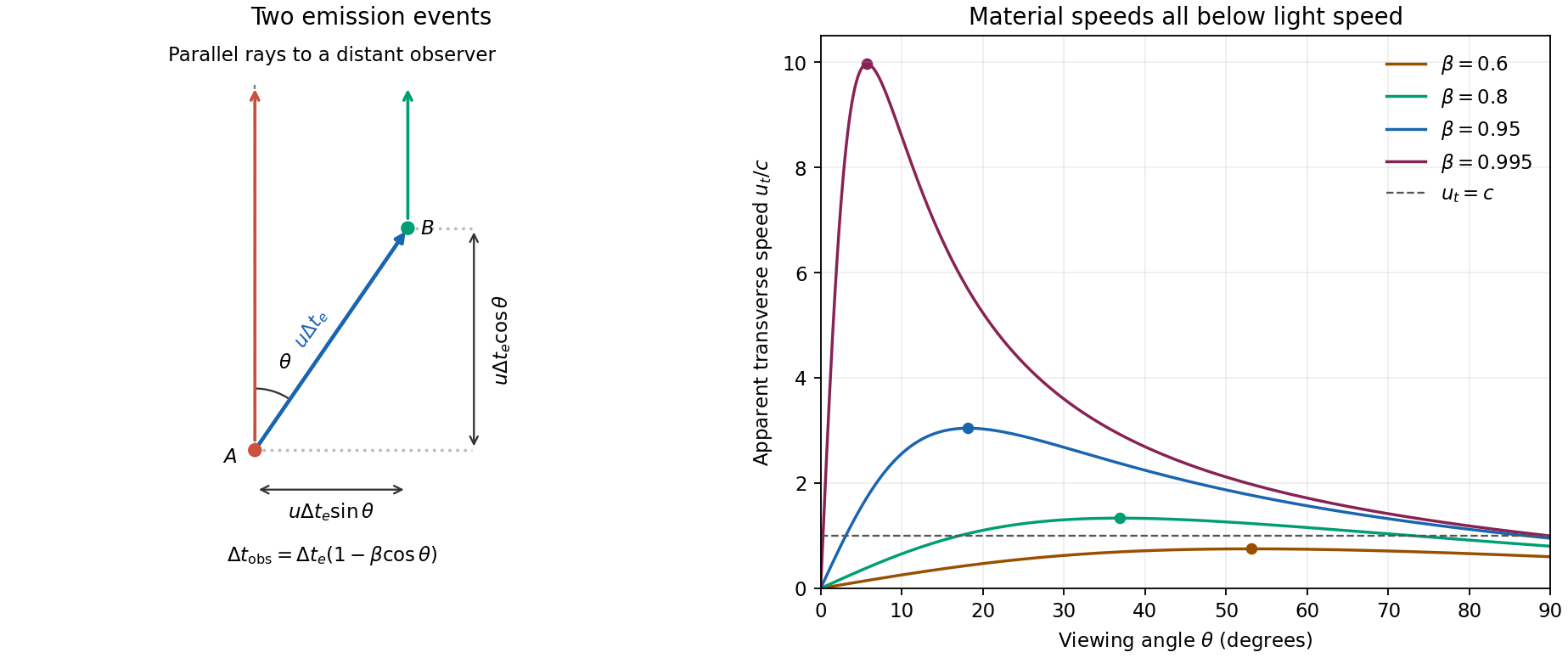
For a blob in a relativistic jet, take two emission events separated by time in the galaxy frame. The blob moves transversely by , while its second photon has less distance to travel to the distant observer. Therefore the arrival interval is andDifferentiating with respect to viewing angle gives . The maximum occurs at and equals . Hence apparent superluminal motion is possible precisely when , or . This is an arrival-time effect; the material and every local signal still travel slower than light.

For , and . Thus the Doppler factor isThe Lorentz-invariant specific intensity gives . Since , a power-law spectrum with gives . This is Doppler boosting of a moving blob: the spectral flux density of an unresolved, intrinsically isotropic blob has the same boost. Comparing identical approaching and receding blobs, with no differential absorption,A spatially steady continuous jet can have a different boost exponent because the emitting material contributing at one arrival time differs; it must not silently replace the specified blob model.
Using the stipulated peak of the photon-photon pair production cross section, not the exact head-on threshold, givesThe relevant photons are near infrared. Interpret the quoted as target-band energy flux, or energy flux per logarithmic frequency interval, consistent with its units ; it is not a spectral flux density per hertz. For isotropic emission . In a stationary source of radius , the order-of-magnitude photon energy density is , soThe luminosity variability size bound gives . Taking the largest allowed radius gives the smallest stationary-source optical depth in this estimate:This assumes the gamma rays and target photons occupy the same region, with an approximately isotropic target field and an order-unity geometric escape factor. A smaller region makes the gamma-ray compactness problem worse.
Here , , and . ConsequentlySuch a stationary co-spatial source would absorb almost all of its high-energy photons.
Let primes denote the blob rest frame and continue to ignore cosmological redshift. For fixed observed gamma-ray energy, . The co-moving target energy at the assumed cross-section peak is therefore . The internal pair-production target energy in a relativistic blob acquires a second Doppler shift when this same target population is observed along our line of sight:It would be incorrect to transform only the gamma ray while treating the internal target radiation as a stationary external field. The target photons responsible for collisions span directions in the blob frame; the observed energy here labels the corresponding part of the internally emitted radiation spectrum.
relativistic beaming both increases the allowed rest-frame source radius, , and lowers the inferred rest-frame luminosity, . The beamed gamma-ray optical depth then follows from :For an unbroken power-law spectrum , , so . In particular, gives the stated . Spectral breaks, an external target field or non-coincident emission regions change this inference. Under the requested scaling, transparency requiresThis minimum uses the most favourable nearly axial view, . The exact axial relation gives ; a less favourable viewing angle requires a larger Lorentz factor. The numerical bound is conditional on the stipulated opacity scaling and internal-source geometry.
The Friedmann-Lemaître-Robertson-Walker metric describes homogeneous, isotropic spatial slices. Here is cosmic time, equal to the proper time of a comoving observer; is the length-valued scale factor; and are dimensionless comoving radial, polar and azimuthal coordinates. The speed of light is , andfor positive, zero and negative cosmological spatial curvature. The convention used makes a squared time interval, with signature ; multiplying the metric by gives the more usual squared-length convention. At fixed , radial proper length is , while a sphere has area .
luminosity distance is defined by for bolometric radiative flux and intrinsic luminosity . Radial null propagation gives . Applying the same path integral to two successive wave crests gives , hence . Each photon loses an energy factor , and their arrival rate loses another. For transparent propagation and isotropic emission,The two redshift factors have distinct physical origins; geometrical dilution alone is insufficient.
With , differentiating yields . Therefore the radial comoving coordinate isThis is independent of any particular matter model; the transverse comoving distance is , which equals only for flat space.
For pressureless matter, the continuity equation integrates to . The cosmological constant is kept separately from this matter density. In the flat Friedmann equation, defineThe flat dust-vacuum Hubble parameter is thereforeIn the equation's convention is mass-equivalent energy density and has units ; the geometrical cosmological constant convention instead writes . The model contains dust and vacuum energy with negligible radiation over the relevant late epochs: “matter-dominated” here does not require matter to exceed vacuum energy today.
The cosmic microwave background supplies a standard ruler through its acoustic scale: the angular positions of the Cosmic microwave background acoustic peaks constrain cosmological spatial curvature, while their relative heights constrain matter and baryon densities. Together with independent distance information, these favour a nearly flat Lambda-CDM model containing substantial cold dark matter and vacuum energy. The cosmic microwave background alone has a geometrical degeneracy between parameters affecting distance to last scattering; its analysis also includes early radiation, which the late-time formula above omits. The nine-year WMAP results were already available as a December 2012 preprint.[ref]
Nine-Year Wilkinson Microwave Anisotropy Probe (WMAP) Observations: Final Maps and Results by C. L. Bennett and others. Version 1 abstract: combined-data curvature constraint and consistency with the six-parameter Lambda-CDM model
A standardized Type Ia supernova at appreciable redshift is fainter, hence farther in luminosity distance, than in a matter-only Einstein-de Sitter universe with the same local expansion scale. Fitting the supernova Hubble diagram supports late acceleration; in flat dust plus vacuum, is negative for . Light-curve and colour corrections, extinction, calibration, selection bias and possible population evolution must be controlled. The supernova evidence and cosmic microwave background constraints are complementary; together they favour this model without proving that every alternative dark-energy model is impossible.[ref]
Observational Evidence from Supernovae for an Accelerating Universe and a Cosmological Constant by Adam Riess and others. Abstract and cosmological fits of the supernova distance-redshift relation
[ref]For the final comparison, assume , a common and in model (a). ThenThus and the integrands obey . Because all three models are flat, compare the normalization-independent distance , rather than separately normalized coordinates. The luminosity-distance ordering of flat dust-vacuum universes is , henceModel (b) gives the largest received flux, model (c) the smallest. Equalities replace the strict ordering at the endpoint values of the vacuum fraction; all have the same leading local Hubble law as .
In a close binary star, the rotating effective gravitational potential defines two Roche lobes meeting at the inner Lagrange point. Stellar expansion or orbital shrinkage can bring the donor into Roche-lobe overflow. Gas then flows through the inner Lagrange point; its angular momentum can form an accretion disk around the companion. wind mass transfer in a binary star is also possible without Roche-lobe filling. For a circular, synchronized binary, the Eggleton Roche-lobe radius approximation isThis describes the lobe geometry, not the donor's dynamical response.[ref]
conservative binary mass transfer has fixed total mass and orbital angular momentum, neglecting stellar spin. Using givesSince , transfer from the more massive donor initially shrinks the orbit; after binary mass ratio reversal it expands. Stability depends on both stars and their changing lobes. Let and . A small mass loss reduces the relative overfill if . Use the adiabatic donor response for dynamical stability, and its thermal response for slower adjustment; an equilibrium mass-radius law alone cannot decide both.
Stable transfer can proceed on nuclear or thermal timescales, while dynamically unstable overflow may create a common envelope, orbital spiral-in and either envelope ejection or a merger. Escaping gas, gravitational radiation and magnetic braking make evolution nonconservative by changing orbital angular momentum. accretion onto a compact stellar object releases power of order , producing bright X-ray binaries; radiation-driven outflows can limit retained mass. Eclipses, radial velocities and disk emission constrain the geometry and masses, but inclination, irradiation and assumptions about mass or angular-momentum loss affect the inference. The essential feedback is the donor's radius relative to its evolving Roche lobe.
A galaxy cluster deflects background light through its projected gravitational field. In the thin-lens approximation for gravitational lensing, maps image to source angle. Its surface mass density enters throughHere is signed lensing magnification; observed brightness uses . The 's are angular diameter distances to lens, source and between them; denotes lensing shear, not a Lorentz factor. strong gravitational lensing creates arcs and multiple images near critical curves. For an axisymmetric lens, a tangential Einstein ring satisfies mean enclosed convergence one, givingThis is projected enclosed mass, not a general three-dimensional mass profile inferred from a single arc.
weak gravitational lensing uses coherent distortions of many background galaxies. Their intrinsic orientations average approximately to zero, allowing an estimate of reduced shear and a projected mass map. The method traces all gravitating material without assuming hydrostatic equilibrium, which is valuable in merging clusters. Accurate work requires correction of the point spread function, calibrated shape measurement, source redshifts, foreground-member rejection and selection effects. Intrinsic shape noise, unrelated line-of-sight structures and lens-model degeneracies remain. The mass-sheet degeneracy leaves reduced shear unchanged under and , so absolute mass normalization needs additional information.
In the Bullet Cluster, weak gravitational lensing places the main projected mass peaks near the collisionless galaxies, displaced from the X-ray-emitting gas that contains most observed baryon mass. Comparing the lensing, optical and X-ray maps supports a dominant weakly collisional dark component under the usual gravity model; lensing alone does not identify its particle species. Cluster lensing measures projected gravitational mass independently of gas temperature or dynamical equilibrium.[ref]
cosmic inflation is an expanding epoch with , equivalently a shrinking comoving Hubble radius . In general relativity it requires for the total effective fluid. A scalar field whose potential energy dominates its kinetic energy has and can produce approximately exponential expansion. slow-roll inflation is one realization; rapid expansion alone without acceleration does not have the required effect.
The horizon problem is that widely separated regions of the cosmic microwave background have nearly the same temperature despite lying outside one another's causal domains in a purely decelerating hot Big Bang extrapolation. Sufficient inflation stretches a previously small causally connected region across our observable universe; relevant perturbation wavelengths can begin inside the Hubble radius, leave it during inflation and re-enter later. This does not require local signals to outrun light. Inflation supplies a possible earlier causal history, not a proof that every possible initial state becomes homogeneous.
For the flatness problem, the Friedmann equation gives when is length-valued. Since grows during inflation,Pre-existing unwanted massive relics such as magnetic monopoles are also diluted: conserved number density falls as . Enough inflation, followed by reheating that does not recreate the relic problem, can make their abundance negligible. These were central motivations of the original proposal, whose first phase-transition implementation also faced a graceful-exit problem.[ref]
Inflationary universe: A possible solution to the horizon and flatness problems by Alan H. Guth. Abstract: horizon, flatness, monopole suppression and limitations of the original scenario
quantum fluctuations of the inflating field and metric supply seeds for linear cosmological density perturbations. Simple single-field slow-roll models predict a dominant adiabatic mode with nearly Gaussian, nearly scale-invariant scalar cosmological perturbations, consistent with the cosmic microwave background; tensor cosmological perturbations are another possible test. These predictions are model-dependent, and consistency is not unique proof of inflation. reheating must connect the accelerated phase to the hot expanding universe. Inflation addresses causal reach, small cosmological spatial curvature and unwanted relic abundance, while providing a mechanism for primordial structure.
accretion onto a massive black hole releases luminosity . Even a small coupling of this energy to surrounding gas can matter because a galactic binding energy is only of order , with stellar velocity dispersion . active-galactic-nucleus feedback means that the energy or momentum changes the gas supply, cooling or star formation, potentially regulating further accretion. Large energy availability alone does not establish efficient coupling.
In a radiatively efficient bright nucleus, radiation pressure and winds can push on dusty or ionized gas. Outflows can remove fuel or shock-heat it; the outcome depends on cooling, covering factor, clumping and whether the flow escapes. In a mechanically dominated state, relativistic jets inflate radio cavities in a hot halo or galaxy cluster. Their expansion, shocks, sound waves and subsequent motions can distribute energy and suppress a cooling flow. The two descriptions identify useful channels rather than a universal sharp division between all nuclei.
An approximately pressure-balanced cavity containing a relativistic fluid has enthalpyX-ray pressure estimates, cavity volume and buoyant or sound-crossing ages permit comparison with radiative cooling losses. Radio images check the jet association; X-ray fronts and ripples help locate transferred energy. Deep Chandra observations of Perseus reveal such structures and motivate mechanical heating of the cooling atmosphere.[ref]
A deep Chandra observation of the Perseus cluster: shocks and ripples by A. C. Fabian and others. Abstract and discussion of radio-bubble-associated fronts, ripples and heating
Projection, nonrelativistic cavity contents, pressure gradients, uncertain ages and intermittent duty cycles affect the power estimate. Injected cavity energy need not all dissipate where cooling occurs. A successful negative feedback loop requires that falling gas increases accretion, heating then reduces cooling or inflow, and the delay does not destroy regulation. This can explain reduced cooling and the shortage of excessively massive star-forming galaxies; correlations between black-hole mass and bulge properties are supporting context rather than standalone proof of causation. The key comparison is coupled heating versus local cooling and binding, including where and when energy is deposited.
The age of the universe is a model-dependent elapsed cosmic time, not simply the inverse present Hubble constant. For a model with a hot Big Bang origin,An Einstein-de Sitter universe gives . The age of a flat matter-Lambda universe, neglecting early radiation, isThis follows by integrating and substituting . It tends to as the vacuum fraction tends to zero. Pure de Sitter spacetime instead has constant and no finite dust Big Bang age obtained from this integral. cosmic microwave background ages therefore depend on the assumed expansion model and fitted parameters; the WMAP nine-year combined-data Lambda-CDM model inference was approximately 13.8 billion years, not a direct clock reading.[ref]
Nine-Year Wilkinson Microwave Anisotropy Probe (WMAP) Observations: Final Maps and Results by C. L. Bennett and others. Version 1 abstract, inferred cosmic age
Old globular clusters provide an independent lower bound. Their main-sequence turnoff identifies stars just exhausting core hydrogen; the nuclear fuel divided by luminosity sets a mass-dependent lifetime, so a fitted colour-magnitude diagram constrains the common stellar age. Distance, extinction, metallicity, helium abundance, diffusion and stellar-model physics introduce uncertainties. The elapsed time before cluster formation must be added when comparing with the cosmic age.[ref]
white-dwarf cooling ages offer another clock: faint remnants have lost more stored thermal energy, but progenitor lifetimes must be added and crystallization, envelope properties and sample completeness affect the inference. nucleocosmochronology uses long-lived radioactive abundance ratios, with for two radioactive species, or a stable reference with . Uncertain initial production ratios and subsequent enrichment limit precision. Every reliably dated object must be younger than the universe by at least its formation delay; consistency among distinct clocks tests both cosmology and their astrophysical calibrations.
Articles by others on the same topic
There are currently no matching articles.