Three tracers give complementary estimates of a cluster's gravitating mass. First, galaxy redshifts measure a line-of-sight velocity dispersion . For a roughly stationary bound cluster, the virial theorem gives a cluster velocity-dispersion mass estimatewith a coefficient depending on the density profile and orbital anisotropy. The galaxy luminosity and plausible stellar mass-to-light ratio supply too little mass to bind typical rich clusters. Foreground interlopers, substructure, velocity anisotropy and a recent merger can bias the dynamical estimate; a large dispersion is not by itself proof of equilibrium.
Second, diffuse X-ray emission measures a hot intracluster plasma, not merely unresolved starlight. Spectral continuum and lines constrain its temperature, while surface-brightness profiles constrain its density after line-of-sight projection and emissivity modeling. If the gas has constant composition and is approximately spherical and in hydrostatic equilibrium,This cluster hydrostatic mass estimator uses as the mean mass per pressure-supporting particle. The inferred potential requires substantially more mass than the stars plus measured gas, although the gas contains much of the visible baryonic mass. Turbulence, bulk motion, temperature structure and departures from hydrostatic equilibrium are important systematic errors.
Third, strong-lensing arcs and multiple images, together with coherent weak-lensing shear of background galaxies, measure projected gravitational deflection. In general relativity,This cluster gravitational-lensing mass estimate does not require the cluster galaxies or gas to be in dynamical equilibrium. It does require source-distance information, a lens model and control of point-spread-function-induced shapes, line-of-sight projection, unrelated line-of-sight structure and the mass-sheet degeneracy.
The convergence of dynamical, hydrostatic and lensing masses, exceeding the baryonic inventory, is the principal evidence. The Bullet Cluster adds a spatial test: collisional X-ray gas lags behind the galaxies during the merger, while the inferred lensing concentrations lie nearer the collisionless galaxy component. An additional weakly collisional gravitating mass accounts naturally for that separation.[ref]
A direct empirical proof of the existence of dark matter by Douglas Clowe and others. L109–L113, optical/X-ray/lensing comparison
The conclusion assumes a gravitational framework and does not identify the microscopic dark-matter particle; the different tracer systematics should be evaluated rather than treating three mass estimates as completely assumption free.cosmic inflation is an early interval of accelerated expansion, . For expansion this means a shrinking comoving Hubble radius, . A nearly constant positive scalar potential can supply it: in units,Potential domination gives and approximately exponential expansion. Sustaining the interval requires sufficiently slow evolution, not just setting the initial field velocity to zero on a steep potential.
The horizon problem is the near equality of conditions in widely separated microwave-background regions that could not equilibrate in the standard decelerating hot Big Bang history. cosmic inflation permits the currently observed patch to descend from an earlier region small enough to have been causally connected, before that patch is stretched to enormous size. The claim concerns a causal history extended before the conventional hot phase; merely accelerating a collection of already disconnected regions would not explain their common temperature.
For the flatness problem, the Friedmann constraint givesA growing drives this curvature fraction toward zero, whereas ordinary matter- or radiation-dominated deceleration makes it grow. cosmic inflation therefore suppresses observable curvature without requiring an equally extreme initial tuning within the later hot evolution.
Pre-existing monopoles and other unwanted relics are also diluted by the volume increase: a conserved particle number density falls as over e-folds. The transition to the hot universe must reheat efficiently, and its temperature must not regenerate an excluded relic population. The required number of e-folds is model and reheating dependent; “about sixty” is a useful scale for many scenarios rather than a universal exact requirement.
cosmic inflation also supplies a mechanism for perturbations. quantum fluctuations are stretched beyond the Hubble radius, and nearly scale-invariant comoving curvature perturbations can later seed cosmic structure. Simple single-field slow-roll models commonly predict approximately adiabatic, nearly Gaussian fluctuations, with a small spectral tilt; tensor perturbations would provide an additional test. Acoustic coherence and the observed scalar spectrum are compatible with this account, but they do not single out one inflaton potential. cosmic inflation addresses causal homogeneity, curvature and relic dilution while motivating the initial perturbations; it does not automatically solve the cosmological constant problem or determine reheating.
A radio pulsar is a rapidly rotating, magnetized neutron star whose emission beam periodically crosses the line of sight. Collapse of a massive stellar core can leave such a compact remnant. Angular-momentum conservation during contraction helps explain rapid rotation, while amplified magnetic fields and a plasma-filled magnetosphere enable particle acceleration and beamed emission. The pulses are not repeated stellar contractions. Not every newborn neutron star is seen as a radio pulsar, because emission, beaming and observational selection matter.
rotation supplies energy to radiation and the magnetized wind. With approximately constant moment of inertia ,An ideal fixed magnetic-dipole torque has . Its integration givesso the pulsar characteristic age approximates the true age only for a short birth period, constant torque coefficient and braking index three. Real magnetospheres, field evolution and kinematic contributions to observed complicate both age and inferred magnetic field.
As the star spins down, the available accelerating potential falls. If particle acceleration and pair production can no longer sustain the radio-emitting magnetosphere, the object crosses a model-dependent pulsar death line and ceases to be detectable as an ordinary radio pulsar. It still exists as a cooling neutron star; “death” refers to the emission state, not disappearance of the star. The death boundary is not a precisely universal spin period.
In a surviving binary, later Roche-lobe overflow from a companion can create an accretion disc. Transferred angular momentum spins the old neutron star up, and the accretion luminosity can produce an X-ray binary. Long accretion episodes can produce millisecond rotation, commonly accompanied by a smaller inferred external magnetic field. After mass transfer declines, the radio pulsar can switch on again as a recycled pulsar, often with a white dwarf companion. Other binary histories can leave a second neutron star, an ablated companion or an isolated recycled object; there is no single obligatory evolutionary sequence.
A direct observational bridge is the coherent approximately X-ray pulsation discovered with RXTE in SAX J1808.4-3658, an accretion-powered binary. It demonstrated an accreting neutron star rotating at a rate appropriate to recycled millisecond radio pulsars.[ref]
Discovery of the first accretion-powered millisecond X-ray pulsar by Rudy Wijnands and Michiel van der Klis. Abstract, coherent pulsations and interpretation
Timing analysis must correct orbital Doppler shifts, telescope and solar-system timing, and instrumental aliases. Radio dispersion, sky coverage and beaming selection affect demographic inferences. The sequence is rotational pulsar spin-down, possible loss of radio activity, and possible accretion-driven recycling—not a necessary path for every neutron star.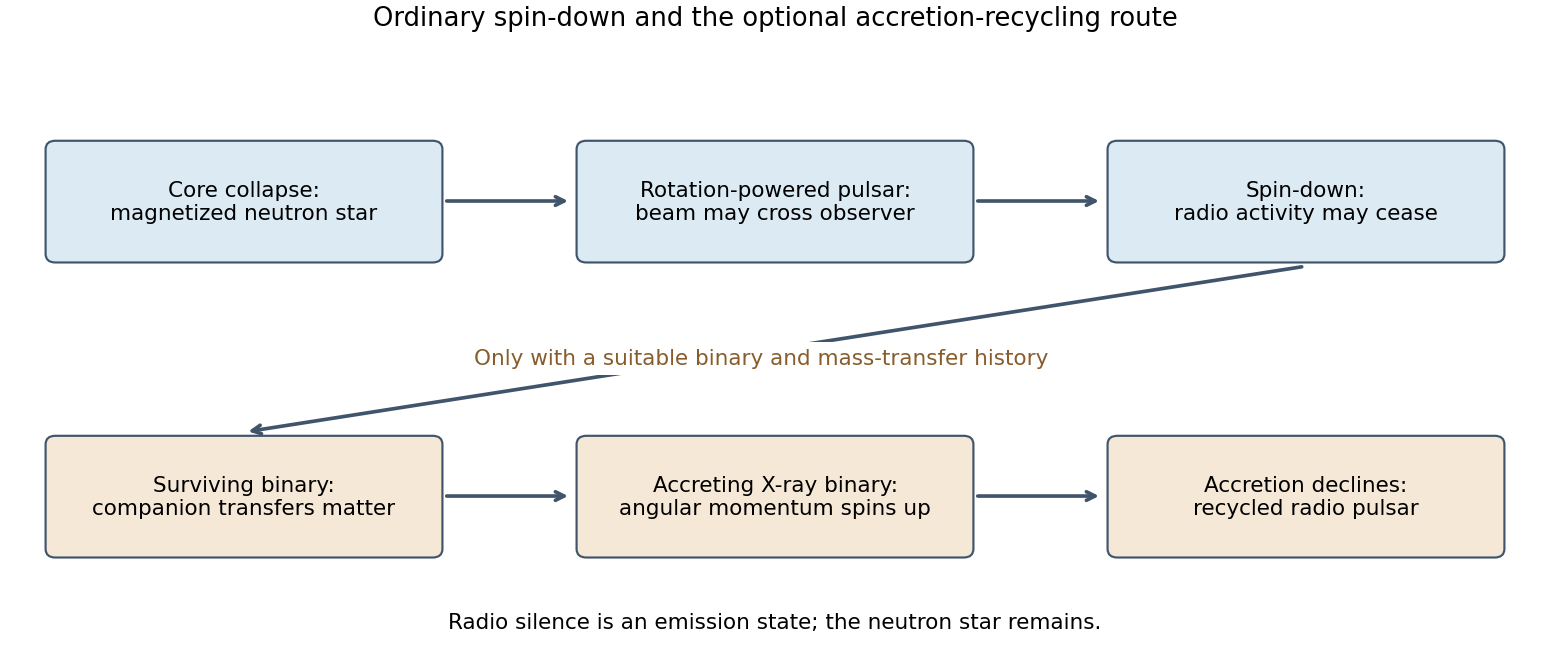
Original schematic of ordinary pulsar spin-down and the conditional binary-recycling route
. Details. 
The cosmic microwave background has an almost perfect blackbody spectrum at about . This is strong evidence for an earlier hot, dense phase in which radiation thermalized, followed by expansion that redshifted the photon spectrum while preserving its Planck form. COBE FIRAS compared the sky with a precision reference blackbody; instrument temperature, gain, foregrounds and calibrator emissivity were crucial controls. Agreement with a blackbody constrains substantial late energy injection or photon-production distortions.[ref]
Nobel Lecture: From the Big Bang to the Nobel Prize and beyond by John C. Mather. FIRAS measurement and external-blackbody calibration account
After subtracting the dominant dipole associated mainly with observer motion, anisotropies at the level of roughly reveal primordial structure. COBE DMR established large-angular-scale anisotropy; multifrequency measurements and independent maps were needed to distinguish it from Galactic emission and instrumental artifacts.[ref]
Structure in the COBE Differential Microwave Radiometer First-Year Maps by George F. Smoot and others. L1–L5, statistical and systematic checks
Approximate isotropy supports a homogeneous background model under the usual cosmological assumptions, but isotropy at one observing position is not alone a proof of spatial homogeneity everywhere.The temperature CMB angular power spectrum has multiple acoustic peaks. Their coherent pattern follows oscillations in the pre-recombination photon-baryon fluid. Peak positions compare the sound horizon with angular diameter distance and hence constrain geometry together with expansion parameters. Relative peak heights test baryon inertia, matter–radiation equality and gravitational-potential evolution, motivating both baryonic and nonbaryonic matter. Cosmic microwave background diffusion damping suppresses small-scale power. Cosmic microwave background polarization and temperature–polarization correlations provide further tests of scattering, acoustic phase and reionization; gravitational lensing remaps the observed pattern and probes intervening structure.
By the time of this examination, the Planck 2013 temperature and lensing analysis supported a spatially flat six-parameter model with cold dark matter and a cosmological constant. This is a joint fit within an explicit model, not an inference that each peak uniquely measures one parameter.[ref]
Planck 2013 results. XVI. Cosmological parameters by Planck Collaboration. Abstract and cosmological parameter/extension analysis
Foreground separation requires frequency coverage, sky masks, beam and noise characterization, and consistency across instruments. The primary microwave background has geometric and other parameter degeneracies, so acoustic-ruler, supernova and structure observations are valuable complements. The spectrum establishes a thermal hot-universe history; anisotropy and polarization constrain its geometry, contents and primordial perturbations. None of these observations by itself demonstrates a unique cosmic inflation mechanism.mass from motion. A resolved Keplerian orbit gives when the orbiting object has negligible mass. At the Galactic centre, repeated infrared astrometry and spectroscopy measure sky motion, acceleration and line-of-sight velocity of stars around Sagittarius A*. Resolving a compact enclosed mass and fitting complete orbits avoids reliance on a single projected velocity. Source confusion, reference-frame stability, distance, inclination and possible extended mass must be included in the fit.[ref]
For an unresolved stellar-mass binary in a circular orbit, the donor's velocity semiamplitude and orbital period give the binary mass functionIt provides a lower mass bound; donor mass and orbital inclination are needed for an actual mass estimate. For an eccentric orbit, multiply the observational combination by when evaluating the binary mass function. Resolved gas or maser rotation and stellar-dynamical models also measure masses, provided pressure support, noncircular motion and line-of-sight projection are modeled. Resolving the black-hole sphere of influence improves separation of central mass from the host galaxy.
For active nuclei, reverberation mapping measures a lag between variable continuum and broad-line response. With a line velocity scale ,The factor accounts for geometry and kinematics and is not known simply from the lag. Cadence, line responsivity, inclination and winds require control. Rapid variability demonstrates compactness but is not by itself a unique mass measurement.
black-hole spin from strong-field emission. Define . Large-radius Keplerian motion is principally a mass probe and usually insensitive to black-hole spin. In the Kerr model, the radius and binding energy of the innermost stable circular orbit vary with and orbital orientation, making inner-disk radiation useful.
black-hole continuum fitting infers an inner emitting radius from the disk's thermal spectrum and flux normalization, then identifies it with the innermost stable circular orbit in a relativistic thin-disk model. Independent mass, distance and inclination, together with atmospheric spectral hardening, absorption and contamination, are needed. Spectra should be selected in a disk-dominated regime where truncation and strong advection are limited. A 2011 Cygnus X-1 analysis combined such spectra with independently constrained binary parameters and reported a near-extreme black-hole spin conditional on black-hole spin–orbit alignment and its disk model.[ref]
The Extreme Spin of the Black Hole in Cygnus X-1 by Lijun Gou and others. Abstract, thermal-continuum fit and dominant mass/distance/inclination/flux-calibration uncertainties
black-hole reflection spectroscopy instead models a relativistically broadened iron-line and reflection continuum: orbital Doppler shifts and beaming broaden the profile, while gravitational redshift contributes to the extended red wing. Its innermost emitting radius can constrain black-hole spin if reflection extends to the stable inner edge. Ionization, abundance, absorption, coronal illumination, disk thickness and possible truncation are competing parameters; a broad line is not a direct black-hole spin reading independent of these assumptions. Timing or precession models can add information but introduce their own dynamical identification.
mass is principally inferred from gravitating dynamics; black-hole spin is inferred from strong-field effects with a specified spacetime and accretion model. Agreement between independent methods is especially valuable because disk inner radius, inclination and radiation-transfer assumptions can otherwise mimic a change of black-hole spin.
Articles by others on the same topic
There are currently no matching articles.