Hamilton's principle makes the action S[q]=∫t1t2L(q,q˙,t)dt stationary under variations vanishing at the endpoints. It need not be a strict minimum. Varying the action and integrating the velocity variation by parts givesThe endpoint term vanishes. Since the interior variations are arbitrary, the fundamental lemma of the calculus of variations yields
δS=[∑i∂q˙i∂Lδqi]t1t2+∫t1t2∑i[∂qi∂L−dtd∂q˙i∂L]δqidt.
dtd∂q˙i∂L−∂qi∂L=0.
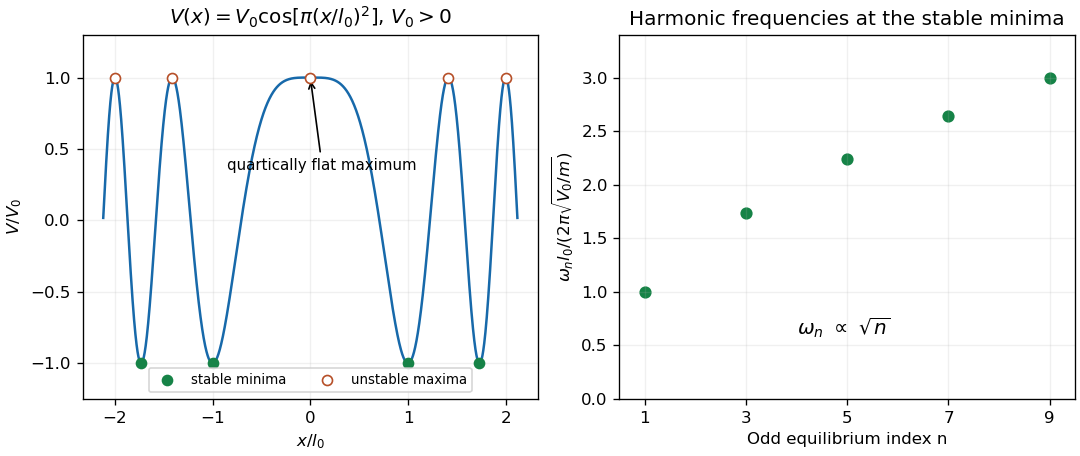
Write u=πx2/l02 and assume V0>0. The derivative of the potential is V′(x)=−2πV0xsinu/l02. Its equilibrium positions are zero and x=±l0n for positive integers n. At a nonzero equilibrium,Thus the stable equilibria and their small-oscillation normal mode frequencies areEven positive n give unstable maxima. At zero the quadratic term vanishes but V(x)=V0−V0π2x4/(2l04)+⋯, so the equilibrium is still unstable; a zero linearized frequency does not prove stability. If the unspecified sign of V0 were chosen negative, even-n positions would be stable instead, together with a degenerate quartic minimum at zero whose frequency tends to zero with oscillation amplitude.
V′′=−l024π2V0n(−1)n.
xn=±l0n,ωn=l02πmnV0,n=1,3,5,….

For an infinitesimal continuous symmetry δqi=εξi(q,t), allow the Lagrangian to change by a total derivative, δL=εdF/dt. Direct variation givesOn a solution of the Euler-Lagrange equations, the first term vanishes. This proves Noether's theorem in the fixed-time form:Spatial translations yield total momentum, and rotations yield angular momentum. Time translations yield energy when the Lagrangian has no explicit time dependence; this follows either from the extended time-transformation form of the theorem or by differentiating H=∑ipiq˙i−L to obtain H˙=−∂L/∂t.
εδL=∑i(∂qi∂L−dtd∂q˙i∂L)ξi+dtd∑ipiξi.
Q=i∑piξi−F,Q˙=0.
The central pair potential is invariant under simultaneous spatial translations, simultaneous rotations and time translations. The corresponding time-independent Noether charges are total momentum P=p1+p2, total angular momentum about a fixed origin, and total energy H.
In one dimension this supplies P and H: two charges. In two dimensions it supplies Px,Py,Lxy,H: four charges. In three dimensions it supplies three momentum components, three angular-momentum components and H: seven charges. For generic states these listed charges are independent in those dimensions. Galilean boosts can also be expressed by explicitly time-dependent conserved combinations, but are not part of the requested translation-rotation-energy count.
In D dimensions the antisymmetric angular momentum tensor has componentsThere are D(D−1)/2 independent rotation generators. Together with D translation generators and one time-translation generator, the standard Noether charge enumeration is thereforeThe word independent here counts symmetry generators and tensor components; it needs qualification if it is meant as functional independence of all charges for only two particles in arbitrarily high dimension. In centre-of-mass coordinates, L=R∧P+r∧p. Consequently P∧L∧L=0, a nontrivial identity from dimension five onwards, since (r∧p)∧(r∧p)=0. Thus the displayed number is the symmetry-charge count; it is not an assertion that these functions have unrestricted values for a two-particle realization in every D.
Lab=∑s=12(qs,aps,b−qs,bps,a),a<b.
1+D+2D(D−1)=1+2D(D+1).
The canonical momentum is pi=∂L/∂q˙i. If the velocity-momentum relation can be locally inverted, the Legendre transform defines H(q,p,t)=∑ipiq˙i−L, with the velocities expressed in terms of q,p,t. Its differential isThe Euler-Lagrange equations then yield Hamilton's equations,A singular velocity Hessian instead requires a constrained-Hamiltonian treatment.
dH=∑iq˙idpi−∑i∂qi∂Ldqi−∂t∂Ldt.
q˙i=∂pi∂H,p˙i=−∂qi∂H.
The canonical momentum is p=γmr˙, where γ=(1−r˙2/c2)−1/2. Eliminating velocity givesIts Hamilton equations are r˙=c2p/H and p˙=0. In the limit ∣p∣≪mc, the Taylor expansion is H=mc2+p2/(2m)+O(p4/(m3c2)), and r˙≃p/m. The additive rest energy does not change the classical free-particle equations.
H=γmc2=m2c4+c2p2.
Minimal electromagnetic coupling changes the canonical momentum to p=γmr˙+qA. The mechanical momentum is π=p−qA. The Legendre transform yieldsThe cancellation of qr˙⋅A in the Legendre transform does not remove magnetic effects: A remains in the relation between canonical and mechanical momenta. The expression is the relativistic kinetic-plus-rest energy with an electrostatic potential-energy term, expressed in canonical variables.
H(r,p,t)=m2c4+c2[p−qA(r,t)]2+qϕ(r,t).
Let E=m2c4+c2π2. Hamilton's equations giveSubtracting qdAi/dt from the second equation gives the familiar Lorentz force, π˙=q(E+r˙×B), with E=−∇ϕ−∂tA and B=∇×A. This also checks the signs of both potential terms.
r˙i=Ec2πi,p˙i=qj∑r˙j∂iAj−q∂iϕ.
The canonical Poisson bracket isThe coordinate derivatives are Kronecker deltas, so direct substitution gives
{f,g}=∑k(∂qk∂f∂pk∂g−∂pk∂f∂qk∂g).
{qi,qj}=0,{pi,pj}=0,{qi,pj}=δij.
For a phase-space function with no explicit time dependence, the chain rule and Hamilton's equations giveAn explicitly time-dependent function would instead satisfy df/dt=∂tf+{f,H}.
dtdf=∑i(∂qifq˙i+∂pifp˙i)=∑i(∂qif∂piH−∂pif∂qiH)={f,H}.
The Jacobi identity is {f,{g,h}}+{g,{h,f}}+{h,{f,g}}=0. If f,g have no explicit time dependence and are conserved, {f,H}={g,H}=0. Taking h=H in that identity yields {H,{f,g}}=0, orThus the Poisson bracket of the two conserved functions is another conserved function; it need not be independent of the original ones.
dtd{f,g}={{f,g},H}=0.
For Li=ϵijkqjpk, the canonical Poisson brackets give {Li,Lj}=ϵijkLk. Consequently projections onto fixed axes n,m obeyIf the two original projections are conserved and the axes are linearly independent, the preceding Jacobi identity argument makes the projection along n×m conserved as well. The vectors n,m,n×m form a basis of three-dimensional space, so every fixed-axis projection is a linear combination of these conserved quantities. Angular momentum is therefore conserved along every axis.
{n⋅L,m⋅L}=(n×m)⋅L.
For the standard meaning of a canonical transformation, the new coordinates must retain Hamiltonian form for every Hamiltonian, with the same physical function expressed in the new coordinates. Let z=(q,p), Z=F(z)=(Q,P), S=DF and J=(0−II0). With K(Z)=H(F−1(Z)), the chain rule givesAgreement with Z˙=J∇ZK for arbitrary K forces SJST=J. Its matrix entries are precisely the Poisson brackets of the new coordinates, soThe qualification for every Hamiltonian matters. Preserving one Hamiltonian flow does not imply canonicality. For example, with two coordinate pairs and H=(q12+p12)/2, the invertible change Q1=q1, P1=p1, Q2=2q2, P2=p2 preserves the equations and the same physical Hamiltonian, but {Q2,P2}=2. Thus a definition requiring only one chosen Hamiltonian flow is too weak to prove the claimed bracket identities. The universal definition supplies the missing condition.
Z˙=SJST∇ZK.
{Qi,Qj}=0,{Pi,Pj}=0,{Qi,Pj}=δij.
Ancestors (9)
- 2015
- Past exam of the short options paper shared by Prelims and Parts A and B of the physics course of the University of Oxford
- Short options paper shared by Prelims and Parts A and B of the physics course of the University of Oxford
- Physics course of the University of Oxford
- Undergraduate course of the University of Oxford
- Course of the University of Oxford
- University of Oxford
- List of universities
- Home
Discussion (0)
New discussionThere are no discussions about this article yet.
Articles by others on the same topic (0)
There are currently no matching articles.